Archive for the ‘Observation’ Category

TV Chip for iPhone

Wednesday, June 27th, 2007

Yes, the Apple iPhone goes on sale Friday. Mr. Packer from Long Island was first in line at the Apple Store in New York. He started the queue at 5:00 a.m. on Monday. Read the "First in Line" blog.

Watch his interview here.  For such an effort, he deserves a digg.

I still think it will be able to receive live TV signals from towers and/or satellites. We blogged about Apple’s trademark filing during  CES 2006. Now consider this new chipset from Samsung, via EETimes:

Samsung Electronics Co., Ltd., has started sampling a multi-standard channel decoder and multi-band radio frequency tuner chipset made using its 65-nm process that it says supports almost all mobile TV standards including DVB-H/T, DAB-IP, ISDB-T, and terrestrial DMB.

Volume production of the part is scheduled for the fourth quarter of 2007.

The chipset is being offered either as two standalone ICs or as a system-in-chip package (SiP).

"Although a new market, we see high growth potential in mobile TV applications," said Yiwan Wong, vice president, Marketing Team, System LSI Division, Semiconductor Business, Samsung Electronics.

Wong added the part will initially be targeted at the European and Asian markets.

Samsung says the multi-band RF tuner, which receives the analog broadcast signal, has a simplified circuit structure by applying a low IF to compliment the conventional zero IF. It is also a general purpose tuner that supports UHF, VHF and L-band commonly used in Europe and the U.S.

The company says the chipset requires no external low noise amplifier (LNA) and additional memory chips, significantly reducing the bill-of-materials (BOM) cost of the total system. The chip set supports Link Layer processing to output fully error-corrected IP datagrams or MPEG2 transport streams.


The iPhone introduction is only the beginning of the new mobile revolution. Keep up with the news if you can.

And now, the official reviews…

David Pogue of The New York Times:


Walt Mossberg of The Wall Street Journal:


Satcom @ CommunicAsia

Friday, June 22nd, 2007

The CommunicAsia 2007 trade show just wrapped up in Singapore, which has been billed as the largest such event ever held in South-East Asia.

There was no shortage of press hype around this show. From Dubai Internet City to Nokia Siemens Networks, Huawei, to Yahoo! and Samsung. We were especially interested in those in the satellite business — and there were nearly 100 of those.


Of the more than 67,000 visitors to this show, we saw one satcom CEO on CNBC Asia this week:


Spy Satellites Wiped Out

Thursday, June 21st, 2007


Yes, the "Misty" satellite program’s next generation will never be seen now. The AP filed this story this afternoon, published in the Seattle Post-Intelligencer, et. al.:

Spy chief scraps satellite program

By KATHERINE SHRADER
ASSOCIATED PRESS WRITER

WASHINGTON — Spy chief Mike McConnell has junked a multibillion-dollar spy satellite program that engineers hoped would someday pass undetected through the space above other nations.

The move from the director of national intelligence comes after several years of congressional efforts to kill the program, known publicly as the next generation of "Misty" satellites. The new satellite was to be a stealthy intelligence spacecraft designed to take pictures of adversaries and avoid detection.

Little is known about the nation’s classified network of satellites, which represent some of the most expensive government programs and receive almost no public oversight. Because of their multibillion-dollar price tags, sensitive missions and lengthy development schedules, spy agencies go to great pains to keep details from becoming public.

McConnell gave no reason for his recent decision. Despite the program’s secrecy, he almost dared further inquiry into it.

Speaking Tuesday to an intelligence conference on workplace diversity, McConnell changed the subject and ended his speech by saying: "I have been advised when I was getting ready for this job, you have to do two things: kill a multibillion-dollar program. Just did that. Word is not out yet. You’ll see soon.

"And fire somebody important. So I’m searching," he added in jest, getting a laugh from the crowd.

Asked during a Q&A session to elaborate on which program he cut, McConnell declined to comment. His spokesman Steve Shaw also declined to comment on Thursday, but he noted that the director had the power to make this type of budget decision.

Loren Thompson, a defense expert with the Lexington Institute, said he was told by an industry source this month that the program to build the Misty satellites was ending. He said the satellite’s true name is not publicly known, but it has been assigned a designation of a letter followed by numbers.

The Associated Press separately confirmed the program was cut.

"People are thinking it is just not worth the huge amount of money it is sucking in," Thompson said.

Speaking generally, Thompson said promises of faster, smaller, cheaper satellites – hopes that became common during the Clinton administration – have been confounded by the laws of physics. The technology simply wasn’t able to meet expectations.

The new generation of Misty satellites was born from the belief that stealth technology would be crucial to deceiving adversaries, since many states are aware when U.S. satellites are passing overhead and can change their behavior accordingly.

Yet the threat has changed in recent years, as the United States became more concerned about difficult-to-track terror cells and underground sites for nuclear programs run by countries such as Iran and North Korea.

"The entire imagery architecture that is in space or under development was conceived prior to 9/11. Changes in the threat have led to a re-evaluation of the threat," Thompson said.

The first satellite launched in the Misty family was disclosed by military and space expert Jeffrey Richelson in his 2001 book, "The Wizards of Langley: Inside the CIA’s Directorate of Science and Technology." That first Misty satellite was launched from the space shuttle Atlantis in March 1990, he wrote.

In an interview, Richelson said a second satellite was launched in 1999. But as insiders debated whether to continue to build the third, some officials didn’t think it was worth the money because other satellites could fulfill the role at less cost, said Richelson, a senior fellow with the National Security Archive.

In 2004, an unidentified government agency asked the Justice Department to open a leaks investigation after The Washington Post reported that the program’s projected cost had almost doubled from $5 billion to nearly $9.5 billion.

Rick Oborn, a spokesman for the tightlipped National Reconnaissance Office, declined to comment on McConnell’s decision. His Northern Virginia-based agency is responsible for designing, building and operating a constellation of U.S. spy satellites.

Those spacecraft are built by American companies contracted by agencies including CIA and NRO and by the Air Force. A spokesman for Lockheed Martin, which is believed to be the lead contractor on this program, declined to comment on McConnell’s decision.

The pricey program has been a source of controversy in Congress.

In the House’s intelligence budget bill approved last month, lawmakers agreed to end a satellite program that they had supported before, according to New Mexico Rep. Heather Wilson, the top Republican on the House Intelligence Committee’s panel on technical intelligence. "We had to make some decisions without a lot of good alternatives," she said in an interview.

The details are in the classified portion of the bill, and Wilson would not confirm that it was a next-generation Misty satellite. But Wilson, a former Air Force officer, said McConnell’s decision was part of ongoing discussions among his advisers, the House committee and the Defense Department. "There was a great deal of communication," she said.

Wilson said the government does not have to walk away from the entire amount sunk into the program. Rather, she said, some of the technology can be harvested and used in other programs. She declined to offer any details.

Wilson praised McConnell’s early moves but said the key factors in his decision to end the program predated his arrival as intelligence chief in February. "I think it is the conclusion that most of the folks involved had come to – based on cost, schedule and performance. It was a conclusion that everyone was coming to at about the same time," she said.

House Intelligence Committee Chairman Silvestre Reyes, D-Texas, could not be reached for comment.

The panel’s top Republican, Rep. Peter Hoekstra of Michigan, said he is not looking for a decision on a single program from McConnell and his advisers. He wants to see leadership.

"I am looking for them to give us a strategy," he said. "This program was there for a reason. What are you going to replace it with? How long is it going to take to develop it? What is the cost for this new program?"

Hoekstra would not identify the program McConnell said was being cut and said he remains doubtful it is truly gone. He said its congressional allies could find a way to bring it back to life through a bill. He also noted that the White House has not sent a revised version of its budget to Congress reflecting McConnell’s change.

Hoekstra also criticized how McConnell made his decision public. "I don’t think the way you go about announcing major policy decision is to make a flippant comment to a group that you are speaking to about diversity," he said.


Global Maritime Satcom

Wednesday, June 20th, 2007

Reading Multichannel News (MCN) yesterday, I came across a "news item" about a new service from Intelsat, calling it a "Global Maritime Solution:"

Intelsat’s Network Broadband GLOBAL Maritime service differentiates itself from other offerings by incorporating two unique technical features. The first feature is an integrated Automatic Beam Switching system, which seamlessly transfers service between the satellites and maintains a site’s Internet session while the vessel is underway, eliminating the need for complex and costly manual intervention such as the re-pointing of antennas. The second feature, the platform’s Global Network Monitoring System, offers customers the ability to monitor all remote locations from a single monitoring site at any location desired by the customer. The requirements of companies managing vessel fleets and maritime infrastructures desiring efficient connectivity worldwide were the driving force behind these design features.

Not exactly a fine piece of investigative journalism here. Both the press release and MCN description have this identical morsel of text:

Utilizing Intelsat’s global satellite C-band capacity, the Network Broadband Global Maritime network operates at rates up to 2 megabits per second, with the initial service offering continuous communications with high-powered bandwidth rates from 128 kilobits per second-512 kbps. In addition, Network Broadband Global Maritime offers always-on broadband access that provides customers with continuous bandwidth for a fixed monthly fee.


C-band? That means me and my boat are gonna need to set aside some space on the poop deck for this little baby. We’re talking about a 10 to 12 foot diameter radome. For example, a Sea Tel Model 9797 ought to do it.

I don’t think the Intelsat satellites’ C-band payloads are hot enough to handle smaller antennas. Some of the newer, higher-power C-band satellites out there, such as GE-23, might be able to use smaller antennas. There was talk about using sub-2-meter antennas within "hotter" coverage beams (40+ dBW in downlink EIRP). In fact, the language in ST Electronics’ press release is remarkably similar to Intelsat’s, but I’m more interested in the 1.2-meter antenna they’re launching at CommunicAsia 2007 in Singapore:

The Agilis 1.2 metre maritime VSAT antenna designed and marketed by ST Electronics subsidiary, ST Electronics (Satcom & Sensor Systems) Pte Ltd, will provide smaller sea going vessels with an “Always On” connectivity for all their communication requirements. It provides not only secure transmission, but also a fast 512Kbps inbound transmission rate and up to 2Mbps for outbound transmission.  Users can expect this cost-effective compact system to provide them with continuous on-board communications through a high performance network.

Recognising the potential in the large and untapped market base of smaller vessels, ST Electronics developed the antenna to provide these vessels an opportunity to benefit from efficient and cost effective broadband satellite communications.  The antenna is considered as the smallest stabilised C-band antenna available in the market currently and will fit perfectly into the confined space of smaller vessels.

Wait a minute: we’re putting a puzzle together here. ST Electronics and VT Systems are part of the same company, and VT Systems bought in to iDirect Technologies. Based on their press release this week, it may be their platform and making this a real solution after all:

IndosatM2 (IM2), one of the largest Internet and multimedia service providers in Indonesia, announced today that it will offer satellite broadband service over Ku-Band using a universal satellite hub from iDirect Technologies. The expanded service follows IM2’s success in providing satellite broadband service over C-Band and enables IM2 to offer satellite broadband to thousands of small and medium enterprises throughout Southeast Asia in remote and unreachable locations, as well as to the consumer market.

Bringing all these technologies together is what it will take to weaken Inmarsat’s firm grasp of the maritime market.


Herbie the Satellite Bug

Tuesday, June 19th, 2007

Sirius Satellite Radio is having a tough time selling the merger with XM in Washington, as we read in Radio Ink:

A letter signed by 72 members of the House of Representatives was sent this week to FCC Chairman Kevin Martin, Attorney General Alberto Gonzales and Federal Trade Commission Chairman Deborah Platt Majoras expressing opposition to the proposed merger of XM and Sirius Satellite Radio.

"On its face, we believe that sanctioning the marriage of the only competitors in the satellite radio market would create a monopoly which would be devastating to consumers," said the letter, which was authored by Reps. Gene Green (D-TX), vice chair of the Subcommittee on Health, and Jim Sensenbrenner (R-WI), second highest ranking member of the House Judiciary Committee.

Among the 47 Democrats who signed the letter are: Budget Committee Chair John Spratt (D-SC), Agriculture Committee Chair Collin Peterson (D-MN), Rules Committee Chair Louise Slaughter (D-NY), and presidential candidate Dennis Kucinich (D-OH).

Among the 25 Republicans who signed the letter are former House Speaker Dennis Hastert (R-IL), Republican Whip Roy Blunt (R-MO), and National Republican Congressional Committee Chairman Tom Cole (R-OK).


We’ve been fond of the original "pocket rocket" for years, so we were glad to read some good news early this morning: Volkswagen is installing Sirius Radio in all their cars:

"The Volkswagen of America, Inc. plan to offer SIRIUS as standard equipment in select models not only proves VW’s commitment to the customer, but also shows VW’s commitment to technology that enhances driving pleasure and enjoyment in every sense," said Adrian Hallmark, Executive Vice President of Volkswagen of America. "SIRIUS Satellite Radio helps to enhance the driving experience and Volkswagen ownership pride."

"Since the first launch on the New Beetle in 2004, to now making it standard on the New Beetle and other key models, VW has always shown to be a significant partner in the growth of SIRIUS," said Mel Karmazin, CEO of SIRIUS. "Volkswagen of America’s decision to move in the direction of standardizing SIRIUS on key models only shows their commitment for expansion and growth of our capabilities."

SIRIUS and Volkswagen of America, Inc. announced in March 2006 that Volkswagen will offer SIRIUS as its sole satellite radio provider for vehicles sold in this country through 2012. Volkswagen has exclusively offered SIRIUS beginning with its 2007 model year vehicles and expects to equip approximately 80% of its vehicles with SIRIUS satellite radio receivers. Volkswagen additionally offers three months of complimentary service on vehicles equipped with SIRIUS.

That’s going to make VWs even more attractive for us rocket scientists, but it still doesn’t beat our favorite, the jet-engine New Beetle, putting out 1450 horsepower.

Of course, we love their "unpimp your ride" TV spots:


The Tribe of Google Earth

Tuesday, June 19th, 2007

Google is harnessing the power of satellite imagery to help the people of Amazon.

No, not that Amazon — this one:


The San Francisco Chronicle explains how Amazon Chief Almir Surui reached out to Google for help in ending violent clashes between loggers and miners and members of the Surui tribe: 

During his visit to the Bay Area late last month, Almir, the first Surui to graduate from college, asked the folks at Google Earth for high-quality satellite imagery that would allow the tribe to monitor loggers and miners, who have no legal right to operate on the tribe’s 600,000-acre reserve about 1,600 miles northwest of Rio de Janeiro.

His plea fell on receptive ears with company officials in Mountain View, who are now at work on a plan to let the Surui use Google’s technology to raise awareness of their plight by working with satellite providers to vastly improve image resolution.

"The Amazon rain forest and its indigenous peoples are disappearing rapidly, which has serious consequences both locally and globally," said Google Earth spokeswoman Megan Quinn. "This project can raise global awareness of the Surui people’s struggle to preserve their land and culture by reaching more than 200 million Google Earth users around the world."

Google Earth has already been used to track disappearing gorillas, the humanitarian crisis in Darfur, and the results of mountaintop removal coal mining in Appalachia. 

This isn’t the first convergence of high technology and the Amazon basin, of course. Last September, we wrote about Intel’s efforts to build a digital city in the Amazon; and the One Laptop Per Child initiative (supported by SES-Americom) promises to bring the power of computers and internet communications to people living in remote locations throughout the world.

Atlas Launches (Secret) NRO Payload

Monday, June 18th, 2007

On Friday, a United Launch Alliance Atlas V rocket lifted off from Space Launch Complex 41 at Cape Canaveral, carrying a pair of top-secret spy satellites for the National Reconnaissance Office (NRO).

The NRO designs, builds and operates America’s reconnaissance satellites. According to their website:

The NRO is guided by its vision of being Freedom’s Sentinel in Space: One Team, Revolutionizing Global Reconnaissance. Our Mission: The NRO develops and operates unique and innovative overhead reconnaissance systems and conducts intelligence related activities essential for U.S. National Security.

We’ve uploaded video of the launch:

And here’s a rather beautiful clip of the rocket in the Centaur stage:

One minor glitch: the satellites initially ended up in the wrong orbit:

Two top secret National Reconnaissance Office (NRO) ocean surveillance spacecraft were fired into the wrong orbit June 15 when the 200-foot-tall Atlas V rocket they were riding on stopped firing too early in space following launch from Cape Canaveral, Fla.

The top secret satellites separated safely from the malfunctioning booster, however, and have enough rocket propellant to continue their mission, an official said on background.

The U.S. Air Force, which managed the Atlas V launch, and the NRO have begun an official investigation into the launch and malfunction. The $83 million Atlas V used in the launch is a model 401 with no solid rocket boosters.

"The Atlas V people have a lot of explaining to do," the official said on background. The flight was the first NRO secret mission for the new Atlas V Evolved Expendable Launch Vehicle.

The two spacecraft are critical to tracking ships that may conceal al Qaeda terrorists. The new spacecraft will also track Iranian and Chinese sea-based military operations.

The Lockheed Martin website has a nice diagram of the Atlas V 400 series. The Atlas is used extensively to lift satellites for the U.S. Air Force and other government customers. In fact, the manifest is so full manifest of government projects that  commercial launches are increasingly going to Kazakhstan and French Guiana. 

The NRO also has a website for children; and for those of us adults with a child-like fascination with all things space, be sure to check out this article from Wired, which covers spy satellites — and the amateurs who look for them.


Liberty and EchoStar to Buy Intelsat?

Thursday, June 14th, 2007

Is it roundup time on the satcom ranch? Might be, partner. Time to drive these little doggies to HDTV city.

Here’s a market-shaker via today’s Wall Street Journal (subscription):

Liberty, EchoStar Plot Intelsat Bid
   
Joint Offer Would Set Up Unusual Pairing of Rivals Looking to Reduce Costs
   
By DENNIS K. BERMAN, ANDY PASZTOR, and DANA CIMILLUCA
June 14, 2007; Page A3
   
Liberty Media Corp. and EchoStar Communications Corp. are preparing a surprising joint offer for satellite-communications provider Intelsat Ltd., which is accepting final bids for its auction today, according to people familiar with the matter.
   
The pairing represents a bold cooperation between satellite-TV broadcaster EchoStar and media holding company Liberty, which is slated to take control of competing satellite-broadcaster DirecTV Group Inc. in the coming months. The two firms still could decide against making a formal bid.
   
Intelsat is expected to draw bids of $4.5 billion to more than $5.5 billion, according to people familiar with the auction. The company already supports about $11.5 billion in debt, put on the company after a series of mergers and one-time dividends paid to its group of four private-equity owners.
   
If it succeeds, the joint bid would create a highly unusual partnership between two strong-willed rivals who run satellite-to-home broadcast systems that currently compete with each other. But the two have been exploring ways to work with one another, according to people familiar with their discussions. Their main goal is to reduce operating costs, these people say, and a substantial amount could be cut from both firms with an Intelsat purchase.
   
The satellite-broadcast segment is different from the satellite-services business, where Intelsat is the industry leader. Intelsat provides wholesale capacity over 51 satellites, and its best customers are cable-television providers. The businesses rely on separate fleets, ground facilities and capital-investment schedules.
   
But there are similarities between the designs and technical details of the satellites used for both purposes. Last year, EchoStar Chief Executive Charles Ergen surprised many on Wall Street by projecting an investment of more than $1.6 billion to dramatically expand EchoStar’s satellite fleet, with some of the proposed satellites slated to lease wholesale capacity.
   
Federal regulators are bound to carefully scrutinize any such partnership, partly because the cable industry traditionally has considered satellite broadcasters as archrivals when it comes to attracting subscribers. The bid also could pave the way for closer ties between DirecTV and EchoStar, or possibly even lead to a merger proposal that consumer groups and other critics have long asserted would hurt consumers.
   
People familiar with the process said Intelsat’s current private-equity owners believe that because Intelsat is in a different business than EchoStar and DirecTV, the joint bid doesn’t pose antitrust hurdles. Under this argument, cable operators would retain existing long-term contracts for satellite capacity, or they could switch to fiber lines as an alternative.
   
Antitrust questions are likely to come up in the course of the auction, which could conclude as early as this weekend. Private-equity firm Blackstone Group, which prompted the auction, isn’t expected to bid, according to two people close to the process. Providence Equity Partners, another private-equity firm, is expected to participate, as well might a group of other players such as Carlyle Group and Australia’s Macquarie Bank Ltd., according to people familiar with the auction.
   
But the most intriguing combination is clearly the Liberty-EchoStar group. Over the years, Mr. Ergen has repeatedly broached the idea of forming a limited joint venture between his Dish Network and rival DirecTV. In the past few months, Liberty Chairman John Malone and Mr. Ergen have met several times to discuss ways to develop broader cooperation, according to people familiar with the discussions, including gaining access to additional satellites already in operation.
   
EchoStar, Liberty and Intelsat declined to comment.

Connectivity While Adrift

Thursday, June 14th, 2007

Isolation has been among the defining characteristics of maritime travel ever since man first crossed the oceans in primitive boats. Once you left shore, there was no way to reach those still on land until the journey was over.

Radio, of course, changed that, though it was not until the advent of satcom that true global connectivity became available. And today the progression of maritime communications continues with the introduction of seamless global roaming for data and voice communications at sea.

A truly seamless system would give each ship a direct phone number that would work anywhere in the world — meaning you could call, say, the rower of the Zeeman Ocean Challenge to say, "How are your arms feeling now?"


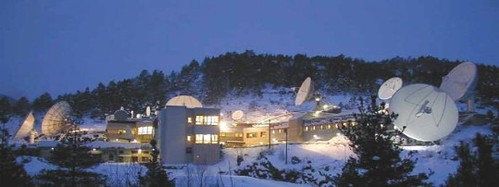
Telenor (whose Eik teleport station in Norway, which provides telecom services to the the North Sea, is pictured above) has just unveiled their product to reach a marketplace that is literally oceans-wide:

OceanRoam™ will provide vessels worldwide Internet and telephone connectivity around-the-clock using the ships’ assigned IP addresses and telephone numbers regardless of location. 
Telenor’s OceanRoam will offer “always-on” Internet access and IP-based service at a fixed monthly price.  The service will enable voice services and unlimited data transfer for ship’s business and crew communications and will feature a variety of committed information rate (CIR) service levels up to 128 kbps.  Additionally, OceanRoam will meet vessels’ communications requirements for bandwidth intensive applications, such as video conferencing and large data transfers, by providing a series of optional bandwidth on demand information rates of up to 1024 kbps.

(Note that the Director of Media and Public Relations is named, appropriately enough, Tom Surface.) 

We haven’t quite delved into the details of how OceanRoam differs from another Telenor product, WaveCall, but Alan Spicer runs a good blog on marine telecom that provides in-depth analysis of products and trends for those interested in following the maritime space (no pun intended) more closely. DigitalShip is also a good resource for tracking the convergence of IP, satcom, and other communications platforms in the maritime marketplace.

New Canadian Satellites

Wednesday, June 13th, 2007


Happy news from Ottawa

Two Ottawa-based satellite companies have awarded a total of 12 licences by the federal government to launch new satellites to improve broadcasting and telecommunications services to Canadian entrepreneurs and customers.

We blogged about Canada’s Community Access Program being at risk in Labrador, and new broadband solutions in Saskatchewan, so we know how important satcom will be in the Great White North.

Ensuring Canadians have acccess to vital communications services, Industry Canada issued several new satellite spectrum licenses today:

Licence                   Frequency Band/Orbital Position          Applicant
2                              17 GHz BSS/72.5W                                 Telesat
5                              17 GHz BSS/82W                                    Telesat
6                              17 GHz BSS/86.5W                                 Telesat
8                              Ka FSS/91W                                            Ciel
9                              17 GHz BSS/91W                                    Ciel
12                            17 GHz BSS/103W                                  Ciel
14                            17 GHz BSS/107.3W                               Ciel
16                            Ka FSS/109.2W                                       Ciel
17                            Extended Ku FSS/111.1W                       Ciel
23                            Ka FSS/118.7W                                       Telesat
24                            17 GHz BSS/118.7W                               Telesat
28                            12 GHz BSS/138W                                  Ciel


Here’s the news release:


The Honourable Maxime Bernier, Minister of Industry, today announced the results of a licensing initiative to authorize the development of new Canadian satellites that will increase and improve broadcasting and telecommunications services to Canadian entrepreneurs and consumers. The first satellites are expected to provide services as early as 2010.

"Canada needs to increase its satellite capacity to keep pace with the ever-increasing demand for satellite services," said Minister Bernier. "By awarding these new licences, we are helping the expansion of satellite capacity and services that will benefit Canadians for years to come. We’re helping to foster an environment that will bring all the benefits of competition, including increased product and service offerings, choice in supplier, competitive prices and export revenues."

Canadian satellite operators Ciel Satellite LP and Telesat Canada have indicated their intention to invest several billion dollars in building and launching new Canadian satellites, which will provide the capacity needed to fully implement high-definition television in Canada and carry important new and advanced telecommunications services such as satellite Internet. These new satellites will also help connect all regions of Canada, especially in the North, where satellites are the vital link to providing public safety, national security and government services. This process represented the largest spectrum licensing initiative ever undertaken in Canada and will lead to Canadian consumers and businesses gaining access to emerging satellite broadcasting and telecommunications services such as high-definition TV, Internet Protocol Television (IPTV), satellite broadband and multimedia consumer applications.