Archive for the ‘Observation’ Category

Lancio Bello di Delta II

Tuesday, June 12th, 2007


We have many observation satellites orbiting Earth. Now we have another.

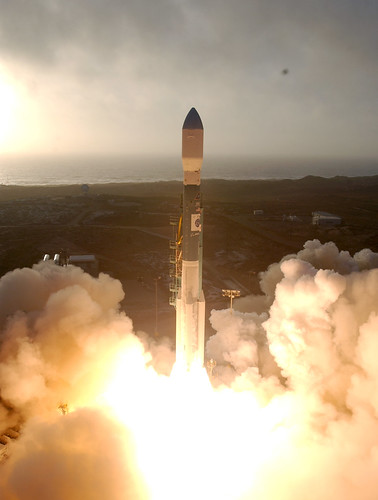
Delta nailed it again, this time from Vandenberg A.F.B in California:
 

"It is very emotional," said a tearful Francesca Sette, Thales Alenia Space-Italia. "We worked very hard for six months on this event; and during the last six months, we began to work 24 hours per day to ensure we completed this project on time."

The group from the Italian launch community used the Pacific Coast Club here to observe the event. An extravagant event, it included everything from 30 plasma screen TVs, to a live broadcast from Rome with a speech by Italian Minister of Defense, Arturo Parisi.

After watching the rocket lifting off the pad during a live broadcast in the PCC, an Italian train of 100 people went hurrying through the door to observe the Delta II rocketing through the sky outside. People were jumping up and down and hugging each other in celebration.

"It was so beautiful," said Mara Midealo, the wife of a Thales Alenia employee. "This was my first launch and it was a great event."

Thales Alenia Space Italia developed the COSMO-Skymed program for Agenzia Spaziale Italiana, using an X-band Synthetic Aperture Radar instrument. More about the mission:

The Cosmo-Skymed satellites are intended to provide monitoring, surveillance and intelligence data during international crisis for military customers, and environmental surveillance of floods, fires, landslides, and oil spill as well as earth topographic mapping, law enforcement for commercial, civilian institutions and scientific communities. Each satellite will be equipped with one X-band multipolarimetric Synthetic Aperture Radar (SAR) that will provide coverage of areas with a maximum width of up to 520 km.

The Cosmo-Skymed satellites will provide high resolution metric and sub-metric imagery through clouds, at night, with a revisit time of few hours. The 4 satellites constellation will acquire and furnish data worldwide.

The SAR sensor can work in four acquisition modes. Using the SPOTLIGHT mode the SAR scans with a resolution of one or less than a meter covering an area of tens of square kilometers. The HIMAGE (stripmap) acquisition mode provides a few meters resolution covering areas featuring a width of several tens of kilometers. The WIDEREGION, also known as ScanSAR, features tens of meters of resolution and swathes areas of hundreds of kilometers. Finally, the HUGEREGION acquisition mode swathes up to 520 km wide areas with a resolution of several tens of meters.

KAGUYA!

Tuesday, June 12th, 2007

Last December, I blogged about satellite-naming being the new new creative gold prize of astronomy —or, as I wrote then, the "new UGG boots of the space agencies" (what was I thinking writing that?). The Japan Aerospace Exploration Agency (JAXA) was planning the launch of their new lunar orbiter (formerly called SELENE), advertised as the the biggest lunar exploration project since the Apollo Project. Who wouldn’t want to name that?

A winner has been chosen! KAGUYA. As LiveScience explains, the name is from an ancient Japanese tale “Taketori Monogatari” – the tale of the Bamboo-Cutter which involves Princess Kaguya, the Moon Princess." (To be clear, KAGUYA is not named after the genetically modified mouse born in 2004 from two parents of the same sex.)

As Space.com explains, the project is perhaps the world’s most extensive current study of the moon (and there are many projects):

SELENE consists of a main orbiting satellite located at about 100km altitude, and two small satellites (Relay Satellite and VRAD Satellite) in polar orbit. The orbiters will carry instruments for scientific investigation of the Moon, on the Moon, and from the Moon.

JAXA claims that SELENE will be the most sophisticated lunar exploration mission in the post-Apollo Era. According to the agency, SELENE will observe the distribution of the elements and minerals on the surface, the surface and sub-surface structure, the gravity field, the remnant of the magnetic field, and the environment of energetic particles and plasma of the Moon. The scientific data will also be used for exploring the possibilities of the future utilization of the Moon. JAXA will also establish the basic technologies for future Moon exploration: lunar polar orbit insertion, 3-axis attitude control and thermal control in lunar orbit. In addition, SELENE will take pictures and movies of Earth-rise from the Moon horizon.

Too bad "Spektor" wasn’t chosen.

EHF Satcom Upgrade For B-2 Stealth Bomber

Tuesday, June 12th, 2007


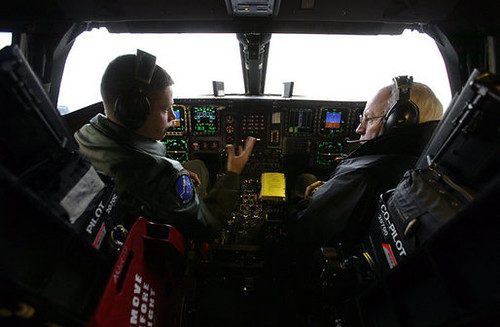
The U.S. Defense Department’s Global Information Grid (GIG) and the doctrine of network-centric warfare are about the touch the B-2 Stealth bomber. Prime contractor Northrop-Grumman got the go-ahead to develop a system using extremely high frequency (EHF) satellite communications earlier this year. Now we read they got a nice contract to really get going on it:

Northrop Grumman Integrated Systems was awarded a $171 million Air Force contract to begin a major step in developing a new satellite communications system for the B-2 Spirit stealth bomber, the company said Monday.

This 62-month phase will be the first of three increments in developing and installing the communications system. Once all three increments are completed, the upgrade will allow the B-2 to send and receive battlefield information up to 100 times faster than its current satellite communications system, the company said.

This contract "provides significant momentum for the work Northrop Grumman and its subcontractors are doing to increase the B-2’s fighting effectiveness in the face of technological advances by our enemies," said Dave Mazur, vice president of Long Range Strike for Northrop Grumman’s Integrated Systems sector, in a statement.

The project will enhance the B-2’s satellite communications system from ultra high frequencies, known as UHF, to extremely high frequency, or EHF.

Most of the work will occur in Palmdale, where Northrop houses its B-2 program, spokesman Brooks McKinney said.

Known as a flying wing because of its unorthodox shape, the Spirit has stealth properties that block enemy detection of the plane.

First introduced into the Air Force’s fleet in 1993, the B-2 has been one of the nation’s most high-profile warplanes because of its technological advancement and success in conflicts.

The first increment will involve replacing the B-2’s flight management computers with a single processing unit developed by subcontractor Lockheed Martin Systems Integration in Owego, N.Y.

The next increment of the upgrade will enable the plane to process signals at EHF frequencies.

The final increment will integrate the EHF capabilities with the aircraft’s controls and displays.

The new satellite communications system also will allow the B-2 to connect easily to the U.S. Department of Defense’s Global Information Grid, a worldwide network of information systems, processes and personnel involved in processing information on demand to warfighters, policy makers and military support people, Northrop said.

The B-2’s new communications system will be compatible with current and future secure military satellite communications networks.

The modernization program is the latest in a series of Northrop’s B-2 upgrades. Other past or ongoing improvements include:

A bomb-rack assembly that allows the aircraft to deliver 80 independently targeted, 500-pound "smart" munitions, five times more than previously.

Application of a surface coating that has reduced B-2 maintenance time and improved operational readiness.

Installation of a line-of-sight tactical communications system to improve pilots’ ability to share targeting and threat information.

Installation of an advanced antenna providing more advanced imaging capabilities in the future. El Segundo-based Raytheon Space and Airborne Systems is developing that antenna.


After the SR-71 Blackbird, the B-2 is the coolest aircraft around. Vice President Dick Cheney got to sit in one last October. How cool is that?

Satcom Supports Security at G8

Thursday, June 7th, 2007

It’s a reoccurring ritual. World leaders gather for a major summit such as the current G8 Summit in Rostock, Germany. Citizens and activist groups gather outside to unfurl banners, carry placards and hoist puppets in the air, all as a means of airing their grievances and points of view. And between these two groups, security personnel work to keep a respectable distance and, when possible, to keep the peace.

Serving those security and first responder forces is an integrated array of satcom technology

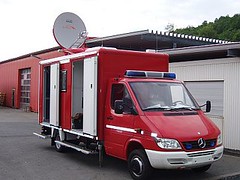
ND SatCom, an SES ASTRA company, is supporting reliable communications during the G8 Summit in Heiligendamm (Germany) for first responders of the German Federal Agency for Technical Relief (THW). THW staff members will be providing technical assistance to the summit’s infrastructure and using the network for telephony and data exchange via satellite. A satellite-based communication network using SkyRAY Light, ND SatCom’s new antenna system, shall establish the link to THW headquarters in Bonn via a mobile station in Heiligendamm. The SkyRAY Light system is very fast to deploy and easy to use, which is of utmost importance in critical government applications. SkyRAY Light’s operational concept is plug & play. Antenna pointing is based on a one-button operation enabling non-technical first responders to be on air within minutes.

There’s no shortage of footage from the current G8 meeting in Rostock, incuding this clip from SkyNews featuring Annie Lennox:

Here’s more from CNN.

But not all the protests are turning into clashes. Here’s a Flickr photo from Tuesday’s campaign stunt by Oxfam, the day before the G8 leaders arrived in Rostock for 2007’s G8 Summit, featuring the infamous ‘Big Heads’ dressed as Pinnochio:


Long March Launches SinoSat-3

Monday, June 4th, 2007

Let’s hope this one turn out better than Sinosat-2 did. Here’s the news report, via IHT:

China launched a new communications satellite into orbit early Friday [1 June 2007] to provide broader radio and television signal coverage across the country, state media reported.

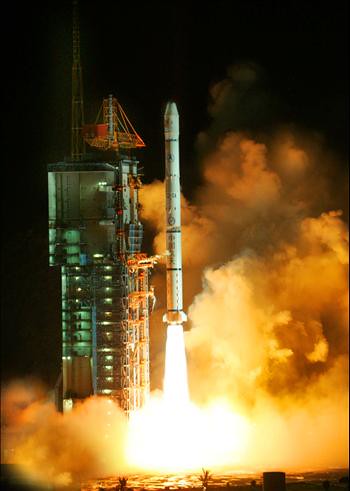
The Long March-3A rocket lifted off from the Xichang launching center in southwestern China eight minutes after midnight (1608 GMT) and separated from the SinoSat-3 satellite 24 minutes later, the Xinhua News Agency said.

The long-scheduled launch follows the failed deployment last October of another communications satellite, SinoSat-2, whose solar panels and communications antennae did not operate properly, Xinhua said.

China has spent decades building an indigenous space program and is trying to attract customers from abroad, after a series of failed launches in the 1990s dampened demand for Chinese launch services.

Both the rocket and the satellite used Friday were mainly developed and manufactured domestically, Xinhua said.

The satellite deployed Friday was not developed as a replacement for the inoperable SinoSat-2, Xinhua said, though Sino Satellite Communications Co., the satellite’s operators, may use SinoSat-3 to replace part of the service the other satellite was to have provided.

Xinhua quoted a company spokesman as saying that a substitute satellite would take at least three years to develop.


Robert Berry to be honored with Lifetime Achievement Award

Monday, June 4th, 2007

This Wednesday, at the ISCe 2007 Conference in San Diego, Robert E. Berry – former systems fellow and chairman of Ford Aerospace and SS/L – will be given a Lifetime Achievement Award.

More about Berry from the press release announcing the award:

"Berry led SS/L and its predecessor, Ford Aerospace, from 1977 to 2000 and, with his willingness to push innovative concepts, was responsible for some of the world’s most advanced communications and meteorological satellite projects for defense, civil, and commercial applications. He cultivated the international market for U.S.-based satellite manufacturing, and under his leadership, SS/L developed the technologies that have put the company at the forefront in providing high-power satellites for direct-to-home television, satellite radio, broadband Internet and international fixed satellite services."

During Berry’s tenure at Ford Aerospace, his team built many satellites for IntelSat, including the notable IntelSat 5 and IntelSat 7 series. After Ford Aerospace was sold to Loral in 1990, Berry led SS/L in developing the FS-1300, which was a very advanced and reliable satellite that in some cases exceeded its design life of 10 – 15 years.

More from the press release:

"Berry was instrumental in providing three generations of satellite platforms to Intelsat, helping the intergovernmental consortium provide fixed satellite services to more than 149 countries, territories, and dependencies. He initiated and managed Ford Aerospace’s participation on the Milstar industry team and advocated multi-mission satellite systems, with SS/L providing military communication payloads for commercial satellites for France, Japan, Spain and Australia. Currently at SS/L, he consults with both government and commercial interests to explore new applications arising from combining satellite, wireless, and fibered transmission."

The ISCe 2007 conference takes place this week, June 5th – 7th, in San Diego. Besides honoring Robert Berry, the conference is hosting a number of other impressive speakers and sure-to-be engaging talks. Check out the speaker list here.

In a related note, Berry’s company Ford Aerospace is also where Linda Hudson, currently of BAE Systems, got her start. She was the first woman manager at Ford, overseeing the quality assurance division. After making a name for herself as an executive at Ford, she eventually became the first female vice president at General Dynamics and now, as the president of BAE’s land and armaments division, has made a significant impact in the defense industry with BAE’s recent $4.1 billion purchase of Armor Holdings. London newspaper The Times calls her "the most powerful woman in the American defence industry" (link).

Recently, Hudson travelled to London to host a BAE leadership conference. She must have made quite an impression, as one British observer noted that "she talked a lot of sense – without the jingoism and rubbish you normally hear from American defence experts" (link).


SumbandilaSat Launch via Submarine Scrubbed

Wednesday, May 30th, 2007


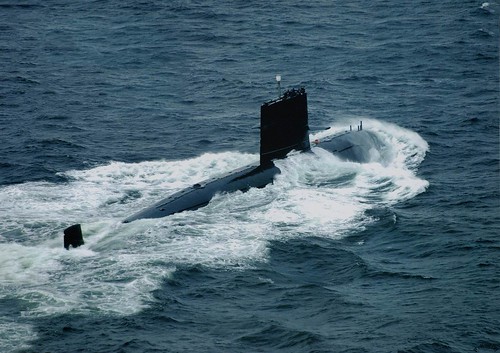
South Africa’s SumbandilaSat, an 81-kg LEO (low-earth orbit) observation/imagery satellite, which was to launch via a Russian submarine in the Barents Sea, has been postponed. The story, via Engineering News (South Africa):

The launch of South Africa’s first government satellite from a Russian submarine next month has been postponed indefinitely, an official said on Tuesday.

"It has been postponed because official documentation still needs to be arranged to issue a decree for the launch," said Nhlanhla Nyide, spokesman for the Department of Science and Technology.

"They are currently working on the process … We will hear from them when they have set a new date for launch," Nyide said.

He told said no additional costs will be incurred and South Africa’s nascent space programme would not be affected because of the cancellation of the launch, which was to have taken place in the Barents Sea near Norway.

The R26-million satellite, intended to orbit some 500 km (310 miles) above earth and have a life-span of three years and longer, would carry high-resolution imaging cameras.

The images from the South African-built satellite would be used across a wide array of applications, from agriculture to land use and infrastructure mapping.

South Africa has pledged millions of rands to build its astronomy and space sector, with the construction of the South African Large Telescope creating a hub for astronomy research in southern Africa.

In July 2006 cabinet approved the establishment of a South African Space Agency as an institutional vehicle to look at space science and technology.


This would have been a cool launch. Back in December, 2006, the satellite was handed off to Russia:

South Africa’s low-earth-orbiting microsatellite, SumbandilaSat, left for Russia on Thursday, ahead of its launch into space off a submarine in early 2007.

The 81-kg SumbandilaSat will generate satellite imagery through its remote sensing camera at 6,25 m ground sampling distance.

Upon arrival in Russia, SumbandilaSat will be taken to the Russian naval base at Murmansk, where the Russian navy will integrate it with a launch rocket. The satellite will then be transported to a submarine at Severemorsk, just off the Russian coast, where it will be launched into space.

The launch window period is between April and May and is strongly dependent on weather conditions at the time. Once in orbit, SumbandilaSat will pass over South Africa mid-morning and mid-evening, at an average orbit altitude of 500 km.

In addition to its earth observation and communications payloads, SumbandilaSat carries five experimental payloads, which will present the scientific community with exciting results in low frequency radio waves, radiation, software defined radio, forced vibrating string and radio amateur transponders.

Speaking at the hand-over ceremony, in Stellenbosch, Science and Technology Minister Mosibudi Mangena said that the development of SumbandilaSat offered South Africa a number of competitive advantages and would support decision-making in natural resource management and sustainable development. He added that the images yielded by the satellite would be used in various applications, which had direct benefits to societies, such as flood and fire disaster management; enhancing food security through crop yield estimation; ensuring better human and animal health through enabling the prediction of the outbreaks of diseases; better monitoring of land cover and use; as well improved capabilities for water resource management.

The actual construction of the SumbandilaSat had been completed at the end of September and had been followed by a battery of trials, including functional testing, space environmental testing, vibration testing and burn-in testing, designed to establish the satellite’s readiness prior to a flight acceptance review.

“The environmental-testing phase determined SumbandilaSat’s ability to withstand extreme variance in temperatures, while the vibration tests verified its ability to endure the shocks it will undergo as it is launched into space. The burn-in testing phase comprised the actual and continual running of the satellite and its systems in order to confirm that all components are fully functional,” the Department of Science and Technology (DST) said.

Sunspace project manager for SumbandilaSat Harry van der Heyden said that the review presentation included an introduction to the hardware produced, as well as the ground support equipment developed for the satellite. “We also conducted demonstrations to illustrate how the satellite communicates with the ground support equipment.”

The birth of SumbandilaSat was initiated by the DST and was given life by numerous stakeholders, including the University of Stellenbosch, Sunspace, the South African Space Council, the Departments of Foreign Affairs, Trade & Industry, and Communications, as well as the Centre for Scientific and Industrial Research.

The launch of SumbandilaSat is envisaged to strengthen South Africa’s technological capability and innovation in space science and technology, as well as reinforce the country’s role in national, regional and international space initiatives.

This is but one aspect of a budding interest in space, as evidenced by South Africa’s National Astrophysics and Space Science Programme. The first "space age school" was established in 2003.

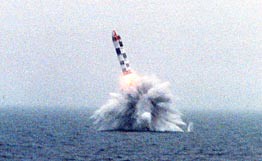
Here’s a clip of U.S. Trident missiles being launched from a sub:


Full-Time Uplinking for Cable Channels

Tuesday, May 22nd, 2007

The list of cable channels keeps growing and they all need to find a way to get it to the top 100 cable systems. Since 1976, the best way to get your cable channel distributed is by satellite — it is the technology that made HBO and CNN what they are today.

First step is to secure a lease on a C-band satellite that cable systems are already "looking at" (have a downlink antenna assigned to it). CED Magazine’s series of wall charts include the annual "Orbital Arc Chart" (link launches PDF), which shows you a snapshot of all the cable channels and which satellites they’re on. Want more detail? Check Lyngsat for each satellite’s ladder chart.

Getting space segment in a high-value "cable neighborhood" is not cheap. For a start-up, viable alternatives to going it alone include origination and uplink centers such as Comcast Media Center (CMC) in Colorado and Crawford Communications in Georgia. 

CMC uplinks the entire HITS ("headend in the sky") platform, which carries a ton of channels.

Broadcast Newsroom just ran a piece on Crawford setting a record for new channel uplinks: 14 new channels so far this year. overall, they uplink 135 full time cable channels. I like their new video tour:


Rubidium Clock Marks Year In Orbit

Tuesday, May 22nd, 2007

Physorg reports on the rubidium clocks being tested for ESA’s Galileo satellite system, which, when fully deployed in the early years of the next decade, will be the first civilian positioning system to offer global coverage:

GIOVE-A, the first Galileo in-orbit validation element, was launched on 28 December 2005. One of its two rubidium clocks was switched on for the first time on 10 January 2006 and Galileo signals were transmitted two days later.

The timekeeping of the clocks on the Galileo spacecraft will play an important role in determining the overall accuracy of the system, so evaluation of their performance is a crucial part of the Galileo in-orbit verification process.

The orbit of GIOVE-A is precisely measured by a network of 10 ground-based laser ranging stations, to provide orbital data independent of the navigation data. The navigation signals broadcast from GIOVE-A, and from the GPS spacecraft constellation, are received by the world-wide network of 13 Galileo experimental sensor stations belonging to the GIOVE Mission Segment.

The technique used to characterise clock performance is known as Orbit Determination and Time Synchronisation (ODTS). ODTS is a statistical method which takes the Galileo and GPS data, together with the laser ranging data, and calculates spacecraft orbits, clock times, the effects of the Earth’s atmosphere on the radio signals and the delays in the receiving systems. The precision of the calculations is so great that even the tiny orbit disturbances caused by the pressure of sunlight shining on the satellites is taken into account…. 

The measured performance of the clocks meets the specification over short and medium timescales. A few ‘jumps’ in clock frequency have been observed, which impact the long term accuracy. Such frequency changes are a well known phenomenon in rubidium clock technology but their cause is not yet well understood. Their effect on GPS performance has already been analysed and corrective measures proposed. The Galileo team are ground testing a number of improvements to the clock design which are intended to minimise both the occurrence and size of the jumps. 

(It ain’t pretty, but it’s accurate!)

The ESA website offers further explanation about the accuracy of the rubidium clock:

The Galileo satellites will carry two types of clocks: Rubidium atomic clocks and Hydrogen atomic clocks. The stability of the Rubidium clock is so good that it would lose only 3 seconds in 1 million years, while the Hydrogen maser is even more stable and it would lose only 1 second in 3 million years. However this kind of stability is really needed since an error of only a few nanoseconds (billionths of a second) on the Galileo measurements would produce a positioning error of meters which would not be acceptable.

For those who really want to get into the complexities of such atomic clocks, check out this page from Harvard’s Department of Physics. In addition to details about the frequencies used by atomic masers (hey, no one said this wasn’t rocket science!) the page features a downloadable poster illustrating N-resonances and atomic clocks.

Free Speech on Satellite Radio?

Thursday, May 17th, 2007


Well, sort of…

Via the Los Angeles Times:

Listeners shocked by XM hosts’ suspension

Many cancel the service. Some suspect a proposed merger with Sirius is a factor in the punishment.

By Jim Puzzanghera and Amy Kaufman, Times Staff Writers
May 17, 2007

WASHINGTON — Satellite radio bills itself as the Wild West of the airwaves, an uncensored outpost beyond the reach of federal regulators where expletives fly with impunity and the banter can get as raunchy as at a strip club.

But the decision this week by XM Satellite Radio to suspend shock jocks Opie and Anthony for 30 days for crude sexual comments about First Lady Laura Bush, Secretary of State Condoleezza Rice and Queen Elizabeth II has listeners wondering whether there’s a new sheriff in town.

Some XM listeners were outraged — not at the comments but at XM’s reaction.

"I signed up for XM because it’s uncensored. I like these guys because they are so unfiltered," said Placentia resident Paul Hebert, who canceled his $12.95 monthly XM subscription Tuesday in protest.

He wasn’t alone. Hundreds of angry subscribers have flooded XM’s operators with calls to cancel since the suspension was announced Tuesday. About 60 listeners smashed their XM receivers Wednesday outside the WFNY-FM studios in New York, where Gregg "Opie" Hughes and Anthony Cumia continued to air their tamer, over-the-air broadcast for CBS Radio.

"The reaction is mind-blowing," said Ryan Saghir of North Branford, Conn., who runs a blog about satellite radio called Orbitcast. "One of the main attractors to satellite radio is the unregulated content. Once you take away that … you’re going to have some upset subscribers."

But industry observers said XM might have been more worried about offending federal regulators, who can block the company’s proposed merger with its only rival, Sirius Satellite Radio, than staying true to its slogan, "Beyond AM. Beyond FM. XM."

Sensitivities have been heightened in Washington since the controversy over veteran shock jock Don Imus’ racially offensive comments about the Rutgers University women’s basketball team, which led to his firing last month by CBS Radio.

"It’s hard to read anything into it other than that they’re catering to federal officials," said William Kidd, a media analyst with Wedbush Morgan Securities in Los Angeles.

XM spokesman Nathaniel Brown would not comment on whether the pending merger was a factor in the suspension and would not say how many people had canceled their subscriptions. XM has suspended on-air personalities before, he said, but none with as high a profile as Hughes and Cumia.

It’s not the first time a skit has landed the two shock jocks in trouble. CBS Radio, then known as Infinity Broadcasting, fired them in 2002 for broadcasting two listeners apparently having sex in New York’s St. Patrick’s Cathedral. The Federal Communications Commission fined Infinity $357,000 for the stunt.

XM, which does not fall under the FCC’s indecency rules because it is a pay service, hired Hughes and Cumia in 2004. Their program, "The Opie & Anthony Show," airs from 6 a.m. to 9 a.m. on XM and 24 CBS radio affiliates, which picked the duo back up last year.

It continues until about 11 a.m. only on XM, a segment that the show’s website touts as "uncut, uncensored and totally filthy."

On May 9, the XM portion of the show aired a skit featuring a character called Homeless Charlie, who graphically described having sex with Bush, Rice and the queen. Hughes and Cumia played along, laughing and asking questions.

XM issued a statement condemning the comments, and Cumia and Hughes apologized on the air Friday.

On Monday’s show, Hughes and Cumia complained about "dumb rules" and an "umbrella of morality and decency" that led Imus and some other hosts to get fired. XM officials suspended the pair Tuesday, saying the comments "put into question whether they appreciate the seriousness of the matter."

Satellite radio followers said the suspension was unprecedented. Some XM listeners were stunned and angry when they heard about it.

Ed L. Kelley of Wagoner, Okla., said he spent six hours on the phone Tuesday night trying to cancel. He’s talking to an attorney about a class-action suit, saying that because "The Opie & Anthony Show" appears on one of XM’s "explicit-language" channels, the company has violated its promise to deliver uncensored content.

"These guys make me laugh and they make fun of everybody equally," Kelley said.

Debbie Wolf, co-founder of People Against Censorship, called the suspension "outrageous" and organized the demonstration outside CBS Radio’s studios. Christopher Lewis of Glenmoore, Penn., quickly registered http://www.cancelxm.com , and the message boards there and on other satellite radio sites have filled up with dozens of angry comments.

"I will not support a company that has decided the one true reason they exist no longer matters," wrote one poster on Orbitcast.

Howard Stern, who left traditional radio in 2004 after battling regulators, also weighed in from his new post at Sirius.

"If you want free speech," he told his listeners Wednesday, "walk in a closet and talk to yourself."

Kidd said the suspension could make it difficult for XM to attract edgy radio personalities who have viewed satellite as a haven for their outrageous acts.

"This will probably be a decision that XM will have to live with and, I suspect, likely regret over time," he said.

The suspension would be as surprising as HBO pulling "The Sopranos" for offensive content and will reverberate through the industry, said Tom Taylor, a former program director who edits the trade journal Inside Radio.

"People in the satellite world have felt safe … until this week," he said.