Archive for the ‘Observation’ Category

GE Deal For AsiaSat

Wednesday, April 25th, 2007

Remember Tianamen Square? To many people, it remains a fuzzy memory. The U.S. State Dept. remembers it well — especially the laws and regulations created since then regarding technology transfer. Satcom falls under that category.

We thought AsiaSat was going to be taken private by GE (see this comment from 2 months ago) after SES bought them out. The South China Post reports this US$295 million deal won’t be happening:

The Bush administration’s decision to stop a General Electric subsidiary from teaming up with state-owned Citic Group to privatise Asia Satellite Telecommunications Holdings is the latest in a long line of mainland-related deals that the United States has blocked for political reasons.

At the root is a policy put in place by former US president George H.W. Bush, father of the current president. On June 5, 1989, the day after the Tiananmen Square crackdown, Mr Bush issued a moratorium on all US military exports to the mainland, including satellites.

Shortly after, the US Congress passed laws banning satellite exports to China. There were two exceptions: the president could issue a special waiver on the grounds that either the mainland had achieved political and human rights reforms or the deal was in the US national interest.

What constitutes "national interest" has since been a subject of keen debate in Washington, and it appears that Citic and GE’s HK$2.3 billion bid for AsiaSat is the latest victim.

"The US Department of State has in correspondence with General Electric said it will not grant the approval necessary to implement the proposed privatisation," AsiaSat said yesterday in an announcement on the scuttling of the deal.

As the leading regional satellite operator in the Asia-Pacific, the company makes for an attractive target. It serves more than two-thirds of the world’s population with its three satellites: AsiaSat 2, AsiaSat 3S and AsiaSat 4. They provide services to the broadcast and telecommunications industries.

More than 240 digital television channels and 130 radio channels are now delivered by AsiaSat’s satellites, reaching about 96 million households with more than 360 million viewers across the Asia-Pacific.

Last year, AsiaSat tapped California’s Space Systems/Loral, a subsidiary of US high technology firm Loral Space & Communications, to build AsiaSat 5. The new-generation satellite is slated for launch next year and it is unclear what impact, if any, the State Department’s latest action will have on that deal.

It is not the first time the company has been at the centre of the US-China export dispute.

In December 1989, despite an outcry in the Congress, the elder Bush ruled that exporting satellites – the manufacture of which is dominated by several US companies – was in the national interest. That cleared the way for AsiaSat 1, which in April 1990 became China’s first commercially launched US-made satellite.

But the following year, Mr Bush blocked the sale of satellite components to the mainland.

The move was interpreted as an attempt to appease Congress – which was upset with Chinese sales of military equipment to Middle East nations – and to win support for Mr Bush’s plans to further liberalise trade with the mainland.

The present-day Bush administration’s move against the Citic-GE deal may have had a similar political motive.

As the US prepares for another presidential election cycle, analysts have interpreted the recent World Trade Organisation case against China as an attempt by beleaguered Republicans to head off some of the inevitable China-bashing that is likely to emerge from a Democrat-controlled Congress.

But, for now, the only obvious loser is business.


And this from Variety:

A plan to take Asia Satellite Telecommunications Holdings, which operates three satellites across the region, into private ownership was quashed Tuesday (April 24) when it was blocked by the U.S. Dept. of State.

The private-ownership plan was proposed by AsiaSat and AsiaCo, a joint venture between China’s state-owned Citic Group and GE Capital Equity Investments from the U.S.

If the company had gone private, Citic and GE would each have owned 50%. GE became a major shareholder of AsiaSat in early April with a 34% holding.

Deal was subject to a number of conditions, one of which was approval by the State Dept. and compliance with U.S. International Traffic in Arms Regulations.

As a result, a court meeting and special general meeting scheduled for Tuesday morning were "adjourned indefinitely" only hours before they were skedded to take place.

The deal appears to have raised national security hackles at the U.S. State Dept. concerning transfer of satellite technology to China.

AsiaSat didn’t immediately return phone calls for comment.

Trading in AsiaSat shares were suspended from just before noon on Monday and trading in American Depositary Shares (ADS) on the New York Stock Exchange was suspended Monday.

Trading resumed Wednesday morning at 9:30 in Hong Kong and once the NYSE opens its trading day Wednesday, ADS trading will start up again.

In an increasingly competitive market, AsiaSat’s shares have continued to drop over the past three years. Price of shares decreased almost 12% during that period compared to a more than 51% increase in the Hang Seng Index.

The company hoped being taken private would give it greater flexibility to focus on the development of business and marketing activities; and relieve it of the financial and administrative burden of dual listings on both the Hong Kong Stock Exchange and the New York Stock Exchange, according to a press release dated Feb. 14.

AsiaSat’s three satellites serve two-thirds of the world’s population with its three satellites, which provide services to the broadcast and telecom industries.

It has more than 270 TV channels and 130 radio channels delivered via its satellites and reaches 96 million households in the Asia-Pacific region.


AsiaSat’s shares fell 5.7% on Wednesday, closing at HK$16.50. It’s U.S. ADRs were down 8.97% on the NYSE.

Televisa Eyes Satmex

Tuesday, April 24th, 2007


Last week, Rocco pointed in the comment threads to a Wall Street Journal (subscription required) report that Intelsat may be for sale. As Rocco so succinctly put it in the comments:

FOR SALE: Global communications satellite business. Only $11 billion in debt. Good cash flow. Nice office in Bermuda; half-empty building in Washington. Heavy regulatory environment. Price: $6 billion.

We wrote a bit about Intelsat’s history in this post; the Wall Street Journal’s report  (here) has more details on Intelsat’s recent history as a private entity.

Yet Intelsat isn’t the only satcom firm in the midst of (possibly) changing hands. Asiasat yesterday asked to have their stock trading suspended due to a pending announcement, and now come reports that Satmex, too, may be in the sites of a takeover entity.

Variety reports: 

MEXICO CITY — Mexican conglom Televisa is hooking up with the Chinese. VP of broadcasting Jose Baston signed an agreement to distrib state broadcaster CCTV’s international feed in Mexico on Monday. Televisa execs will travel to China in the coming weeks to explore sales of telenovelas and formats to that country…

Net also is considering bids for Endemol and Mexican satellite firm Satmex as possible destinations for its bulging cash reserves.

With Satmex in its fold, Televisa could cut its own international distribution costs as well adding revenue from Satmex’s three birds that cover the American continents. Global sat firms such as PamAmSat also are expected to go after Satmex.

Business News America has greater detail on Televisa’s thinking behind a Satmex buyout:

 Televisa is analyzing what sorts of operational synergies exist between its own operations and Satmex’s coverage, according to de Angoitia….

However, Alberto Moreno, an analyst with corporate ratings firm Fitch Ratings México, downplayed the news saying that it is just one of many investment options that Televisa is weighing up and that it is too early to tell whether the company is a serious contender.

If the company is indeed seriously interested, an official announcement should be made in the short term, Moreno told BNamericas.

Despite the uncertainty, Moreno said that Televisa is looking for new investment opportunities to grow their business particularly to address the US Hispanic market.


Satmex has decent coverage of the Americas with only three satellites. Although Televisa’s recent sale of its stake in Univision was big news, it’s clear from the Satmex reports that Televisa’s interest in the growing U.S. Hispanic market is far from over.


Breakout Your 3-D Glasses… the First STEREO Pictures are In

Monday, April 23rd, 2007


With you kind of coverage you’d expect from RRS, we’ve been following NASA’s stereo since its launch last October and some of the first non-3-D photos were released in late February.

As seen in the photo above, NASA is releasing the first 3-D photos taken by the STEREO project at a press conference taking place in the next few minutes. According to the NASA press release, these photos represent a significant advance in astronomy, allowing those who study the heavens an opportunity to finally really see what they’re observing.

"In the solar atmosphere, there are no clues to help us judge distance. Everything appears flat in the 2-D plane of the sky. Having a stereo perspective just makes it so much easier," said Dr. Russell Howard of the Naval Research Laboratory, Washington, the Principal Investigator for the SECCHI (Sun Earth Connection Coronal and Heliospheric Investigation) suite of telescopes on the spacecraft.

‘With STEREO’s 3-D imagery, we’ll be able to discern where matter and energy flows in the solar atmosphere much more precisely than with the 2-D views available before. This will really help us understand the complex physics going on,’ said Howard."

Oh, and the knowledge gained by the observation will do more than look pretty, helping scientists better gauge changes in space weather patterns and forecasts by helping them better understand Coronal Mass Ejections (CMEs).

"CMEs are eruptions of electrically charged gas, called plasma, from the sun’s atmosphere. A CME cloud can contain billions of tons of plasma and move at a million miles per hour.

The CME cloud is laced with magnetic fields, and CMEs directed toward Earth smash into our planet’s magnetic field. If the CME magnetic fields have the proper orientation, they dump energy and particles into Earth’s magnetic field, causing magnetic storms that can overload power line equipment and radiation storms that disrupt satellites.

Satellite and utility operators can take precautions to minimize CME damage, but they need an accurate forecast of when the CME will arrive. To do this, forecasters need to know the location of the front of the CME cloud. STEREO will allow scientists to accurately locate the CME cloud front. ‘Knowing where the front of the CME cloud is will improve estimates of the arrival time from within a day or so to just a few hours,’ said Howard. ‘STEREO also will help forecasters estimate how severe the resulting magnetic storm will be.’"

Those interested in seeing more will definitely want to check out the STEREO mission page following the press conference (11:00am EDT) when additional photos will be released.

(Don’t have a pair of 3-D Glasses on you?  Check out the NASA Guide on how to make your own 3-D specs.)

India’s PSLV Launched

Monday, April 23rd, 2007

Via The Times of India:

The Polar Satellite Launch Vehicle-C8 (PSLV-C8) has been launched successfully today from Sriharikota.

PSLV is carrying the Italian Satellite Agile along with it. The countdown progressed smoothly for the first commercial launch of PSLV-C8 with a 352 kg Italian astronomical satellite onboard from Sriharikota spaceport, about 150 kms from Chennai.

“The atmosphere is calm and quiet. Countdown is progressing as per schedule," said an ISRO spokesman.

The launch vehicle lifted off at 1530 hrs.

The 42-hour countdown for the launch of the 11th flight of PSLV-C8 began on Friday evening. It was launched from the second launch pad at the Satish Dhawan Space Centre, SHAR.

Apart from the Italian satellite, Agile, PSLV-C8 would also carry an Advanced Avionics Module (AAM), weighing 185 kg, to test advanced launch vehicle avionics systems like mission computers, navigation and telemetry systems.

A workhorse launch vehicle of ISRO, PSLV has launched nine successful consecutive flights till now since its first launch in 1994. It would also launch India’s first mission to the moon, Chandrayaan-1 in 2008.

Official press release from the ISRO.

BlackBerry NOC Down

Wednesday, April 18th, 2007

Chuck Scarborough used to live down the street from me in Bronxville years ago. Last night I watched him tell me my BlackBerry‘s not working. Neither is anybody’s in North America, according to Computerworld:

The BlackBerry wireless e-mail service from Research In Motion Ltd. appears to have suffered a widespread outage that started last night in the U.S.

Customers on the BlackBerry Forums discussion board complained of having no service starting at about 5.15 p.m. PDT yesterday.

Callers to the BlackBerry U.S. technical support line were still greeted with the following message early this morning: "We are currently experiencing a service interruption that is causing delays in sending or receiving messages. We apologize for the inconvenience and will provide updates as soon as they become available."

New York television news channel NewsChannel4 reported last night that the problem affected "all users in the Western hemisphere."

However, comments from operators in Asia and Europe, as well as postings to the BlackBerry Forums, suggested that the problem may be limited to North America.

"Officials with RIM said they are trying to reset the system and told NewsChannel4 that they are concerned that the backlog of data, which will rush through when it comes back on line, could cause a bigger problem," the news channel reported on its Web site.

RIM officials advised people who use Blackberry as a major way of communications to make back-up plans, the channel reported.

A RIM official contacted in France was unaware of the problems, and said she had received messages sent to her BlackBerry as normal. Other RIM officials did not return calls seeking comment.

The outage may have been cause by one of RIM’s Network Operating Centers (NOC) going down, according to Emma Mohr-McClune, principal analyst with Current Analysis Inc. "This has happened before," she said.

RIM operates two NOCs, both located in Canada, according to Mohr-McClune. The company has considered locating additional NOCs outside of Canada, she said.

Companies that provide BlackBerry service connect their mail servers to a BlackBerry Enterprise Solution (BES) server located on their premises, which in turn is linked to one of RIM’s NOCs, according to Mohr-McClune. "All data slides to Canada and back," she said.

RIM may have been fortunate that the outage began at about 5 p.m. Pacific Time, because it would have been after the busiest part of the U.S. work day. Engineers were likely scrambling through the night to bring the service back online before the start of the U.S. workday today.

Other parts of the world appeared to have been unaffected. A representative for Taiwan Mobile Ltd., RIM’s BlackBerry partner for the island, said the problem is limited to North America, and that users would not be affected unless they are sending or receiving e-mail through a BlackBerry server there.

"RIM has not communicated with Taiwan Mobile about when this problem might be fixed," said the representative, April Hong.

NTT DoCoMo Inc. in Tokyo said its BlackBerry users in Japan were also unaffected. And In Europe, a spokesman for T-Mobile Deutschland GmbH was unaware of any problems, and Blackberry users in Germany and France reported no interruption of service.

The problems come at a time of continued rapid growth for the company, based in Waterloo, Ontario. It added 1.02 million subscribers in the quarter ended March 3, for a total of approximately 8 million BlackBerry subscribers worldwide. Revenue for the quarter was $930.4 million, up 66% from a year earlier. Net income for the quarter before adjustments was $187,928, the company said.

Wish they had built-in satellite connectivity. Thuraya phones have it.

The Great Turtle Race!

Tuesday, April 17th, 2007

Here’s a great story about how the combination of satellite tracking technology and the Internet can be used to raise awareness about conservation efforts around the world.

The Leatherback Sea Turtle is the biggest of all living turtles and the world’s fourth-largest reptile, reaching more than 6 feet in length and weighing up to 2000 lbs. It is also listed as endangered worldwide by the U.S. government, with the global population of female leatherbacks plunging from an estimated 115,000 in 1980 to fewer than 43,000 today.

Ranging throughout the Pacific, Atlantic and Indian oceans, leatherbacks worldwide are threatened not only by coastal development and loss of habitat, but by ocean pollution and "floating plastic bags or sheets which they mistake for jellyfish — a staple of their diet." 90 percent of the leatherbacks have vanished and the species may disappear within 10 years due to illegal poaching of their eggs, according to conservationists.

To draw attention to the plight of the leatherbacks, conservationists yesterday launched the Great Turtle Race.

The AP reports:

Biologists will switch on satellite trackers strapped to the backs of 11 female leatherback turtles on Monday, starting what conservationists have dubbed the "Great Turtle Race" to raise awareness of a species threatened with extinction.

Sponsored by U.S. and Costa Rican environmental groups and businesses, the race will track the turtles on their annual 1,200 mile journey from Costa Rica’s Pacific coast to the Galapagos Islands….

Most of the competing turtles are expected to be in the water by Monday after laying their eggs on the beach at Playa Grande in Costa Rica.

The Web site features virtual trading cards with caricatures of the turtles with names like Freedom, Windy and Stephanie Colburtle after U.S. comedian Stephen Colbert of Comedy Central fame. It also has stats on their egg-laying history…

Ten race sponsors — including Yahoo Inc., Plantronics Inc., Philadelphia’s Drexel University and Dreyer’s Ice Cream — donated $25,000 each to purchase the tracking equipment and protect nesting areas from development.

Leatherbacks aren’t the only sea creatures that are getting tagged with satellite trackers to raise awareness and scientific knowledge about  the world’s oceans. The Census of Marine Life has a great site, Tagging of Pacific Pelagics, where users can track tracking projects of a variety of species and view real time data of the movement of sharks and other animals in the Pacific. And NASA is tracking sea lions to gain a better understanding of the world’s oceans.

For ease of use and entertaining presentation — especially for a younger audience — it’s hard to beat the Great Turtle Race website. Check it  out, because those turtles are, um, making some quick tracks.

I Love You, C-band

Monday, April 16th, 2007

This may not be the same love as the backyard-dish people were feeling 20 years ago, but these folks are digging IP-PRIME, which is carried nationally via AMC-9’s C-band payload in the U.S.:

“We have an extraordinary partnership with SES AMERICOM and with the launch of IP-PRIME we can now reach out securely and effectively to IPTV viewers across the country who will be able to access their favorite NBCU programs,” commented Henry Ahn, executive vice president, NBC Universal TV Networks Distribution.

“Showtime Networks is excited about the ability of SES AMERICOM to securely and reliably deliver all of our networks to the telcos with video initiatives, using enabling technologies such as MPEG4,” said Michael Tas, Senior Vice President, Distribution and Sales Strategy for Showtime Networks. “SES AMERICOM has been a proven partner of Showtime Networks for decades now and we look forward to extending the relationship well into the future.”

“We are sensitive to the costs of getting into the distribution business and are happy IP-PRIME is in place to fill the technology gap for small operators,” said Karen Byko, executive vice president of operations for Turner Network Sales.

“Consumers want alternatives in how they spend their entertainment dollars,” said Mike Biard, Senior Vice President, Affiliate Sales, Fox Cable Networks. “IP-PRIME will deliver Fox’s networks securely to a new generation of distributors, and we are delighted to be working with SES AMERICOM to do so.”

"We’re excited to be a part of SES AMERICOM’s new IP-PRIME programming lineup," said Mark Cuban, chairman and co-founder, HDNet. "By including HDNet and HDNet Movies, SES AMERICOM is making sure IPTV viewers receive the highest quality HD programming, including our acclaimed movies, original programming, investigative news, popular series and sports.”

Multichannel News followed up with a question on ESPN, of course.

Will this revive the backyard dish market? I can almost imagine a DTH service using C-band. I want my IPTV!

Space Tether Experiment Launches Today

Monday, April 16th, 2007

If you were up with the sun (or the clouds, if you’re in the eastern portion of the US) this morning, you might have caught the report on NPR on Space Tethers and Tethers Unlimited efforts to change the way satellites are transported.

While science fiction, Victoria’s Secret, and long-woven ropes are rarely mentioned in the same breath (unless of course you’re in some bizarre John Waters movie), the work of Dr. Robert P. Hoyt and Dr. Robert L. Forward have brought the two strangely together to solve a real problems posed by simply moving obejcts around space.


"For 50 years, people have relied on rockets to move things around in space. But rocket fuel is expensive and heavy. [Hoyt with the help of Forward realized how] much easier it would be to just fling things around using orbiting tethers.

‘It’s sort of like using the techniques of Tarzan to move around in space,’ explains Hoyt. ‘You’re basically grabbing onto a long, high-strength rope and using it to swing you from one place to another.’"

The problem, of course, was how you got those ropes to last in an environment where they were being constantly pounded by the debris that litters our orbit. And that’s where the underwear comes into Tethers Unlimited business plan…

"The company makes tethers by starting with light but strong fibers, like Kevlar. Then the strands are woven together using a computerized machine.

‘[That machine is] normally used for fabricating things like lacy edgings on Victoria’s Secret undergarments," says Hoyt. "We’ve developed ways to use that to braid the multi-line tether structure that we’re testing in space.’"

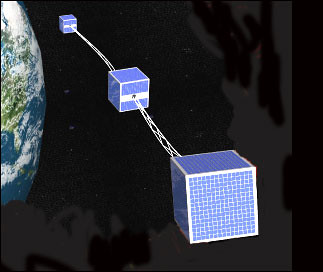
That testing begins imminently, a Dnepr rocket blasting off from Baikonur Cosmodrome today contains, within its payload, three mini-satellites that will deploy a half-mile tether, two of the satellites anchoring either end. The third, dubbed, according to a recent Engadget report, Inspector Gadget (Ted and Ralph make up the other two members of the trio), will move up and down the tether taking pictures that will allow those on the ground to learn how many cuts or tears the rope takes on over the next few months.

While it might be awhile until we see tether’s in action, propelling satellites in space, this initial experiment is an important first step in a lot of new space technology, possibly including space elevators.

High-Speed Internet for Movin’ Military

Tuesday, April 10th, 2007

Is this the future of acquisition procedures for the U.S. government’s satcom needs?

The Wall Street Journal (subscription required) reports that the U.S. Defense Department has formed an unusual partnership with Intelsat Ltd., Cisco Systems Inc., and private investors to bring high speed internet connections to military units on the go:

 The demonstration project requires private investors led by a fledgling private-equity fund to shoulder the entire cost of a networking system for directing messages, a sort of Internet router in the sky for soldiers and intelligence gatherers…..

Private investors are gambling that the U.S. military will make long-term commitments to support technical breakthroughs and new acquisition procedures….

Claire Fairfield, managing director of venture fund Concerto Advisors Inc., said his group is looking to raise as much as $200 million to fund four total satellites involving Intelsat or other commercial operators.

Cisco top executive for the program, Rick Sanford, says the project is "really a business approach, not a government program." By acting like a consumer, the DoD hopes to overcome the delays and cost overruns that have frustrated their more traditional attempts to meet the military’s soaring demand for satellite IP connections. (Cisco is providing software integration for the project.)

By developing and deploying such technology in about two years — dramatically faster than traditional military-satellite programs — such shared commercial-government payloads could pave the way for providing lower-cost, more flexible digital-communications links to fighting forces and intelligence operatives in the field. If successful, the model also will help the military, along with users of navigation, homeland-security and other civilian applications better coordinate future satellite needs.

In this case, "We get to test something for a fraction of what it would cost" if the Air Force funded it, said Mike Florio, the military’s lead manager for the program. "And we’ve got some stars of industry trying to make this work." 

The deal marks another milestone in Intelsat’s history. Intelsat was established in 1964 by 11 countries as an international intergovernmental agency to provide satellite services to member countries; by 1973, more than 80 countries had joined the consortium. In 2001, Intelsat became a private company, opening up new avenues of business — including deals like this one with the DoD. Still, vestigal problems remain from its days as the satcom provider to a broad spectrum of political organizations (see here and here,  as well as this odd entanglement between Sri Lanka, Amnesty International, and the International Cricket Council (whose Cricket World Cup is taking place now.)


As in the civilian world, the U.S. military’s need for faster and more reliable IP communications has grown exponentially as the convergence between IP technology and two-way and broadcast communications accelerates. AMERICOM Government Services’ C2OTM (Comms-on-the-Move, pictured above) for example,  provides "real time support for a full range of IP applications including VOIP, two way video surveillance, warfighter coordination tools such as common operational perspective and force tracking, and a full range of logistics and training applications" by integrating with ArcLight(r) modem technology from ViaSat

Anik F3 Launch Update

Monday, April 9th, 2007


As you probably know those of us here at Really Rocket Science love a good launch, especially that of a big GEO satellite.

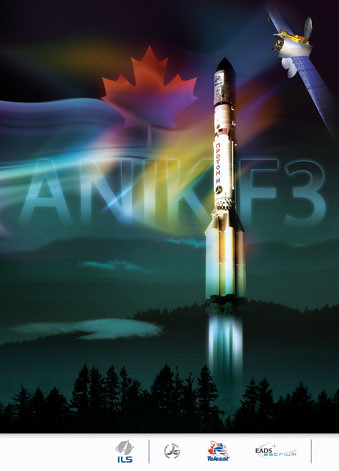
The Anik F3 will be launching tonight (04:54 April 10 Baikonur, 22:54 April 9 GMT, 18:54 April 9 EDT) this from launch pad 39 of the Baikonur Cosmodrome in Kazakhstan. You can, of course, catch the launch live via streaming, although hopefully we’ll be able to find on YouTube sometime tomorrow for those looking to beat a wicked case of the Mondays by heading to Happy Hour early.

Those nerdier than us might want to catch a live feed of the launch via satellite or over the phone at the following locations.

Live Broadcast
North America: Telstar 6 @ 93° West, transponder C11, downlink 3920 MHz (vertical), analog NTSC. Test signals start at 18:00 EDT.

Live Broadcast
Europe: NSS-7 @ 338° East, transponder WHL4/EUH3 CH1, Ku-band, 338 degrees West downlink 11098.9 MHz (horizontal), digital PAL symbol rate 6.1113, fec: 3/4. Test signals start at 22:00 GMT.

U.S. domestic Launch Hotline at 1-800-852-4980.

What does Anik F3 do? Basically its a comm sat for Telsat Canada, but since you asked:

"Multipurpose communications satellite with payloadsin Ku-, C- and Ka-band. The Ku- and C-bands will carry a wide range of broadcasting, telecommunications, business and Internet-based services throughout North America"

See you at the launch!