Archive for the ‘Satellites’ Category

Mugunghwa ho ga uhjea balsa hesamnida (Koreasat Launched)

Tuesday, August 22nd, 2006

Sea Launch launched the Koreasat 5 satellite last night from a converted oil platform in the Pacific Ocean, 1500 miles south of Hawaii. Named after the Korean national flower, Mugunghwa, the satellite will be replacing Koreasat 2. Incidently, the number 4 was skipped when naming this satelite (4 is a very unlucky number in Korea; its pronunciation is similar to the pronunciation of the Chinese character for Death). The satellite itself has a very interesting payload.


Koreasat-5 to Launch Tonight

Monday, August 21st, 2006

As we reported last week, SeaLaunch is set to lift the Koreasat-5 communications satellite from its launch facility in the Pacific this evening.


The Korea Times reports: 

KT, South Korea’s largest fixedline and broadband operator, said Monday that it will send its fourth commercial satellite into orbit from the Pacific Ocean this week, marking the nation’s first satellite launch from the open sea.

The Koreasat-5 will be launched at 12:27 p.m. Tuesday [8:27 p.m. U.S. Pacific time on Monday evening] from an area south of Hawaii. The launch will be controlled by an assembly and command ship and a launch platform ship, KT said.

The satellite will replace the Koreasat-2 satellite in providing wireless communications and broadcasting services, the company said.

Unlike previous KT satellites that helped telecommunications in local areas, the Koreasat- 5 will cover other Asian countries, including Japan, China, the Philippines and Taiwan.

The satellite will start its service after four months of testing, it added.

 The SeaLaunch Mission page can be found here.

Move Over Pluto?

Wednesday, August 16th, 2006

12 Planets

That was quick. Just days ago Sebadoh brought news that Pluto might be on its way out of the solar system, at least as far as being considered an actual planet is concerned. Now it looks like Pluto may get some company and keep its out at the far end of the solar system

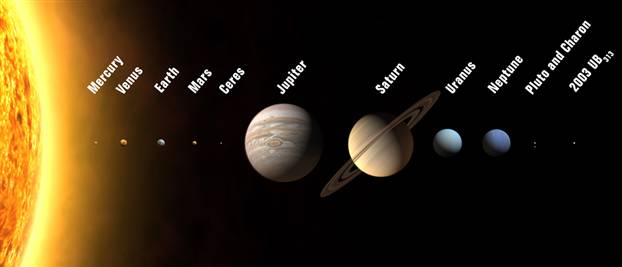
The tally of planets in our solar system would jump instantly to a dozen under a highly controversial new definition proposed by the International Astronomical Union.

Eventually, there would be hundreds of planets, as more round objects are found beyond Neptune.

The proposal, which sources tell Space.com is gaining broad support, tries to plug a big gap in astronomy textbooks, which have never had a formal definition for the word "planet." It addresses discoveries of Pluto-sized worlds that have in recent years pitched astronomers into heated debates over terminology.

  • The asteroid Ceres, which is round, would be recast as a dwarf planet in the new scheme.
  • Pluto would remain a planet, and its moon Charon would be reclassified as a planet. Both would be called "plutons," however, to distinguish them from the eight "classical" planets.
  • A far-out Pluto-sized object known as 2003 UB313, currently nicknamed Xena, would also be called a pluton.

It’s not a popular idea, but it’s an interesting one. Should someone start a contest for the best mnemonic for the new solar system? "Mary Very Easily Makes C_____ Jam Saturday Unless No Plums C_____ X_____"?

Real Russian Rocket Report

Tuesday, August 15th, 2006

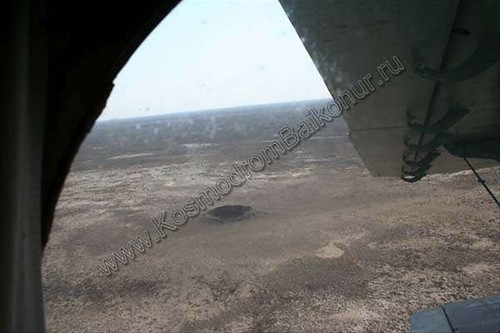
Last month’s Dnepr rocket crash in Kazakhstan, which destroyed Montana’s first satellite, blasted a crater 165 feet wide and 50 feet deep. Fortunately, there were no injuries or fatalities in the vast arid steppes near the Uzbek border. What about the environmental damage? Keep in mind most rocket fuel is considered "nasty stuff." According to NBC News space analyst James Oberg, this launch failure’s aftermath is reminiscent of old habits:

Last month’s crash of a Russian Dnepr space booster with 100 tons of toxic rocket propellant poisoned a small corner of the empty steppes in Central Asia — but may have left a wider legacy of bitterness that will impact Russian space activities for years to come.

And whatever the actual cause of the rocket’s embarrassing failure, the poisonous consequences could have been largely avoided if Moscow space officials hadn’t reverted to almost Soviet-style cover-ups and hollow reassurances about the accident.


I found Mr. Oberg’s piece on this topic, featured recently on the MSNBC site, superbly written, accurate and insightful.

Feeling adventurous? Try reading the original report, in Russian, from 31 July 2006. At least you’ll understand the pictures, and the gist of the English translation (scroll down for both).


All Hail Hale

Tuesday, August 15th, 2006

We found NASA’s Picture of the Day on Sunday to be particularly fascinating.

This Mars Global Surveyor (MGS) Mars Orbiter Camera (MOC) image shows dried streambeds—martian gullies— in the mountainous central peak region of Hale Crater. Some scientists have suggested that the fluid which carved these gullies was liquid water, and that it either resulted from ancient snowmelt or from release of groundwater that percolated to the surface in the intensely fractured rock of Hale’s central peak. In either case, the gullies are dry today, and dark sand can be seen as dunes near the right/lower right part of the image.


Arianespace Successfully Launches Twin Satellite Payload; Koreasat 5 to Lift via Sea Launch Next Week

Monday, August 14th, 2006

Arianspace’s Friday evening launch of a twin satellite payload, which Spektor previewed last week, was a success. From the mission update:

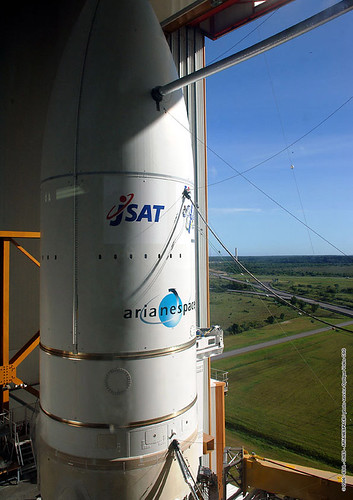
After an on-time lift-off at 7:15 p.m. from Europe’s Spaceport in French Guiana, the heavy-lift Ariane 5 delivered Japan’s JCSAT-10 telecommunications spacecraft and the European Syracuse 3B secure military relay platform into an accurate geostationary transfer orbit.

Tonight’s flight was Ariane 5’s 28th mission, and marked its 14th consecutive success – underscoring the launcher’s maturity. JCSAT-10 was installed in the upper payload position on Ariane 5, and was released approximately 27 min. into the mission. This was followed some 5 minutes later by the separation of Syracuse 3B, which occupied the lower slot in the payload "stack." 

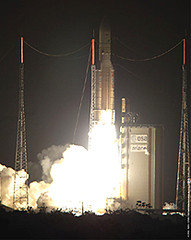
A series of photographs from the launch can be seen here

In other commercial satellite launch news, Sea Launch will be lifting the Koreasat 5 communications satellite on the evening of August 21st. Sea Launch has provided a nice graphical display of the satellite launche’s profile and groundtrack here.

As always, we’ll have more updates on the launch as it approaches. 

Blast from the Past: Saving Skylab

Friday, August 11th, 2006

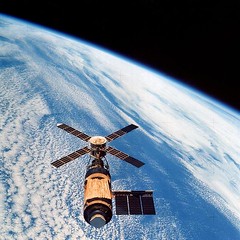
Although Skylab, America’s first space station, fell back to Earth more than 17 years ago, the full-size training mock-up of Skylab is still intact — although in incredible disrepair (and inhabited by several raccoons) —  outside the U.S. Space and Rocket Center near NASA’s Marshall Space Flight Center in Hunstville, Alabama.

Now, a group of volunteers has launched the Skylab Restoration Project with the goal of restoring the training module to its former glory. CNN reports:

Tom Hancock, a board member of the American Institute of Aeronautics and Astronautics, is the leader of the project. He said he is working on the restoration for people like his 18-year-old daughter.

"It’s history. It’s a chance for people my daughter’s age to kick back and see what it was like when I was young," said Hancock.

Made primarily from spare parts left over from the Apollo program, Skylab orbited the Earth for six years beginning in 1973. It helped pave the way for science projects aboard the space shuttle and the International Space Station currently in orbit.

Astronauts learning to live in space trained in Skylab mock-ups at Marshall and the Johnson Space Center in Houston. Three crews of three astronauts each spent a total of 171 days in Skylab, which re-entered the atmosphere in a fiery blaze in 1979.

The Skylab mock-up was displayed for years inside the Space and Rocket Center. But exhibits change, and it was eventually moved outside to a back lot.

 The Skylab Restoration Project is seeking volunteers in the Huntsville area and donations to assist with the project. Visit SaveSkylab.org to learn more and to see "then and now" photos and videos of the Skylab training module.

ArianneSpace To Launch Two Satellites Tonight

Friday, August 11th, 2006

European commercial space transportation company Arianespace is launching not one but two satellites into orbit this evening. From Europe’s space center, the Guiana Spaceport in Kourou, French Guiana, Arianespace’s Ariane-5ECA will take to the skies for its 28th time, marking the 172nd mission for the Ariane fleet, at some time between 6:15 pm and 7:52 pm EST. The launch can be watched starting 20 minutes before launch time, at Arianspace’s Video Corner.

The Ariane-5ECA is 50.5 meters tall and will weigh in at about 780 tons at lift off, requiring over 400 tons of fuel to ramp the beast up to over 2900 pounds of fource to lift-off.

The payload, a Japanese television (JCSAT-10) and French military communications (SYRACUSE 3B) satellites, is expected to be in operation for between 15 and 12 years, respectively.

For those looking for even more information, download the launch kit in English or French and you’ll have more data on this evening’s than you ever thought you wanted.

It’s a Bird, It’s a Plane, It’s a… WiFi Balloon?

Wednesday, August 9th, 2006

Across the pond, The University of York is reporting that an effort to bring wireless through the skies to people in areas that typically don’t have access to the super-fast Internet is near completion.

By the end of October, researchers on York’s CAPANINA project — which uses everything from solar powered, unmanned aircrafts to giant ballons and airships to relay wireless signals back to planet Earth — will finish its main research and present their findings a couple of week’s later during the University’s conference on High-Altitude Platforms (HAP), York HAP Week.

According to a press release the school put out about the research, the system developed could bring low-cost broadband speeding along at rates 100 times faster than ADSL networks to remote regions of the world and high-speed trains. As the project’s lead scientist, Dr. David Grace says:

"The potential of the system is huge, with possible applications ranging from communications for disaster management and homeland security, to environmental monitoring and providing broadband for developing countries. So far, we have considered a variety of aerial platforms, including airships, balloons, solar-powered unmanned planes and normal aeroplanes — the latter will probably be particularly suited to establish communications very swiftly in disaster zones."

The CAPANINA project may rely upon the "paint-on" antenna technology we mentioned a few weeks ago, and clearly indicates a growing interest in looking to the skies to solve connectivity issues that plague many of the world’s least connected and least connectible areas.

Music via Wifi

Tuesday, August 8th, 2006

I haven’t listened to the radio regularly in years, but I’ve spent a bit of time lately covering the goings-on in the world of satellite radio, including the latest lawsuit-inducing players. I haven’t yet been convinced to replace my trusty iPod with such a set-up. That is until I saw a couple of items that caught my eye with the ability to deliver music via wifi.

Gizmodo has a tantalizing review (including video) of the new personal communicator from Sony, which (among other things) let’s users wirelessly stream music to other users in the area if there’s a wifi hotspot nearby.
MyloCompared to most Sony gear we’ve seen over the past few years, the mylo is a breath of fresh air. The media player does MPEG-4, digital audio, and pictures. But it also has a WiFi connection and a QWERTY keyboard, for chatting on Google Talk and Yahoo Messenger (No AIM support, sorry.) Wait, wait, wait! It also works as a wireless Skype phone! And it has an Opera browser. And it can wirelessly stream music to other mylo owners in the area, ala iTunes. Without cellular connectivity, its not going to best a Hiptop, but we love the open standard support. Full Stats and a video review after the jump.

Sounds tempting. Yet, there’s more. I’m not the kind person who requires a lot of arm twisting to go out and buy the latest gadget, but coming across this wifi music delivery meme twice in one day seems like the universe is trying to tell me something. After reading the Gizmodo piece I happened across the June issue of OMMA, "the magazine of online media, marketing & advertising," and thumbed through their article on "10 Sites Worth Watching." That’s where I learned about Music Gremlin, which OMMA describes as follows:

Music Gremlin uses web intelligence and storage to deliver music through wifi hotspots to consumers in real time. Better yet, the stream is so smart it can customize stream to a user, in effect creating a personal radio station.

Gremlin offers its own player, but you can also use the service with other players. (The article also mentions that Sirus.Com and XMRadio.Com have become popular music content destinations in their own rights, as users sample both sites’ streamed content.)

Like I said before, I haven’t been a regular radio listener in years; since I bought my first Walkman, really. My attitude has been that I’d rather listen to what I want to hear than what they want to play. But with all the satellite and wifi-capable players ready to stream customized music to me, I might be in for an attitude adjustment in the near future.