Archive for the ‘Satellites’ Category

Blast from the Past: Hotbird 8

Monday, August 7th, 2006

We’ve got another rocket launch for you. This time it’s one from the more recent past. The HOT BIRD 8 broadcast satellite was place into orbit on Friday via a Proton Breeze M launch vehicle, and we’ve got the video.

We’ve also got a blog post from the HOT BIRD 8 team describing the launch.

We are thrilled to have a successful return to flight for Proton M Breeze M. After a long and sleepless night, 9 hours, 11 minutes, and 20 seconds after lift-off, spacecraft separation was confirmed and the HOT BIRD 8 SC was acquired by the Eutelsat ground stations. The Eutelsat team started the process of opening the solar arrays and beginning health checks of the SC, before flying her to her final destination. After having been up all night, we headed back to the hotels to catch a quick nap and freshen up before the post-launch festivities.

See the press release for more information.

Google, XM to Share Ad Inventory

Friday, August 4th, 2006

As new technologies continue to break down the old barriers in the media business — we watch TV on our cell phones, as the saying goes, and make telephone calls through our cable company — there will be new mergers and deals between once-disparate companies as businesses look for new ways to expand their reach and customer base in a transformative media landscape.

Among the most creative and forward-looking companies is, of course, Google — and now they’re getting involved in the satellite radio business as a means of expanding their advertising reach: 

Google and XM Satellite Radio today announced an agreement that hints at the future of not only radio, but also television advertising. Under the terms of the deal the two companies will help each others advertisers reach the other’s audience–including letting Google advertisers place targeted radio spots within XM channels.

Inventory on XM’s non-music channels will be available to Google’sadvertising base through dMarc’s media network (www.dmarc.net). As part of the deal, Google advertisers will be able to reach XM’s millions of subscribers nationwide and XM will have access to Google’s large and small advertisers to offer relevant, targeted messages to their subscribers.

The dMarc platform, acquired by Google in January 2006, simplifies the sales process, scheduling, delivery and reporting of radio advertising, enabling advertisers to more efficiently purchase and track their campaigns on terrestrial radio, and now on XM Satellite Radio. For XM, Google’s technology automatically schedules and inserts advertising across XM’s non-music commercial channels, helping to increase revenue with a wealth of new advertisers, while decreasing the costs previously associated with processing advertisements.

After months of trials, the new platform is now in full production for dMarc advertisers. Google AdWords’ customers will be able to place terrestrial and satellite radio spots when the dMarc platform is integrated into AdWords targeted for fourth quarter of this year. 

Our industry observers tell us that Google is still working on ways to improve the CTR of radio ads, which remain stuck at a disappointing  0%. 

Goodbye Static!

Thursday, August 3rd, 2006

I drive an old pick-up truck most of the time– a rock-bottom barebones 1996 Mazda B2300 with something like 135,000 miles on it– and when it comes to listening to music I have only three options: AM, FM, or trying once again to dislodge the copy of The Cure’s Disintegration, which has been stuck in the casette player since about 2003.

To put satellite radio or an MP3 player in the poor beleagured truck would be like dressing up a pig in pearls. Why bother?

But for those who drive newer vehicles, an iPod- and satellite-connected vehicle will soon be de rigeur

In the latest boost to its dominance in portable music players, Apple Computer Inc. is teaming with General Motors Corp., Ford Motor Co. and Mazda Motor Corp. to integrate the iPod into car audio systems.

GM and Ford are the nation’s No. 1 and No. 2 automakers, and the new alliances mean the iconic audio gadget will now be compatible with more than 70 percent of the new 2007 model vehicles sold in the United States, Apple said Thursday….

Demand for built-in satellite radio features has also prompted Ford to expand its relationship with Sirius Satellite Radio Inc. VanDagens said more than 90 percent of Ford and Lincoln Mercury cars will offer satellite radio by the 2008 model year.

What will be truly interesting is the impact that standardized satellite radio availability will do to the market share of local radio stations. They don’t call the peak listening hours "drive time" without reason. As more drivers tune out the radio and tune in their favorite satellite station or MP3 playlist, the over-the-air radio industry will be forced to undergo transformative change– or face the same decline that cable brought to the Big 3 Networks.


We Got Your Rocket Scientsts Right Here

Wednesday, August 2nd, 2006

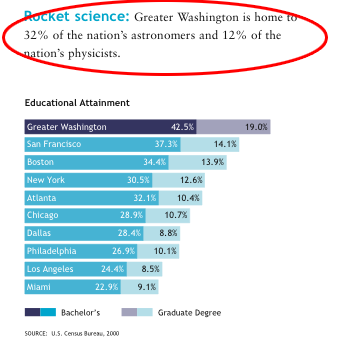
Here’s an interesting tidbit. Here in DC, I’m surrounded by rocket scientists. OK, not surrounded but it turns out the metro-DC area is home to a large percentage of the rocket scientist population. Higher than most cities, I bet.

The latest issue of The Washingtonian pulls some data from the Greater Washington Initiative’s latest regional report, which puts the percentage of rocket scientists in the area at 32% of the population. (12% of the nation’s physicists).

Rocket Scientists in DC

Impressive. But that’s only about a third of the country’s rocket scientists. Where are the rest of them? Where are most of them?


The Missing Moonwalks

Monday, July 31st, 2006

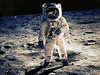
A couple of weeks ago, I posted about the dual anniversaries of the Viking I landing on Mars and the first humans (Neil Armstrong and Buzz Aldrin) to walk on the moon. Well, NPR has video footage of Armstrong’s and Aldrin’s lunar jaunts. The only problem is that they’re pretty shoddy copies. So NPR is looking looking for the original footage.

LandingAlmost everyone on the planet who had access to television watched the first moon landing, back on the night of July 20, 1969. What the TV viewers didn’t know is that they weren’t seeing the best images.

The astronauts actually beamed higher-quality footage back to Earth, but it was only seen by a small number of people at three tracking stations.

Those original images were recorded and put into storage — somewhere. Now, a small crew of retirees, space enthusiasts, and NASA employees are searching for a moon landing that the world has never seen.

The NPR piece goes on to describe how the images most Americans saw on their televisions sets back in 1969 were so degraded — compared to what the folks in Houston’s mission-control saw — and incompatible with television broadcasts that they had to be converted to the right format. Afterwards, the original footage was recorded onto 14-inch reels, which disappeared into the National Records Center in Maryland before NASA brought them to Goddard for "permanent retention." They haven’t been seen since.

The folks from the Apollo team would like very much to see the footage again. Actually, so would I. For the first time, of course.


A Closer Look At GeneBox

Monday, July 31st, 2006

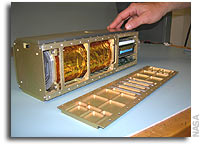
SpaceRef has a bit more about the NASA GeneBox I posted about last week, that’s on board Robert Bigelow’s Genesis I spacecraft. Including a tiny little photograph.

GeneBoxNamed "GeneBox", this small payload was developed by NASA Ames Research Center to test out new ways to perform in-flight genomic analysis of living systems. Indeed, much of what is being flown aboard this satellite is cutting edge biotech – the likes of which have yet to fly aboard the International Space Station. Future versions will be even more capable.

NASA developed the GeneBox payload and Bigelow Aerospace integrated and launched GeneBox – at no cost to NASA. ARC estimates that GeneBox cost approximately $1 million to fabricate, test, and prepare for flight. GeneBox is an adaptation of the "GeneSat" free flyer nanosatellite. NASA ARC expects GeneSat to cost approximately $6 million to develop.

GeneBox was funded entirely by NASA. This effort began with the (now disbanded) NASA Office of Biological and Physical Research (OBPR), then by the NASA Exploration Systems Mission Directorate (ESMD), and currently with NASA ARC internal R&D funds.

Of course, NASA’s collaboration with Bigelow is even more interesting in light of news that the agency is thinking about canning its space station research.


MobaHO!

Friday, July 28th, 2006

We love the name MobaHO! That exclamation point captures perfectly the exciting potential of satellite digital multimedia broadcasting.

That potential is being realized in Tokyo, as JCN reports

Mobile Broadcasting Corporation (mbco) and Sapporo-based taxi company Daikoku Kotsu will introduce MobaHO!, the world’s first satellite digital multimedia broadcasting service for personal and mobile device use, for taxi customers this month.

Taxis are equipped with LCD monitors which come with an internal speaker and are placed on the head rest of the passenger seat.

The service will provide taxi customers with a variety of programs such as real-time news, genre-specific music programs and overseas FM radio through 37 audio channels, and seven video channels including news, sports, and entertainment. All programs include ‘taxi ads’ as well.


Russian Rocket Crash Destroys Montana’s First Satellite

Friday, July 28th, 2006

Launching rockets into space has become so common and frequent that we tend to forget that space flight is an inherently risky business. As the old adage about general aviation goes, it’s safe– but extremely unforgiving. When things go wrong, they tend to go wrong spectacularly, and the result can be years and years of work lost, as students at Montana State University learned this week when the Russian rocket carrying Montana’s first satellite crashed in Kazakhstan:

At 100 feet tall and 15 feet across, the Dnepr missile was to carry 18 satellites into orbit. Nearly 200 students, faculty, and members of the public gathered at the Engineering and Physical Sciences building on the campus of Montana State University to cheer the launch from Baikonur Cosmodrome as it was relayed by live video.

However, 13 minutes after the launch, a much-anticipated signal from the rocket had not been received. About two hours later, a space news Website posted a story that the rocket had crashed….

The rocket carried MEROPE, Montana EaRth Orbiting Pico-Explorer, which was the culmination of five years of work and waiting by more than 100 MSU students….

MEROPE was a specific satellite design known as a CubeSat. CubeSats are shaped like a cube 10 centimeters (4 inches) on a side and weigh 1 kilogram (2.2 pounds). They were envisioned as student satellites that could be designed, built, tested and launched in the time it takes a student to earn a four-year undergraduate degree.

Undergraduates from physics, electrical engineering, computer science, mechanical engineering, art, business, even geology and microbiology, worked on the project through MSU’s Space Science and Engineering Lab. …

Over its four-month lifetime, MEROPE was to take measurements of the Van Allen Radiation Belt, a donut shaped band of super-charged particles that can kill astronauts and destroy satellites. The belt’s radiation levels and its shape are constantly changing. MEROPE’s monitoring was to contribute to the understanding of "space weather," Larsen said.

As Bill Hiscock, head of MSU’s physics department, points out, 95% of the work done by the students took place simply in getting the satellite to the launch pad. So, although the satellite was lost, the educational value of the project for tomorrow’s engineers and scientists was not.

Russia’s Federal Space Agency says a first stage engine shutdown caused the crash.

Send Your Junk Into Space

Thursday, July 27th, 2006

This might be a good way of getting rid of excess junk that you have lying around: Send it to space. Earlier this month I posted about the launch of Robert Bigelow’s inflatable spacecraft, Genesis I. Well, via Space Pragmatism comes news of Bigelow’s next big plan. When Genesis II goes up, he’s gonna let you fly your stuff into space, and send you pictures too.

Whereas space was once the domain of only the privileged, Bigelow Aerospace is offering the public an exciting new opportunity to reach the final frontier. For the first time, you can actually send an item of your own into space. Your personal selection will be floating inside a spacecraft hundreds of miles above the Earth. If all systems function properly, your personal treasure (be it a photo, ring, bottle-cap or toy) will be floating in space for years.

And here is the best part: You might even be able to see it. That’s right! The Bigelow Aerospace spacecraft known as Genesis II will be carrying multiple cameras. Some of these cameras will be viewing areas inside the spacecraft where your prized possession is floating. Everyday, Bigelow Aerospace will be downloading images and video from these cameras to its Website. If you log onto the Bigelow Aerospace Web portal, you will have a chance to actually see your item floating by! And who knows? If the Genesis II spacecraft stays in orbit for several years as we expect, you may see your face (or item) many times over!

Inside Genesis I

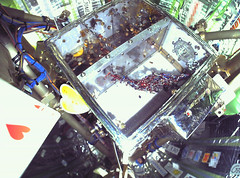
You can also look inside Genesis and see what’s already gone up (besides NASA’s GeneBox, that is). The picture above, by the way, is a box of Mexican jumping beans sent up in Genesis I by Bigelow Aerospace employees.

For $295 a pop, you can send up anything you want as long as it’s:

  • smaller than a golf ball;
  • less than 1 oz. in weight;
  • doesn’t contain any magnets;
  • doesn’t contain power-operated devices, liquid, or powder.

I’m not sure what options that leaves or whether the price beats a similar program from Masten Enterprises, but at least there’s now another way to send more junk into space.


Heatwave, As Seen From Space

Tuesday, July 25th, 2006

Hot enough for ya? You don’t have to read the news to know there’s a heatwave going on, even though it’s heating up Europe to the point that some people think houses may collapse (due to subsidence if heavy rain causes the bone-dry soil to expand and move buildings as it does so). And things have gotten so hot in the U.S. that blackouts and power outages are happening in California, Missouri, and New York.

All you really have to do is step outside. But if you want the big picture, you can check out Envisat’s satellite pictures of Europe which, according to the BBC, show dramatic increases in land and sea temperatures in the UK.

ENVISAT

The images were generated from data gathered by the European Space Agency’s Envisat and Nasa’s Aura satellites.

John Remedios, head of Earth Observation Science at the University of Leicester, said: "The latest satellite data shows a perspective of the environment in which we live that can only be obtained from space.

"The images show temperature increases and increased pollution for every region in the UK."

Envisat, an advanced polar-orbiting Earth observation satellite, was launched in March 2002 by the European Space Agency and provides measurements of the atmosphere, ocean, land, and ice.