If thoughts of super-fast satellite link-ups from spy movies have you considering satellite broadband service, we have some news you’d like to hear.
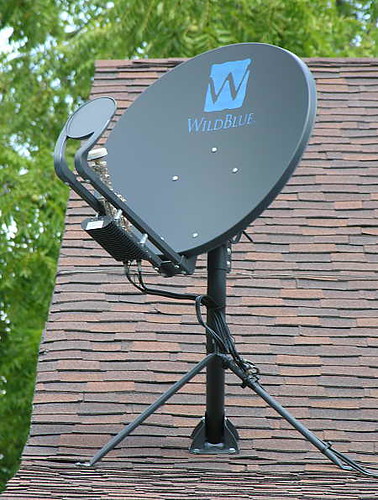
WildBlue, one of the top satellite broadband providers in the US, is upgrading its capacity to allow for 150,000 new customers. How are they doing it? Rather than launching a new bird, they’re upgrading their transmission link hardware and software to allow 50 percent more information bits through the same existing radio link.
For those of us who live in urban areas and take it for granted that we can shop around for internet service, we should count ourselves lucky:
WildBlue estimates that there are over 11 million households in areas throughout the United States where DSL or cable broadband services are not available and that over 7.5 million of these households are still accessing the Internet through a traditional dial-up connection.
With WildBlue’s latest upgrades, they seem to be beating out their other major competitor in the satellite broadband space: HughesNet. In fact, in a Consumer Reports review of ISPs, HughesNet got the lowest possible rating in all categories. This customer seems to agree.
Let’s say you live in an urban environment like this. And what you long for is the sounds of long-ago summers, and the relaxing sound of cricketsong.
Unfortunately, live crickets won’t make it very long on the mean streets of the big city. But you don’t need to pine away any longer, because today’s DIY Friday project is about making electronic crickets:
Is that too much work for you? You can always download a cricket ringtone to create that relaxing summer evening feeling whenever someone calls.
We’ve all heard about the ice samples found by the Phoenix Mars Lander on the surface of Mars.
For the past several weeks, the Martian dirt and ice have been clutched in the scoop of the Lander’s robotic arm, in a sort of scientific Butoh dance, while NASA engineers and scientists have figured out a way to get the sample into the Thermal and Evolved Gas Analyzer (TEGA) — AKA the "analysis ovens:"
TEGA… heat[s] Martian soil so that any gases emitted can be analyzed. On its first test in mid-June, the oven being used developed a short circuit. [NASA] scientists stalled any further TEGA analysis while they were studying the problem. And now they’ve halted planned tests and moved a test of Martian ice up to the front of the line, according to Ray Arvidson, a co-investigator for the Phoenix Mars Lander’s robotic arm team and a professor at Washington University in St. Louis.
"Because of the possibility, even the remote possibility, that TEGA might go belly-up in the next sample, we wanted to go straight to ice," said Arvidson. "We cleared the pathway to get the next sample from the ice. The prudent choice is to go off and get the most important sample."
The two most likely possibilities are that the water was lost to space, or that it is now underground, as a huge amount of buried ice.
But Mars isn’t the only place in the solar system where evidence of water has (possibly) been found; a study published today in Nature reveals that researchers have found evidence of water molecules in pebbles retrieved by NASA’s Apollo missions on the moon, nearly forty years ago:
Erik Hauri of the Carnegie Institution for Science in Washington had developed a technique called secondary ion mass spectrometry or SIMS, which could detect minute amounts of elements in samples. His team was using it to find evidence of water in the Earth’s molten mantle.
"Then one day I said, ‘Look, why don’t we go and try it on the moon glass?"’ Alberto Saal of Brown University, who helped lead the study, said in a telephone interview….
What they found overturned the conventional wisdom that the moon is dry.
"For 40 years people have tried (to find evidence of water) and were not successful," Saal said.
"Common sense tell us there is nothing."
Saal’s team did not find water directly, but they did measure hydrogen, and it resembled the measurements they have done to detect hydrogen, and eventually water, in samples from Earth’s mantle.
The evidence shows that the hydrogen in the sample vaporized during volcanic activity that would be similar to lava spurts seen on Earth today.
It took the scientists nearly three years to get NASA to fund their project. The findings point to the existence of water deep beneath the moon’s surface — a radical change in the scientific understanding of our moon’s formation.
The pebbles analyzed were scattered by lunar volcanoes that erupted three billion years ago, when the moon was still a cooling hunk of magma cast into orbit by the collision of a Mars-sized asteroid with Earth, according to ABC News:
Though NASA’s Lunar Prospector appeared to have struck ice in 1999, its findings proved inconclusive. Had they been supported, scientists predicted that any water would have come from gases emitted by meteorites striking the moon….
Critically, telltale hydrogen molecules were concentrated at the center of samples rather than their surfaces, assuring Saal’s team that water was present in an infant moon rather than added by recent bombardment.
"That was not known," said William Feldman, a Los Alamos National Laboratory geophysicist who was not involved in the study.
If that water in fact came from the Earth, then planetary geologists can be certain that our planet contained water 4.5 billion years ago. That would change the dynamics of models of Earth’s formations….
Alternatively, water could have been added after the moon was ejected into space but before it cooled, raising new questions about the water’s origin.
"This opens up so many lines of study," said Saal.
More practically, the widespread presence of water beneath the moon’s surface could prove a boon to future lunar colonies, who could harvest it for breathable oxygen
Meanwhile, here on Earth, potable water is increasingly under short supply as droughts and population growth put a strain on our own water resources.
The solution increasingly is desalination plants, particularly in the Middle East, where the amount of fresh water available to each person could fall by half by 2050:
The UAE and other Gulf countries have traditionally responded to water scarcity by boosting desalination capacity. Most of the potable water in the region is produced via desalination, a process in which dissolved salts are removed from seawater.
However, earlier this year a UN official warned that GCC countries would find it increasingly difficult to continue building desalination plants at the current rate.
The region’s water consumption was so high that continuing in the same way would require significant financial investments and might prove impossible to sustain, said Dr Ahmad Ali Ghosn, the natural resources programme officer at the UN Environment Programme.
In Abu Dhabi, residents consume an average of 550 litres of water per day. If consumption levels remained this high, Gulf governments would have to spend up to US$35 billion (Dh129bn) in the next decade to finance the expansion of their desalination capacity.
In addition, water is heavily subsidised in the region, with end-users paying between five and 10 per cent of the cost. The UN estimates that GCC countries spend between US$1 and US$2 to produce a cubic metre of desalinated water.
Desalination unfortunately has several adverse effects on the environment. It is a very energy-intensive process, with desalination plants releasing large amounts of carbon dioxide into the atmosphere, which contributes to global warming.
Perhaps a water pipeline from the moon is in our future?
Posted
July 10th, 2008 in Uncategorized
|
1 Comment »
Some interesting news coming out of Canada recently, some of it satcom-related, and some not. Ciel Satellite received "approvals in principle" from Industry Canada to develop a half-dozen orbital locations over North America, right in the "sweet spot" for direct-broadcast satellite TV. Using the Ka-band for BSS spectrum (17/24 GHz) represents new capacity and will probably lead to more innovation. More HDTV channels? You better believe it.
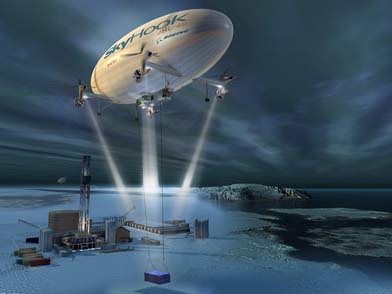
We know RIM’s BlackBerry represents Canadian innovation at its finest, and the Canadarm contribution to the space program is well-known, but we couldn’t help but notice the news from Sky Hook International for a new transport system — using blimps:
A Calgary company will team up with aerospace giant Boeing to build a giant dirigible-like craft capable of lifting heavy loads for the oil and gas, mining and forestry sectors.
SkyHook International Inc. president Peter Jess said the companies plan to build two prototypes of the JHL-40 rotorcraft — a combination helicopter and blimp — before proceeding with a production run of 50 to 60 units.
According to company officials, there isn’t anything quite like it in existence and the prototypes will mark the commercial development of a whole new breed of aircraft.
"The list of customers waiting for SkyHook’s services is extensive and they enthusiastically support the development of the JHL-40."
The patented craft will be capable of hauling 40-tonne loads up to 320 kilometres in areas without basic infrastructure such as roads.
Jess said the first two initial craft would be deployed in the Arctic.
Formerly with Dome Petroleum, Jess said he came up with the idea decades ago while working in the Far North.
Boeing will build the prototypes at its manufacturing facility in Pennsylvania while SkyHook will own, maintain and operate the aircraft on a worldwide basis.
The JHL-40 has yet to be certified by aviation authorities in Canada or the United States and won’t come into service until 2012.
Innovation leads economic development in any business — especially satcom.
Between the trance music, the beaches, and the all-day-and-all-night parties…. well, we can understand why management never leaps at the idea when we propose a blogging retreat there at the beginning of each new quarter.
But if you’re actually doing business in India, Goa’s a nice destination, which is why the Joint Working Group of the Indian Space Research Organisation and the French Space Agency Centre National d’Etudes Spatiales (CNES) met there this past weekend to review the progress of their collaborative projects.
Top of the agenda (besides suntanning and dancing, we presume) was the status of Megha Topiques, an Indo-French collaborative satellite project scheduled for launch in 2009 for tropical weather monitoring:
The french-indian MEGHA-TROPIQUES satellite is devoted to atmospheric research. The data collected by the satellite will … improve our knowledge on the water cycle contribution to the climate dynamic in the tropical atmosphere and our understanding of the processes linked to the tropical convection. CNES and the Indian Space Research Organization (ISRO) will share joint responsibility for the satellite and science missions, with CNES acting as prime contractor for some of the instruments.
Megha Tropiques carries four payloads– a microwave radiometer, a humidity sounder, a radiation measuring instrument and a radio occulation sounder for atmospheric studies. Key among its tools is MADRAS, a conical scanning microwave imager developed jointly by CNES and ISRO.
The Megha-Tropiques satellite will be launched by an Indian PSLV launcher on a 800 km orbit with an inclination of 20°.
It will be identifiable by the glowsticks attached to the satellite upon launch. </snark>
Posted
July 8th, 2008 in Uncategorized
|
No Comments »
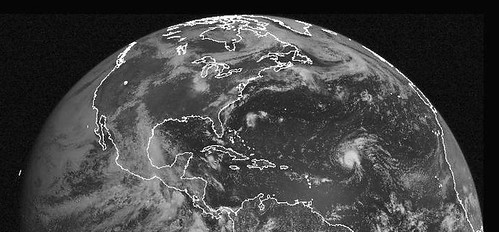
Whether you might find yourself in the eye of the storm or you’re just intrigued by extreme weather, you’re sure to appreciate the fun tools that the National Weather Service puts out for the public. This one lets you track the storm’s movements. And this one shows wind speeds.
How do they get all the data for these cool images? Why satellites, of course. And the NOAA has a full arsenal. But how does all the information coming from those satellites turn into something we can understand, like this animation of the season’s first hurricane?
Giovanni is actually an acronym for the GES-DISC (Goddard Earth Sciences Data and Information Services Center) Interactive Online Visualization ANd aNalysis Infrastructure.
In other words, it’s a web-based application developed by NASA that is available to anyone with a computer and a bit of spare time. But beware, for those of us who’ve lost hours tooling around on Google Earth, this can become a bit addictive…
The Ariane 5 ECA will deliver a payload performance of 8,639 kg. – which includes 7,537 kg. for the mission’s ProtoStar I and BADR-6 spacecraft passengers, along with their integration hardware and the SYLDA 5 multiple satellite dispenser system.
ProtoStar I is the first in a fleet of relay platforms that Asian satellite services company ProtoStar will deploy for advanced satellite television services and powerful two-way broadband communications access. It is based on Space Systems/Loral’s 1300 spacecraft bus, and will provide K-band/C-band relay capacity over Asia for the needs of both emerging and existing direct-to-home (DTH) operators, as well as other broadband communication requirements in the region.
Arabsat’s BADR-6 satellite will open up new video broadcasting and telecommunications services for the entire Middle East and North Africa region, along with a large part of sub-Saharan Africa. Built by EADS Astrium, the Ku/C-band relay platform is designed for a lifetime of about 15 years, and will operate from Arabsat’s 26 deg. E geostationary orbital location.
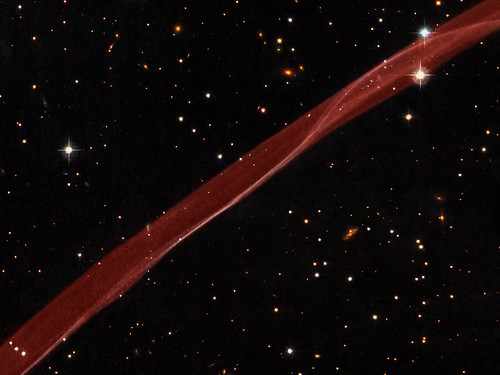
A delicate ribbon of gas floats eerily in our galaxy. A contrail from an alien spaceship? A jet from a black-hole? Actually this image, taken by NASA’s Hubble Space Telescope, is a very thin section of a supernova remnant caused by a stellar explosion that occurred more than 1,000 years ago.
Around May 1, 1006 A.D., observers from Africa to Europe to the Far East witnessed and recorded the arrival of light from what is now called SN 1006, a tremendous supernova explosion caused by the final death throes of a white dwarf star nearly 7,000 light-years away. The supernova was probably the brightest star ever seen by humans, and surpassed Venus as the brightest object in the night time sky, only to be surpassed by the moon. It was visible even during the day for weeks, and remained visible to the naked eye for at least two and a half years before fading away.
It wasn’t until the mid-1960s that radio astronomers first detected a nearly circular ring of material at the recorded position of the supernova. The ring was almost 30 arcminutes across, the same angular diameter as the full moon. The size of the remnant implied that the blast wave from the supernova had expanded at nearly 20 million miles per hour over the nearly 1,000 years since the explosion occurred.
Today, SN 1006 has a diameter of nearly 60 light-years, and it is still expanding at roughly 6 million miles per hour. Even at this tremendous speed, however, it takes observations typically separated by years to see significant outward motion of the shock wave against the grid of background stars. In the Hubble image as displayed, the supernova would have occurred far off the lower right corner of the image, and the motion would be toward the upper left.
Image Credit: NASA, ESA, and the Hubble Heritage Team (STScI/AURA)
But NASA is predicting a planetary alignment for today and this weekend, via PhysOrg.com:
The show gets going on Friday, July 4th. Red Mars and ringed Saturn converge just to the left of the bright star Regulus. The three lights make a pretty 1st-magnitude line in the heavens.
But that is just the beginning. On Saturday, July 5th, with weekend fireworks at fever pitch, a lovely crescent Moon joins the show. Saturn, Mars, and the Moon trace an even brighter line than the night before.
Scan a small telescope along the line. You’ll see Saturn’s rings, the little red disk of Mars, a grand sweep of lunar mountains and craters, and just maybe—flash!—a manmade incendiary. How often do you see fireworks through a telescope?
This is, however, more than just a flashy gathering of planets—it is also a gathering of spaceships and robots.
Each of the three worlds is orbited or inhabited by probes from Earth. Saturn has the Cassini spacecraft, studying the gas giant’s storms, moons and rings. The Moon has two probes in orbit: Kaguya from Japan and Chang’e-1 from China. The pair, operating independently, are mapping the Moon and scanning for resources in advance of future human landings. NASA’s Lunar Reconnaissance Orbiter will join them later this year.
Mars has more probes than the others combined. Three active satellites orbit the red planet: Europe’s Mars Express and NASA’s Mars Odyssey and Mars Reconnaissance Orbiter. The three not only study Mars with their own instruments, but also form a satellite network in support of NASA’s Mars rovers Spirit and Opportunity and Mars lander Phoenix.
None of these mechanical specks are visible in a backyard telescope, but they are there, heralds of a growing human presence in the solar system. Tell that to your buddy at the fireworks show!
During the short night of July 5th, the Moon glides past Mars and Saturn so that nightfall on Sunday, July 6th, brings a different arrangement—a scalene triangle. The triad is easy to find in the hours after sunset. Look west and let the Moon be your guide.
In the nights that follow, the Moon exits stage left, leaving the others behind. Don’t stop watching, though. Saturn and Mars are converging for their closest encounter of the next 14 years. After nightfall on Thursday, July 10th, the two planets will be just ¾ of a degree apart, snug enough to fit behind the tip of your pinky finger held at arm’s length.
Now that’s spectacular—no fireworks required.
Cool. No smoke, fire or noise. There’s more than enough of that going on around you. To all the rocket scientist in the U.S., have a great 4th of July.
If you ever felt things were a little off-kilter, now we know why:
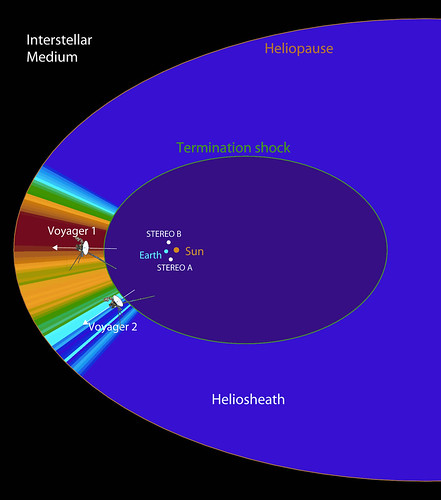
The Voyager 2 spacecraft, which has been traveling outward from the Sun for 31 years, has made the first direct observations of the solar wind termination shock, according to a paper published in the July 3 issue of the journal Nature.
At the termination shock the solar wind, which continuously expands outward from the sun at over a million miles per hour, is abruptly slowed to a subsonic speed by the interstellar gas.
Shock waves in the thin, ionized gas — called plasma — that exists in space are similar in some respects to the shock waves produced by an airplane in supersonic flight. Shock waves in space are believed to play an important role in the acceleration of cosmic rays, which are very energetic atomic particles that continually bombard Earth.
The most energetic cosmic rays, which are potentially hazardous to astronauts, are believed to be produced in intense shock waves caused by supernova explosions — immense stellar explosions that occur in massive stars toward the end of their lives.
The termination shock is believed to be responsible for the origin of less energetic cosmic rays called "anomalous cosmic rays." The recent observations at the termination shock are expected to help physicists understand how cosmic rays are produced by the turbulent fields that exist in such shocks.
Gurnett said,"There is no way for us to make direct measure of a super nova shock, so the Voyager 2 measurements at the termination shock provide us the best opportunity in the foreseeable future to understand how cosmic rays are produced by supernova cosmic shocks."
Here’s a summary of the electric field amplitudes in the Voyager-1 1.78 kHz and 3.11 kHz PWS spectrum analyzer channels from 1992 to present:
So what does all that mean?
You can dig into the scientific analysis here. Or, NASA’s Jet Propulsion Laboratory provides a lay explanation, as well as a much better picture:
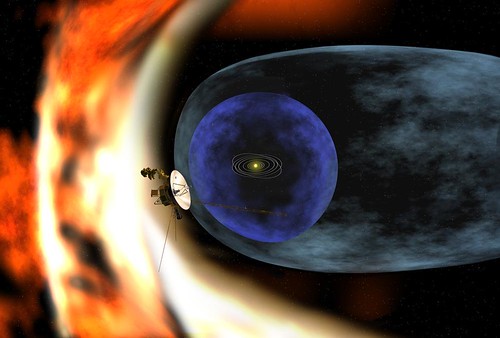
This artist’s rendering depicts NASAs Voyager 2 spacecraft as it studies the outer limits of the heliosphere – a magnetic ‘bubble’ around the solar system that is created by the solar wind. Scientists observed the magnetic bubble is not spherical, but pressed inward in the southern hemisphere, according to recent data published as part of a series of papers in this week’s (July 3, 2008) Nature. These findings help build up a picture of how the sun interacts with the surrounding interstellar medium.
Having crossed the termination shock and the edge of our solar system, Voyager now continues on; in five to seven years, it may have something equally profound to tell us about deep space.
Meanwhile, NASA’s Stereo Mission (which we blogged about here and here) has created its first images of the edge of the solar system, and its findings are equally interesting and helpful in understanding what happens at the point where the solar system meets interstellar gas:
NASA’s sun-focused Solar Terrestrial Relations Observatory, or STEREO, twin spacecraft unexpectedly detected particles from the edge of the solar system last year. …
From June to October 2007, sensors aboard both STEREO spacecraft detected energetic neutral atoms originating from the same spot in the sky, where the sun plunges through the interstellar medium.
Mapping the region by means of neutral, or uncharged, atoms instead of light "heralds a new kind of astronomy using neutral atoms," said Dr. Robert Lin, professor of physics at the University of California, Berkeley and lead for the suprathermal electron sensor aboard the STEREO spacecraft…..
The results, reported in the July 3 issue of the journal Nature, clear up a discrepancy in the amount of energy dumped into space by the decelerating solar wind. The solar wind was detected when Voyager 2 entered the heliosheath.
Researchers determined that the newly discovered population of ions in the heliosheath contains about 70 percent of the dissipated energy from the solar wind, exactly the amount unaccounted for by Voyager 2’s instruments. The Voyager 2 results also are reported in the July 3 issue of Nature.
The Berkeley team concluded that these energetic neutral atoms were originally ions heated up in the termination shock area that lost their charge to cold atoms in the interstellar medium and, no longer hindered by magnetic fields, flowed back toward the sun and into the sensors aboard STEREO.
Would it be a bad holiday pun to call all of this a shocking discovery?
Indeed it would be a bad pun. But now it’s done.
Enjoy the Fourth!
Posted
July 3rd, 2008 in Uncategorized
|
No Comments »
Bèibei, Jīngjing, Huānhuan, Yíngying, Nīni — the Fuwa, official mascots of the Beijing 2008 Olympiad. Each represents one of the five Chinese elements: Water, Wood, Fire, Earth, Air, respectively. Colored for the five Olympic rings, we can expect a lot of them over the course of this summer, with the Beijing 2008 opening ceremony on Friday, 8 August 2008.
The swirling stories around the 3.5 hour show are getting interesting — from a giant winking panda to fantastic fireworks. According to one of the producers, "The world can expect, of course, to be gobsmacked…"
Imagine a 100-m-wide red flower opening up its petals; picture 10,000 bicycles circling the Olympic stadium and transforming into hi-tech robots; then envisage Peking Opera performers morphing into hip-hop dancers and singing in English.
Finally, picture a 50-m-tall giant inflatable panda, which turns its head and winks at the world.
These powerful images of rapid change and spectacular icons are the possible eye-candy in the Middle Kingdom’s biggest ever ceremony.
China’s record-breaking social and economic changes over the past 20 years will become one of the major themes of the Olympic opening ceremony, according to one of the key members of the team.
Although opening ceremony organizers are sworn to secrecy, Games ceremonies guru Ric Birch has hinted that China’s great changes will be a dominant theme.
"The fact China has achieved so much in one generation is so extraordinary, we can’t compute it," he told China Daily.
"There has never been an equivalent, so we don’t have benchmarks.
"All these issues will come together for me in Beijing for the opening ceremony."
Australian Birch is a key adviser to Zhang Yimou, who wields full creative control over the ceremonies.
The Olympics are an immense undertaking and China will be under an intense global media spotlight. TV news crews from all over the world will need to coordinate their RF transmit-receive equipment like never before.
What we might expect to see unveiled is which mobile TV standard will be selected as the national standard in China. EE Times did a piece on this a month ago:
"We used to joke that there are as many standards in China as there are universities, but it looks like CMMB is pulling ahead," said Azzedine Boubguira, vice president of business development for DiBcom, which designs demodulators.
DiBcom, Siano and Beijing-based Innofidei Inc. will all have CMMB silicon ready by the end of this year or early next. Innofidei already has a chip out, having released a first-generation demodulator in March, and hopes to have a smaller, lower-power version by October. Around that time, two satellites will be launched in preparation for network trials in the spring and modest commercial services targeted at the Olympics.
At least, that’s the plan. "It will be a rush job for sure. I don’t see it happening by then," said Duncan Clark, managing director of telecom consultancy BDA China. Others are also doubtful, including the chip makers themselves.
It has become increasingly clear that CMMB’s benefactor, the State Administration for Radio, Film and Television (Sarft), is willing to use its power over frequency allocation and content licensing to see that CMMB wins out over competing standards, including established international formats such as Europe’s DVB-H and South Korea’s T-DMB. But the CMMB effort’s estimated $3 billion price tag may not fly with government bean counters. And China’s track record for implementing homegrown technologies is spotty. Its highest-profile case thus far is a 3G technology, TD-SCDMA, whose ascendancy has easily set back the rollout of 3G services for at least a year as engineers rush to make it reliable.
Sarft introduced CMMB last October. The spec is based on a homegrown transport technology known as STiMi (short for "satellite and terrestrial interactive multiservice infrastructure"). The service operates in the 2.6-GHz frequency, using 25 MHz of bandwidth to offer 25 video and 30 radio channels, plus some data channels. STiMi supports the S- and UHF/VHF bands and will use both satellites and terrestrial relays to implement coverage. The technology bears some resemblance to Europe’s DVB-SH (for satellite service to handheld devices).
Competitive and regulatory challenges could impede CMMB’s progress. A chip maker associated with the development of China’s free-to-air transmission standard, DMB-T, is trying to field a low-power chip set for portable media players (PMPs), automotive displays and notebook PCs (via USB dongles). The company, Legend Silicon, believes those uses will trump handsets as the early market for mobile TV in China.
"There’s enough money to be made in USB and PMPs, plus we have the larger market of set-top boxes and TVs," said Hong Dong, a co-founder of Legend.
Interestingly, the USB and PMP market is also the initial target of CMMB backer Innofidei. By sidestepping the handset, at least for now, these companies are waiting to see the outcome of a potential showdown among CMMB, DMB-T and another, little-known standard that has been floated by a rival bureaucracy, the Ministry of Information Industry (MII).
The spec, T-MMB (Terrestrial-Mobile Multimedia Broadcasting), is a T-DMB derivative developed by Beijing software firm Nufrontsoft in conjunction with two local universities. The MII-backed format supports frequencies from 30 MHz to 3 GHz. Like T-DMB, which is based on the Digital Audio Broadcasting spec, it uses bandwidth of 1.536 MHz and can support four to seven video channels and two audio channels.
At the moment, it’s uncertain how committed MII is to backing T-MMB and instigating a turf battle. Insiders said T-MMB seems to have the least support.
The minutiae of bureaucratic maneuvers may have a profound impact on the way the mobile-TV industry develops in China. If CMMB is to be successful, it needs the backing of telecom regular MII, which approves handsets for distribution to operators. On the other hand, if MII wants to push T-MMB, it would have to get Sarft to approve frequencies and content licenses.
"They need each other to be successful, but they need telecom convergence to see this happen. So they are kind of stuck," said BDA’s Clark.
All this uncertainty greatly influenced EchoStars decision (10-Q Statement) to suspend their S-band payload plans:
We are suspending construction of the CMBStar satellite and may record an impairment charge. During April 2008, we notified the State Administration of Radio, Film and Television of China that we were suspending construction of the CMBStar satellite pending, among other things, further analysis relating to efforts to meet the satellite performance criteria and/or confirmation that alternative performance criteria would be acceptable. We are also currently evaluating potential alternative uses for the CMBStar satellite. Therefore, we could be required to record an impairment charge relating to the CMBStar satellite. We currently estimate that this potential charge could be as much as $100 million, which would have a material adverse effect on our results of operations and financial position.
Good of EE Times to pick up on that one, too, and concluding no satellite capacity exists to launch a new national standard in China:
When the Beijing Olympic Games start in August, China’s much-touted mobile TV broadcast service will have to crawl before it can walk–because it’s missing one leg.
The homegrown Chinese system has been designed to operate by picking up two signals: a 2.6-GHz satellite signal and a 700-MHz terrestrial signal. (see: Satellite mobile-TV spec gains influential backers in China)
However, no satellite will be operating in time to realize the full promise of the China Multimedia Mobile Broadcasting (CMMB) standard — technology also known as STiMi (satellite and terrestrial interactive multiservice infrastructure).
EchoStar, the primary provider of S-band satellite capacity for China’s mobile video project, quietly revealed in its 10-Q form filed with the U.S. Securities and Exchange Commission in late May that it is suspending construction of the CMBStar satellite.
China Satellite Mobile Broadcast (CSM), a company overseen by the Wireless Bureau of China’s State Administration of Radio, Film and TV (Sarft), last year selected China Mobile Broadcasting Satellite (CMBSat), a Hong Kong-based affiliate of EchoStar, as its partner.
EchoStar claimed that it already notified the Sarft of its intentions in April. But the U.S. firm has not explained why it suspended activities in China, other than saying that its decision is "pending, among other things, further analysis relating to efforts to meet the satellite performance criteria and/or confirmation that alternative performance criteria would be acceptable."
It remains unclear if any technical problems have surfaced, or if the delay is purely a negotiating ploy by EchoStar or CSM.
Although EchoStar remains a viable candidate to deliver a satellite to China, a growing likelihood is that China will turn to its own satellite companies to launch a satellite in the first quarter of 2009.