Satcom in Uganda

We’ve written extensively about efforts to connect Africa with the digital world (see Com in Africa: A Changing Marketplace, A Pan-African E-Network, With India’s Technology, and Which Satellites Aid Oil Exploration in Africa?, for examples).

Now, East and Southern Africa are about to be connected to the global internet pipeline by undersea cable, and terrestrial networks are rapidly expanding in major towns.

But what about the more remote nations of Africa, such as Uganda, home of the Bwindi Impenetrable National Park?
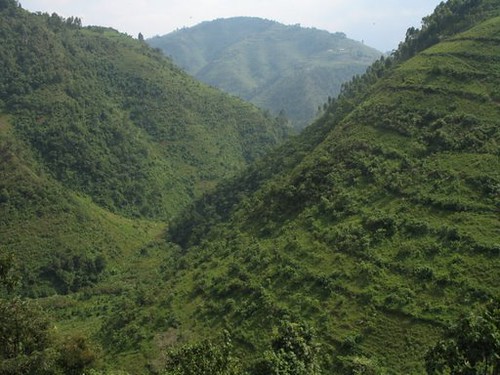
 

Like Nigeria, Uganda relies upon satellite for its principle mode of digital communications

Satellite transmission remains the most apt mode of digital communication in Uganda and much of Africa where spotty infrastructure and geographical isolation still pose a formidable challenge to the deployment of fibre optic cables, according to an official from Afsat Communications ltd.
 
Afsat is Africa’s largest provider of Very Small Aperture Terminal, (VSAT) based internet services. At a June 19th media presentation in Kampala on the potential of satellite technology in bringing internet access, Afsat’s General Manager Job Ndege said VSATs were still the best and cost efficient means of bringing the Ugandan masses access to internet.

Currently Afsat is marketing its services in Uganda under the brand name iWay Africa and connects its clients to: “fast, reliable, efficient and cost effective broadband intenrt” and “Tailor designed and highly available intra-corporate connectivity solutions.”

The company is present in 28 sub-Saharan African countries and has installed about 5200 VSATs on both the broadband and intra-corporate platforms. Lately there has been a lively debate among the ICT industry analysts, policy makers and academics on the relevance of VSATs in the wake of efforts, now in advanced stages, to connect East and Southern Africa to the word’s fibre optic network.

Monitor Online has a good interview with Afsat’s Job Ndege, who notes that VSAT is immune to the problems of poor infrastructure "because it is possible to have a VSAT system that completely bypasses the local infrastructure.
This is a key advantage of VSAT as compared to other technologies."

For delivery of the digital connection, Afsat’s iWay Broadband utilizes the Intelsat 10 (IS-10) and NSS-7 satellites. 

Space Weddings

Last month, we read on Pink Tentacle about a company in Japan offering weddings in space via Kistler’s RocketPlane.

Today we read in The Australian they’re accepting reservations:

Each happy couple will spend 240 million yen ($A2.4 million) for the ceremony in a small space vessel, which will shoot up 100km into the sky.

During the hour-long flight, the couple will spend several minutes in zero gravity during which they will exchange their vows with up to three guests present, said Taro Katsura, a spokesman for Japanese firm First Advantage.

The couple would perform most of the ceremony before takeoff "so that they can say their vows and look out the window," Mr Katsura said.

The firm is offering the space marriages in a tie-up with US-based Rocket Plane, which will conduct the flights from a private airport in Oklahoma. From the spaceship, the couple would probably be able to see the outline of the Earth although they will not be far enough into space to allow complete floating, Mr Katsura said.

Despite launching the offer in Japan, the company said it expected most of its customers to be from China or Arab Gulf nations. There are currently no plans to start the space weddings in the United States, Mr Katsura said.

Sure, I’ll look out the window for a few minutes. Other newlywed activities may be more interesting for most people — especially rocket scientists.

I can almost hear Frank Sinatra singing the song now…

Interference in the Ku-band


Last week a petition that floated up to the FCC prompted multiple meetings between the federal regulatory agency, Global VSAT Forum (GVF), and the European Satellite Operators Association (ESOA). The contents of the petition? A request by the Utilities Telecom Council (UTC) and Winchester Cator, LLC (remember these, we’ll come back to them in a second) to allow shared, secondary terrestrial fixed service (FS) use of the 14.0-14.5 GHz band–a move that would cause harmful interference to fixed and mobile satellite-based services used by millions across the US.

The issue has been simmering for a few weeks now, with letters coming from the Satellite Industry Association since early June

So what dog does the UTC have in this fight? Well, they’re seeking access to the radio spectrum with a petition being circulating to gain support.

It doesn’t stop there, among the signatories of the petition is Winchester Cator, LLC, comprised of Jared Abbruzzese and Raj Singh, both of whom have been making all the wrong kind of news for a while now.

Jared Abbruzzese as been implicated in questionable dealings with Mobile Satellite Ventures (via Business Week), and Raj Singh was one of the owners of Motient, so he’s been at it for a while. Abbruzzese also got himself into some hot water with the New York State Legislature.

This surely won’t be the end of this saga. We’ll be sure to keep you updated.

DIY Friday: Biofuels

I’m feeling rather confident in my DIY skills at the moment. I just fixed up my bike last night, put up a new shelving unit, and re-wired a lamp. So, I’m thinking I might take on something a bit more challenging. How about solving the world energy crisis by breeding bacteria that eat CO2 and produce fuel? No big deal — I’ve got all weekend.

Hey, Craig Venter is working on it, and all he’s done is decode the human genome. http://www.ls9.com/ is also getting into the bacteria market.

No one would accuse Craig Venter of harboring humble ambitions. In 2000 he decoded the human genome faster than anyone else—and he did it more cheaply than a well-funded government team. More recently he’s set a new goal for himself: to replace the petrochemical industry. In a Maryland lab, he’s manipulating chromosomes in the hopes of creating an energy bug—a bacterium that will ingest CO2, sunlight and water, and spew out liquid fuel that can be pumped into American SUVs.

But if cooking up bacteria in your basement makes you a bit squeamish, you can always go the homemade ethanol route. These guys are developing a DIY kit for just $10,000.

Or you can just follow these step-by-step instructions to get up and running.

You can even get a tax credit for it, as long as your particular brand of fuel qualifies.

Free P*RN in France

Yes, the number of free-to-air channels featuring "adult content" in Europe is astounding — over 70 in France via Eutelsat alone. And France’s CSA (Le Conseil supérieur de l’audiovisuel) wants to know more about, ahem, these channels. With names like "Happy Hour Girls," "Babecast" and "The Basement," it’s market segmentation at its best. The news item, via Broadband TV News:

The French media authority CSA says it has written a letter to satellite operator Eutelsat demanding all necessary information about the seventy porn and adult channels that transmit over one of their satellites. The regulator wants to identify all these broadcasters and their place of origin, apparently in a move to better control the channels.

The CSA wants to identify all such broadcasters and see if they operate with a proper broadcasting licence. Lately, in some European countries there has been some uproar about the large number of adult channels available free to air on satellite.

No wonder Eutelsat named their satellites "Hotbird."

Let’s go camping

It’s almost the 4th of July, and, if you’re anything like me, you still haven’t figured out what to do with that long weekend.

True, there are usually some good movie marathons on cable, but you could probably use some time in the sun before you start to look like one of those mole-people. (Oh, they exist…I think I saw it on tv somewhere…)

So, why not take a low impact, low cost vacation and go camping? You might even prove that those MacGyver re-runs really were a good use of time.

If you need to brush up on your survival skills before hitting the great outdoors, this weekend is the Great American Backyard Campout. What better place to try to remember your old boy-scout tricks than the safety of your own yard?

If the thought of leaving your high-tech life at home leaves you a bit panicky, have no fear. There are plenty of fun new gadgets to make your camping trip feel a bit more 21st Century.

Pump up an air mattress, and you’ll forget you ever left home.

Or, for the ultimate experience of sleeping under the stars, check out this hammock.

And this GPS system with emergency beacon will ensure that you can escape the great outdoors in the case of a killer bee attack. (I DEFINITELY saw that on tv…)

But, whatever you do, leave the blackberry at home.

Broadcast Boo-Boo in Basel


Are you kidding me? During a LIVE broadcast, ESPN’s feed from Switzerland goes dark? That’s right, rocket scientists, they lost the signal during the Euro 2008 semi-final match between Turkey and Germany. I missed one of the goals! And it wasn’t only ESPN that lost the feed — everybody lost it. Germans, Turks — all the live broadcasts were depending on that pool feed from Basel, Switzerland (live webcam image above).

Why? Has the world gone mad? Where’s my Swiss dependability? Perhaps I shouldn’t trust those aerial trams and cable cars at ski resorts like I used to, owing to "Swiss dependability." Well, it’s got nothing to do with "the Swiss." This was all UEFA: they decided to handle all the technical stuff themselves by forming UEFA Media Technologies SA, who was in charge of the International Broadcast Centre in Vienna, Austria. The operation is run by Alexandre Fourtoy, who used to run their Web site, uefa.com.

Apparently lightning struck the power source and knocked out the feed several times, via Canadian Press:

A violent thunderstorm swept across Austria and knocked out power at the International Broadcast Center in Vienna, from where television images of the match were beamed around the world.

With the match delicately poised at 1-1 in the second half at St. Jakob Park in the Swiss city of Basel, screens around the world flickered and went blank. Internet coverage also was hit by the blackout.

"Tonight the television signal in the International Broadcast Centre for the Germany-Turkey game has been interrupted several times in the second half due to technical reasons which are currently being investigated, in particular to evaluate the impact of the violent electrical storm over Vienna at that time," UEFA said in a statement.

As the thunderstorm raged over Vienna, the images came and went several times in the closing minutes.

In between the blackouts, Miroslav Klose gave Germany a 2-1 lead in the 79th minute off a cross from Philipp Lahm. But screens were blank when Semih Senturk pulled off what looked like another Turkey escape act with an 86th-minute equalizer, beating goalkeeper Jens Lehmann at the near post.

Images returned in time for viewers to watch Lahm eliminate Turkey with a goal in the last minute of regulation time.

The only broadcasters whose signal escaped the interruption were Swiss public TV company SRG in Zurich and Al-Jazeera, said UEFA, which couldn’t immediately explain why those feeds were unaffected by the Vienna broadcast centre blackout.

However, SRG spokesman Daniel Steiner, said the broadcaster has access to an official feed in all Swiss stadiums, and they were able to tap into that when the connection went down. The Swiss broadcaster provided the feed to German TV station ZDF for 15 minutes, during which time the two goals were scored.

The heavy rain, high winds and lightning also sparked the evacuation of a fan zone in downtown Vienna and two people were injured after being trampled in the rush to leave the area, police said.

Authorities said they gave the order to close the fan zone at 10:15 p.m. local time after the storm unleashed winds exceeding 100 kilometers per hour.

While the disruptive storm hit Vienna, spectators watching the game at the ground in Basel remained dry and unperturbed throughout.


Look, this isn’t some minor league game from Ukraine — this is the European Championships, aruguably the second most important soccer (football) tournament after the World Cup. You’re providing the satellite feed for hundreds of television networks. Where’s your redundancy?

When Fox does an NFL game from the Los Angeles, for example, they buy three fiber and two satellite paths, and probably a couple of power generators (properly grounded) standing by. Nobody wants to break the news to Rupert they saved some money by not having an extra back-up on Monday.

So they switched to a feed showing the "fanzone" in the Muensterplatz. Actually, the match ended while we were watching that feed. I’m sure I was not the only one outraged by this. Al-Jazeera’s feed was not affected? Dude…


We’ll follow up on this one later.

The Guardian’s live text coverage captured the moment well:

GOAL! Germany 2-1 Turkey (Klose 78): Goal! And I didn’t see it! Rustu comes for a cross, makes a right pig’s ear of it, and Klose heads home. So I’m told.

Fill Er Up, With Hydrazine


Gasoline prices don’t have much affect on hydrazine, the primary fuel used for spacecraft propulsion. Demand for ethanol has had a remarkable affect on corn prices (up 21%), however, with far-reaching implications on chemical processes that use it during fermentation. But there is new research showing a promising reduction in cost.

Doesn’t have much direct affect on the cost to design, build, launch and operate a communications satellite. But, as with other markets, pricing is based on supply and demand. With the recent change in ownership of International Launch Services, there could be changes afoot. When United Launch Alliance was formed, most of their launch manifest was taken up by the U.S. Air Force, leaving the commercial market scrambling for alternatives.

Good thing Arianespace is moving right along — their next launch is at the end of next week, only 3 weeks after their last (de continuer d’avancer).We blogged about the controversy surrounding the Protostar-1 satellite last month, which naturally turned up again during CommunicAsia last week, via Telecom TV:

Interviewed at the Communicasia 2008 summit in Singapore yesterdaym by our sister publication Commsday, the president of ProtoStar Asia, Dr Eui K. Koh said that while co-ordination issues with the two other birds remain a problem, the company has no plans to delay the launch of its first satellite. 

“We are doing it [co-ordination] diligently. These things take time,” Dr Koh said. “The co-ordination will continue after the launch. As a satellite operator, you have to respect your customers, as well as the customers of other satellite operators.” 

According to Mr. Koh, the company has had several meetings with the owners of the two adjacent satellites and will continue to have negotiate going forward. 

ProtoStar One will be launched onboard an Ariane 5 ECA heavy-lift launcher version from Arianespace. The satellite will feature a C-band foot- print over most of South East Asia, India and the Middle East as well as two Ku-band beams covering India and an area stretching from Singapore northward to the southern border of China. 

In an earlier media report, it was reported that ProtoStar has come under fire from rival operators because it did not co-ordinate with the industry to avoid possible interference on nearby satellites before finalising its launch plans. The Chinese government’s Ministry of Information and Industry has reportedly protested about the launch, as has AsiaSat. 

According to industry sources, the situation is further complicated because ProtoStar has already signed up a customer in India and has a deadline and schedule for the delivery of services.

Well, it looks like we’re in for a show for the 4th of July:

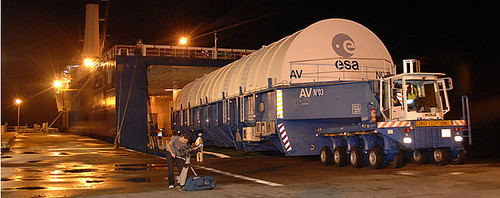
Arianespace has taken delivery of the fourth Ariane 5 in 2008, maintaining its accelerated flight pace during the busiest year of commercial mission activity for this workhorse launch vehicle.

The handover occurred with Ariane 5’s transfer from the Launcher Integration Building at Europe’s Spaceport – where its build-up was performed under responsibility of prime contractor EADS Astrium, to the Final Assembly Building – where Arianespace will oversee integration of the mission’s ProtoStar I and BADR-6 payloads.

In its trademark dual-passenger configuration, the heavy-lift Ariane 5 ECA will carry ProtoStar I in the upper payload position, with BADR-6 riding below it inside the SLYDA 5 dispenser system.  Liftoff is scheduled for an evening launch window on July 4.

ProtoStar I is the lead satellite in a fleet of relay platforms that Asia’s ProtoStar plans to launch for advanced satellite television services and powerful two-way broadband communications access.  Built by Space Systems Loral, the spacecraft was designed to meet the needs of both emerging and existing direct-to-home (DTH) operators in Asia, as well as other broadband communication requirements in the region.

The BADR-6 spacecraft was built jointly by EADS Astrium and Alcatel Alenia Space, and will be used for video broadcasting services over the Middle East and North Africa regions.   To be operated by Saudi Arabia-based Arabsat, BADR-6 carries a mixed payload of 24 C-band and 20 Ku-band transponders, and is designed for a lifetime of about 15 years.  The spacecraft will be located at Arabsat’s 26 deg. E geostationary orbital position.

Paglen’s Spy Satellites

It’s a bird…it’s a plane…it’s a super secret spy satellite?!

This is the stuff of Ian Fleming, mixed with a bit of high art.

Trevor Paglen has spent years photographing things in the night sky that supposedly don’t exist. Using time-lapse photography, he has captured 1,500 images of mysterious objects.

A small selection of these photos are now on view at the Berkeley Art Museum.

And these photos don’t skimp on political symbolism:

In taking these photos, Paglen is trying to draw a metaphorical connection between modern government secrecy and the doctrine of the Catholic Church in Galileo’s time.

“What would it mean to find these secret moons in orbit around the earth in the same way that Galileo found these moons that shouldn’t exist in orbit around Jupiter?” Paglen says.

Satellites are just the latest in Paglen’s photography of supposedly nonexistent subjects. To date, he’s snapped haunting images of various military sites in the Nevada deserts, “torture taxis” (private planes that whisk people off to secret prisons without judicial oversight) and uniform patches from various top-secret military programs.

…well, at the very least they’re pretty cool. And we’ve been interested in this subject for a while, ever since we learned about the “MISTY” satellite program.

I’m guessing the “powers that be” won’t be too pleased with Paglen’s exhibit, judging by the steps they take to ensure that their programs stay secret. Remember when the DoD shot down the spy satellite to keep information from getting into the wrong hands?

And this exhibit isn’t the first time Paglen has given the world a glimpse into the intriguing world of secret military programs. His book, “I Could Tell You but Then You Would Have to Be Destroyed by Me” offers a rare look inside the Pentagon’s Black Budget, through images of the patches worn by the nation’s stealthy, high-tech warriors.

Keep it comin’ Paglen. With stuff like this, who needs science fiction?

Pool Hopping

It’s officially summer, and I’m feeling a bit nostaligic.

Like many kids who grew up in the suburbs, my memories are filled with ice-cream trucks, slip-and-slides, and…oh yeah…petty crime. Before images of vandalism start running through your mind, let me explain. My misdemeanors were of a more innocuous variety, namely pool-hopping:

pool hopping
Hoping from pool to pool; usually done at night, or during the day when people (pool owners) are working. It is the act of running to one neighbours pool jumping in, then running to another pool to jump in,, and continue the cycle.This is all done without getting caught(hopefully).

We all knew which houses in the neighborhood had the best pools, and, after some fence-scaling and other secret-agent-worthy tactics, we’d be cannon-balling into the deep end.

But these days the childhood pasttime is going high-tech. Groups of kids are using Google Earth to find pools and organizing their outings on Facebook.

Call me old-fashioned, but I agree with this guy. Between creating facebook groups and dodging motion detectors, all the technology has taken the fun out of it.