Long March Launches SinoSat-3

Let’s hope this one turn out better than Sinosat-2 did. Here’s the news report, via IHT:

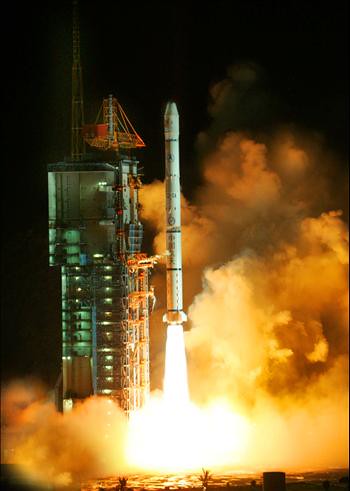
China launched a new communications satellite into orbit early Friday [1 June 2007] to provide broader radio and television signal coverage across the country, state media reported.

The Long March-3A rocket lifted off from the Xichang launching center in southwestern China eight minutes after midnight (1608 GMT) and separated from the SinoSat-3 satellite 24 minutes later, the Xinhua News Agency said.

The long-scheduled launch follows the failed deployment last October of another communications satellite, SinoSat-2, whose solar panels and communications antennae did not operate properly, Xinhua said.

China has spent decades building an indigenous space program and is trying to attract customers from abroad, after a series of failed launches in the 1990s dampened demand for Chinese launch services.

Both the rocket and the satellite used Friday were mainly developed and manufactured domestically, Xinhua said.

The satellite deployed Friday was not developed as a replacement for the inoperable SinoSat-2, Xinhua said, though Sino Satellite Communications Co., the satellite’s operators, may use SinoSat-3 to replace part of the service the other satellite was to have provided.

Xinhua quoted a company spokesman as saying that a substitute satellite would take at least three years to develop.


Robert Berry to be honored with Lifetime Achievement Award

This Wednesday, at the ISCe 2007 Conference in San Diego, Robert E. Berry – former systems fellow and chairman of Ford Aerospace and SS/L – will be given a Lifetime Achievement Award.

More about Berry from the press release announcing the award:

"Berry led SS/L and its predecessor, Ford Aerospace, from 1977 to 2000 and, with his willingness to push innovative concepts, was responsible for some of the world’s most advanced communications and meteorological satellite projects for defense, civil, and commercial applications. He cultivated the international market for U.S.-based satellite manufacturing, and under his leadership, SS/L developed the technologies that have put the company at the forefront in providing high-power satellites for direct-to-home television, satellite radio, broadband Internet and international fixed satellite services."

During Berry’s tenure at Ford Aerospace, his team built many satellites for IntelSat, including the notable IntelSat 5 and IntelSat 7 series. After Ford Aerospace was sold to Loral in 1990, Berry led SS/L in developing the FS-1300, which was a very advanced and reliable satellite that in some cases exceeded its design life of 10 – 15 years.

More from the press release:

"Berry was instrumental in providing three generations of satellite platforms to Intelsat, helping the intergovernmental consortium provide fixed satellite services to more than 149 countries, territories, and dependencies. He initiated and managed Ford Aerospace’s participation on the Milstar industry team and advocated multi-mission satellite systems, with SS/L providing military communication payloads for commercial satellites for France, Japan, Spain and Australia. Currently at SS/L, he consults with both government and commercial interests to explore new applications arising from combining satellite, wireless, and fibered transmission."

The ISCe 2007 conference takes place this week, June 5th – 7th, in San Diego. Besides honoring Robert Berry, the conference is hosting a number of other impressive speakers and sure-to-be engaging talks. Check out the speaker list here.

In a related note, Berry’s company Ford Aerospace is also where Linda Hudson, currently of BAE Systems, got her start. She was the first woman manager at Ford, overseeing the quality assurance division. After making a name for herself as an executive at Ford, she eventually became the first female vice president at General Dynamics and now, as the president of BAE’s land and armaments division, has made a significant impact in the defense industry with BAE’s recent $4.1 billion purchase of Armor Holdings. London newspaper The Times calls her "the most powerful woman in the American defence industry" (link).

Recently, Hudson travelled to London to host a BAE leadership conference. She must have made quite an impression, as one British observer noted that "she talked a lot of sense – without the jingoism and rubbish you normally hear from American defence experts" (link).


DIY Friday: TiVo on your mobile phone

Picture it: you’re at a baseball game and are fighting with your buddy about whether or not the last hit was fair or foul. The away team’s manager is screaming at the ump and the home team isn’t showing the replay on the scoreboard to avoid controversy. You are stuck guessing — and your honor is on the line.

The solution: pull out your mobile phone, connect to your home’s TiVo, rewind the recording, then force your friend to buy you a beer for getting the call wrong. It’s possible!

An innovative blogger pulled off a very useful mashup by connecting his PPC-6700 mobile phone to a Slingbox, and the Slingbox to his TiVo. A Slingbox is a TV streaming device that enables viewers to remotely view content.

After connecting your TiVo to the Slingbox, download the appropriate player for your mobile phone. Currently there are versions for Windows Mobile 2003, Windows Mobile Version 5.0 for Smartphone, and Palm OS.

While many users find the ability to easily record shows to be most important, I’m intrigued by the convenience of having vast amounts of mobile content. The screen size on the 6700 or the Q is not much different than on an iPod and this mashup avoids hard drive space limitations and the trouble of having to download content, then add it to the iPod. By streaming from your TiVo, you are guaranteed a steady selection of fresh media—both live and recorded.

From early user reviews, the quality appears to be more-than-sufficient. Here is a video from a Motorola Q (skip to 3:30 to watch the Chappelle Show):

Don’t have a Slingbox or TiVo but still want to stream TV on your phone? Try a free service called Orb. While it let’s your home computer be a hub that streams all types of media—music, photos, and videos—to any Internet-connected device, its tv feature may be most useful. Simply connect your tv or set-top box to your computer’s tv tuner card (instructions on buying one are here), then install Orb’s free software. Your computer becomes a server distributing your tv’s content. Orb includes DVR technology, allowing you to (like the TiVo mashup) remotely record programming.

Enjoy the game!

DirecTV-10 Satellite Launch Postponed


According a local news agency, Kazakhstan Today, DirecTV’s new HD-dedicated satellite won’t be launched until next month:

Launch of space vehicle DirecTV-10 planned for June 20 has been postponed at the cosmodrome Baikonur. Federal space center Baikonur press service informed the agency.

According to the press service, the launch date of the American telecommunication satellite DirecTV-10 has been shifted for July. "The date transfer has been done due to the request of foreign manufacturers of the satellite and is connected with the terms of preparation of a space satellite and its delivery to the cosmodrome," the press service informed.

The exact date of the satellite launch by means of a carrier rocket Proton-M will be defined later after delivery of the satellite to the cosmodrome and will depend on the degree of readiness of foreign partners.

This was indeed confirmed by DirecTV’s press guy, via SatelliteGuys.us:

here’s a statement i just received from bob mercer, directv’s director of public relations:

“The launch date of D10 has slipped to july 7. there were some late processing issues in the Boeing factory but they have been resolved and we are moving forward.”

he sent me a follow-up email from his blackberry to clarify the date:

“that’s actually july 6 in the US.”

Back in January, DirecTV promised up to 70 national HD channels via this and another new satellite in 2007. This is a key launch for them.


The ‘Rocket Docket’ for EchoStar

If this post’s title doesn’t confuse you, EchoStar’s legal battles sure will.

While other Cable and Satellite operators that use DVR technology (including Time Warner, Comcast, and DirectTV) settled with Forgent Networks, which owns a patent on a specific DVR-playback technology, EchoStar didn’t back down. And, last week, EchoStar won:

A team of Morrison & Foerster attorneys and their co-counsel have won dismissal of a patent infringement case brought against client EchoStar Communication Corp. after a Texas jury took just over an hour to find the plaintiff’s patent invalid. It was only the second time on record that a jury in the Eastern District of Texas had handed down a defense win in a patent case by finding the patent at issue invalid.

The court ruled that Forgent’s patent claims against EchoStar were all invalid as anticipated, obvious, and lacking proper written description. The jury instructions describe the legal parameters for "obviousness," but Forgent’s CEO, Richard Snyder, summarizes it best in his company’s recent earnings call: "The outcome of many of these events relating to intellectual property are complex and uncertain."

"Complex" is right. For clarification I turn to Wikipedia: "The inventive step and non-obviousness reflect a same general patentability requirement present in most patent laws, according to which an invention should be sufficiently inventive, i.e. non-obvious, in order to be patented." It appears Forgent’s computer controlled video system that allows playback during recording is not valid for a patent as it is an obvious extension of existing technology. If we have any lawyers in our community, please weigh-in.


By not settling, EchoStar took a big risk. The company faced the prospect of over $200 million in damages if it lost and it’s legal arena was daunting. The Denver Post describes the case’s context:

EchoStar’s hard-line approach isn’t surprising, given its history. The company is known as being litigious, and only rarely does it back down from a legal fight. Founder Charlie Ergen bet the company on a lawsuit in 1997, when he sued Rupert Murdoch’s News Corp. for $5 billion over a failed merger of satellite-TV operations. News Corp. settled.

Drapkin and others called the Forgent verdict an unusual outcome in the Eastern District of Texas, known as the "Rocket Docket" for the speed with which patent cases are handled.

"It’s rare that a defendant would win a jury case in that district … particularly a large company," said Kirstin Stoll-DeBell, of Merchant & Gould in Denver, who represented a client there who settled a patent case. "I think jurors down there are biased against corporate America."

Where does this leave other cases in the DVR-patent war, mainly the TiVo/EchoStar saga which is currently pending in the Federal Circuit Court of Appeals? (Until it considers the case, the court gave EchoStar a stay on an earlier injunction that would force it to turn-off all of its customers’ DVR capabilities.) To be true to this post’s theme, I would have to say…well…unclear.

EchoStar and TiVo both see the light after this Texas ruling and a recent regulatory review of TiVo’s patents. Last week, as part of an ongoing lawsuit filed by TiVo against EchoStar, the U.S. Patent and Trademark Office reviewed 61 of TiVo’s patents and ruled that most (as many as 59), but not all, were valid.

EchoStar spins this their way:

"We are pleased that the United States Patent and Trademark Office yesterday rejected many of TiVo’s patent claims as invalid. That re-examination ruling, together with the favorable decision from the Court of Appeals earlier this month…are steps in the right direction as we prepare our response to TiVo’s recently filed injunction motion,"

TiVo’s CEO, Tom Rogers, argues that their case against EchoStar is:

moving closer to resolution at the Federal Circuit Court of Appeals. AT&T recently attempted to file an Amicus brief [which was denied] supporting EchoStar which speaks to how others perceive the importance of this case. We are actually pleased with EchoStar’s recent victory in another patent case, the Forgent litigation. I say pleased because EchoStar cited as a key defense one of TiVo’s important patents.

Still a little confused? Me too. We will keep you updated as this legal mess unravels in the courts.
SumbandilaSat Launch via Submarine Scrubbed


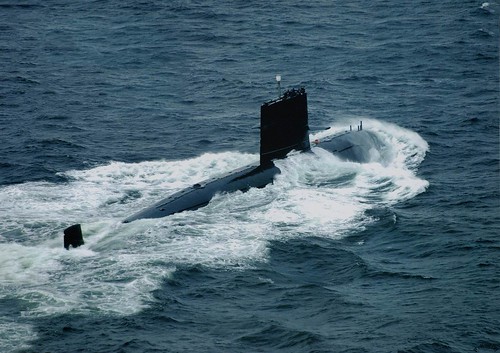
South Africa’s SumbandilaSat, an 81-kg LEO (low-earth orbit) observation/imagery satellite, which was to launch via a Russian submarine in the Barents Sea, has been postponed. The story, via Engineering News (South Africa):

The launch of South Africa’s first government satellite from a Russian submarine next month has been postponed indefinitely, an official said on Tuesday.

"It has been postponed because official documentation still needs to be arranged to issue a decree for the launch," said Nhlanhla Nyide, spokesman for the Department of Science and Technology.

"They are currently working on the process … We will hear from them when they have set a new date for launch," Nyide said.

He told said no additional costs will be incurred and South Africa’s nascent space programme would not be affected because of the cancellation of the launch, which was to have taken place in the Barents Sea near Norway.

The R26-million satellite, intended to orbit some 500 km (310 miles) above earth and have a life-span of three years and longer, would carry high-resolution imaging cameras.

The images from the South African-built satellite would be used across a wide array of applications, from agriculture to land use and infrastructure mapping.

South Africa has pledged millions of rands to build its astronomy and space sector, with the construction of the South African Large Telescope creating a hub for astronomy research in southern Africa.

In July 2006 cabinet approved the establishment of a South African Space Agency as an institutional vehicle to look at space science and technology.


This would have been a cool launch. Back in December, 2006, the satellite was handed off to Russia:

South Africa’s low-earth-orbiting microsatellite, SumbandilaSat, left for Russia on Thursday, ahead of its launch into space off a submarine in early 2007.

The 81-kg SumbandilaSat will generate satellite imagery through its remote sensing camera at 6,25 m ground sampling distance.

Upon arrival in Russia, SumbandilaSat will be taken to the Russian naval base at Murmansk, where the Russian navy will integrate it with a launch rocket. The satellite will then be transported to a submarine at Severemorsk, just off the Russian coast, where it will be launched into space.

The launch window period is between April and May and is strongly dependent on weather conditions at the time. Once in orbit, SumbandilaSat will pass over South Africa mid-morning and mid-evening, at an average orbit altitude of 500 km.

In addition to its earth observation and communications payloads, SumbandilaSat carries five experimental payloads, which will present the scientific community with exciting results in low frequency radio waves, radiation, software defined radio, forced vibrating string and radio amateur transponders.

Speaking at the hand-over ceremony, in Stellenbosch, Science and Technology Minister Mosibudi Mangena said that the development of SumbandilaSat offered South Africa a number of competitive advantages and would support decision-making in natural resource management and sustainable development. He added that the images yielded by the satellite would be used in various applications, which had direct benefits to societies, such as flood and fire disaster management; enhancing food security through crop yield estimation; ensuring better human and animal health through enabling the prediction of the outbreaks of diseases; better monitoring of land cover and use; as well improved capabilities for water resource management.

The actual construction of the SumbandilaSat had been completed at the end of September and had been followed by a battery of trials, including functional testing, space environmental testing, vibration testing and burn-in testing, designed to establish the satellite’s readiness prior to a flight acceptance review.

“The environmental-testing phase determined SumbandilaSat’s ability to withstand extreme variance in temperatures, while the vibration tests verified its ability to endure the shocks it will undergo as it is launched into space. The burn-in testing phase comprised the actual and continual running of the satellite and its systems in order to confirm that all components are fully functional,” the Department of Science and Technology (DST) said.

Sunspace project manager for SumbandilaSat Harry van der Heyden said that the review presentation included an introduction to the hardware produced, as well as the ground support equipment developed for the satellite. “We also conducted demonstrations to illustrate how the satellite communicates with the ground support equipment.”

The birth of SumbandilaSat was initiated by the DST and was given life by numerous stakeholders, including the University of Stellenbosch, Sunspace, the South African Space Council, the Departments of Foreign Affairs, Trade & Industry, and Communications, as well as the Centre for Scientific and Industrial Research.

The launch of SumbandilaSat is envisaged to strengthen South Africa’s technological capability and innovation in space science and technology, as well as reinforce the country’s role in national, regional and international space initiatives.

This is but one aspect of a budding interest in space, as evidenced by South Africa’s National Astrophysics and Space Science Programme. The first "space age school" was established in 2003.

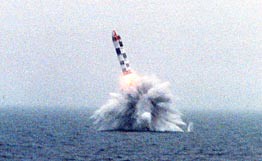
Here’s a clip of U.S. Trident missiles being launched from a sub:


Joint C3I Shows Skillz


No, the title of this post isn’t referring to a new rap group. Joint C3I stands for "Joint Command, Control, Communications and Intelligence," and Raytheon Company recently demonstrated its Joint Battlefield Integration capability with a "real-time hardware in-the-loop" demonstration of Joint C3I:

 The… demonstration pushed required battlefield situational awareness to a new level by using existing and future communications infrastructures to enable real-time warfighter response at both strategic and tactical command levels. Using Raytheon’s Joint Fires (JFires) tool, which brings its own unique warfighting capability, commanders will now be able to view a single integrated picture by integrating tactical command and control with intelligence systems using satellite communications links. Open architecture and net-enabled products were key contributors bringing this capability forward….

The backbone technology that enables this capability is Raytheon’s TCN(R) (Tactical Component Network) software. Systems integrated for the demonstration included the U.S. Navy’s Zumwalt Total Ship Computing Environment, Raytheon’s JFires sensor networking environment, a satellite communications link, the U.S. Air Force’s Distributed Common Ground System, and Deep Siren, a submarine tactical paging system. Raytheon officials conducting the demonstration said that other sensor systems will also be integrated into Joint C3I.

Global connectivity is achieved using advanced extremely high frequency satellite communications with bandwidth to support video streaming, still images and intelligence, surveillance and reconnaissance data among geographically dispersed terminals.

Solypsis has a flash animation that gives you more information about one TCN (Tactical Component Network), while this document from the Navy Department Library explains the Navy’s view of network-centric warfare:

The concept of network-centric warfare (NCW) is a key element of the Department of Defense’s (DOD’s) transformation effort.1 NCW focuses on using computers, highspeed data links, and networking software to link military personnel, platforms, and formations into highly integrated local and wide-area networks. Within these networks, personnel will share large amounts of critical information on a rapid and continuous basis. DOD believes that NCW will dramatically improve combat capability and efficiency.

While we’re on the subject of the Navy, this weekend marks the 20th Navy Fleet Week in New York. Among the events (opens in PDF) are the chance to speak with developers of the latest Navy/Marine Corps technologies; the chance to take a virtual tour of a battle zone; and (this one we’re looking forward to) the opportunity learn to weld pipes in a virtual shipyard using the Office of Naval Research´s virtual reality training systems.

And who knows, learning to weld pipes might come in handy for our DIY Friday series.

DIY Friday: Tech Grilling

Memorial Day Weekend Edition

In preparation for this weekend’s festivities, we bring you three Do-It-Yourself BBQ ideas—from the useful to the absurd.

Can-in-Can Grill

Originally designed as an efficient wood stove for developing countries (see: Vesto Stove), one DIY’er pulls together a similar version using household trash: 2 empty paint cans of differing sizes and a handful of rivets.

The complete step-by-step directions for this high-efficiency BBQ are here but the process is remarkably simple.

  1. Find two paint cans, one slightly smaller than the other—providing enough space to create an air chamber that will pre-heat the incoming air to increase the efficiency of the fire.
  2. Drill vent holes on the sides.
  3. Construct a top that the small can can be mounted to, allowing for an air chamber below the smaller can but within the larger can. This is done by taking the larger can’s lid, cutting out an inner circle about an inch smaller than the dimensions of the smaller can, then folding-in the excess material to attach the smaller can to.

A grill with an IP-Address

Rock’s BBQ has developed a piece of hardware that will monitor the temperature of your grill or smoker, including a probe to monitor the temperature of your meat. The hardware connects to fan that can throttle the temperature to your desired level. But what if you are slow smoking a pork leg for 17 hours and need to go to work?

Simple: monitor the BBQ "vitals" on the Internet. The "Stroker" has a built-in ethernet connection and web server that lets you control your grill from anywhere you have Internet access (see: large image).

Since this is DIY-Friday, try connecting the Stroker to a homemade smoker built from an inexpensive terracotta flower pot. Directions on building the pot-smoker are here and you can learn how to get your pot "online" here.

Now for the absurd: a USB BBQ

For the nerdiest of carnivores: by connecting 30 USB cords to a hotplate you can grill without ever needing to leave your desk or cubicle! The complete directions are in Japanese but you can read the translated page. And if you can stomach it, check out the video.

Tagging an Asteroid — how hard can it be?

So a massive asteroid is coming our way… And, yes, I’m serious. As SatNews Daily reminds us this morning, in just 22 years, Apophis-99942 will be at its closest distance to the Earth (in about 200 years).

At its worst, the asteroid—identified as Apofiz-99942—should smash into the Earth by 2036. At the least, it should wipe out practically all civilian and military satellites in geostationary orbit, which is about 42,000km above the planet. […] Apofiz (spelled Apophis in the West) will pass the Earth at a distance of 30,000 to 40,000 km. Whatever happens, the Earth will suffer from the effects of the close encounter with this asteroid.

Before we start to panic, the odds of a 2036 collision are very small—about 1 in 24,000. But scientists want to know more. That’s why the California-based non-governmental group, The Planetary Society, has launched the "Apophis Mission Design Competition." The contest offers $50,000 in prize money for the winner who designs a mission to "tag" the asteroid. So far, more than 100 teams and individuals from 25 nations are developing plans.

You may be wondering: how will tagging the asteroid help?image of Apophis in orbit

Tagging may be necessary to track Apophis accurately enough to determine whether it will impact Earth, and thus help decide whether to mount a deflection mission to alter its orbit. Apophis is a Near Earth object (NEO) some 400 meters in size. If Apophis passes through a several hundred-meter wide "keyhole" in 2029, it will impact Earth in 2036. While current estimates rate the probability of impact as very low, Apophis is being used as an example to enable design of a broader type of mission to any potentially dangerous asteroid. Very precise tracking may be needed to determine the probability of a collision. Such precise tracking could require "tagging" the asteroid, perhaps with a beacon, transponder, reflector — or some other method. Exactly how an asteroid could best be tagged is not yet known, nor is it obvious.

What if we find out that the worst case scenario is taking shape? While NASA currently has no plans to study methods of asteroid deflection, Russia has made some claims:

Russia, however, has said it is prepared to repel asteroids to save the Earth. Viktor Remishevsky, deputy head of the Russian Federal Space Agency (Roscosmos) was reported to have said that if necessary, Russia’s rocket-manufacturing complex can create the means in space to repulse asteroids threatening Earth. He also noted that saving the Earth from the threat of asteroids demands international cooperation.

Rest easy. We have at least 22 years to figure it out.

Comet Crushed Clovis Culture?

There is something oddly compelling about doomsday scenarios in which an asteroid or comet tumbles to earth and destroys an entire civilization. Maybe it is the religious element or the “hero that saves the world” drama we see in movies (there are a lot of flicks out there).

So what better place to discuss a sexy topic like this than the beach paradise of Acapulco?


This week, geologists will convene at the American Geophysical Union’s Joint Meeting in Acapulco to discuss a controversial new theory: that an extraterrestrial impact, possibly a comet, impacted North America nearly 13,000 years ago, setting off a 1,000-year-long cold spell and wiping out entire species.

The BBC summarizes the evidence:

The evidence comes from layers of sediment at more than 20 sites across North America.

These sediments contain exotic materials: tiny spheres of glass and carbon, ultra-small specks of diamond – called nanodiamond – and amounts of the rare element iridium that are too high to have come from Earth.

All, they argue, point to the explosion 12,900 years ago of an extraterrestrial object up to 5km across.

No crater remains, possibly because the Laurentide Ice Sheet, which blanketed thousands of sq km of North America during the last Ice Age, was thick enough to mask the impact.

Another possibility is that it exploded in the air.

Researchers have for some time proposed that a reversal in the world’s ocean currents and a corresponding global cooling was responsible for the rapid geological change that led to the extinction of multiple species of animals and the end of the Clovis Culture. A comet could explain the shift:

According to the new idea, the comet would have caused widespread melting of the North American ice sheet. The waters would have poured into the Atlantic, disrupting its currents. This, they say, could have caused the 1,000 year-long Younger Dryas cold spell, which also affected Asia and Europe.

This geological rap session may be just sexy enough to keep the scientists from laying on the beach all-day.