BP Hits Oil Off Angola

Offshore Magazine reports that BP has hit deepwater oil off the coast of Angola:

Sociedade Nacional de Combustíveis de Angola (Sonangol) and BP Exploration (Angola) Ltd. have hit oil with the Cordelia discovery in ultra deepwater block 31 offshore Angola. Cordelia is BP’s fourteenth discovery drilled in block 31.

GlobalSantaFe’s Jack Ryan drillship drilled the Cordelia well in 2,308 m (7,572 ft) water depth 371 km (230.5 mi) northwest of Luanda. The well reached a TVD of 4,040 m (13,255 ft). Cordelia lies 3.5 km (2 mi) to the southeast of the recently announced Miranda discovery. The well tested at an operationally restricted flow rate of 2,063 b/d of oil.

Sonangol is concessionaire of block 31. BP Exploration (Angola) Ltd. operates the block with 26.67% interest. Partners include Esso Exploration and Production Angola (Block 31) Ltd. with 25% interest, Sonangol E.P. with 20% interest, Statoil Angola A.S. with 13.33% interest, Marathon International Petroleum Angola Block 31 Ltd. with 10% interest, and Total subsidiary TEPA (Block 31) Ltd. with the remaining 5%.

The capital city, Luanda, is booming.

Full-Time Uplinking for Cable Channels

The list of cable channels keeps growing and they all need to find a way to get it to the top 100 cable systems. Since 1976, the best way to get your cable channel distributed is by satellite — it is the technology that made HBO and CNN what they are today.

First step is to secure a lease on a C-band satellite that cable systems are already "looking at" (have a downlink antenna assigned to it). CED Magazine’s series of wall charts include the annual "Orbital Arc Chart" (link launches PDF), which shows you a snapshot of all the cable channels and which satellites they’re on. Want more detail? Check Lyngsat for each satellite’s ladder chart.

Getting space segment in a high-value "cable neighborhood" is not cheap. For a start-up, viable alternatives to going it alone include origination and uplink centers such as Comcast Media Center (CMC) in Colorado and Crawford Communications in Georgia. 

CMC uplinks the entire HITS ("headend in the sky") platform, which carries a ton of channels.

Broadcast Newsroom just ran a piece on Crawford setting a record for new channel uplinks: 14 new channels so far this year. overall, they uplink 135 full time cable channels. I like their new video tour:


Rubidium Clock Marks Year In Orbit

Physorg reports on the rubidium clocks being tested for ESA’s Galileo satellite system, which, when fully deployed in the early years of the next decade, will be the first civilian positioning system to offer global coverage:

GIOVE-A, the first Galileo in-orbit validation element, was launched on 28 December 2005. One of its two rubidium clocks was switched on for the first time on 10 January 2006 and Galileo signals were transmitted two days later.

The timekeeping of the clocks on the Galileo spacecraft will play an important role in determining the overall accuracy of the system, so evaluation of their performance is a crucial part of the Galileo in-orbit verification process.

The orbit of GIOVE-A is precisely measured by a network of 10 ground-based laser ranging stations, to provide orbital data independent of the navigation data. The navigation signals broadcast from GIOVE-A, and from the GPS spacecraft constellation, are received by the world-wide network of 13 Galileo experimental sensor stations belonging to the GIOVE Mission Segment.

The technique used to characterise clock performance is known as Orbit Determination and Time Synchronisation (ODTS). ODTS is a statistical method which takes the Galileo and GPS data, together with the laser ranging data, and calculates spacecraft orbits, clock times, the effects of the Earth’s atmosphere on the radio signals and the delays in the receiving systems. The precision of the calculations is so great that even the tiny orbit disturbances caused by the pressure of sunlight shining on the satellites is taken into account…. 

The measured performance of the clocks meets the specification over short and medium timescales. A few ‘jumps’ in clock frequency have been observed, which impact the long term accuracy. Such frequency changes are a well known phenomenon in rubidium clock technology but their cause is not yet well understood. Their effect on GPS performance has already been analysed and corrective measures proposed. The Galileo team are ground testing a number of improvements to the clock design which are intended to minimise both the occurrence and size of the jumps. 

(It ain’t pretty, but it’s accurate!)

The ESA website offers further explanation about the accuracy of the rubidium clock:

The Galileo satellites will carry two types of clocks: Rubidium atomic clocks and Hydrogen atomic clocks. The stability of the Rubidium clock is so good that it would lose only 3 seconds in 1 million years, while the Hydrogen maser is even more stable and it would lose only 1 second in 3 million years. However this kind of stability is really needed since an error of only a few nanoseconds (billionths of a second) on the Galileo measurements would produce a positioning error of meters which would not be acceptable.

For those who really want to get into the complexities of such atomic clocks, check out this page from Harvard’s Department of Physics. In addition to details about the frequencies used by atomic masers (hey, no one said this wasn’t rocket science!) the page features a downloadable poster illustrating N-resonances and atomic clocks.

Surf’s Up

First, let’s set the mood. (Click the button to play .)

Next, let’s set the scene.


That’s right — it’s Monday, and we don’t feel like working, so we’re going to fantasize for a bit about surfing and the freedom of the endless summer that is almost upon us.

This idle day dreaming, to be clear, is prompted by this news report of a series of huge waves that struck Reunion Island in the Indian Ocean (as well as parts of Indonesia, the Maldives, Thailand and Western Australia) on Saturday.

There was no official warning about the freakish waves that killed at least one person, damaged hundreds of homes and displaced thousands of people across Indonesia. Homes and fishing boats were also damaged in Thailand and the Maldives.

Weather officials said the waves were the result of an accumulation of winds in one spot on the ocean, but were looking at why they were so intense.

How do weather officials know where the waves originated? Why, through satellite observation, of course:

The origin and movement of waves reaching up to 11 metres that devastated France’s Reunion Island in the Indian Ocean on Saturday evening have been detected with ESA’s Envisat satellite.

The waves that thrashed the southern port of Saint Pierre, leaving two fishermen missing, causing several piers to collapse and flooding several homes and businesses, originated south of Cape Town, South Africa, and travelled northeast for nearly 4000 km over a period of three days before slamming into Reunion Island.

Dr Bertrand Chapron of IFREMER, the French Research Institute for Exploitation of the Sea, and Dr Fabrice Collard of France’s BOOST Technologies in Brest located and tracked the swells using standard processed Synthetic Aperture Radar (SAR) ESA products…

Chapron and Collard are working on a project that will make data for global swells available to scientists and users by the end of the year as a demonstration. The products will be useful for weather centres to complement the accuracy of their sea forecast models.

Envisat is equipped with an advanced version of the SAR instrument, Advanced Synthetic Aperture Radar (ASAR), flown on the ERS-1 and ERS-2 missions. Its wave mode acquires 10 by 5 km small images, or ‘imagettes’, of the sea surface every 100 km along the satellite orbit. These small ‘imagettes’, which depict the individual wave heights, are then mathematically transformed into averaged-out breakdowns of wave energy and direction, called ocean-wave spectra, which ESA makes available to scientists and weather centres.

A typical SAR satellite images a swath of 400 km, enough to capture complete ‘mesoscale’ phenomena such as tropical storms. While optical satellite images show the swirling cloud-tops of a hurricane, a SAR image pierces through the clouds to show the sea surface roughness and its modulation through the combination of wind wave and currents….

As part of the Global Monitoring for Environment and Security (GMES), a joint initiative of the European Commission and ESA, the space agency has undertaken the development of Sentinel-1, a European polar-orbiting satellite system for the continuation of SAR operational applications. The Sentinel-1 SAR instrument will have a dedicated wave mode allowing the Near Real Time tracking and forecasting of swell for European users. 

No need to wait for the Europeans to get their act fully together, however. Thanks to publicly-available information from the U.S. Navy’s Fleet Numerical Meteorology and Oceanography Center, surfers can already plan their vacations according to where the waves are, dude. Using the WaveWatch III model, FNMOC provides computer-generated models of global wave height and direction (such as this global model).

Proving, as we well know as we sit at our desks this morning daydreaming, that the surf’s up, dude. Somewhere. 

DIY Friday: Six-Axis Playstation 3 Controller

I haven’t had the opportunity (read: hundred of dollars of extra cash) to get my hands on one of the new Playstation 3s, but, according to some people, the controller on the beast of a console leaves a little to be desired. Don’t get me wrong, it’s still damn cool with its six-axis control functionality (as we saw demoed at last year’s E3), but the design is over a decade old and could stand to be a little changing.

Enter DIY master Ben Heck.

Notorious for backwards engineering and recreating (himself!) portable versions of just about every video game console in recent memory, Heck, also frustrated with the new Playstation controller’s old design, last month announced that he had figured out how to stuff the cutting edge electronics into the (supposedly) more hand-pleasing Xbox form factor. It turns out Heck’s announcement released pent up demand for a modified Playstation paddle that it quickly outpaced his ability to produce the mod-ed controllers even at "consignment" rates.

So rather than keep the details himself, like a dedicated DIY aficionado, Heck, just a couple of weeks ago on Engadget, released an easy to follow how-to guide for the project that’s a lot less complicated then you would think.

More committed DIYers (especially those who don’t like to deal with consoles) should take a look at this post on building your on 6-axis controller for your PC and check out the fan-boy produced video below. It’s undoubtedly a harder project, but at least you’ll have bragging rights.

Test

Take a Deep Breath

Breathing Powered USB Charger

Fwoevt6F1Oabqa8.MediumJmengel has built a USB charger from an old CD drive, a rubber band (from broccoli!), and a name badge strap. The device stretches when you breathe in and converts the motion into a five volt DC output.

The concept is simple but the making part is a little scary, involving the design of drive trains, circuit boards and lots of fiddly work. This first version only puts out 50mW, which means that you would take around a day to charge a cellphone, but the intention is noble, and there is a Version 2.0 on the way.

Head over to Instructables if you are feeling handy.

Breath powered USB charger [Instructables via Make]

Free Speech on Satellite Radio?


Well, sort of…

Via the Los Angeles Times:

Listeners shocked by XM hosts’ suspension

Many cancel the service. Some suspect a proposed merger with Sirius is a factor in the punishment.

By Jim Puzzanghera and Amy Kaufman, Times Staff Writers
May 17, 2007

WASHINGTON — Satellite radio bills itself as the Wild West of the airwaves, an uncensored outpost beyond the reach of federal regulators where expletives fly with impunity and the banter can get as raunchy as at a strip club.

But the decision this week by XM Satellite Radio to suspend shock jocks Opie and Anthony for 30 days for crude sexual comments about First Lady Laura Bush, Secretary of State Condoleezza Rice and Queen Elizabeth II has listeners wondering whether there’s a new sheriff in town.

Some XM listeners were outraged — not at the comments but at XM’s reaction.

"I signed up for XM because it’s uncensored. I like these guys because they are so unfiltered," said Placentia resident Paul Hebert, who canceled his $12.95 monthly XM subscription Tuesday in protest.

He wasn’t alone. Hundreds of angry subscribers have flooded XM’s operators with calls to cancel since the suspension was announced Tuesday. About 60 listeners smashed their XM receivers Wednesday outside the WFNY-FM studios in New York, where Gregg "Opie" Hughes and Anthony Cumia continued to air their tamer, over-the-air broadcast for CBS Radio.

"The reaction is mind-blowing," said Ryan Saghir of North Branford, Conn., who runs a blog about satellite radio called Orbitcast. "One of the main attractors to satellite radio is the unregulated content. Once you take away that … you’re going to have some upset subscribers."

But industry observers said XM might have been more worried about offending federal regulators, who can block the company’s proposed merger with its only rival, Sirius Satellite Radio, than staying true to its slogan, "Beyond AM. Beyond FM. XM."

Sensitivities have been heightened in Washington since the controversy over veteran shock jock Don Imus’ racially offensive comments about the Rutgers University women’s basketball team, which led to his firing last month by CBS Radio.

"It’s hard to read anything into it other than that they’re catering to federal officials," said William Kidd, a media analyst with Wedbush Morgan Securities in Los Angeles.

XM spokesman Nathaniel Brown would not comment on whether the pending merger was a factor in the suspension and would not say how many people had canceled their subscriptions. XM has suspended on-air personalities before, he said, but none with as high a profile as Hughes and Cumia.

It’s not the first time a skit has landed the two shock jocks in trouble. CBS Radio, then known as Infinity Broadcasting, fired them in 2002 for broadcasting two listeners apparently having sex in New York’s St. Patrick’s Cathedral. The Federal Communications Commission fined Infinity $357,000 for the stunt.

XM, which does not fall under the FCC’s indecency rules because it is a pay service, hired Hughes and Cumia in 2004. Their program, "The Opie & Anthony Show," airs from 6 a.m. to 9 a.m. on XM and 24 CBS radio affiliates, which picked the duo back up last year.

It continues until about 11 a.m. only on XM, a segment that the show’s website touts as "uncut, uncensored and totally filthy."

On May 9, the XM portion of the show aired a skit featuring a character called Homeless Charlie, who graphically described having sex with Bush, Rice and the queen. Hughes and Cumia played along, laughing and asking questions.

XM issued a statement condemning the comments, and Cumia and Hughes apologized on the air Friday.

On Monday’s show, Hughes and Cumia complained about "dumb rules" and an "umbrella of morality and decency" that led Imus and some other hosts to get fired. XM officials suspended the pair Tuesday, saying the comments "put into question whether they appreciate the seriousness of the matter."

Satellite radio followers said the suspension was unprecedented. Some XM listeners were stunned and angry when they heard about it.

Ed L. Kelley of Wagoner, Okla., said he spent six hours on the phone Tuesday night trying to cancel. He’s talking to an attorney about a class-action suit, saying that because "The Opie & Anthony Show" appears on one of XM’s "explicit-language" channels, the company has violated its promise to deliver uncensored content.

"These guys make me laugh and they make fun of everybody equally," Kelley said.

Debbie Wolf, co-founder of People Against Censorship, called the suspension "outrageous" and organized the demonstration outside CBS Radio’s studios. Christopher Lewis of Glenmoore, Penn., quickly registered http://www.cancelxm.com , and the message boards there and on other satellite radio sites have filled up with dozens of angry comments.

"I will not support a company that has decided the one true reason they exist no longer matters," wrote one poster on Orbitcast.

Howard Stern, who left traditional radio in 2004 after battling regulators, also weighed in from his new post at Sirius.

"If you want free speech," he told his listeners Wednesday, "walk in a closet and talk to yourself."

Kidd said the suspension could make it difficult for XM to attract edgy radio personalities who have viewed satellite as a haven for their outrageous acts.

"This will probably be a decision that XM will have to live with and, I suspect, likely regret over time," he said.

The suspension would be as surprising as HBO pulling "The Sopranos" for offensive content and will reverberate through the industry, said Tom Taylor, a former program director who edits the trade journal Inside Radio.

"People in the satellite world have felt safe … until this week," he said.

Dark Matter

Dark matter makes up more than 90% of the universe, yet because it neither emits nor reflects electromagnetic radiation, it cannot be observed directly.

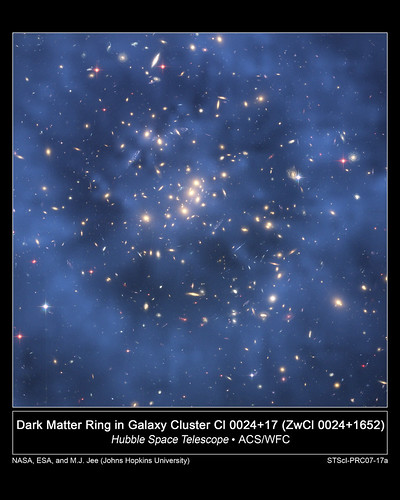
Yet a group of astronomers in Baltimore have used the Hubble Space Telescope "to map the dark matter billowing out from the long-ago collision of two galaxy clusters."

The photo released by NASA is quite extraordinary:


The Baltimore Sun explains: 

They’re calling it the strongest evidence yet of the existence of dark matter, and the first observation to separate it from its associated stars, galaxies and glowing gas.

"What we found is a very peculiar structure – a ring-like structure that surrounds the core of the cluster," said Johns Hopkins University research scientist M. James Jee, lead author on the study that will appear in the June 1 issue of The Astrophysical Journal.

It’s not exactly a ring of dark matter, he said. Rather, it’s a map of where the densest regions of dark matter must be, based on measurements of how that mass and gravity are bending the light streaming by from galaxies far in the background….

Jee likened the ring (in three dimensions actually a flattened spherical shell) to a jam-up of dark matter particles hurled outward from the collision, like commuters headed out of town, backing up behind slowing traffic ahead.

The Sun article notes that there is skepticism among some astronomers, who would like to see the evidence captured from a second source to rule out "peculiarities" in Hubble’s camera. Perhaps the image above is simply the astronomical equivalent of refracted light on film appearing as a "ghost" in your family photographs. Nonetheless, the evidence for dark matter is there, whether we’ve observed it yet or not.

(Also be sure to click here for a related video simulation of two galaxy clusters colliding.) 

Watch this Hubblecast to better understand the significance of this finding.


On or Off? Intelsat Still Confused in Sri Lanka

According to the Sri Lankan Army, LTTE broadcasts continue via the Intelsat 12 satellite. Via the Asian Tribune:

THE SRI LANKAN EMBASSY in Washington has complained to the US Justice Department, State Department and the Federal Bureau of Investigation (FBI) against Washington based Intelsat Ltd., for reneging its promise of removing the National Television of Tamil Eelam (NTT) channel and Pulikalin Kural radio from the Intelsat 12 satellite transponder and for continuing to facilitate and broadcast terrorist propaganda.

Before lodging the complaint, the Sri Lankan Embassy brought to the communication satellite company’s notice that despite its assurance that it has removed both channels from its transponder, it continues to broadcast National Television of Tamil Eelam, and Pulikalin Kural (Voice of Tigers radio) the official television and radio of the LTTE.

Intelsat Ltd., according to sources, laid down conditions to the Sri Lanka Embassy that talks with them should not be publicised or divulged to anyone which the Embassy refused even to consider.

Subsequently, the Sri Lankan Embassy alleged that the satellite provider is violating US law by continuing to broadcast the propaganda television and radio services of the foreign terrorist organisation LTTE, through the satellite they own despite public assurances given ago to the contrary.

National Television of Tamil Eelam, the official television channel of the LTTE is a free-to-air channel to Asia and an encrypted channel to Europe.

The four-hour daily programme of the NTT channel broadcasts propaganda material of the LTTE, a terrorist organisation banned in United States of America, Canada, India and in European Union countries.

The illegal transmission of the NTT channel of the LTTE was for the first time brought to Intelsat Ltd’s notice by Asian Tribune on March 10.

Dianne VanBeber, Intelsat Ltd Vice President in charge of Investor Relations and Corporate Communication, told ‘Asian Tribune’ that the LTTE is pirating the Intelsat’s 12 bandwidth without the company’s knowledge.

"Intelsat has notified the original customer for the capacity that they are in violation of their contract, and Intelsat has informed them to cease transmissions," VanBeber said.

Asked to identify the original customer of Intelsat, VanBeber refused to disclose the service provider’s name who has accommodated the LTTE’s media without Intelsat Ltd’s knowledge.

Asked whether Intelsat was not aware that the LTTE’s National Television of TamilEelam was using the Intelsat 12 satellite bandwidth since 2005, she clarified that Intelsat Ltd acquired PanAmSat only on July 3, 2006, and LTTE’s National Television of Tamil Eelam might have come to quietly share the Intelsat 12 satellite.

She said: "We are taking action to cease their transmission soon." Subsequently this issue was taken up by Bernard Goonetilleke, Sri Lanka’s Ambassador in Washington with Intelsat’s General Counsel, Phillip Spector.

A press statement was released by the Intelsat after the meeting.

In a press statement dated April 10 Intelsat Corporation said: "Intelsat officials, including its technical experts, met with Sri Lanka’s Ambassador to the United States, Bernard Goonetilleke, on April 10 to discuss the steps Intelsat is taking to address the unauthorised use of one of its satellites by the LTTE.

During the meeting, Intelsat’s General Counsel, Phillip Spector, said:’ "Intelsat does not tolerate terrorists or others operating illegally on its satellites. Since we first learned of the LTTE’s signal piracy, we have been actively pursuing a number of technical alternatives to halt the transmissions. We are clear in our resolve to ending this terrorist organisation’s unauthorised use of our satellite’."

Later, the Sri Lankan embassy revealed that Intelsat Ltd., stated that during April 21-22 they switched off the transponder of the free to air NTTE channel beamed to Asia and the encrypted channel beamed to Europe.

The Lyngsat site confirms that both the television and radio broadcasts were up and running on 29 April 2007 — nearly three weeks after we first blogged it. The program can be found every day, from 18:00 to 21:30 GMT, on Intelsat 12, transponder 2 (downlink frequency: 11,504 Vertical; symbol rate: 2894; FEC: 3/4).

How did that happen? If you read ToTheCenter.com, you’d think it was indeed turned off:

INTELSAT INFORMS SRI LANKA EMBASSY IN WASHINGTON IT SWITCHED OFF LTTE BROADCASTS FROM THEIR SATELLITE

( By Walter Jayawardhana)

Sri Lanka’s envoy in Washington, D.C. said his office had been given an assurance by Washington based Intelsat Corporation that they have switched off the transponder used by the Liberation Tigers of Tamil Eelam (LTTE) to broadcast its propaganda, during the last weekend.

“We were told last evening by Intelsat executive Phillip Spector that the transponder used by the LTTE was switched off during the weekend,” Bernard Goonetileke, Washington, D.C.’s Sri Lankan Ambassador told this correspondent.

However, Goonetileke said he was still not sure whether the banned terrorist group has made some other arrangements with a European satellite company to carry on with the broadcasts continually.

He said inquiries are made to check whether LTTE is continuing its broadcasts and whether they are doing it through another channel, suspected to be Globe Cast satellite of a European company.

A press release issued by the Washington, D.C. Embassy of Sri Lanka said,
“Intelsat Ltd., a U.S. based satellite company has terminated the “unauthorized” use of one of its satellites, Intelsat12, by the Sri Lanka based terrorist organization, the Liberation Tigers of Tamil Eelam (LTTE), for its TV and radio transmissions to Europe and Asia.”

The Executive Vice President and General Counsel of Intelsat Ltd., Mr. Phillip Spector, confirmed to Rajika Jayatilake, Counselor (Information) at the Sri Lanka Embassy in Washington, D.C., that Intelsat Ltd. had, over the April 21/22 weekend, shut down the transponder, which the LTTE had used for its transmissions, the press release said further.

Whatever new channel the LTTE is using will have to be advertised through some means since the viewers and listeners of its propaganda have to be informed about the changes in the broadcasting frequencies. So far, no such advertisement has been found.

Following the meeting with Ambassador Goonetileke on April 10, 2007, Mr. Phillip Spector, of Intelsat Ltd., stated that the LTTE transmissions were “unauthorized.” Countering the position taken by Intelsat Ltd., speaking from Sri Lanka’s north to wire services in Colombo, the LTTE denied it was using the satellite services illegally. “We are accessing it legally and there is no signal piracy,” said an LTTE spokesman.

However, inquiries by this correspondent could not find out any evidence to confirm the statement of Phillip Spector, that the LTTE was a pirate of the satellite.

The Embassy press statement traced the history of the LTTE-INTELSAT connection as follows: “Since March 2005, the LTTE had been transmitting TV and radio programs through Europe Star 1 satellite owned by French satellite provider, Alcatel. PanAmSat, a satellite operator headquartered in Wilton, Connecticut in the U.S., acquired Europe Star 1 satellite in July 2005. In July 2006, Intelsat Ltd. acquired PanAmSat, following which, Europe Star 1 satellite was renamed Intelsat12. The programs that the LTTE had been transmitting through Europe Star 1, thus continued uninterrupted even after Intelsat Ltd. acquired the satellite.”

It is believed that it was the intense pressure used by the Washington Embassy of Sri Lanka and the U.S. State Department and the Department of Justice, together with press publicity, that was adversely affecting Intelsat that finally brought an end of the deal.

The Sri Lanka Embassy said, the U.S. Department of State and the Department of Justice had both been informed that a terrorist group designated by the U.S. as a Foreign Terrorist Organization (FTO), was using a satellite owned by a U.S. based satellite company to transmit their TV and radio programs to Europe and Asia. (EOM)