Sensor Flight Computer Anomaly
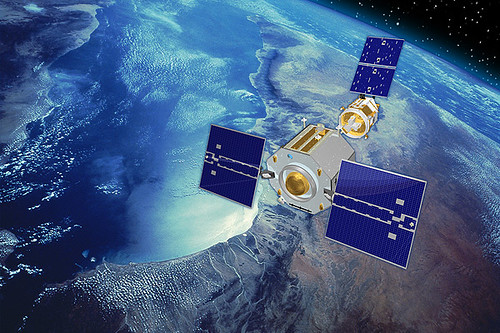
Launched in March, the Orbital Express mission has been progressing nicely. We blogged this cool space video last month, and I like the possibilities of this mission: on-orbit servicing of satellites. Potentially saving millions for all dependent on commercial space systems.

Then we read this from the DARPA Public Affairs Office, via SpaceRef.com:

15 May 2007 Update from Jan Walker, DARPA PAO:

"During Scenario 3-1 execution on the evening of May 11, Orbital Express encountered a serious sensor flight computer anomaly on the ASTRO while stationkeeping at 10 meters separation distance from the NextSat. Onboard fault protection reacted immediately, placing the ASTRO into an abort trajectory which carried it to a hold-point 120 meters from the NextSat. The Orbital Express team has spent the past several days recovering from this fault and from problems associated with loss of relative navigation at the longer-than-anticipated separation distances for this scenario. The ASTRO has since coasted at distances of up to several kilometers from the NextSat. Both vehicles are safe. The ASTRO powered up its redundant sensor flight computer and is processing sensor data nominally. The team is in the process of developing a recovery scenario for ingress and remate, and hopes to execute this ingress in the next several days."

Editor’s 14 May 2007 note: At this point ASTRO and NextSat should be a few meters apart. Some observers are suggesting that they are kilometers apart. No word from DARPA.

OE observed with Nextsat, SeeSat-L

"… NEXTSAT appeared to trail by about 0.5 deg, when at a range of about 600 km, which indicates a distance of about 5 km."

The account by New Scientist was more alarming than that:

The US military’s experimental satellite mission, Orbital Express, may be in peril. The lead spacecraft ASTRO has drifted several kilometres away from where it should be.

No updates from Boeing yet, but they’ve got a great team of people working on this mission. I’m sure they’ll recover from this without a scratch.
 

Here Comes BPL!

"While DirecTV and fellow satellite TV operator EchoStar Communications have managed to keep increasing their subscriber base in the face of stiff competition from cable operators, Wall Street analysts have long questioned what broadband strategy the satellite operators will employ to counter competitive pressures," says USA Today.

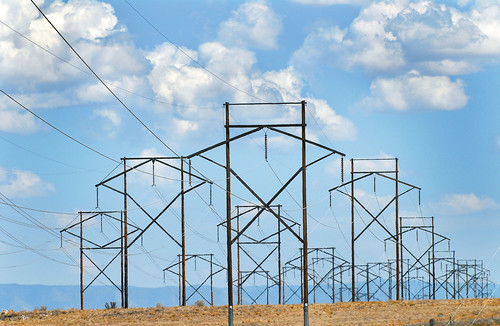
The answer to that question may now be visible on the horizon, with the news that DirecTV may test delivering high-speed Internet service through power lines in a major U.S. city in the next year.


USA Today explains:

DirecTV and others are talking to companies that specialize in providing broadband through the electrical grid, Chief Executive Chase Carey said at the Reuters Global Technology, Media and Telecoms Summit in New York.

"We’re not the only ones talking to them," Carey said, in response to a question on whether DirecTV would consider a test in a major city. "I think you’ll see some meaningful tests in this arena."

DirecTV would like to test delivering Internet access on power lines in a "top 50 city where you’re covering at least half the city."

Indeed, DirectTV isn’t the only company exploring Broadband-over-Powerline, or BPL, as it is known. Intellon Corporation, a leading provider of HomePlug-compatible integrated circuits (ICs), will be demonstrating a "HomePlug AV-enabled home entertainment ecosystem" at WinHEC 2007 in Los Angles.

The HomePlug AV standards can move data around the house at up to 200 Mbps — including VOIP and HDTV. Rather than using WiFi or cat 5 cables for networking, the system relies on power sockets for your network connections, thus eliminating the rat’s nest of cables that lie behind most people’s CPUs and TVs.

BPL is also moving into government use: Telekonet just yesterday announced (PDF press release) that they have won a contract with the DoD to deploy their IP-over-powerline LAN (which, for you sticklers, is FIPS 140-2 validated).  

Nigeria’s NigComSat1 Launches in China

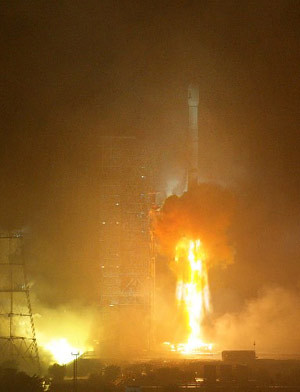
 Nigeria’s NigComSat1 (which we reported on just a couple of weeks ago) lifted off successfully from the Xichang Satellite Launch Center in southwest China’s Sichuan Province just after midnight this morning. The Nigerian paper The Guardian had some of the most extensive coverage of the launch:
True to prediction, the much awaited launch of the Nigerian communication satellite, the first of its kind in Africa, took place and went on the 20 to 30 – minute trip into orbit where it is expected to provide robust and reliable satellite services to citizens in Africa and Europe.

The excitement at the site, according to Nigerian officials at the launch, was "electrifying."

Head of Corporate Affairs and Media at the National Space Research and Development Agency (NASRDA), Mr. Felix Ale, told The Guardian on phone that the launch was successful.

He quoted the agency’s Director General Prof. Robert Ajayi Boroffice, as saying that the 30-minute movement of the satellite went on without delay.

According to Ale, "Prof. Boroffice has also called President Olusegun Obasanjo to inform him of the success of the launch. The President was impressed and full of praises for NASRDA.

NASRDA is, of course, Nigeria’s national space agency, who, incidentally, also has a pretty cool PowerPoint presentation available about NigComSat1 online.

In addition to be the first communications satellite launched on behalf of an African country, the launch of NigComSat1 also marks a significant first for China, as the first time a foreign buyer has purchased a Chinese satellite and its launching service. The Chinese news service, Xinhua, also points out that the launch represents the culmination and beginning of a relationship between Nigeria and China that will likely continue throughout the life-span of the satellite (about 15 years)…

The satellite will be monitored and tracked by a ground station to be built in Abuja, the capital of Nigeria, by Chinese firm Great Wall Industry Corporation, and a ground station in Kashgar, in northwest China’s Xinjiang Uygur Autonomous Region.

The satellite’s ground facility in Abuja "had the potential of making Nigeria a major traffic hub in the west and central African region" and will prompt Nigeria and neighboring countries to "expand their switching facilities to be able to handle international traffic", according to a Nigerian communication official.

The Chinese company will offer support services and training for Nigerian technicians.

China was awarded the deal in 2004 after it outbid 21 international rivals to secure the 311 million U.S. dollar deal.

And also, may point to China’s expanding relationship with the developing world.

The satellite represents China’s wish to cooperate with developing countries in the peaceful use of outer space and to promote a closer relationship between China and African countries, observers say.

China has signed several cooperative contracts offering commercial launching services for foreign satellites, said an official on space development, citing a similar satellite contract with Venezuela in November 2005 and adding that China has been commissioned to send about 30 foreign satellites into space.

Want more info on NigComSat1? Check out the photo gallery over at Xinhua and the Google Map’s powered realtime tracking at n2yo.com.

DIY Friday: Build Your Own DVR


I love my TiVo. My roomates love my TiVo. Pretty much everyone that has met it loves my TiVo. But TiVo isn’t cheap (especially if you want to record HD content) and I’m sure the $12/month I pay to keep up access to the TiVo service is going to get old when I start living on my own. So what’s a good RRS reader who loves TiVo — but just can’t fit the bill for it — to do?

Well, Duh. Make our own, of course.

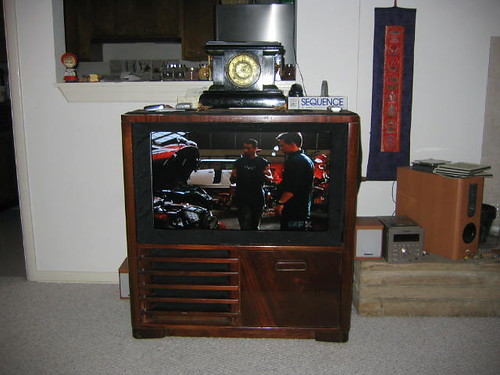
Forutunately for us, plenty of people have beat us to the punch and begun building their own DVR (digital video recorder), whether its to save money or build the ultimate, tricked out HD-ready, multi-tuner beast they always wantend… that also just happens to fit into an antique television console (as seen above).

The best place to start your efforts to build your own DVR is Build Your Own PVR (the P stands for personal, but basically means the same thing) which has tons of how-tos, construction guides, and forums for sharing tips and tricks about building your own TiVo-like device. If you want to build something this weekend and have an old (but not too old) computer lying around, check-out this how-to to figure out how to build your own homebrew PVR for less than $200 and a couple of hours. The site also has a pretty cool wiki (although it could stand a little fleshing out).

Be prepared, however, to get a DVR you can really write home about (i.e. brag about to your neighbors), you’re going to need to spend some real money on a nice hardware decoder (Hauppauge WinTV PVR 250/350 seems to be the favorite) and some time tinkering with whatever software you chose run your box of digital delight (MythTV, is, of course, the free standard bearer, but other options — Sage TV, Snapstream BeyondTV — do exist).

But if you’re willing to put in the time (and a little dough), I’m sure anything you build will have even the most hardcore TiVo enthusiats asking for a spec sheet.

Dense, Dark and Hot

Spitzer has done something amazing.

No, not the Governor of New York, although that Spitzer did recently nominate a new Executive Director of the New York State Foundation for Science, Technology and Innovation.

Rather, we’re talking about the first map of an extrasolar planet, HD 189733b, a "hot Jupiter" planet — and the hottest planet yet observed in the universe — which is located approximately 60 light-years from Earth.

The planet is so hot that astronomers believe it’s absorbing almost all of the heat from its star, and reflecting almost no light and thus making its appearance black, as this artist’s rendition of the planet illustrates:


(Live animations of the picture above can be found here.)

NASA explains the mapping project and the resulting discoveries: 

 Roughly 50 of the more than 200 known planets outside our solar system, called exoplanets, are hot Jupiters. Visible-light telescopes can detect these strange worlds and determine certain characteristics, such as their sizes and orbits, but not much is known about their atmospheres or what they look like.

Since 2005, Spitzer has been revolutionizing the study of exoplanets’ atmospheres by examining their infrared light, or heat. In one of the new studies, Spitzer set its infrared eyes on HD 189733b, located 60 light-years away in the constellation Vulpecula. HD 189733b is the closest known transiting planet, which means that it crosses in front and behind its star when viewed from Earth. It races around its star every 2.2 days.

Spitzer measured the infrared light coming from the planet as it circled around its star, revealing its different faces. These infrared measurements, comprising about a quarter of a million data points, were then assembled into pole-to-pole strips, and, ultimately, used to map the temperature of the entire surface of the cloudy, giant planet.

The observations reveal that temperatures on this balmy world are fairly even, ranging from 650 degrees Celsius (1,200 Fahrenheit) on the dark side to 930 degrees Celsius (1,700 Fahrenheit) on the sunlit side. HD 189733b, and all other hot Jupiters, are believed to be tidally locked like our moon, so one side of the planet always faces the star. Since the planet’s overall temperature variation is mild, scientists believe winds must be spreading the heat from its permanently sunlit side around to its dark side. Such winds might rage across the surface at up to 9600 kilometers per hour (6,000 miles per hour). The jet streams on Earth travel at 322 kilometers per hour (200 miles per hour).

"These hot Jupiter exoplanets are blasted by 20,000 times more energy per second than Jupiter," said co-author David Charbonneau, also of the Harvard-Smithsonian Center for Astrophysics. "Now we can see how these planets deal with all that energy." 

As Wired points out,  Spitzer’s technology could be used to map Earth-like planets — like the recently-discovered Gliese 581c, which we wrote about here.

For more on the Spitzer Space telescope, check out this great video found in the motherlode of online video, aka YouTube:

Your Majesty, It Really Is Rocket Science


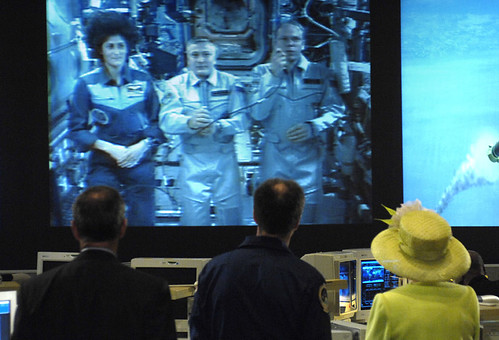
Queen Elizabeth II, in a speech at the White House Arrival Ceremony, was anticipating a visit to NASA’s Goddard Space Flight Center:

This visit also gives us a window on the future – both the future of the United States and the future cooperation between our countries.  I particularly look forward in the next two days to seeing at first hand something of how the cutting edge of science and technology can take us to the next phases of discovery and exploration in human endeavour.

NASA TV carried the visit live. You can watch the canned highlights any time you like. The tour occurred near the end of the queen’s visit to commemorate the 400th anniversary of the Jamestown settlement in Virginia.

TV at 65 Miles Per Hour

The backseat of the Chevy is now more entertaining than ever.

Echostar Communications Corporation and the DISH Network last week announced the launch of their MobileDISH Programming Packages.


Dallas Daily Business News reports:

[T]he MobileDISH™ in-car satellite service [is] a programming package that combines cutting-edge antenna technology from RaySat™. The MobileDISH™ technology, which was showcased at the 2007 Consumer Electronics Show earlier this year, allows DISH Network customers to watch live satellite television from their vehicles, even while in motion.

“We’re excited to partner with RaySat because we know people today are always on the move and have a need for TV even while on the road,” said Mark Jackson, President of EchoStar Technologies. “The MobileDISH technology is just another example of how we’re providing our extensive line of cutting-edge technology and exceptional programming packages to reach our more than 13 million subscribers everywhere.”

The mobile satellite antenna, designed by RaySat™, mounts to a vehicle’s roof rack and provides hundreds of channels of all-digital DISH Network satellite TV with programming for everyone in the family. The MobileDISH technology is perfect for occupying the kids, monitoring weather and road conditions, keeping up on breaking news and watching movies on long road trips.

We first wrote about the RaySat antenna system (pictured above) in September.

For sports fans, the MobileDISH service is particularly attractive: just yesterday, it was reported that DISH had added two new HD regional sports networks to its list of channels, and was looking at several more — which could bring a whole new level of connectivity to your local tailgate party.

But how much will it set you back?

New and existing DISH Network customers can choose from a variety of programming packages that start at $29.99/month for the MobileDISH 100 package, and $42.99/month for the MobileDISH 200 package. The Starz Movie Pak can be added to the MobileDISH packages for $12.99/month, and the Encore Movie Pak may also be added to a MobileDISH package for $4.99/month.

Not bad for those who’ve always wanted to watch the game while on the road or in the driveway. 

Plop-plop, Fizz-fizz in Zero-G

You Can Always Go Home Again (Unfortunately)

An interesting article over on ABC News website, explains that most cosmonauts love their job so much they actually don’t look forward to coming back to earth.


"’The hardest thing is coming back to Earth,’ [Cosmonaut Vladimir Dezhurov] said. The problem is not so much the mundanity of earthly existence — bills to pay, food to buy, chores to complete.

‘The muscle fabric degrades very much. It’s hard to walk. You have to learn how to walk again, like a small child.’

Astronauts train daily aboard the orbiting space station to prevent the atrophy of their legs and feet which are under-used in weightlessness. It takes several weeks under medical supervision to recover from a long stay in space.’"


But then again, any real space geek probably already knew that…

What might be interesting for those of us who know a little more is the information the article provides about Star City, Moscow’s tightly secured 1960s area Cosmonaut space center and the surrounding community, as seen above.

While supposedly time has kind of stopped in area, most cosmonauts never really feeling the full-effect of the collapse of the Soviet Union, what has changed is who is doing a lot of the blasting off in the environs… most notably in the increased presence of tourists.

While we all saw Stephen Hawking have a zero-g experience last week, in Star City, Russia the zero-g experience has you (and for just $3400-4000).

ASTRA 1L Launch Video