DIY Friday: HDTV Free-to-Air Box

So you’ve finished your Quantum Eraser Experiment from last week, and are ready to spend the weekend kicking back and watching a little TV.

But there’s nothing on the cable, and what you really want is to watch your favorite show from overseas.

Enter today’s DIY project — an HDTV Free-to-Air satellite receiver.

Back in September, we wrote about the Lyngbox Free to Air receiver, which promised up to 50,000 storable channels and global functionality:

Most “satellite people” are very familiar with the Lyngsat Web site. It could very well be the world’s most complete database of accurate satellite ladder charts. Pick a satellite and you can view all the channels available for viewing. For example, the AMC-4 satellite carries a number faith-based and international channels in North America. On another site, LyngSat Address, select a country and you can find out which satellites their channels are using for broadcasting – in their home market and internationally. TV Prima Romania, for instance, is using several satellites over Europe, Asia and the Atlantic.

At the time, the Lyngbox seemed imminent, but then we began to hear that they were looking for additional start-up funding and, whatever the case, the Lyngbox has yet to come to market.

Beating them to the punch, however, is the Fortec Star Passion HD Satellite Receiver. And doing-it-yourself (ie, hooking it up) promises to be quite easy: 

 The PASSION HD satellite receiver can connect to your HD-ready television using the HDMI output connection. The component (YPbPr) output can also be used. For analogue connectivity, SCART jacks, composite and S-Video outputs are provided. In addition to the analogue audio RCA jacks, PASSION also provides for digital audio output. For software loading, the USB port can be used. It is conveniently located behind the front panel door next to the two common interface slots.

And this puppy is loaded:

 # MPEG-2, MPEG-4 H.264 HD/SD Digital Video Decoding
# DVB-S2 and DVB-S compatible
# PCMCIA interface (2slots) according to DVB Common Interface standard
# DiSEqC 1.0, 1.2 and USALS (1.3) compatible
# HDMI, Component, Composite, S-Video, Digital Audio (SP/DIF) and SCART outputs
# Multiple output resolution modes: 1080i, 720p, 576p
# 16 bit True color On-Screen Display (OSD)
# Variable Aspect Ratio (4:3, 16:9)
# Multilingual Audio and Menu Text support
# Saves 10,000 channels (TV: 7000 CH, RADIO: 3,000 CH)
# VFD Display (Vacuum Fluorescent Display) for Channel Number, Name and Time
# Full Picture-In-Graphic (PIG) support
# SCPC/MCPC channel receivable from C/Ku band satellites
# Simple Operation through On-Screen Display
# Electronic Program Guide (EPG) for on-screen service information

Fortec is ready to ship, and their website includes a great set of instructional videos, including this explanation of free-to-air channels that is a must-see for anyone who doesn’t understand what it is we’re talking about. (Though we suggest turning down your volume before watching the video, as the music is terrible.)

So what are you waiting for? With cold air in the West, thunderstorms in the MidWest and rain throughout much of the East, this is a fine weekend to stay indoors and watch your favorite TV shows from around the world.
 

Go Sat, Go!

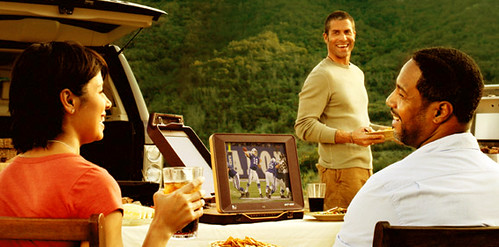
From the man who created CHiPS, an idea we blogged in January is finally here: Sat-Go:

  • Integrated 17-inch LCD monitor and satellite receiver with two speakers
  • Compact and portable flat antenna and satellite receiver
  • DIRECTV® programming accessed through a platform based on DIRECTV’s D11 set top box
  • Small profile IR remote
  • Component and composite A/V inputs
  • Composite A/V out
  • Satellite in connection
  • Phone Jack
  • USB connection
  • AC and DC capable (cigarette lighter adapter included)
  • Rechargeable, replaceable, laptop-style battery

All this for US$1,500. Today’s press release:

Just in time for the summer travel season, DIRECTV, Inc., the nation’s leading satellite television service provider, is launching DIRECTV(R) Sat-Go ("Satellite-to-Go"), the world’s first portable satellite TV system.

Beginning today, the DIRECTV(R) Sat-Go unit, created by DIRECTV and TV producer/writer, Rick Rosner, is available to DIRECTV customers for $1,499. DIRECTV customers who are interested in purchasing a DIRECTV Sat-Go unit can call 1-800-DIRECTV. The DIRECTV Sat-Go will be available at participating retail locations across the country soon.

"DIRECTV’s digital satellite technology enables us to do what no cable service can, offer consumers TV programming that they can watch wherever they are," said Eric Shanks, executive vice president, DIRECTV Entertainment. "DIRECTV Sat-Go is the perfect companion for a summer road trip and the ultimate tailgating accessory for any sporting event. Since we unveiled a prototype of the unit in January, the DIRECTV Sat-Go has created an exciting buzz in the marketplace and we are thrilled to make it available now to DIRECTV customers across the country."

The DIRECTV(R) Sat-Go is specifically designed to be compact and highly portable. The unit comes in an easy-to-carry, briefcase-like design that includes a 17-inch LCD monitor with integrated DIRECTV Receiver, flat antenna and replaceable/rechargeable lithium-ion battery. The unit also includes AC/DC adaptors for home and car.

Once the DIRECTV Sat-Go unit is opened, there is no installation necessary. It’s quick and simple setup makes it easy for customers to find line-of-sight with DIRECTV satellites and receive DIRECTV(R) programming within minutes (provided the user is within range of the DIRECTV signal).

When not being used as a portable/ travel unit, the DIRECTV Sat-Go can also be utilized as an additional in-home DIRECTV Receiver and television. The LCD TV screen has a built-in DIRECTV Receiver, which can be separated from the DIRECTV Sat-Go antenna casing and connected to a customer’s existing DIRECTV Satellite Dish.

GSA Awards $750m in Satcom II Contracts to 24 Companies

The General Services Administration (GSA) yesterday inked deals with 24 satellite communications companies to deliver the next-generation satellite solutions for government agencies, known as Satcom II.

The Satcom II program is meant "to provide an expanded range of end-to-end satellite solutions for government agencies and serves as the primary replacement vehicle for the highly successful Satellite Services contracts."

Among the service providers are nine small business contractors, according to Washington Technology:

The large contractors are Americom Government Services Inc.; Arrowhead Global Solutions Inc.; Artel, Inc.; AT&T Corp.; DRS Technical Services; EDS Corp.; Global Communications Solutions Inc.; Hughes Network Systems LLC; Intelsat General Corp.; Mackay Communications Inc.; Segovia Inc.; Stratos Mobile Network Inc.; Telecommunications Systems Inc.; Telenor Satellite Services and ViaSat Inc. The small business awardees are CVG Inc.; DasNet Corp.; E&E Enterprises Global; Knight Sky Consulting and Associates LLC; New Orleans Teleport Inc.; Psi Systems Inc.; RiteNet Corp.; Satellite Communication Systems Inc. and Skjei Telecom Inc.

The same story provides details on the Satcom II system:

The Satcom II system will allow federal workers to use hand-held receivers similar to cell phones, as well as access full broadband computer networks, anywhere in the world. It is designed for use in areas where no phone or cable lines exist and to help federal workers fight wilderness wildfires, patrol remote borders and rescue the trapped and injured from hurricanes or tornadoes.

The system also makes possible broadcast services in distance learning for federal customers throughout the world…

The GSA press release notes that the "SATCOM-II program has an estimated value of $750 million over the life of the five-year, indefinite delivery, indefinite quantity contracts, and… offers competitive pricing throughout the life of the contract, as well as flexible ordering and billing."

Computerworld also files a report on the contracts, which, while certainly important to the businesses that inked them, essentially provide basic satcom services. The really cool technological breakthroughs (such as the next-stage C4ISR bandwidth, advanced extremely high frequency satellites and Wideband Global Satcom program) tend to come through military contracts.

Enter The HDTV Challenge


I’ve heard people argue that standard-definition reception from an old backyard C-band dish is still better than today’s highly-compressed HD available from direct-to-home services in the U.S.

Now comes this via Television Week:

Comcast Enters HD Quality Dispute
This week Comcast launched a major ad campaign that opened a new battlefront in the HD service provider war: comparative picture quality.
Touting a study by Frank N. Magid Associates, Comcast took out full-page newspaper ads in 15 markets claiming its HD picture quality is superior to satellite competitors DirecTV and Dish.

"We always knew we offered more HD choices, and we always thought we had more convenient HD service and better HD picture quality, but now we can prove it by a fairly overwhelming margin," said Page Thompson, senior VP and general manager of video services at Comcast.

Though Comcast said the study has been long planned, the ads could be seen as a response to DirecTV’s ongoing television campaign featuring celebrities touting the satellite provider’s HD service as better than cable. Cable operator Time Warner has filed lawsuits over the DirecTV ads, claiming they’re false advertising.

"They’re talking about service they’ll have in the future because the product they have today doesn’t compare," Mr. Thompson said.

When DirecTV’s campaign started late last year, the satellite provider initially claimed to have a superior HD picture quality. But a New York federal judge upheld Time Warner’s objection to the seemingly unverifiable claim in February and the ad was changed. Current DirecTV ads claim the satcaster will "soon" have more HD channels than cable, a boast that has withstood a legal challenge.

But while Time Warner was busy filing lawsuits, Comcast commissioned a study to try to prove, once and for all, who has the best picture.

The study was conducted in March, with 309 subjects showed side-by-side images from DirecTV, Dish and Comcast on identical TV sets. To eliminate set bias, the HD signals were rotated among the sets. Subjects were shown various genres of programming from different networks.

To help protect the study from legal challenges, Comcast tapped Magid to conduct the test; Accenture, a technology consulting company, to oversee the technical aspects; and Loeb & Loeb, a national law firm, for legal guidance on the survey process.

The result: 66 percent preferred Comcast to DirecTV, and 70 percent preferred Comcast to Dish.

A DirecTV spokesman questioned the validity of the results, noting there are several ways picture quality could be skewed: the equipment used, instructions given to subjects, the content chosen and whether the Comcast signal at the test location was representative of the cable operator’s markets as whole.

"There’s not much substance here," spokesman Robert Mercer said. "While they’re making claims about their signal clarity, the methodology of the survey seems questionable at best."

Mr. Mercer added that an independent company surveyed home theater installers last year, who said, by a 4-to-1 margin, that DirecTV had the best signal quality.

As for whether DirecTV will take the Time Warner route and file a lawsuit to halt the picture-quality claim, Mr. Mercer said, "We’re evaluating our options."

A Dish Network representative had no comment.

In addition to the newspaper ads, Comcast plans a radio and online ad campaign to tout the results of its study.

The Comcast ads were greeted with cheers from HD online fan communities-even from satellite subscribers-who are pleased that top-notch HD picture quality is becoming a point of contention among service providers.

For years HD fans have debated the picture quality of HD providers. As bandwidth-strapped providers have added more HD networks to remain competitive, some sharp-eyed viewers claim signal compression is causing visible quality degradation.

Though fans definitely want more HD channels, some say they do not want content at the expense of what made them fall in love with HD in the first place: its startling, lifelike images. Dismissive statements by service providers that all HD is the same, or that, as one DirecTV executive once put it, "Viewers don’t watch the back of their TVs," have further frustrated fans.

With Comcast, the country’s largest cable operator, making picture quality a battleground issue, fans hope its competitors will soon follow suit.

"I think it’s outstanding Comcast did this," said one poster on AVS Forum.

"As a DirecTV customer, this makes me very happy," enthused another.

Comcast still must contend with DirecTV’s planned barrage of 100 HD channels by the end of the year, though Mr. Thompson reiterated that quality matters more than quantity.

"Our plan is to launch every HD channel that really matters to our customers," he said. "To put out an arbitrary number of HD channels without regard for the quality of the channels seems like a strange strategy.

"In addition to the channels, we have 100 HD video-on-demand hours. We’ll double that by the end of the year and double again by the end of next year."

Ariane Launching ASTRA 1L Satellite


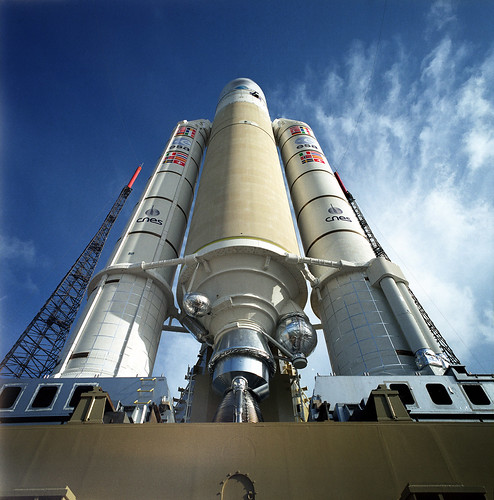
We have a potentially record-setting launch coming up on Thursday, 3 May 2007, from the jungles of French Guiana. We’re talking some heavy payload here. The news via L’Express

La fusée européenne Ariane 5 doit décoller jeudi soir de Kourou pour mettre en orbite une masse sans précédent constituée de deux satellites de communication.

La masse totale – celle des deux satellites Astra 1L et Galaxy 17 et des interfaces – s’élève à 9,4 tonnes, un record mondial pour un lancement sur orbite géostationnaire, rapporte Arianespace, l’exploitant du lanceur.

Le décollage est prévu à 19h29 (22h29 GMT) du Centre spatial guyanais, la base de l’Agence Spatiale Européenne.

Il s’agit du 176e lancement d’Ariane, du 32e vol d’une Ariane 5 et du 10e d’une Ariane 5 ECA, modèle le plus puissant de la gamme, qui peut mettre jusqu’à dix tonnes sur orbite.

Le satellite Astra 1L doit être placé sur orbite 27 minutes après le décollage et Galaxy 17 cinq minutes plus tard.

Construit par l’industriel américain Lockeed Martin Commercial Space Systems en Californie, Astra 1L a une masse au décollage de 4,1 tonnes, selon Arianespace.

Il sera positionné au-dessus de l’Europe continentale, d’où il assurera la diffusion de chaînes de télévision de haute définition (HD) pour le compte de SES Astra, société du groupe Société Européenne des Satellites (SES), basée au Luxembourg.


I’m making plans to watch it myself. The launch window opens at 22:29 GMT and closes at 23:13 GMT on 3 May 2007. Local time in French Guiana is right after dinner (between 19:29 and 08:13 on 3 May 2007), but I doubt anyone will be able to eat beforehand. Here are some local times:

New York: 18:29 to 19:13 on 3 May 2007

Luxembourg: 00:29 to 01:13 on 4 May 2007

Singapore: 06:29 to 07:13 on 4 May 2007

Live television broadcast begins at 21:50 GMT (17:50 EDT; 23:50 CET): 

  • In Europe, the launch will also be broadcast live via ASTRA satellite from the orbital position 19.2° East (downlink frequency: 12.5515 GHz, vertical polarization, service ID 12122, service name ASTRA Vision 2).
  • In North America, lock your antenna on Galaxy 3 at 95 West (transponder 22, C-band; Format: digital 9 MHZ, 4126.5 Vertical, FEC: 3/4, Symbol Rate: 6.1113).
  • Click here to watch the live webcast.

According to our friends at ASTRA, the satellite will be performing a critical mission:

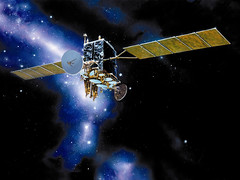
ASTRA 1L will be located at 19.2° East, ASTRA’s prime orbital position for delivering broadcast services to continental Europe, where it will also transmit the increasing number of HDTV channels. The new satellite will allow SES ASTRA to move its satellite ASTRA 2C from 19.2° East to 28.2° East, in order to meet the high demand for capacity from the U.K. and Irish markets. It will also extend the ASTRA coverage from the Canary Islands in the West to the Russian border in the East and further strengthen SES ASTRA`s unique in-orbit back-up scheme.


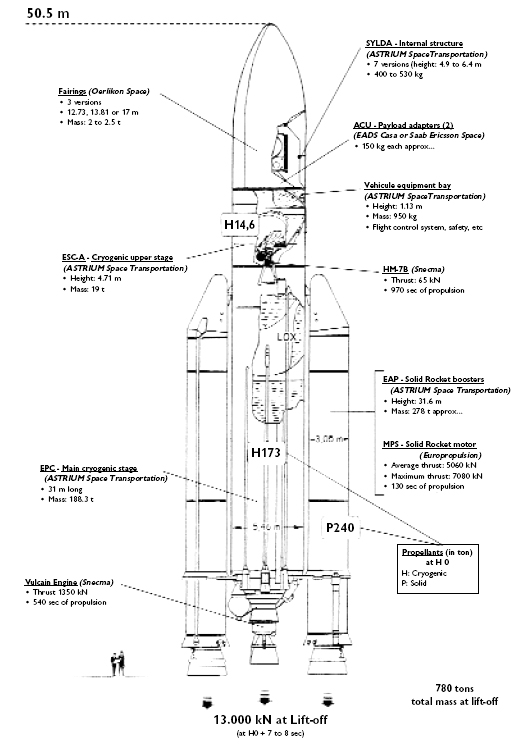
The launcher itself is described in great detail on the ESA Web site.

TO SAVE MY COUNTRY, I NEED TO BORROW THE SUM OF $200 MILLION

Nigeria is a country best known for its email marketing scams. You know, the ones written in all caps and started off something like…

"Dear Friend,
It is with heartfelt hope that I write to seek your co-operation and assistance in the context stated below, I am Barrister Fenner Mark Elvis, the personal Attorney to the late Mr. Nobert Spagele. I got your contact through the help of my brother-in-law that works with the American Chambers of Commerce and Tourism, though I did not disclose to him my humble intention for an honest foreigner like you, having noted the confidence reposed on your person by the sponsor of the recommendation…

Well, according to SpaceMart, last January a Chinese Bank fell for a similar line and, at present, is financing the construction of Nigeria’s first communications satellite, NigComSat, which is now set to launch before the end of this month.

While this is not Nigeria’s first satellite, a title held, according to allAfrica.com, NigeriaSat-1, launched in 2003 to take photos of Nigeria’s environs, it does mark the first time a Sub-Saharan African country has launched and retained control of their own communications satellite.

Recently "replaced" Nigerian President General Olusegun Obasanjo said that the satellite is a part of his country’s commitment to development:

"This commitment has informed our embarking on programmes and initiatives that would effectively address the challenges of poverty, food security, infrastructural development, sustainable energy, affordable health and housing, and protection from natural and man-induced disasters.

Space technology is key to the realization of the Millennium Development Goals (MDGs) and the objectives of our holistic reform agenda as encapsulated in the NEEDS document. It guarantees the availability and speedy access to real-team data and geo-partial information, as well as the availability of relevant infrastructure and backbone for information communication"

The Chinese, who are financing, building, and launching the project, are also proud of the effort, the first step in a move to develop a satellite design and construction export business. The launch will take place at the Jiuquan Satellite Launch Center, which has launched some 30 satellite since 1990, 24 of which were commercial launches for overseas clients.


The satellite itself is being constructed by China Great Wall Industry Corp., based on China’s latest model of satellite platform, DFH No. 4, and will feature 28 transponders, including 4 C band, 18 Ku band, 4 Ka band and 2 L bands. The whole thing weighs somewhere around 5000 kg and has an anticipated life-span of 15 years.

Blast Me Off, Scotty


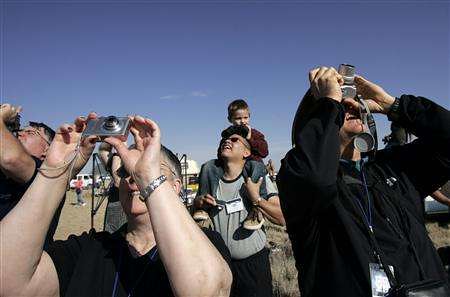
The earthly remains of the one and only Scotty from Star Trek, Canada’s own James Doohan, beamed himself into outer-space from just outside of Truth or Consequences, NM this weekend in one of the first successful launches from America’s first commercial spaceport, Spaceport America.

The ashes of Doohan and 200 other space enthusiasts, including Astronaut Gordon Cooper, were launched into outer space Saturday aboard a Spaceloft XL rocket (made by UP Aerospace) for 15 minute, 72 mile high flight. The flight, which cost each "passenger" $495, was arranged by the Houston-based, Space Services, Inc. (the same company that put the ashes of Star Trek creator Gene Roddenberry in to the sky in 1997) and ended in a parachute ride back to earth. According to Reuters, "Capsules containing the ashes are retrieved, mounted on plaques and given back to relatives."

The coverage of Scotty’s lift-off has been pretty wide, including some coverage in Scottish papers and, not surprisingly, a bevy of stories from the area surrounding America’s spaceport.

We’re working to find a YouTube of the lift-off, but, for now, be sure to check out the QuickTime version of the launch on the UP Aerospace website.

DIY Friday: Quantum Eraser Experiment

I’ll be the first one to admit that I don’t REALLY get the ideas behind quantum mechanics. Sure, I have a loose idea of what it is, somehow managing to bring complexity and relativity into the precise world of classic, Newtonian physics — you know, something to do with light being both waves and particles at the same time — but if you ask me to go into any more depth I’ll either fake it or redirect your attention to a funny cartoon I saw in the New Yorker last week.

But my lack of knowledge shouldn’t mean that you should be deprived on an excellent DIY Friday that focuses like a laser beam (ha ha, RFLMAO) on one of the central cases for the necessity of quantum theory, the double-slit experiment, that you can do it home.

First and foremost, before you even try the experiment I’ll link to below, do yourself a favor and check out the Dr. Quantum YouTube video below to get a basic handle on the experiment. The visualizations mean that, even if you’re a dolt like me, you’ll understand just why you’ll want to do this experiment yourself.

If you’re interested in the larger question of observer effects in quantum theory and you don’t mind delving a bit into the philosophy of science (the only way I had stumbled into this whole quantum theory business before), do a little reading on the famous Schrödinger’s cat thought experiment… its good fun and it’ll, again, make the DIY experiment a little more thought provoking.

Finally, if you’re ready to go for the good stuff, check out Scientific American’s DIY Quantum Erasure experiment page and learn how to do the double-slit experiment on your own all while working through the paradox posed by Schrödinger’s work. Also be sure to check out the awesome slide show SA has for the experiment (which shows how to conduct the experiment in a little more detail) and some other neat online extras.

Not looking to delve that deeply into the major problems of contemporary physics this weekend? Well, just watch the video below and laugh comfortably knowing that now you have the knowledge necessary to make your own video on a physics superhero too.


The Quantum EraserThe funniest bloopers are right here

Earth-Like Planet Found, But What Does It Mean?

By now, most people have heard the news about the discovery by a team of Swiss, French and Portuguese scientists of an earth-like planet just 20.5 light years away from Earth. The news has clearly captured the imagination of scientific writers and people around the world, in no small part because the potential implications of what we might learn about the planet are deep with existential meaning. (This AP title — "Planet-finder says search for alien life next" — exemplifies the anticipatory nature of the coverage.)

But reigning in our imaginations for a moment, what did the scientists truly discover, and how? 


Universe Today offers some good detail on the discovery: 

The host star is called Gliese 581, and it’s one of the 100 closest star to us, located only 20.5 light years away in the constellation Libra. Unlike our Sun, it’s a red dwarf star, emitting much less light and energy. This brings its habitable zone in close and tight to the star. For a planet to be orbiting its parent star within this habitable zone, it’s got to have a really tight orbit.

And this is how the planet was discovered. It was made by measuring the star’s radial velocity, where the planet’s gravity tugs its parent star back and forth (aka, the Wobble Method). Astronomers can measure this velocity with tremendous precision to determine the planet’s mass and orbital period. And the tool for the job is the European Southern Observatory’s HARPS (High Accuracy Radial Velocity for Planetary Searcher) spectrograph connected to the 3.6-m telescope at La Silla, Chile.

The planet is “Earth-like”, but it wouldn’t seem much like home. It’s 50% larger than the Earth, and has about 5 times our planet’s mass. It also completes an orbit every 13 days – it’s 14 times closer to its star than the Earth is to the Sun. Since it’s in the habitable zone, there would very likely be liquid water on its surface.

Unfortunately, the radial method only tells astronomers what the planet’s mass and orbital distance are. They’re not directly observing it. So there’s no way to know if there is actually water on the surface, or even oxygen in the atmosphere that would indicate the presence of life. But future missions, like Darwin, will certainly put it in the cross hairs to get a better look for life.

The discovery was made by a team of astronomers at the European Southern Observatory in Chile. Naturally they are the go-to source for additional information, including this summary video already up on YouTube.

The press release from ESO also tells us that computer models indicate that the planet should be "either rocky — like our Earth — or fully covered with oceans."

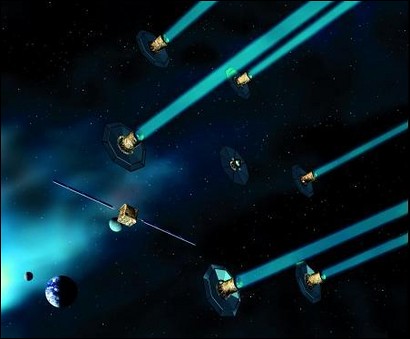
The ESA’s Darwin Flotilla (artist’s rendering below; scheduled for launch in 2015) will give scientists additional tools in exploring Gliese 581 and other exoplanets that may harbor life.


And perhaps this discovery will jump start a new, friendly "space race" to discover details about distant exoplanets. As The daily Tribune de Geneve boastfully pointed out, "American scientists recently estimated that the discovery of an exoplanet resembling the Earth would probably take 20 years," it wrote. "The Europeans didn’t wait for them."

NASA’s AIM Spacecraft Launch via Pegasus XL


Nice launch of the AIM spacecraft, via NASA press release:

During the next two years, AIM scientists will methodically address each of six fundamental objectives that will provide critical information needed to understand cloud formation and behavior.

"This mission has many firsts, including that Hampton University is the first historically black college and university to have the principle investigator and total mission responsibility for a NASA satellite mission," said Program Executive Victoria Elsbernd, NASA Headquarters, Washington.

NASA’s Kennedy Space Center, Fla., is responsible for launch vehicle/spacecraft integration and launch countdown management. NASA’s Goddard Space Flight Center, Greenbelt, Md., is responsible for the overall AIM mission management in collaboration with Hampton University, the University of Colorado, Boulder, and Virginia Polytechnic Institute and State University, Blacksburg. Orbital Sciences Corporation, Dulles, Va., is responsible for providing the Pegasus XL launch service to NASA.