Space Video: On-orbit Servicing with NextSat

We told you about the launch a few weeks back, but the Orbital Express refueling system appears to be up, running, and pretty effective. For those that don’t remember here’s the story about the new technology:

The goal of the Orbital Express Space Operations Architecture program is to validate the technical feasibility of robotic, autonomous on-orbit refueling and reconfiguration of satellites to support a broad range of future U.S. national security and commercial space programs. Refueling satellites will enable frequent maneuver to improve coverage, change arrival times to counter denial and deception and improve survivability, as well as extend satellite lifetime. Electronics upgrades on-orbit can provide regular performance improvements and dramatically reduce the time to deploy new technology on-orbit.

The full story about the mission of the Orbital Express satellite can be found at NASA’s Automated Rendezvous & Docking program website.

The video you see about you is a survey of the NextSat, the kind of serviceable satellite the Orbital Express is designed to fuel, and its refueling buddy as taken by the camera on its own arm.

100 MPG X-Prize

It’s no secret that those of us here at Really Rocket Science were big fans of the original X Prize and the X Prize Foundation.

For the uninitiated, the original Ansari X Prize, according to Wikipedia:

… was a space competition in which the X PRIZE Foundation offered a US$10,000,000 prize for the first non-government organization to launch a reusable manned spacecraft into space twice within two weeks. It was modelled after early 20th-century aviation prizes, and aimed to spur development of low-cost spaceflight. The prize was won on October 4, 2004, the 47th anniversary of the Sputnik 1 launch, by the Tier One project using the experimental spaceplane SpaceShipOne.

How could we not be obsessed with such a competition? Not only did the winning craft give us an opportunity to rekindle our long-held admiration for the aerospace designs of Burt Rutan — but the prize helped launch the X-Prize Cup and our beloved X-Racers.


The second X Prize, the Archon X Prize, is "$10 million for the first non-governmental organization to sequence the complete genomes of 100 humans in 10 days time."

And now, in accord with our obsession with speed and technology, comes the Automotive X Prize.

From the website:

People love their cars. They are vital links to our jobs, our community, ourselves. For everything we love about them, cars are chained to the most severe global crises of our time: oil dependence and climate change.

We aim to break this deadlock through the most radical approach to innovation yet – the X PRIZE.

The Automotive X PRIZE will invite teams from around the world to focus on a single goal: design viable, clean and super-efficient cars that people want to buy.

This will be a race for the ages, with major publicity and a big sack of cash waiting for the champion, and perhaps our future hanging in the balance.

How’s that for gripping PR copy? It sure makes us want to channel our inner De Lorean and get to work.  (Guidelines for entry can be found here.)

We’ll be keeping you up to date on the progress (and cool designs) of the Automotive X Prize as well as future X Prizes in other fields and technologies. Becuase we, too, believe in "revolution through competition." And one never knows what form of locomotion the winning design might use.


Google offers FREE residential Broadband Service!!!!!!

Welcome to Tisp

Sign up for our free in-home wireless broadband service

Sick of paying for broadband that you have to, well, pay for?

Introducing Google TiSP (BETA), our new FREE in-home wireless broadband service. Sign up today and we’ll send you your TiSP self-installation kit, which includes setup guide, fiber-optic cable, spindle, wireless router and installation CD.

Get Started with Google TiSP


TiSP in-home wireless broadband is:

  • Free, fast and highly reliable

  • Easy to install — takes just minutes

  • Vacuum-sealed to prevent water damage

DIY Friday: Satellite Radio Round-Up

We tend to write a lot about Satellite Radio here on DIY Fridays, but that’s probably because it represents the next frontier for true satellite geeks. Digital quality audio, anywhere in the country, in your home or on the road, satellite radio represents a dream come true for nerdy enthusiasts: technical superiority, freedom, and a new chance to tinker with technology. So while, its not a purely DIY task, I thought I might use this week’s DIY Friday to talk a little bit about our new favorite technology.

First of all, for those who admit that they need to learn a little bit more about satellite radio technology, this article by the folks over at Crutchfield Advisor explains the reality of the satellite radio marketplace and the options out there for those looking to tune in in an incredibly readable way. While normally I’d be a little concerned about passing along a guide about a product from a company that looks to sell you something (especially on a DIY Friday), Crutchfield is famous for being a dream company for DIYers looking to add new and improved audio technology to their car. Not only does every install kit from Crutchfield come with thorough, user-friendly instructions, but the company’s sales and help lines are famous for their knowledgeable, no pressure operators most of whom are willing to talk you through almost any car stereo installation troubles you can imagine.

But what about those times that you’re not in your car or near an otherwise wonderful satellite radio receiver. Well, have no fear, an amazingly productive community of open source developers is here to bail you out of radio-less existence. According to WIRED, developers have rolled their own solution to the problem of no satellite signal =ing no radio with Pocket Satellite Radio and Mobile Satellite Radio which are able to grab the streams using a cell phone’s internet connection. While it means you might be limited to whatever stations Sirius or XM stream over the net (which means no Howard for dedicated Stern-ites), it does give you access to most stations when your in a dire situation (read: without a satellite signal). The best part? It’s a receiver for only $20.

Nortel, MSV to build Hybrid Satellite-Terrestrial Network

We’ve seen the future, and it contains uninterrupted service.

Mobile Satellite Ventures (MSV) and Nortel this week announced that they are partnering to deploy the first integrated 4G and satellite broadband network:

"This trial is a significant step toward next-generation mobility," said Drew Caplan, MSV chief network officer. "Nortel’s 4G and IMS expertise will help us demonstrate our transparency network architecture to support hybrid satellite-terrestrial communications on the basis of a 4G broadband platform, enabling new dimensions of service for our customers."

The trial with Nortel, which will be conducted in the Reston, Virginia area, will initially feature high-speed wireless voice, data and Web access, file sharing, and VoIP connectivity using residential gateway devices and PC Cards for users in fixed and portable modes of use. Subsequently, MSV expects to incorporate push-to-talk, video calling, picture-caller ID, and presence capabilities, full MSS/ATC integration, and support for a range of mobile devices. Nortel will integrate its WiMAX and IMS connectivity as well as devices and ASIC technology from Kyocera, WiNetworks, and Runcom Technologies.

The Ottawa Business Journal also has coverage of the joint venture, which was announced this week at the CTIA Wireless 2007 Conference in Orlando, Florida. (Some other interesting and hip tidbits from CTIA: Nokia had one of the cooler displays, and AT&T’s COO was spotted with an iPhone.)

Although MSV  was the first company to get an Ancillary Terrestrial Component license from the FCC, which provides the legal permit for the hybrid system, they’re certainly not the only company pursuing the promise of a network that combines the best of tower and satellite mobile communications. TerreStar Networks is building "North America’s first all-IP enabled, next generation mobile communications network over an integrated satellite-terrestrial system" that "will provide universal access and tailored applications to millions of users throughout North America via mass market commercial wireless devices." Low-Earth Orbit satcom company LeoTerra is also involved.

Whichever company gets there first with a hybrid system, however, the 4G broadband marketplace is likely to be tumultous in the coming years, as we wrote earlier this month. In January of 2008, the FCC will be auctioning off "the last beachfront-property" spectrum in the nation — the 60 megahertz spectrum being vacated by television broadcasters when they cease analog broadcasting in 2009 — and there are some big names — including Yahoo! and Google — that are lobbying the FCC to allow bidders to aggregate enough licenses to create new national 4G networks.

It truly is a brave new world.

Look out below!!!


Flaming space junk from a Russian satellite narrowly missed hitting a Chilean airliner over the Pacific Ocean, reports said Wednesday.

The pilot of a LAN Chile Airbus A340 en route to New Zealand told air traffic controllers he had seen pieces of flaming space junk falling about eight kilometres (four miles) in front of the plane and behind it, TV3 said.

The aircraft was not struck by any of the debris and later landed safely in Auckland.

Airways New Zealand, which manages New Zealand’s air traffic, said it had been warned by Russian authorities that an obsolete satellite was due to fall into the Pacific Ocean on Wednesday.

But the debris had apparently fallen into the area 12 hours earlier than the time advised by the Russians.

A spokesman for the Civil Aviation Authority, which is responsible for air safety, said it would launch an inquiry after it was advised of the details of the incident.

Hu, Putin Orbit Around Mars


We blogged about the Chinese-Russian mission to Mars last August, so this isn’t really news to us. But during Chinese President Hu Jintao’s visit to Russia the other day, a formal announcement was made about a mission to Phobos, a Martian moon. Here’s the story from People’s Daily:

A Chinese satellite is expected to orbit Mars in 2009, thanks to an agreement the country signed with Russia on Monday

During President Hu Jintao’s current visit to Moscow, the two countries agreed to stage a joint unmanned mission to the red planet and one of its moons in two years, the China National Space Administration said yesterday in Beijing.

The agreement represents a "milestone" in the history of space cooperation between the two neighbors, the agency said in a statement.

"It indicates the two sides have taken a key step forward to working together on a large space program."

According to the agreement, a micro-satellite developed by China will be launched along with "Phobos Explorer", the Russia spacecraft, atop a Russian rocket in 2009.

A timetable was not mentioned, but earlier Russian reports said the launch window for the 10-11 month voyage to Phobos, a Martian moon, will be October 2009.

Phobos became a satellite of Mars millions of years ago, so studying material from the asteroid will give scientists information on the origins of the solar system and of Earth, the Russian news agency RIA Novosti cited Russian Academy of Sciences member Mikhail Marov as saying.

After entering Mars’ orbit, the Chinese micro-satellite will be detached from the Russian spacecraft, and probe the Martian space environment, according to the statement.

The "Phobos Explorer" spacecraft, with some equipment developed by the Hong Kong Polytechnic University, will land on the Martian moon and return to Earth with soil samples.

Monday’s agreement was signed by the China National Space Administration head Sun Laiyan and the Russian Federal Space Agency chief Anatoly Perminov and witnessed by the two countries’ presidents.

Last year, the Russian space chief revealed that his country would work "closely" with China on lunar exploration.

Youriy Nosenko, deputy chief of the Russian space agency, told a press conference in Beijing last November that Russia regards China as a "partner" in space exploration, and the two sides have shown interest in a lunar project.

China has started a three-stage moon exploration project, including sending a lunar orbiter some time this year, followed by a soft landing in 2012 and the return of lunar samples in another five years.


Unlike NASA, a civilian agency,  the China National Space Administration falls under the supervision of the Commission of Science Technology and Industry for National Defence. But hey, the Taikonauts have their fans.


Spacesuit Riot (Riot!)

At Johnson Space Center, scientists are hard at work building the next generation of spacesuits for American astronauts’ return to the moon.

And at least one scientist there seems to have been destined to do this work; his name, appropriately enough, is Joe Kosmo.

The Associated Press explains:

Developing the new suits is easier than in the Apollo era, when designers had to rely on slide rules and drafting tables. The suits are designed and re-designed on computer screens before any hardware is used.

"There’s a lot more capable tools and technology to get the job done – a lot more knowledge, as well – so we can capitalize on them," said Joe Kosmo, who participated in the design, development and testing of suits from the Mercury, Gemini, Apollo, Skylab and shuttle eras.

At the top of the list is making the next spacesuit smaller and lighter – engineers are hoping to halve the 200-pound weight of the suit and life support backpack that Apollo astronauts lugged around.

NASA plans to use new, lightweight composite materials and take advantage of smaller electronics to shrink the life support backpacks. NASA also wants the astronauts to be able to move around easily.

Terry Hill, who’s developing the new spacesuit, recalled the robotic-like hops of the Apollo astronauts broadcasting from the moon.

"Mostly, that was because of mobility – they just didn’t have it," he said. 

(An interesting aside found in the AP’s report is that Russian spacesuits, unlike American ones, are only designed to be worn a few times before being thrown away. We reckon that’s how we ended up with Suitsat, the ad-hoc communications "satellite" that we blogged so enthusiastically about last year (here and here).)

Scientists at Johnson Space Center aren’t the only ones working on new spacesuits, however. Students at the University of North Dakota and four other schools are testing their design in the Utah desert, according to another AP report. And scientific advancements in other arenas could quickly find their way into the next generation of space suits, as this New Scientist Space article on "power skin" technology suggests.


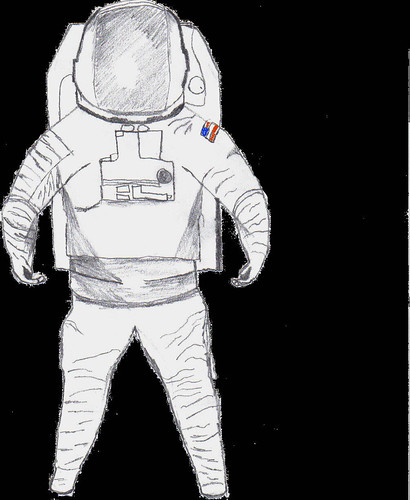
For ourselves, we’re looking forward to seeing more of the next iteration of the Joe Kosmo line (sketched above). But we know without a doubt that, as with any summer line of fashion, lightweight is in.

Spaceport in New Mexico?

The Washington Post writes today about the growing effort to build a spaceport in rural New Mexico:

"In a referendum, the people of Las Cruces and surrounding Do?a Ana County will be voting on a proposal to slightly raise their county sales tax, a highly unpopular idea these days. But in return, southern New Mexico, one of the poorest regions in the nation, would jump on a fast track to hosting the world’s first all-commercial spaceport.

If the effort succeeds, a desert valley used by a handful of ranchers could become Spaceport America — a 21st-century portal for thousands of people hoping to blast into space as tourists, explorers, researchers and, maybe someday, as commuters to destinations halfway around the world."

Located near the White Sands Missile Range (& National Monument) and Truth or Consequences, NM, the planned SpacePort America is already set to be one of the main launch points for Richard Bronson’s Virgin Galactic (which we’ve already written about a few times). The controversy, of course, stems from the sales tax increase that would be needed to build the the spaceport which would ad around $0.25 to a $100 purchase, mostly on the backs of poor, area residents, some of whom already live in areas without proper roads, water, or waste removal systems.

We’ll let you know how the vote turns out in the weeks ahead.

DIY Friday: Your Own Home Theater System!

For today’s Do It Yourself activity, all you need is some wood, carpeting, a TV set with DVD and a surround sound system, and… oh, yeah…. an indoor pool.
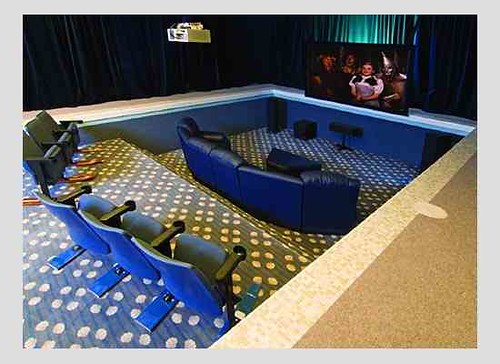
 

Electronic House provides the details: 

Swimming pools, even indoor ones, just aren’t all that tempting in regions where the mercury rarely reaches above 80 degrees.

So when the owners of this Wisconsin home purchased their residence, they decided to convert the indoor in-ground pool that came with the property into a fully functional home theater. Flooring and carpeting were added to the concrete bottom of the 20-by-40-foot area, and draperies were hung over the room’s windows and metal walls to soften up the space. However, not all signs of the building’s former life were removed. Wiring for the audio and video components was pulled through the pool’s existing plumbing systems, and the slope of the pool floor was maintained to create a stadium-style seating arrangement.

The concrete sides of the pool precluded speakers from being built in, so the homeowners opted for Klipsch floorstanding models. The 106-inch Draper screen was suspended from the room’s existing rafters using aircraft cabling and secured at the edge of the pool to keep the material taut. Last but not least, the Marantz video projector was mounted to the ceiling, and the audio and video components were stowed inside an equipment rack at the back of the room.

Sound like too much work for a simple DIY Friday project? Or, more to the point — don’t have a high-falutin’ indoor pool? 

Well, luckily there are options for the more proleteriat among us.

DIY Home Theater Design provides a good run down of all your different options, walking you through the pros and cons of LCD, DLP and LCOS screens, as well as a summary of what you’ll want in your sound system:

 The basic surround sound setup consists of 5 speakers plus a subwoofer, known as 5.1 surround. The center speaker, called the center channel, is positioned just above or below the television and is intended to handle dialog. A pair of left and right speakers are placed to the sides of the television about 6 to 8 feet apart; wider if you have a very large screen. The left and right speakers handle the heavy lifting of the soundtrack like music and sound effects. A pair of satellite speakers are placed on each side of the viewing audience to add atmospheric sound effects like the sound of a crowd or bullets whizzing by. The "point one" in 5.1 is for the subwoofer. The sub handles low frequency sound and adds emphasis to explosions or to a dramatic music score.

The only bad advice from DIY Home Theater Design comes when they advise: "Don’t let the new terms and acronyms spook you because it’s really not rocket science."

We, of course, beg to differ. It is rocket science.

An even cheaper mini-home theater system can be created using your existing television components and a Mac (details here), but if you really want to combine your computer and home theater system into one seamless operation (and solve the "last 50 feet" problem that must be overcome before non-rocket-scientists really start to embrace the nexus of IP and broadcast technology) and chuck the whole DIY concept out the window in the process, then check out the just-released Apple TV.

The New York Times has a good review:

So what is Apple TV? Basically, it’s an iPod for your TV. That is, it copies the iTunes library (music, podcasts, TV shows, movies) from one Mac or Windows PC on your wired or wireless home network to its 40-gigabyte hard drive and keeps the copy updated.

The drive holds about 50 hours’ worth of video or 9,000 songs; if your iTunes library is bigger than that, you can specify what subset you want copied — only unwatched TV episodes, for example.

At this point, you can play back videos, music and photos even if the original computer is turned off or (if it’s a laptop) carried away. (Photo playback requires iPhoto on the Mac, or Photoshop Album or Photoshop Elements on Windows.)

A tiny white remote control operates Apple TV’s stunning high-definition white-on-black menus, which are enlivened by high-resolution album covers and photos. You can see the effect at apple.com/appletv.

The integration of iPod, iTunes and Apple TV offers frequent payoffs. For example, if you paused your iPod partway through a movie, TV show or song, Apple TV remembers your place when you resume playing it on your TV. Cool.

Cool indeed.