NASA to Close NAIC (and stop thinking about the Future)

So what do you call a space agency with no institute for advanced research? Wait, you can still call it a space agency?

While that’s not much of joke, it reflects the increasingly grim reality at NASA if the recent reports in the New Scientist and WIRED are believed to be true that suggest the NASA Institute for Advanced Concept (NIAC) is being closed due budget constraints. What’s the ironic source of the constraint’s that might put an end to NASA most forward thinking research institution? Why building the next generation space craft set to replace the shuttle after its forced retirement in 2010.

For those who haven’t seen the many different stories we’ve done on all the various projects the NIAC has undertaken since its 1998 founding, NAIC has a far out mission that aims to prepare NASA for humanity’s future in space, from their website:

"NIAC seeks proposals for revolutionary aeronautics and space concepts that could dramatically impact how NASA develops and conducts its missions. It provides a highly visible, recognizable, and high-level entry point for outside thinkers and researchers. NIAC encourages proposers to think decades into the future in pursuit of concepts that will "leapfrog" the evolution of current aerospace systems. While NIAC seeks advance concept proposals that stretch the imagination, these concepts should be based on sound scientific principles and attainable within a 10 to 40-year time frame."

While budget constraints are budget constraints, I’m going to have to agree with the folks over at the NASA Watch when they say eliminating the NIAC is a big mistake.

"This is just plain stupid. Let me repeat this for clarity’s sake, Mike [Griffin, NASA Administrator & "head honcho"], (whoever made it) this is A STUPID DECISION. Advanced spacesuits that will open the surface of the moon – and then Mars- to meaningful and productive human exploration, tethers and other innovative and upmass-saving technologies, and other in-space technologies.

Where are you going to get all of the things you need to put on those Ares rockets so as to allow their crews to carry out their missions, Mike? Or do you "just need a good map"? Explorers without the right tools die – or turn around – and head back home. Wrong answer, Mike."

Right on!

Falcon 1 Rocket Launch OK, then…


SpaceX’s second demo flight was a success, reaching 300 km in altitude. The first stage went well, but then contact was lost. As always, SpaceFlightNow.com gave us the news as it unfolded:

Some quotes from the media briefing with Elon Musk following tonight’s launch:

Question: what is the fate of the second stage?

"We didn’t achieve the desired orbit. But at this point I don’t exactly know the fate of the second stage. We got to 300 km. That’s about all I know at this point."

"All that I can say for sure right now is it’s not in the intended orbit. The likelihood is that it re-entered after probably half an orbit or so."

"The roll-control anomaly did cause the second stage to shut off prematurely. So that’s not achieving the intended orbit. However, I would say we’ve retired probably in excess of 90 percent of risk associated with the rocket. And it is worth noting, this was a test launch not a satellite launch."

Elon Musk‘s brother said it best via this blog post. More photos here.


He’s right: entering space is a success — all the riskiest aspects were well done. They’ll probably learn much from this experience and the next one will be perfect. Hey, they might even be able to recover the first stage and use it again!


These Old Eyes Need New Glasses

An aging satellite that has been in operation for seven years but was expected to last for only five is putting America’s hurricane forecasting ability at risk, according to a story from the Associated Press.


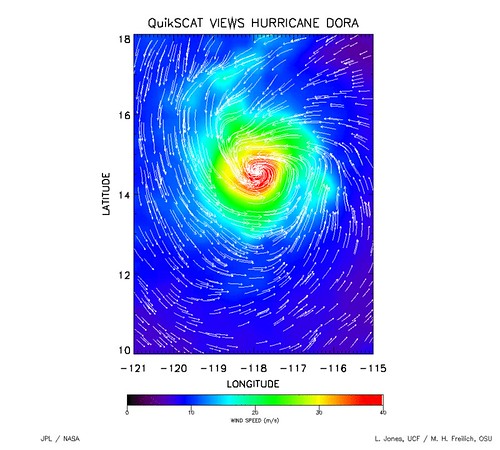
The QuickSCAT satellite "conducts daily surveys of 90 percent of the ice-free oceans, using a so-called radar scatterometer to measure surface wind speed and direction."

The resulting images are not only visually compelling — they provide scientists with fresh information about our planet’s weather patterns.

(For example, this set of images helped scientists understand that the Santa Ana winds that dry out coastal and interior regions of California and help fan the flames of wildfires produce a previously unknown benefit to the region’s fisheries.)

But the cause celebre of QuickSCAT are images like the one above, showing the wind speeds of Hurricane Dora back in 1999.

But scientists may have to attempt hurricane forecasts without the aid of QuickSCAT, according to the AP report:

Certain hurricane forecasts could be up to 16 percent less accurate if a key weather satellite that is already beyond its expected lifespan fails, the National Hurricane Center’s new director said Friday in calling for hundreds of millions of dollars in new funding for expanded research and predictions….

One of Proenza’s immediate concerns is the so-called "QuikScat" weather satellite, which lets forecasters measure basics such as wind speed. Replacing it would take at least four years even if the estimated $400 million cost were available immediately, he said.

It’s in its seventh year of operation and was expected to last five, Proenza said, and it’s only a matter of time until it fails.

Without the satellite providing key data, Proenza said, two- and three-day forecasts of a storm’s path would be affected. The two-day forecast could be 10 percent worse, while the three-day one could be affected up to 16 percent, Proenza said.

That would mean longer stretches of coastline would have to be placed under warnings, and more people than necessary would have to evacuate, he said.

We’ll keep you updated (as we always do) on efforts to replace QuickSCAT and other observation satellites that help bring people the accurate forecasts (we’re not joking here!) that they’ve come to expect.

Lots in Alaska for… Free?


Rocket scientists looking for a cheap place to crash might want to check out the friendly hamlet of a recent AP report, the town is giving away land in a fashion reminiscent of the old Homestead Act of the 1862. Here’s the skinny direct from the city’s web page on the give away:

"The City of Anderson is selling up to twenty-six lots at no costs starting March 19, 2007 at 9:00 AM. Applications will be selected on a first come, first served bases. A $500.00 refundable deposit will be required at the time of application. Applicant will be required to build a residential home within 2 years from date of signed agreement. Other covenants and restrictions apply. Lots are 1.3 acres in size, electrical and phone has been installed. In April, the city council will hold a lot selection meeting for applicants to select their individual lots, based upon the first come, first served criteria. For more information contact the city clerk @ 582-2500 or [email protected]."

Supposedly those who are already up there or proxies in the area are most likely to get access to the lots, since the Post Office doesn’t deliver mail to city offices until after noon.

So why might Rocket Scientists be up for cold (but free) Alaska winters? Well, it seems the Clear Air Force Station is located not too far away from the free lots, making them ideal cheap digs for those looking up and listening to the night sky for Uncle Sam. While it might not be northernmost military base in the US (that honor belongs to Thule Air Base in Greenland), its certainly among the coldest. Hey, at least its neighboring communities are pretty hospitable, right?  Look, residents can even participate in the Nenana Ice Classic (just 20 miles from Clear AFS), that lets people win if they guess when the ice in the Tanana River finally moves out.  Watching ice melt… talk about a good time!

DIY Friday: Build Your Own HDTV on the Cheap

Last November we told you how to make your own HDTV antenna for next to nothing, but once you get your antenna on the roof you going to need an HD display to get the picture, right?


Well, not so much. As we also said in November, the monitors necessary to see the sneaker scuffs on on the boards of your favorite team’s NCAA tournament game (which will no longer includemy alma mater — thank you very much, Villanova) are usually the expensive part of the HDTV conversion, but if you have a spare (decent) PC/Mac lying around you could just make it your required monitor. What we didn’t share with you in November was the number of tuners (super tiny ones at that) that can help you grab the signal coming from your antenna even when your on your laptop.

While the ATI TV Wonder 650 might be considered old faithful, it is, after all, a card designed to be inserted into your PC meaning you’re pretty much stuck watching television on your desktop. If you’re looking for a more mobile experience (and don’t mind watching TV in your hotel room while holding an aerial), you should check out the crazy small Fuji PLUS FD-USB728 USB 2.0 Interface USB HDTV ATSC/NTSC TV Tuner For PC&Notebook (right). Designed specifically for your laptop, the Fuji PLUS seems to be the for anyone looking to see television the way it was meant to be watched from anywhere in the country.

Oh and what if you’re a mac user, like yours truly? Well, have no fear, the four-and-a-half Macworld mouse-rated Miglia TVMini HD is here for your viewing pleasure, complete with Elgato Systems‘ award winning EyeTV 2 software (although if you’re interested in this feature, buy it as fast as you can, because Elgato seems to have just yanked Miglia’s distribution liscense for the software), which lets you schedule recordings and turn your saved shows into DVD and Video iPod-compatible formats.

A Boatload of Bandwidth

Have you ever contracted the annoying song virus?

You know, you’re minding your own business in the office when someone says to you, "I can’t get this annoying song out of my head."

And proceeds to tell you what is is — or sings it. 

And then you’ve got that thing stuck in your head for the rest of the day?

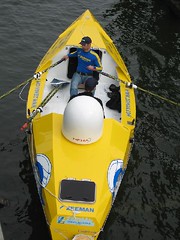
Well we contracted that virus via the Internet this morning when we saw the photo to the left.

We’ll let you guess the song (we won’t be cruel), but what the heck is that a photo of? 

It’s the Zeeman Ocean Challenge, an attempt to do what no one has ever done before: row across the Pacific Ocean at its widest point with no support at all. (9 people have done it with support.)

That’s 16,000 kilometers, and a pretty amazing thing to attempt. But what really caught our eye was the white umbrella on the stern deck.

We’ve written before about the use of satellite communications to keep in touch on maritime adventures (such as when the Kon-Tiki sailed again). It’s worth taking a moment to look at the marketplace again.

How does one stay in touch while in the middle of the ocean?

First, one needs a good maritime satellite antenna — such as this new C2SAT antenna. Then, if you’re not going to subscribe to Direct to Sailor TV, you’ll need to subscribe to a service for phone and internet connections.

So you can surf while you drift, as it were.

Eutelsat offers always on net capability, whether you’re in a rowboat or something bigger or something bigger still. Their maritime service is available on their W3A satellite (7 East), which is good for the Mediterranean and coastal Europe as well as coastal sub-Saharan Africa, or on Atlantic Bird 1 (12.5 West), which covers the Western European coast, North Sea, and the coastal waters off eastern North America.

But the "King of the Hill" in maritime communications is Inmarsat, which provides flexible pricing plans for the little guy in the rowboat but also the bandwidth to broadcast a rare Marathon in Antarctica.

Now if we could just get that song out of our head.

Sea Launch Investigation Completed

Regarding the Sea Launch failure that destroyed the NSS-8 satellite, Novosti in Russia reports:

An unsuccessful rocket launch under the Sea Launch project in late January was caused by engine failure, the press secretary of Russia’s federal space agency said Tuesday.

A Sea Launch Zenit-3SL rocket carrying a commercial communications satellite exploded shortly after liftoff from an oceangoing platform in the Pacific on January 31.

"The intergovernmental commission comprising representatives of Ukrainian and Russian organizations – the developers of the Zenit-3SL carrier rocket … has completed its work. It has established that the engine failed after a metal particle accidentally went into the engine’s pump," Igor Panarin said.

Panarin said the commission has proposed recommendations whose implementation will provide for the continued use of Zenit-3SL carrier rockets.

Viktor Remishevsky, deputy head of Russia’s federal space agency Roskosmos, earlier said rocket launches under the Sea Launch project would resume in 2007, adding that the Odyssey platform had suffered only minor damage.

The Satellite News Digest (subscription) goes further in its commentary:

Stray particle blamed on Zenit-3SL explosion

According to the Russian Federal Space Agency (Roskosmos), the explosion of a Zenit-3SL in late January was caused by poor workmanship that led to an engine failure.

"The intergovernmental commission comprising representatives of Ukrainian and Russian organisations, the developers of the Zenit-3SL carrier rocket … has completed its work. It has established that the engine failed after a metal particle accidentally went into the engine’s pump," Roskosmos spokesman Igor Panarin said.

He said the commission has proposed recommendations whose implementation will provide for the continued use of Zenit-3SL carrier rockets.

Viktor Remishevsky, deputy head of Roskosmos, earlier said rocket launches under the Sea Launch project would resume in 2007, adding that the Odyssey platform had suffered only minor damage.

It’s a rather surprising that the quality control problems with rockets from the former Soviet Union still persist as they have been known for years. Stray particles in various parts of rockets botched two Proton launches in July and October 1999 as well as a Soyuz-U launch in October 2002. Most recently they affected a Briz-M upper stage which failed to deploy Arabsat 4A into geostationary transfer orbit in February 2006.

An investigation into a Proton failure found piece of asbestos fabric, traces of aluminium and copper, and even sand in defective engines. Among the recommended modifications were additional filters in fuel lines, checking internal cavities for foreign particles as well as the quality of welding seams in the turbo-generators.

[These recommendations may have been applied to Proton but apparently not to other rockets. Some may call this "learning the hard way."–Ed.]

IP Radio Comes to Indonesia


Last week’s announcement of the deployment of an integrated IP-based radio network in Indonesia isn’t the first time that Indonesia has been an early adopter of the latest communications technology.

ND SatCom, an SES ASTRA company, partnered with Studio Hamburg Media Consult International (MCI) GmbH to deploy the IP-based radio contribution and distribution network for Radio Republik Indonesia (RRI).

The Jakarta-based, state-owned radio broadcast is operated by the Indonesian government and consists of 21 regional stations. (You can find frequencies here, or — if you’re not in Indonesia — you can listen online here.)

Back in the 1970s, Indonesia was one of the first countries (following Canada and then the United States) to realize the importance of satellite communications for networking, and to deploy a satcom network for telephone and fax communications.

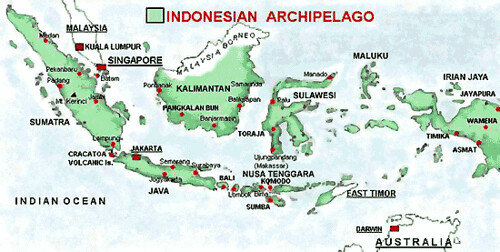
It’s no wonder that Indonesia has been an early adopter of communications technology, when one considers the hundreds of islands that it must connect:


Google Selling Ads on Dish Network

We blogged about what Google may have up its sleeve before, so naturally we were intrigued by what VentureBeat.com picked up from The Wall Street Journal last Saturday:

Google is about to sign a deal with Dish Network, the nation’s second largest satellite TV company, to deliver ads for Dish’s network, VentureBeat is hearing.

We haven’t been able to confirm the rumor (Google has not yet responded to a request for comment).

In an effort to extend its growing advertising empire to television, Google has already started a pilot project in Concord, Calif. to deliver ads to cable television subscribers, it was revealed in yesterday’s WSJ.

The latest reports are significant because they suggest Google may be on its way to cracking the huge television market, to deliver a very different kind of ad to peoples’ living rooms. Dish is the nation’s leader in high definition and interactive TV programming. Google’s TV ads, like the ones Google distributes already to Internet sites, would be delivered more efficiently — targeted more closely to the content of the TV programming being watched, and more relevant to the people actually watching it — or at least, that is Google’s intent.

The Mountain View search engine is already making more than $10 billion from online ads. The U.S. television advertising market is about $55 billion, and so is a juicier target than even the Web.

According to the WSJ Saturday, Google has begun a test run serving up TV commercials to cable subscribers of Astound Broadband in Concord, Calif. In this deal, as in the one with Dish, Google is expected to purchase TV spots in advance, and then insert its own advertising — supplied by its advertising clients — so that it looks much like it does today. The difference is, Google would be the powerbroker.

It is unclear, however, how Google would access information about TV households in order to target its ads, without raising significant privacy concerns. But a Dish partnership is notable because of how interactive the Dish experience has become. Users already use keywords to search for programming, choose themes they like and create custom guides — all indicators of personal taste. Dish and Google might be able to obtain permission from users to exploit such information. Google could then work with any number of technology providers to help it automatically insert relevant ads into the programming.

Read more about this concept of "mass personalization" on the ITVT blog. Once you get into the details, I think you’ll agree this is not Spotrunner, which sounds more like a buying agency.

Facing the Next Katrina with Satellite

Nearly five and a half years after September 11 and eighteen months since Katrina, the U.S. Department of Homeland Security and many of the country’s public safety agencies and organizations have yet to solve the problem of interoperatable communications. While this might seem pretty nerdy, its the lack of communication system cross compatibility that prevented firefighters from hearing police calls to escape the WTC when its exterior began crumbling and ultimately limited the execution of a full-scale evacuation of the Gulf Region in August 2005.

Fortunately, the U.S. Congress is finally starting to make some headway, albeit after Former DHS head Tom Ridge slammed the government for failing to deal with the problem. In addition to pushing legislation that would modernize the 911 system throughout the country (particularly in rural areas), the Senate recently approved Interoperable Emergency Communications Act (S.385), which according to Senator Ted Stevens (R-Alaska)’s website,

"provides the National Telecommunications and Information Administration (NTIA) with more guidance as it awards $1 billion in interoperable emergency communications grants to police, firemen, and emergency medical personnel… This bill would allow up to $100 million of the expedited $1 billion to be used to establish technology reserves that would assist emergency response agencies in pre-positioning communications equipment in state or regional facilities. These reserves can be activated quickly in the event of a major emergency or natural disaster"

While this has led to Nextel co-founder Morgan O’Brien to suggest (and for Fmr. Sec. Ridge to support) the creation of a national broadband public safety network using "a slice of spectrum in the 700 MHz band that is scheduled for auction in 2008," there is another more immediate and potentially less costly option… satellite. As Satellite Industry Association (SIA) Executive Director David Cavossa recently pointed out in a press release,

"Hurricane Katrina and other recent disasters have shown, satellite communications are uniquely able to provide resilient, redundant, and ubiquitous communications when all other terrestrial-based communications fail."

While its probably not the only solution, it seems that Katrina probably taught us that satellite technology should be included in any robust, interoperatable emergency communication systems solution. Working together with standard radio-based wireless technologies, options built on technology similar to SES-Americom’s REDiSat Network might be just the ticket.