Insat 4B and Skynet 5A Launched by Ariane 5

The news from Arianespace

Coup double pour Arianespace / Mission réussie pour Skynet 5A et Insat 4B

Dans la nuit du dimanche 11  au lundi 12 mars 2007, Arianespace a mis en orbite de transfert géostationnaire deux charges utiles : le satellite de télécommunications militaires Skynet 5A pour le Ministère britannique de la Défense (MoD) et le satellite de télécommunications civiles Insat 4B pour l’Agence Spatiale Indienne (ISRO).

Trente-et-unième lancement d’Ariane 5, dix-septième succès d’affilée.


Sounds a lot better than the English translation:

Arianespace begins its 2007 mission activity with a successful dual-payload launch

Ariane 5 underscored its mission capability and operational maturity with tonight’s successful dual-passenger mission, which placed the Skynet 5A and INSAT 4B satellites into geostationary transfer orbit.

The March 11 mission was Ariane 5’s 31st liftoff from the Spaceport and the launch vehicle’s 17th consecutive success.

Lifting off from the Spaceport in French Guiana, the Ariane 5 deployed Skynet 5A at 26 minutes into the mission, followed four minutes later by INSAT 4B.

"With this first launch of the year 2007, Arianespace has once again demonstrated its leadership," said CEO Jean-Yves Le Gall. "The satisfaction of every customer is our keyword, offering the best possible Service & Solutions to each one."

DIY Friday: SXSW & Austin

This week’s DIY Friday combines two of my real loves – DIY projects and music – by bringing together two of my favorite things: Make Magazine and South By Southwest (aka SXSW). I know all of you have already heard about MAKE (we’ve covered a few of their projects right here in this weekly feature), but, for those who haven’t heard about SXSW, its one of the best general "media" conferences in the world.

Even those who’ve heard about SXSW might not know that it is really three different events rolled into one: The SXSW Music and Media Conference, the SXSW Interactive Festival, and the SXSW Film Conference and Festival. The whole affair begins today and lasts ten days (that’s through the 18th) and features hundreds of musical acts on 50 stages in downtown Austin, dozens of keynote presentations and workshops by leading thinkers and new medias, and a series of films from rising talent that easily rivals Sundance. In short, for those interested in what we’ll be watching, listening to, and thinking about in the next five years, SXSW is the place to be.

While that all might be enough for any dedicated RRS reader, those interested in DIY projects like myself might be excited to learn that the Senior Editor of Make Magazine, Phillip Torrone, will be keynoting with Limor Fried, a DIYing Engineer and Artist in her own right, on Sunday. While its hard to predict what two brilliant DIY minds might get into during the talk, I can assure you it will be interesting.

For those that can’t make it, while you might not be able to see Sunday’s kick ass keynote, you can tune to channel 101 on your DirectTV [fuller descriptions are available at the listings at SXSW Live] and check out many of the festivities (although mostly musical) in the weird, liberal oasis that is Austin, TX.

Oh, and if you missed out on the fun of SXSW like I will you might want to make plans to visit Austin this fall nonetheless, because it looks like Austin will also be the home to one of 2007’s MAKE Faires. While it might not have the hipster cachet of SXSW, you better believe you’ll have the opportunity to see (and make) some cool stuff like the crowds did last year.

Atlas V Launch Tonight!

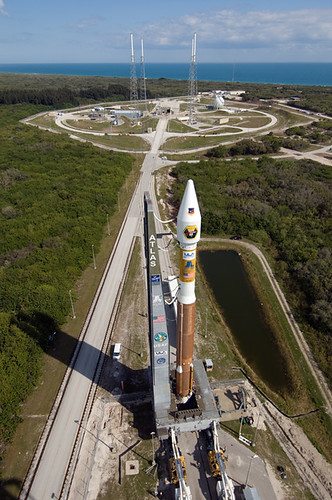
A United Launch Alliance Atlas V rocket is scheduled to launch this evening from Cape Canaveral Air Force Station.


The launch is set to go at 9:37 EST; the launch window extends until 11:42 EST. The 45th Space Wing of the U.S. Air Force will be handling launch operations, and the weather forecast (opens in PDF) looks good, if a little gusty. A live webcast can be found here.

The always-convenient worldwide launch schedule details the payload: 

The United Launch Alliance Atlas 5 rocket (AV-013) will carry six satellites during a complex launch of the Air Force’s Space Test Program-1 mission. The payload list is led by the Orbital Express in-space refueling demonstration mission consisting of the Autonomous Space Transfer and Robotic Orbiter, or ASTRO, prototype servicing satellite and the NextSat serviceable spacecraft. 

Space.com has more on the Orbital Express: 

Built for the Defense Advanced Research Projects Agency (DARPA), the Orbital Express vehicles are aimed at demonstrating autonomous spacecraft refueling and servicing techniques [video, image].

For military uses, such capabilities would allow reconnaissance satellites to keep station over specific areas of interest and tank up on vital propellant later, though the technology could also aid general-use spacecraft in need of periodic equipment repairs, replacements or an orbital boost, mission managers said.

Additional information on the mission can be found on DARPA’s Tactical Technology Office website. Also be sure to check out this series of pictures of the Atlas 5’s pad rollout on the Spaceflight Now website.

And if you’re online later this evening for the live webcast — please share your reactions to the launch in the comment thread below. 

Dish Network & DirecTV Team Up with Google, Intel, Skype and Yahoo!

Very interesting twist to the upcoming spectrum auctions. Breaking story via Multichannel News:

DirecTV and EchoStar Communications formed an alliance with Google, Intel, Yahoo and Skype in support of a national licensing plan for a pending federal spectrum auction expected to take in at least $10 billion, according to draft of the plan obtained by Multichannel News Tuesday. The formation of the alliance doesn’t mean that the companies are going to bid together in the auction, which, by law, has to begin by Jan. 28, 2008. Instead, each alliance member has an interest in seeing that the Federal Communications Commission permits bidders to aggregate enough licenses to cover substantially all of the United States. The 60 megahertz of spectrum up for auction is returning to the FCC as a result of TV broadcasters’ transition to digital-only transmission. Broadcasters won’t require the same amount of bandwidth in total because digital signals are spectrally more efficient than analog airwaves.

Every full-power TV station is required to terminate analog TV service no later than Feb. 17, 2009. The analog cutoff would also allow public-safety entities to obtain 24 MHz of former analog-TV spectrum.


Satellite Radio’s Competition

Sirius CEO Karmazin went up The Hill last week where he used the argument that satellite radio competes with not only over-the-air AM/FM radio, but also Internet radio and iPods. Well, it looks like the Internet radio folks are bracing for a fight. Check this from Wired:

Royalty Hike Panics Webcasters

Internet radio companies big and small are revving up for a fight with the Copyright Royalty Board that could lead to the halls of Congress and — some fear — the end of streaming music stations in the United States.

The panicked preparation follows last Friday’s buzz-killing bombshell: As 50 million or so online radio listeners geared up for their weekends, the board released new royalty rates representing a potential tenfold increase webcasters would have to pay out.

In the old, percentage-based fee system, webcasters paid SoundExchange — the Recording Industry Association of America-associated organization that pushed the Copyright Royalty Board to adopt the new rates — between 6 percent and 12 percent of their revenue, depending on audience reach. The new system charges all webcasters a flat fee per song per listener; for instance, in 2007, streaming companies would owe $0.0011 per song per listener (rates change based on year).

That amount may not sound like much, but it adds up quickly. Consider, for instance, AOL Music, with its average of 210,694 listeners for November 2006. According to calculations made by the Radio and Internet Newsletter, or RAIN, AOL retroactively owes about $1.65 million in sound-recording royalties for that month alone (and that doesn’t include songwriting royalties). By the end of this year, according to RAIN, the company could owe roughly $20 million — unless the rates are overturned by the board or by Congress, which is still a possibility.

Larger services that offer thousands of channels, such as the free Pandora, are also facing a huge spike in royalty costs. Kurt Hanson, publisher of RAIN and CEO of AccuRadio, went so far as to speculate that Pandora, which is based in the United States, could "disappear" as a result of the new rates. Overseas competitors like Last.fm, which is based in London and removed from the board’s restrictions, could easily claim Pandora’s market share. If Pandora has to pay the annual $500 minimum for each channel, Hanson said, its sound-recording royalty bill for 2006 alone would be capped at about $2 billion (based on the service’s 300 million registered users, each of whom gets to create up to 100 unique channels).

"The rates are disastrous," says Joe Kennedy, CEO of Pandora. "I’m not aware of any internet radio service that believes it can sustain a business at the rates set by this decision."

The situation for smaller webcasters isn’t any better. And for the likes of Bill Goldsmith, who runs Radio Paradise, it’s far worse: "This royalty structure would wipe out an entire class of business, small independent webcasters such as myself and my wife. Our obligation under this rate structure would be equal to over 125 percent of our total income."

The smallest webcasters, who use services such as Live365 for their shows, will likely vanish as well unless the rates are overturned. RAIN pegs Live365’s royalty obligation for 2006 at approximately $4.2 million — and that’s not counting the minimum $500 it could owe annually for thousands of its channels. Again, that’s in addition to other royalty fees. (The site, like most others, already pays songwriter royalties to performing rights organizations BMI, ASCAP and SESAC.)

Live365 did not respond to e-mail and phone queries from Wired News in time for publication, and Yahoo declined to comment. SoundExchange also failed to respond.

Hanson, who testified at the hearings on behalf of small webcasters, said he doesn’t "think the people actually running the record labels want to see internet radio shut down," but that SoundExchange’s lawyers had planned "an aggressive, win-all-you-can battle in Washington. I think they were more successful than they expected to be."

Pandora’s Joe Kennedy believes the board’s decision will not stand — it’s simply too extreme. He wrote to Wired News, "The only reason the (online streaming) services are not shutting down today is the belief that rationality will ultimately prevail here, either through appeal or congressional intervention." (A third option, according to Hanson, is that SoundExchange could choose to continue licensing music as a share of revenue, as it did before the Copyright Royalty Board decision.)

Only webcasters that were involved in the original Copyright Royalty Board decision-making process (Yahoo, AOL, Live365 and a few smaller webcasters including Radioio, Ultimate80s and Accuradio) will be able to file an appeal, and they have 15 days to do so.

The House Commerce Committee’s telecommunications subcommittee is holding a hearing on March 7 to hear testimony on the current and future radio industry. Witnesses will include Mel Karmazin from Sirius, Peter Smith from broadcaster Greater Media and Bob Kimball from RealNetworks.

If the new rates stick, online music fans may come to expect far less innovation, variety and quality when it comes to internet radio. Some industry experts fear that even more users could be driven to illicit services that pay no royalties or those that operate from other countries.

Time Travel?


Read on slashdot.org this morning:
PreacherTom writes
"Scientists at the NEC Research Institute in Princeton, NJ are reporting that they have broken the speed of light. For the experiment, the researchers manipulated a vapor of laser-irradiated atoms, causing a pulse that propagates about 300 times faster than light would travel in a vacuum. The pulse seemed to exit the chamber even before entering it."
This research was published in Nature, so presumably it was peer-reviewed. It’s impossible from the CBC story to determine what is being claimed. First of all they get the physics wrong by asserting that Einstein’s special relativity only decrees that matter cannot exceed the speed of light. Wrong. Matter cannot touch the speed of light in vacuum; energy (e.g. light) cannot exceed it; and information cannot be transferred faster than this limit. What exactly the researchers achieved, and what they claim, can only be determined at this point by subscribers to Nature.

Space Weather Forecast Sees (STEREO) Gain

To the left: An image of a February 25 eclipse taken from NASA’s STEREO-B satellite.

Back in October, we wrote about the successful launch of of NASA’s STEREO mission. (Click here for video of the Delta II launch.)

The STEREO (Solar TErrestrial RElations Observatory) Mission uses stereoscopic 3D vision to construct a complete picture of the sun and the nature of solar flares. Among the uses of such knowledge: protecting future astronauts from the dangerous effects of solar flares and providing better space forecasting.

The Washington Post now gives us an update on STEREO’s progress

The effort to improve space weather capabilities took a major step forward last week with the transmission of never-before-seen images of a solar eruption traveling the 93 million miles from the sun to Earth.

Sent back by the twin satellites of NASA’s newly launched Solar Terrestrial Relations Observatory (STEREO), the video is part of an ambitious new effort to learn more about massive electromagnetic storms on the sun, and the dynamics and characteristics of their eruptions. The sun is a huge furnace of nuclear fusion, in constant turmoil with flares, eruptions, convections and the release of lower-energy solar winds.

The "fronts" produced by coronal mass ejections, as the biggest eruptions are called, are the prime movers of space weather in Earth’s neighborhood, and understanding them better is essential to space weather forecasting.

"With STEREO, we can track the front from the sun all the way to Earth and forecast its arrival within a couple hours," said Russell Howard, principal investigator for STEREO’s most cutting-edge instrument, which will allow researchers to observe the movements of solar eruptions in three dimensions. "The new views from STEREO are like having a curtain lift from our eyes — they are extraordinarily instructive."

They are also pretty amazing, as this video animation taken from STEREO images shows. 

The Washington Post continues: 

STEREO cost NASA and its European partners about $600 million to build and is expected to operate for at least two years. It has already detected somewhat surprising characteristics of the solar eruptions. Researchers have, for instance, located "hot spots" within a solar eruption as it speeds from the sun, and they have seen loops and arcs formed from the hot plasma. They have also begun to measure the velocity of the eruptions, which gradually slow as they collide with other solar matter moving far more slowly in the solar winds.

Like most researchers, STEREO team members say they are looking for solar surprises as much as confirmation of existing hypotheses. The detailed study of space weather is in its infancy, they said, and the opportunity for discovery is vast.

We’ll keep you updated on STEREO’s discoveries as they are reported; in the interem, be sure to check out the STEREO mission homepage for the latest developments. 

Satellite Distributed Movies Set to Emerge in 2007

While the technology has been talked about for years, many experts are positioning 2007 as the year that digital movies and satellite distribution of box-office blockbusters take flight. Working in conjunction with Warner Bros. Entertainment and Universal Pictures, Digital Cinema Implementation Partners (made up of big name theater companies AMC, Cinemark and Regal) is working to "use satellite and broadband delivery systems to beam digital films directly to theaters, rather than have them copied onto hard drives and delivered by hand, as they usually are now."

While the theater chains and studios are looking at the technology as a great way to decrease the likelihood of piracy (the theory being that encrypted satellite transmissions would mean fewer hands are on the prints), it could also mean improved access to popular films and big screen showings of smaller films that struggle for an audience large enough to usually get them. As the AP article about the technology notes that satelite distribution,

"would give U.S. theater operators the flexibility to put a popular movie on an extra screen as quickly as the demand arises… At the same time, theater operators could stop showing a surprisingly unpopular film and even book an art-house film with a small but devoted audience for a day or two."

While Variety and Hollywood are explicitly concerned with the digital cinema’s implications for the US market, the Hindustan Times points out that the technology may be even more welcome throughout the developing world where, although movie theaters are plentiful (with over 12,500 movie houses throughout India alone), the relatively small number of "prints" (sometimes only 500) available of any given film arbitrarily limits distribution.

DIY Friday: Beer Launching Fridge!

Real rockets scientists are obsessed with launches. There’s something about cylindrical metal objects flying through the sky that captures our imagination.

Beer captures our imagination, too, which is why today’s DIY Friday combines two great obsessions into one lazy invention: the Robotic Beer Launching Refridgerator!

John W. Cornwell, a student at Duke University, invented this contraption — which we are certain history will rank alongside the printing press and the remote control for its impact in changing our lives for the better. He writes

Have you ever gotten up off the couch to get a beer for the umpteenth time and thought, "What if instead of ME going to get the BEER, the BEER came to ME???" Well, that was how I first conceived of the beer launching fridge. About 3 months and several hundred dollars later I have a fully automated, remote controlled, catapulting, man-pit approved, beer launching mini-fridge. It holds 10 beers in its magazine with 14 more in reserve to store a full case. It is controlled by a keyless entry system. Pressing unlock will start the catapult rotating and when it is aiming at your target, pressing unlock again will stop it. Then the lock button can be pressed to launch a beer in the selected direction….

To everybody who is asking about price, the BLF took me at least a hundred hours to build, as well as several hundred dollars worth of parts. I would put the price at about $2500 to build ONE.

The photos posted on Cornwell’s website reveal pure engineering genius, though for a while we puzzled why the the "magazine" only holds 10 cans of beer when they are sold in 12 packs.

The answer, of course, is that you and your buddy drink one while you load the fridge with beer.

Beautiful

The latest image from Cassini of Saturn’s rings is a sight to behold:


More images here