Wee TV

Very cute, little "Wee TV" via Reuters

Verizon Wireless kicks off mobile phone TV

By Sinead Carew

NEW YORK, March 1 (Reuters) – Verizon Wireless, the second-biggest U.S. mobile phone provider, said it launched the country’s first commercial mobile television service in 20 states with full-length programs and picture quality similar to regular TV.

The venture of Verizon Communications Inc. <VZ.N> and Vodafone Group Plc <VOD.L> said on Thursday it is charging $15 a month for the service, which was developed by Qualcomm Inc. <QCOM.O> unit MediaFlo and includes eight channels broadcasting full-length TV shows to phones 24 hours a day.

Verizon Wireless and its rivals have been pushing services such as video and music to boost revenue as the price falls for traditional mobile phone calls.

But mobile video services have been slow to take off due to high prices and poor quality compared with television at home.

The picture quality of the new service will be on a par with home TV and roughly twice as clear as Verizon Wireless’s existing Vcast video service, spokesman Jeffrey Nelson said.

Mobile video services, first launched in the U.S. in 2004, have only about 7 million customers out of about 232 million mobile subscriptions, according to Ovum analyst Roger Entner, who said that higher-quality pictures could change that.

"I think the impact in the beginning will be modest," since Verizon is rolling out the service gradually, said Entner. But he estimated that MediaFlo users could increase to 20 million to 30 million people within about seven years.

CINGULAR TO FOLLOW

AT&T Inc.’s <T.N> Cingular Wireless, the biggest U.S. mobile service in terms of subscribers, has said it plans to launch MediaFlo to its customers later in the year.

The first phone to support MediaFlo, the U620 from Samsung Electronics Co. <005930.KS>, is being sold for $199, or $149.99 for customers who sign a two-year contract. Verizon plans to add an LG Electronics Inc. <066570.KS> phone in weeks.

Subscribers who also sign up for mobile Internet access, for $5 a month, and Verizon’s existing Vcast service, which lets users download short video clips for $15 a month, can add MediaFlo for $25 a month, or $10 less than if they were to buy the three separately.

Entner said adding eight channels for another $5 could be attractive for existing Vcast and Web subscribers.

The MediaFlo service became available on Thursday in cities such as Chicago; New Orleans; Portland, Oregon; Seattle; Las Vegas; Tucson, Arizona; Kansas City; Dallas-Forth Worth; and Salt Lake City.

Available channels include a live feed from MTV and programming from CBS Corp. <CBSa.N>, NBC, ESPN, Fox, Nickelodeon and Comedy Central. Some programs are shown at the same time as regular TV, while others are rescheduled to match the heaviest mobile phone television viewing times, Nelson said.

Viacom Inc. <VIAb.N> owns MTV, Comedy Central and Nickelodeon. General Electric Co. <GE.N> controls NBC. Walt Disney Co. <DIS.N> owns ESPN.

Wireless chipmaker Qualcomm plans to build a nationwide network for delivering television to mobile phones to kick-start the market. In that way, established operators such as Verizon can offer additional media services to customers without clogging up their own networks.

Modeo, a unit of Crown Castle International Corp. <CCI.N>, is also building a network dedicated to mobile television, but it has yet to name any customers for its service, currently in trial in New York.
Wee TV

UPDATE 1-Verizon Wireless kicks off mobile phone TV
Thu Mar 1, 2007 6:32 PM ET

(Recasts lead, paragraph two)

By Sinead Carew

NEW YORK, March 1 (Reuters) – Verizon Wireless, the second-biggest U.S. mobile phone provider, said it launched the country’s first commercial mobile television service in 20 states with full-length programs and picture quality similar to regular TV.

The venture of Verizon Communications Inc. <VZ.N> and Vodafone Group Plc <VOD.L> said on Thursday it is charging $15 a month for the service, which was developed by Qualcomm Inc. <QCOM.O> unit MediaFlo and includes eight channels broadcasting full-length TV shows to phones 24 hours a day.

Verizon Wireless and its rivals have been pushing services such as video and music to boost revenue as the price falls for traditional mobile phone calls.

But mobile video services have been slow to take off due to high prices and poor quality compared with television at home.

The picture quality of the new service will be on a par with home TV and roughly twice as clear as Verizon Wireless’s existing Vcast video service, spokesman Jeffrey Nelson said.

Mobile video services, first launched in the U.S. in 2004, have only about 7 million customers out of about 232 million mobile subscriptions, according to Ovum analyst Roger Entner, who said that higher-quality pictures could change that.

"I think the impact in the beginning will be modest," since Verizon is rolling out the service gradually, said Entner. But he estimated that MediaFlo users could increase to 20 million to 30 million people within about seven years.

CINGULAR TO FOLLOW

AT&T Inc.’s <T.N> Cingular Wireless, the biggest U.S. mobile service in terms of subscribers, has said it plans to launch MediaFlo to its customers later in the year.

The first phone to support MediaFlo, the U620 from Samsung Electronics Co. <005930.KS>, is being sold for $199, or $149.99 for customers who sign a two-year contract. Verizon plans to add an LG Electronics Inc. <066570.KS> phone in weeks.

Subscribers who also sign up for mobile Internet access, for $5 a month, and Verizon’s existing Vcast service, which lets users download short video clips for $15 a month, can add MediaFlo for $25 a month, or $10 less than if they were to buy the three separately.

Entner said adding eight channels for another $5 could be attractive for existing Vcast and Web subscribers.

The MediaFlo service became available on Thursday in cities such as Chicago; New Orleans; Portland, Oregon; Seattle; Las Vegas; Tucson, Arizona; Kansas City; Dallas-Forth Worth; and Salt Lake City.

Available channels include a live feed from MTV and programming from CBS Corp. <CBSa.N>, NBC, ESPN, Fox, Nickelodeon and Comedy Central. Some programs are shown at the same time as regular TV, while others are rescheduled to match the heaviest mobile phone television viewing times, Nelson said.

Viacom Inc. <VIAb.N> owns MTV, Comedy Central and Nickelodeon. General Electric Co. <GE.N> controls NBC. Walt Disney Co. <DIS.N> owns ESPN.

Wireless chipmaker Qualcomm plans to build a nationwide network for delivering television to mobile phones to kick-start the market. In that way, established operators such as Verizon can offer additional media services to customers without clogging up their own networks.

Modeo, a unit of Crown Castle International Corp. <CCI.N>, is also building a network dedicated to mobile television, but it has yet to name any customers for its service, currently in trial in New York.

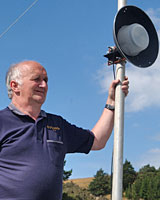
Wok TV System

Love this story about Kiwi ingenuity from the New Zealand Herald:

$10 wok keeps TV station on air

Why pay $20,000 for a commercial link to run your television station when a $10 kitchen wok from the Warehouse is just as effective?

This is exactly how North Otago’s newest television station 45 South is transmitting its signal from its studio to the top of Cape Wanbrow, in a bid to keep costs down.

45 South volunteer Ken Jones designed the wok transmitter in his spare time last year when he wanted to provide wireless broadband to his Ardgowan home.

"A group of us wanted to connect our computers to each other and then we worked out a way to get of getting the signal between two points," he said.

He discovered satellite dishes were between $100 to $400 retail and that smaller dishes, the same size as a wok, were $80.

Mr Jones thought he could do better.

Along with friend Murray Bobbette they worked out mathematical equations to prove the curved metal face of a wok would have the same effect as a small satellite dish.

"We have spent a lot of time getting it right — the first time we installed one we had it up a pole with the handle still on the end of the wok," he said.

"We had it connected to the woolshed and initially you couldn’t get a signal the width of the paddock and now it can reach up to 20km."

When the television station 45 South (UHF channel 41) started up in September last year, Mr Jones thought the same technique could be applied.

"The $20,000 for a commercial link was just money we didn’t have, so we bought several woks from The Warehouse instead which was convenient and cheap," he said.

Pre-recorded clips at the studio are fed through a computer and beamed to Cape Wanbrow where they are relayed off to television sets around North Otago.

The classic case of Kiwi ingenuity has made its way onto the internet and the technique has been posted by an American website, Mr Jones said.

"People wanted to know all the details about how to make their own, so it is now all publicly documented," he said.

One of the issues they had to deal with was making the pole that the wok sits on high enough to clear the Kingsgate Brydone Hotel.

Of course, this story found it’s way to Make a day after it was published.

Iran’s Sputnik?

What precisely did Iran launch earlier this week, and what does it mean?


That’s a hot topic among space, military and diplomacy analysts around the world. 

"Calling the test a scientific achievement which will help propel Tehran’s research into the next century, Iranian leaders say its aerospace research center has launched a rocket 150km (93 miles) above the Earth, which returned with the aid of parachutes,"  Iranian.ws reports.

The Fars News Agency claims the "space rocket" was launched for "scientific purposes." 

"But the 25-30-ton rocket could be a wolf in sheep’s clothing to test longer-range Iranian missile technologies," Spaceref.com counters. 

What’s the truth? Radio Free Europe spoke to Shannon Kile, a senior nonproliferation expert at the Stockholm International Peace Institute in Sweden, for analysis. She says:

Well, there is actually some confusion about exactly what Iran launched. The initial reports that came from the Iranian state media indicated that Iran was in fact trying to place a satellite into orbit, and the head of the Iranian space agency quickly dismissed that, saying no, that in fact this was a sounding rocket [a rocket bearing scientific instruments to probe the upper atmosphere] and the purpose of the rocket was basically to go above the 100 kilometer boundary that is commonly considered to mark the beginning of space. The type of rocket that Iran used appears to have been a single-stage, liquid-fuel rocket that probably is a derivation of one of their simpler, medium-range ballistic missiles….

The rocket that was launched last week was basically a sounding rocket, this is half-a-century-old technology. It doesn’t represent any major technological achievement for Iran. [However], it’s important to keep in mind that there are a number of reports recently in trade and industry publications which indicate that Iran is preparing a real satellite launcher based on the Shahab-3 medium-range ballistic missile.

The Shahab missle series, interestingly enough, is a variation of the Scud missles made famous during the first Gulf War.

What do you think is the meaning of this week’s rocket test by Iran?

To Pluto at 52,000 MPH

The New Horizons spacecraft used Jupiter’s gravitational pull to increase its speed by 9,000 MPH to a total of 52,000 MPH, as reported by Alex DeMetrick at WJZ in Baltimore:

Heading To Pluto With Help From Jupiter

LAUREL, Md. There are all kinds of test drives, but only one at 52,000 miles per hour.

That’s the speed scientists here in Maryland are aiming for and as Alex DeMetrick reports, the test track is Jupiter.

Man’s first journey to Pluto left a little over a year ago. But for the New Horizons Spacecraft to get there, it’s difficult.

"There’s this little keyhole the spacecraft must reach," Dr. Hal Weaver from the Hopkins Applied Physics Lab said.

That little keyhole just happens to be the biggest planet in the solar system. Jupiter is the spacecraft’s turbo charger, guided by controllers at Hopkins Applied Physics Lab in Laurel.

"We’re using Jupiter as a catapult. By passing fairly close to Jupiter, it’s going to sling-shot us faster toward Pluto. We’re gaining 9,000 miles per hour," Weaver said.

It’s man’s fastest vehicle. While passing by, instruments will be checked out, observations made, including a ride down the planet’s massive magnetic tail.

New Horizons will train its instruments on Pluto in a fly-by in 2015. That’s a long time, but scientists hope it will get there thanks to Jupiter’s assistance.

Not only will New Horizons provide scientists with their first close look at Pluto, the spacecraft will also continue on into the Kuyper belt in search of other Pluto-type objects.


That spacecraft was speeding from the moment it was launched. Watch this launch video and you’ll see the camera operator had trouble keeping up with it:

Danger Of Early Daylight Savings: Mistimed Coffee Brewing

From the batten-down-the-hatches dept…

Los Alamos Highlights Real Danger Of Early Daylight Savings: Mistimed Coffee Brewing

The upcoming early arrival of Daylight Savings Time continues to make some headlines, even if there really isn’t a whole lot to worry about. The latest story looks at how the Los Alamos National Laboratory is coping with the change, and things seem fine, as its IT director is apparently most concerned about people who use calendar programs showing up for meetings on time. The lab’s newsletter, though, had some more pressing advice for employees: make sure things like the clocks on their coffee pots are set correctly, as clearly it would be a significant problem if their coffee wasn’t ready as expected on March 11. Perhaps when we repackage our Y2K preparedness kits and bunkers, we should make sure they include coffee pots that don’t contain a clock.

Real Danger Of Early Daylight Savings: Mistimed Coffee Brewing

Los Alamos Highlights Real Danger Of Early Daylight Savings: Mistimed Coffee Brewing

from the batten-down-the-hatches dept

The upcoming early arrival of Daylight Savings Time continues to make some headlines, even if there really isn’t a whole lot to worry about. The latest story looks at how the Los Alamos National Laboratory is coping with the change, and things seem fine, as its IT director is apparently most concerned about people who use calendar programs showing up for meetings on time. The lab’s newsletter, though, had some more pressing advice for employees: make sure things like the clocks on their coffee pots are set correctly, as clearly it would be a significant problem if their coffee wasn’t ready as expected on March 11. Perhaps when we repackage our Y2K preparedness kits and bunkers, we should make sure they include coffee pots that don’t contain a clock.

Anti-Jamming Technology Goes Commercial

The Times reported yesterday that Boeing is looking to put anti-jamming technology previously reserved only for the military on commercial satellites used by business and the communications industry. According to the article,

"Anti-jamming technology is already used by military and spy satellites, but proposals to install similar protection in the 250 large satellites in commercial operation have been prompted by the threat of disruption.

The successful jamming of video, data, or voice signals by individuals or groups could jeopardise the millions of dollars spent on just a handful of satellites, operators fear.

Such jamming of government navigation satellites has already occurred, according to Lieutenant General Robert Kehler of the US Air Force, ‘as has jamming of commercial telecommunications satellites.’"

Space.com has a great background report on Spy Satellites for those who want to know a little bit more about the technology and the American Military and Intelligence communities uses of the technology. While Spy Satellites have been used for quite a long time, even the latest anti-jamming technologies are unable to prevent detection, the spy satellite holy grail. While satellite project, such as MISTY, have been able to avoid detection by laser and microwave radar, none has been able to completely avoid visible detection, a limitation which has prompted the emergence of a small, but strong spy satellite monitoring enthusiast community.

Oh, and for those of you who might be worried about the commercial anti-jamming technologies making it into the wrong hands, it looks like your not alone. While Boeing seems confident that they’ll win it, the U.S. government does have to approve the use of the "top secret" anti-jamming technology on commercial satellites before the company can start introducing it on products sold to foreign customers.

UN Getting Closer to Space Junk Guidelines


We all know space debris (or space junk, as I like to call it) is a big problem. While the lost cameras, gloves, and toothbrushes may reenter the atmosphere and burn-up without too much of a problem, the sheer number of spent rocket stages, broken down satellites, and broken off bits and pieces that come along with both pose a real hazards for working satellites, the International Space station, and astronauts on a space-walk. Moreover, the more space junk we create the more we have to watch. Currently, U.S. Strategic Command tracks over 10,000 pieces of space junk to ensure each piece’s reentry is not mistaken for enemy fire from above.

Fortunately, according to Aviation Week, the UN is making some headway in the fight against the floating trash, having secured the support of China for a landmark resolution that would set guidelines for limiting space debris. China’s support for the resolution was less than certain, particularly given its recent testing of anti-satellite weapons technology that generated a fair amount of space junk, itself, in the process. Most likely the Chinese may have felt they were safe from scrutiny, because the new guidelines are designed to curtail unintended space debris.

"While the Chinese test, which has been described as the worst debris event in space-flight history, was deliberate, the problem of unintended debris generation was underscored this month by the apparent rupture of a fuel tank on a Russian rocket that malfunctioned during a communications-satellite launch last year."

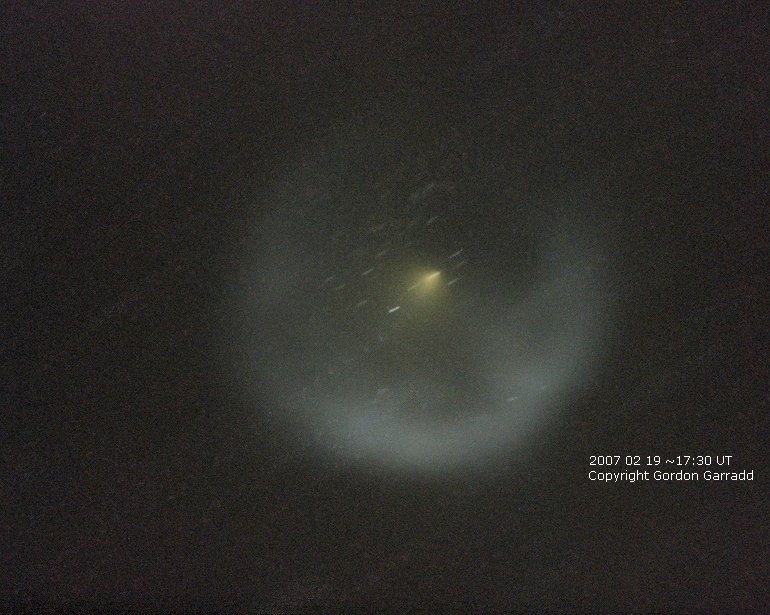
Above you’ll find one of the better photos of last year’s explosions that we found on Spaceweather.com. We found at least two other photos on the same site.

While it remains to be seen when an actual resolution will emerge from the UN regarding approaches for dealing with the problem of space trash and what (if any) teeth it might have when it’s passed, but its good to hear that someone is making some headway in solving this complicated problem.

Boring Press Releases

I’m so glad we have journalists around to make the news interesting. Imagine if we only had press releases.  B-O-R-I-N-G !

Just look at all these releases surrounding the Satellite 2007 show in Washington last week. Open your eyes wide and read these exciting excerpts:

"…released two new software options to their industry leading product lines that extend their already unique ability to…"

"This flexibility makes the product line more accessible to the networking requirements of government, military, and commercial customers who increasingly value high uplink and downlink speeds at a node and desire to blend terrestrial solutions with their satellite backhaul."

"The company’s DVB-RCS/S2 solutions are the only multiple-access satellite solutions capable of delivering data transfer rates of up to 80 Mbps for downloads and up to 8 Mbps for uploads at each remote terminal, or enough bandwidth to support a variety of users such as a small business or battalion unit to an entire community/military base from a single remote terminal."

And this quote is typical from apparently happy customers:

“We are looking forward to working with X on the development of this next generation intelligent network. Significant improvements can be made to future VSAT systems with the addition of artificial intelligence to the network. These capabilities offer the promise of enhanced performance and economic gains which will allow us to offer new and more cost effective services to our customers.”

I think it’s time we put some excitement in our "realeases" and start making some real news. I’ve noticed NASA’s public affairs people are putting some fun into their work and coming up with some very creative angles over the past year or so — just take a look at this "Camping on the Moon" release. Brilliant!