Talk about a Payload…

The Stanford Daily last week reported on a joint venture between NASA and Stanford University that would putting E. coli into space.

The project, which has been dubbed GeneSat-1, has involved the launching of a new non-harmful strain of E. coli bacteria into orbit in an attempt to observe the impact that zero gravity and space radiation have on the DNA of living organisms. By studying the data that is being transmitted to Earth from the shoebox-sized project satellite, the GeneSat-1 team believes that the mission could offer insight into the health risks of prolonged manned space missions. Spearheading the GeneSat-1 mission is a host of Stanford-affiliated technologists and NASA researchers.

I wonder if this is the first time blasting the bacteria commonly found in excrement into space might actually help humanity? I don’t know, but the mission appears to have been a part of the payload in the first launch from the Mid-Atlantic Regional Spaceport. Talking about some history making bacteria … hey, at least its not in my Spinach. 🙂
 

DIY Friday: Paint That Satellite Dish

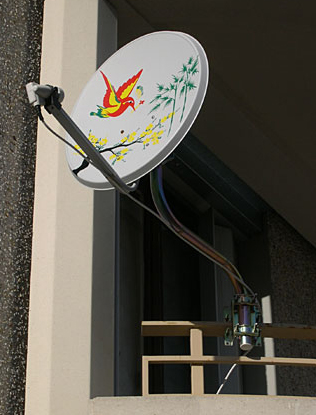
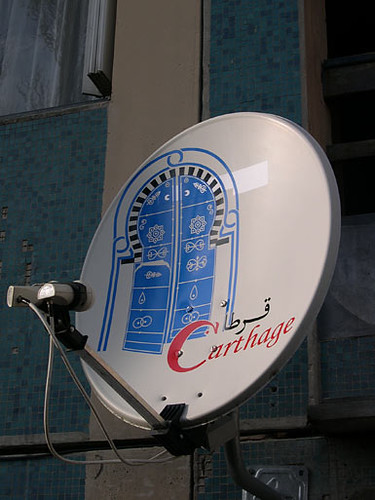
We’ve blogged about unobtrusively installing your own dish — but most satellite TV customers rarely decorate their antennas by painting them.

After coming across this site, showing beautifully painted and decorated satellite antennas in North Africa, we may want to reconsider.

Before we run out and start painting, we need to keep in mind the reflector serves a purpose, and never paint the LNB. Check ehow.com for details.


DISA Issues RFI for TCA to Industry, With Help from the Comms FIO and NSSO

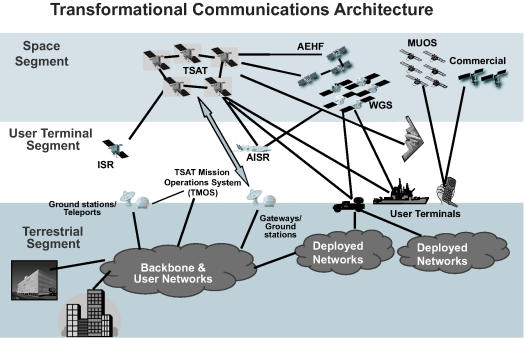
DISA (Defense Information Systems Agency) is turning to the commercial satcom community for what appears to be a huge undertaking: the TCA (Transformational Communications Architecture). It includes satcom systems serving NASA, DoD and the Intelligence Community. Like I said: HUGE.

Federal Computer Week has the story:

Transformational Communications Architecture will address the potential for an expanded role for commercial satellite communications to meet the requirements of DOD, NASA and the intelligence community through the year 2020, according to the request for information released Jan. 9.

The Communications Functional Integration Office (FIO) of the National Security Space Office (NSSO) is overseeing the project.

According to the RFI, the agency wants to assess the ability of the commercial satellite industry to meet a wide range of requirements, including wideband and narrowband communications provided by satellite systems operating in L, S, C, X, Ku, and Ka bands.

DISA also needs to know how well commercial services can support various communication platforms, such as handheld, airborne (including unmanned aerial vehicles) and shipboard communications. Replies to the RFI are due Jan. 26.

Bernie Skoch, a consultant with Suss Consulting who worked for DISA as director of customer advocacy, said it makes sense to bundle future NASA requirements with DOD because NASA has a lot of satellite assets that lie fallow between space missions.

Skoch said that the RFI indicated that DOD does not have enough in-house expertise to develop its own architecture and needs to reach across the table for help from industry.

In a briefing delivered to a Satellite Industry Association conference late last year, Cmdr. Allan Assel of the FIO said DOD needs a new architecture to address potential shortfalls in the coming years as the demand for satellite communications exceeds capacity.

Assel said next-generation communications architecture should also leverage IP-based communications, which can support interoperable voice, video and data streams, memory in space, and information assurance. The new TCA should also work in concert with DISA’s Global Information Grid to help synchronize multiple acquisitions.

NSSO, in cooperation with the Transportation Department, is also developing an architecture for satellite-based positioning, navigation and timing services.

I didn’t write this! Sounds more like Dickens

While some might say it reminds them of a game of "Spot the Looney," there seems to be some confusion across the pond about whether or not the U.K. is going to venture to the moon or not.

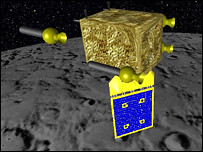
According to the BBC, the UK’s astronomy funding agency, the PParc, is planning on taking the country’s first mission to the moon by 2010. The proposed craft, named Moonlight, would be designed to orbit the satellite and shoot four "suitcase-sized darts containing various instrumentation into the lunar surface.

"The darts could carry a small suite of instruments, such as seismometers to listen for ‘Moonquakes’. Analysing these tremors would give scientists new insight into the make-up of the lunar interior.

According to Dr Andrew Coates, of the Mullard Space Science Lab and who has contributed to the concept study, the impactors would represent the first time there had been a detailed study of the Moon’s sub-surface."

Another proposed designed, code-named Moonraker, would be designed to land on the surface of the moon.

"Its scientific goal would be to study the lunar surface, perhaps at the poles or in the giant impact crater that resides on the far side of the Moon. It might also provide useful information for space agencies searching for suitable sites for eventual human habitation."

Cool ideas, so what’s the problem? Well, it turns out key British Science officials are saying that its pretty unlikely that the UK is going to go it alone on a project of this magnitude.

According to science blog Physorg.com, David Parker, director of space science at the British National Space Centre (BNSC), the plans the BBC reported on are the "’most unlikely outcome’ of Britain’s space plans."

D’Oh!

Consumer Electronics Everywhere: Updates from CES & Macworld

Yesterday was a huge day (probably the biggest of 2007… just 9 days in) for the announcement and release of Consumer Electronics, as we teased yesterday, at CES and Macworld Conference & Expo.

Of course, Apple takes the cake with three of the biggest announcements of the day:

The release of Apple TV which brings iTunes Store purchased music, television shows, and movies (over 350, now including many from the Paramount vault) to the big screen via your wired or wireless network.

The introduction of the iPhone, a product which will foreseeably revolutionize the mobile phone market. WIth over 200 individual patents to its name, when its released in June, the iPhone will be the most technology advanced mobile phone on the market featuring a full blown operating system, multiple wireless connection technologies (Quad-band GSM, EDGE, 802.11b/g, & Bluetooth 2.0 w/ EDR), and a huge 3.5-inch screen that utilize new multi-touch display technology.

The announcement that the company would know be known as Apple, Inc. rather than Apple Computers, Inc. While meaningless to most techies, the name change is akin to Apple screaming, "Bring it on" to consumer electronic juggernauts such as Sony, Motorola, or Nokia, representing its transition to a consumer electronics company and a willingness to take on a new industry.

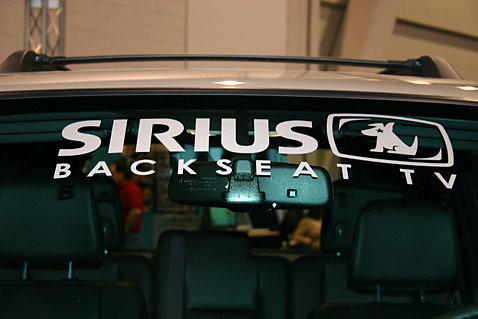
Back at CES, Satellite Radio company Sirius announced, according to Sat Radio blog Orbitcast, that Dodge will be offering Sirius Backseat Television in some 2008 models. With multiple zones, Orbitcast notes, the Dodge set-up allows the driver to listen to the raunchiest bits of Howard Stern while the kids watch Spongebob. Coolness!


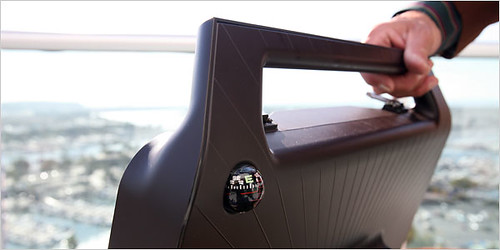
For those looking to watch TV themselves, The New York Times featured an article Monday about another major announcement from DirectTV, Sat-Go, which allows you to watch satellite TV anywhere. With an interesting genesis, partially invented by the man who produced CHiPS and The New Hollywood Squares, its a product that sure to be a huge hit in the right markets, even if there have been less elegant solutions in the past.

The News at CES and MacWorld

The 40th Annual CES (Consumer Electronics Show) kicked off yesterday in Las Vegas — and even if you’re thousands of frigid miles away (as we are), you can be there virtually by following Engadget’s live coverage of the event.

And if you want to duck out virtually, take this virtual tour of the Venetian, where the conference is being held. 

But we digress. The big news to come out of CES yesterday was DIRECTV’s announcement of their launch and carriage of 100 HD channels in 2007. 

The big news today? Well, it might actually come from the MacWorld Conference and Expo in San Francisco, where today may be:

… the day we find out whether all the rumors are true and the Applephone and / or solid-state ultraslim MacBook and / or iTV and / or true wireless-video-touchscreen iPod will be announced (we’re not holding our breath on any of the above), or whether we’ll spend another few months sorting through rumor, speculation, and bad Apple product mockups.

The keynote at MacWorld will be broadcast live beginning at 12 noon EDT today; you can tune in for a webcast and get other breaking news from both conferences on the Engadget website.

‘Plutoed’ chosen as ’06 Word of the Year

The AP reports that our dear former planet has found newfound fame in the slang of the hip:

 Pluto is finally getting some respect — not from astronomers, but from wordsmiths.

"Plutoed" was chosen 2006’s Word of the Year by the American Dialect Society at its annual meeting Friday.

To "pluto" is "to demote or devalue someone or something," much like what happened to the former planet last year when the General Assembly of the International Astronomical Union decided Pluto didn’t meet its definition of a planet….

"Plutoed" won in a runoff against "climate canary," defined as "an organism or species whose poor health or declining numbers hint at a larger environmental catastrophe on the horizon."

Other words considered: murse (man’s purse), flog (a fake blog that promotes products) and macaca (an American citizen treated as an alien).

Comet McNaught Streaks Towards Sun

It’s our esteemed scientific opinion that global interest in astronomy would skyrocket (pun somewhat intended) if all comets and space objects had names as cool as Comet McNaught.

The comet was only recently discovered — on August 7th of last year

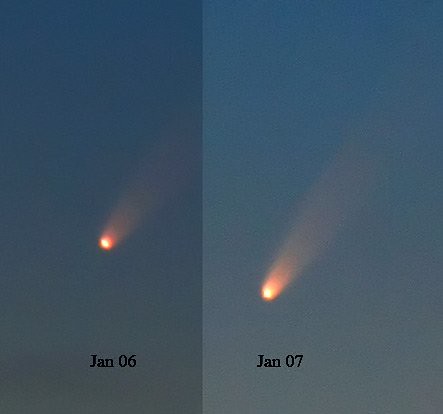
When Australian astronomer Robert McNaught announced Aug. 7 that he had discovered a faint comet on a photograph taken at the Siding Spring Observatory in New South Wales, it was a distant and inconspicuous object.  But its orbital motion at once made it clear that this comet, officially catalogued as C/2006 P1, might grow very bright right about now.

Comet McNaught’s orbit indicates that it will sweep to within just 15.8 million miles (25.4 million kilometers) of the Sun on Jan. 12.  This rather close approach—less than half the average distance of Mercury, the closest planet to the Sun—suggests the comet has the potential to briefly evolve into a bright object. The big question is, just how bright?

Recent estimates have ranged widely from magnitude +2.1 (about as bright as Polaris, the North Star) to a dazzling -8.8 (about 40 times brighter than Venus)!  

Just how brilliant McNaught gets remains to be seen over the next 4 days…. but it’s already dazzling the naked eye around the world:


A series of images of Comet McNaught can be found here; or click here for a video of McNaught’s orbit.

We encourage you to bring binoculars and a camera when viewing the comet, but never fear if you miss that great shot: 

Regardless of just how bright Comet McNaught becomes, beginning on Friday, Jan. 12 and continuing through Monday, Jan. 15, it will be passing through the field of view of the Solar and Heliospheric Observatory ("SOHO"); a spacecraft that was launched in 1995 to study the Sun.

Astronomers hope to get spectacular views of the comet by utilizing SOHO’s LASCO C3 camera, whose images can also be viewed in real time here.  

We’ll have more on McNaught when it’s closest to the sun on the 12th of this month. 


DIY Friday: WiFi Signal Amplifier

This rocket scientist has recently discovered the joys of a Verizon Aircard while traveling. No more dropping $10 extra bucks in a $200 a night hotel just to get online, or wrestling with the credit card at the airport to check your email between flights. It’s liberating, and wonderful, and somewhat akin to magic.
That said,  my personal plan is $50+ per month, and whenever I use the wireless broadband these days, it seems there’s a freely availably wifi service just out of reach. If only my wifi receiver were better, I might be able to save even that dough.

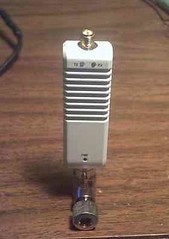
Which brings us to today’s edition of DIY Friday, and that rugged little gizmo to the left, which looks like a cross between a Glade Plugin and the valve on my gas grill:


Most laptops nowadays have a mini PCI Wi-Fi card hooked to an antenna which is located inside a screen plastic cover on the laptop. I was browsing eBay recently and noticed that there were some Wi-Fi amplifiers available that promoted themselves as improving the reception of the signal. Sadly most of those amplifiers are designed to be hooked to a PCMCIA type card or a router! None of them seemed to be specifically made for a mini PCI card.

I decided to buy a Wi-Fi amplifier and hook it to my laptop. I have an ASUS A2H laptop with a Dell 1470 a/b/g Wi-Fi mini PCI card inside, I bought the card for $20 off of eBay. I bought the amplifier for $118, it is a 500 mw bi-directional amplifier called "turbo tenna", the amplifier was shipped from Hong Kong and I received it shortly after ordering on eBay.


 A nip and tuck of a wire here and there, and the author of the piece found "a dramatic increase in signal strength! More than -80dBm, and the speed of the connection is 24Mbps with signal strength 34% as compared to the same connection at 1% previously tested. You can also see more Wi-Fi connections around you, though of course they’re all password protected."

 But hey — it’s not $50 a month, either.

FCC Authorizes New NGSO Satellite System


Several years ago, there were several companies who wanted to use the Ku-band in operating non-geosynchronous satellites (NGSO’s), causing an uproar among established GEO operators at the time.  As proposed, they’d interfere with high-value satellite services around the world. That wasn’t gonna happen.

Most of those interference issues were resolved via an agreement at the ITU. Now, via Doug Lung’s RF Report, we see the FCC authorizing one of those original applicants:

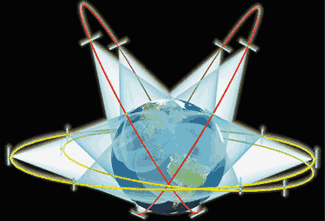
The commission allowed Virtual Geosatellite LLC to begin building a non-geostationary satellite system that will use a network of satellites with highly elliptical orbits. The system is composed of three sub-constellations, each with five satellites. Two of the sub-constellations track the Earth’s northern hemisphere and the third tracks the southern hemisphere. Each sub-constellation will have one spare satellite. To eliminate interference with satellites in geostationary orbits and terrestrial microwave systems using the same frequency band, Virtual Geo terminals and gateway stations will communicate with the satellites only when the satellites are above a certain elevation angle and the satellites in each sub-constellation will actively communicate with earth stations only when they are at an orbital position that is at a latitude greater than 45 degrees away from the equator in their respective operating hemisphere.

Virtual Geo was allowed to use 5925-6725 MHz, 12.75-13.25 GHz and 13.8-14.5 GHz for uplinks and 3700-4200 MHz and 10.7-12.7 GHz for downlinks. User-to-satellite links will use the 14.0-14.5 GHz band and satellite-to-user links will use 11.2-11.7 GHz.

Is this what’s left of Teledesic?