Meteor Crashes in New Jersey
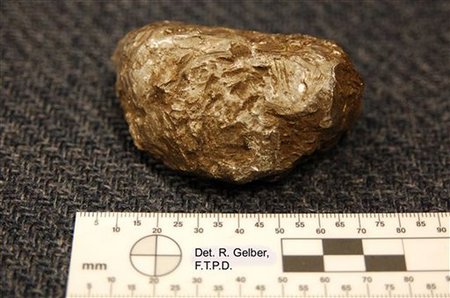
 

One of my Brooklyn buds sent me this from the Asbury Park Press:

It fell from the sky! Mystery object hits Freehold Township house

Posted by the Asbury Park Press on 01/3/07
BY JAMES A. QUIRK

FREEHOLD TOWNSHIP — The Federal Aviation Administration is currently investigating the origin of what appears to be a lump of metal that fell from the sky and through the roof of a home on Kentucky Way last night.

The metal object is about the size of a golf ball and weighs nearly as much as a can of soup, authorities said. Nobody was injured when the oblong object, weighing more than 13 ounces, crashed into the home.

Police received a call Wednesday morning that the metal object had punched a hole in the roof of a single-family home and damaged tiles on a bathroom floor below.

The object was heavier than a usual metal object of that size, said police Lt. Robert Brightman. He added that investigators with the Monmouth County Office of Emergency Management this morning brought in Geiger counters to determine if the object posed any radiological hazard to the homeowners or responders, and the object was found not to be radioactive.

Brightman would not immediately disclose the address or the names of the people who lived at the home, other than to say that a couple and their adult son live there. He said a man who lived at the home found the object at about 9 p.m. Tuesday after returning from work and hearing from his mother that something had crashed through the roof a few hours before.

The Federal Aviation Administration sent a team to the home this afternoon to check whether the object came from an airplane, said spokeswoman Arlene Murray.

"We won’t know what it is until our inspectors have a chance to look at it,” she said. If the investigators cannot identify the object on sight, it may be sent for testing, she said.


Meanwhile, over Colorado, there was a spectacular meteor shower. Fox31 has the video.
DIY Satellite Radio Merger

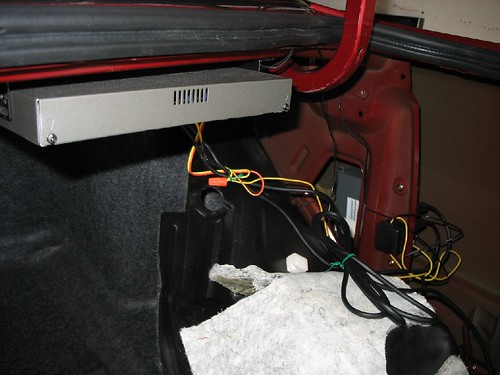
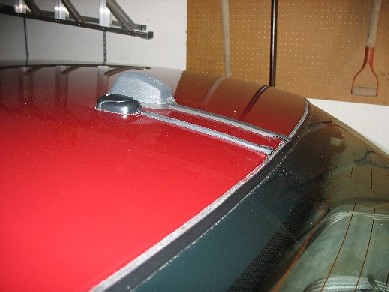
While the NYTimes confirmed rumors that the two were headed towards mergers-ville Monday, some hackers over in the XM fan forums have been discussing a joining of Sirius and XM that even the FTC can’t shut down. As with most two headed consumer electronic beats, the rig requires ignoring manufacturer claims that the doing so is impossible and leaving a mess of cables and random boxes in your trunk.


Hey, who said you needed to put groceries in there anyway.

[Adding XM to Sirrus]

Satcom: The Fiber Cut Remedy

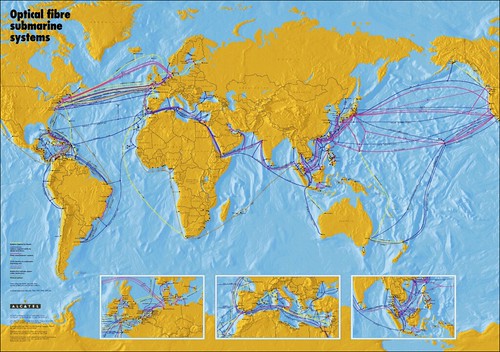
Heard about that Pacific earthquake near Taiwan while taking a break last week. Read in the New York Times how data and Internet traffic was significantly distrupted:

The quake disrupted services in Taiwan, Singapore, Hong Kong, South Korea and Japan, but a ripple effect was felt in other parts of the world. Many phone subscribers could not get through to Europe, regional telecommunications operators reported, as they raced to reroute their traffic to alternative lanes.

How prepared was everyone with mission-critical operations suddenly stopping? How vulnerable are these undersea fiber optic cables?


Was it really that bad? Seems like it was. The Korea Times reported that 6 of Korea’s 7 cables were cut, disrupting banking operations:

LG Dacom, which provides Citibank Korea’s dedicated data cables, said that the bank’s lines were cut by the 6.7-magnitude quake that struck the southern part of Taiwan.

Citibank Korea said the disruptions would not have happened if the bank had its own communication network in Korea.

"A network systems team in Taiwan oversees Citibank transactions in Korea. Severance of the submarine cable cut our connections with them, causing all the problems,’’ an official said, requesting anonymity.

HSBC Korea also relies on a foreign carrier for dedicated data lines, which are managed by its Asia-Pacific headquarters in Hong Kong.

Officials at KT and Dacom, Korea’s fixed-line operators, which jointly manage with foreign partners the cables damaged by the quakes, said other data lines were affected.

"A total of 92 dedicated data lines were severed, partially disrupting the operations of 32 of our corporate customers,’’ a KT official, Park Hae-dong, said.

KT’s clients include the Ministry of Foreign Affairs and Trade, Reuters, AT&T Korea, Posdata and SK Telink. Among financial clients are Metlife Korea, Korea Exchange Bank and Kookmin Bank.

Dacom, Citibank’s service provider, said the quake cut 26 of its lines.

Fortunately, satellites over the Pacific act as back-ups for some, while others rely exclusively on space-based redundancy for their critical communications. Several intra-Asian satellites, such as those operated by AsiaSat, came to the rescue. You can bet you sweet bippy trans-Pacific satellites such as Telstar 18, NSS-5, IS-701, AMC-23 and PAS-8 got some business from this outage.

 With communications returning to normal, we may not know the extent of the damage for another 2 weeks.  I can tell one thing we’ll know in a couple of weeks. THE hot topic at the Pacific Telecommunications Council’s annual conference in Honolulu will be the race to build another cable across the Pacific.

2007: The Year of the Moon?

Is 2007 going to be the year of the moon?
In one respect, yes. A slate of robotic lunar explorers are set to head for our lone satellite in 2007 — though not from the United States.

Space.com reports: 

This year, China is set to launch its first lunar orbiter, followed by the summer sendoff of a mega-powerful mooncraft from Japan.

Both nations are kick-starting a barrage of robotic survey ships that shoot for the Moon, including lunar missions by India and the United States in 2008.

As global interest in the Moon grows, so too does the call for multi-nation collaboration in robotic and future human exploration of Earth’s neighboring natural satellite.

China is wrapping up fabrication next month of Chang’e I to be sent spaceward atop a Long March 3A rocket.

The lunar orbiter design—based on their Dongfanghong III satellite platform—is reportedly headed for an April departure from the Xichang Satellite Launch Center in Sichuan Province.

According to Chinese news services, once Chang’e I circles Earth for nearly 8 hours, the spacecraft will then depart on its journey, taking 114 hours to reach Moon orbit.

While precise specifications about onboard science gear is not widely known, Chinese space planners have explained in broader terms the goals of the mission. The craft will yield 3D images of the Moon’s surface, probe the distribution of 14 “usable elements” on the Moon, gauge the temperature of the Moon, estimate the depth of the lunar crust, as well as study the space environment between the Earth and the Moon. The lunar orbiter is designed to carry out a one-year mission.


RRS Over The Holidays: See You in ’07

ReallyRocketScience is going to be taking a bit of a break over the Holidays, but we’ll see you all back here bright and early on Tuesday, January 2nd, nursing our lingering hangovers, and still wondering what happened the evening before last.

 In all seriousness, whatever you celebrate (and even if you’re celebrating nothing in particular), best wishes to you and yours for a happy and safe holiday season.  See you in 2007!

DIY Friday: Car Laptop Desk and a Flash Diffuser (Holiday Edition)

With just three shopping days left before the big day, many of us are trying to frantically figure out how we’re going to get all our work done before the end of 2006, while simultaneously hitting the malls getting gifts of all 27 nieces and nephews that we all of the sudden have.


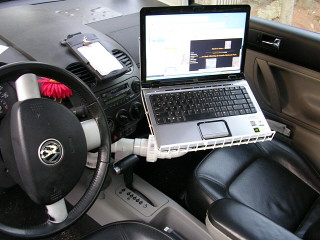
While you’re probably better off not turning to ReallyRocketScience for gift giving suggestions (Hint: Your girlfriend really isn’t going to love that "Build Your Own" Rocketry Kit as much as you think she is), we will direct you to site that will show you how to "build your own", cup-holder-based laptop desk for your car. Sure, checking your email while you’re hunting for that great parking space might lead to one or two fender benders or incidences of road rage, but, hey, at least you’ll be able to make sure your boss thinks you’re still at your desk.


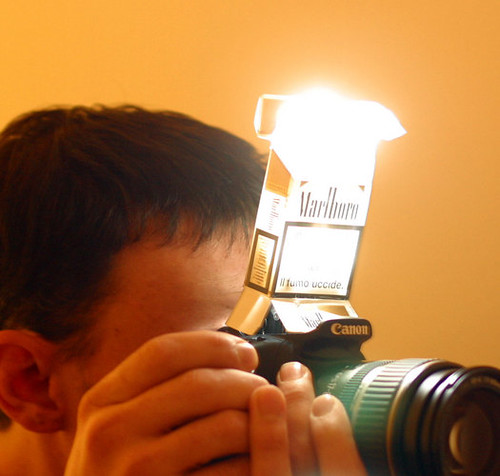
For those of you that have the shopping done, but are planning to photograph the christmas morning festivities only to find out that you didn’t get the flash diffuser you wanted from Santa, here’s a site where you can figure out how to make your own. Just one word of caution: While the resulting diffuser may be good for your evening photos, the cigarettes it takes to make it are bad for your health and, in the long term, far more expensive than the priciest diffuser you can buy.

Solar Storms


We wrote yesterday about the challenges a hostile space environment presents to satellite technology; last week we were all reminded of those challenges when a solar flare disrupted satellite signals:

An "energetic" storm on the sun disrupted signals in space and forced mission controllers to shut systems down to avoid damage to spacecraft orbiting Earth, the European Space Agency said.

The sun on December 13 expelled a solar flare after a buildup of magnetic energy near its surface triggered an explosion, the agency said today in an e-mailed statement. The flare caused a so-called coronal mass ejection, which sent a stream of fast-moving atomic particles toward Earth…

The flare was the strongest of five categories for such ejections and was one of a series of eruptions this week that emanated from a region of active sunspots. 

The flare even affected the ISS:

 It may also have caused a fault in the system controlling the space station’s orientation in space.

The ISS usually relies on four large gyroscopes that spin to control its "attitude" without consuming copious amounts of propellant.

Space station flight director Joel Montalbano told reporters in Houston, US, that the unusual solar activity had caused the density of Earth’s atmosphere to increase.

"We’re seeing some problems with our software converging on a nice stable attitude for attitude control," Space.com quoted him as saying.

Last week, astronauts were forced to sleep in protective areas of the station and shuttle as a precaution against the storm.

What do satellite operators like SES AMERICOM do in a case like this? Nothing, really, other than ride it out. 

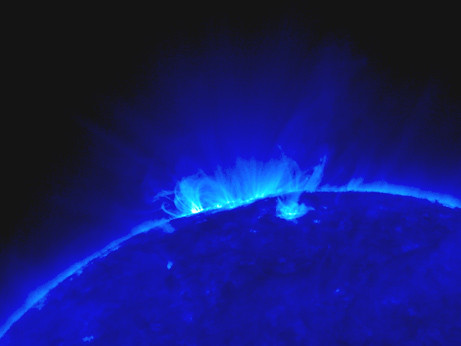
But all that solar activity can be beautiful. The image at the top of this post is from NASA’s twin Solar Terrestrial Relations Observatories (STEREO), which sent back their first images of the sun ‘s growing activity. And some musicians at Berkeley are even making music inspired by "the breeze of electrons from the sun."

Zamfir, eat your heart out.  

But as beautiful as the images of the sun are from last week, some impatient people may wonder what the sun looks like right now. For that, bookmark SolarMonitor.org, which provides nearly real time images of the sun.


Rhythm and Blues Replacing Rock and Roll

Is time running backwards, or are music lovers just getting back to their roots?

Well, neither, as it turns out. Rather, "Rhythm" and "Blues" are the names of the two new satellites that will bring XM Satellite Radio to consumers:  

On Friday, XM began broadcasting through its recently launched XM-4 satellite (known as "Blues") manufactured by Boeing Satellite Systems International, Inc. The combination of "Rhythm (the XM-3 satellite launched in early 2005)" and "Blues" provides a solid foundation to deliver a full complement of digital broadcasts to the XM Nation across the next two decades…

Rhythm and Blues replace XM’s original satellites, "Rock" and "Roll," launched in 2001, which will serve as in-orbit spares for the near-term.

"Rock" and "Roll" were just launched in 2001 — so why replace them so soon?

The first Boeing 702 spacecraft had problems with the solar arrays, which experienced "faster than expected performance degradation during early operational life."

That’s a mere euphemism, insurers say. In a satellite version of a "lemon law," the world’s "largest space-insurance underwriters have agreed to seek damages from Boeing Co. for what they allege was gross negligence in the manufacturing of the first six Boeing 702-class satellites, all of which had defective solar arrays," according to Space News.

Solar array problems aren’t always a case of manufacturing errors, however. The space environment is extraordinarily hostile, and solar array failures can often be caused by conditions in space

In 1997, scientists and engineers of the Photovoltaic and Space Environments Branch of the NASA Lewis Research Center, Maxwell Technologies, and Space Systems/Loral discovered a new failure mechanism for solar arrays on communications satellites in orbit. Sustained electrical arcs, initiated by the space plasma and powered by the solar arrays themselves, were found to have destroyed solar array substrates on some Space Systems/Loral satellites, leading to array failure. The mechanism was tested at Lewis, and mitigation strategies were developed to prevent such disastrous occurrences on-orbit in the future.

Not all problems lead to array failure, however. But maintaining the functionality of solar arrays remains one of the key challenges to satellite engineers working in a difficult environment.

Satellite Internet Coming to Saskatchewan

Say that three times fast, eh?

We’ve written before about the challenges of bringing broadband access to remote, rural regions of Canada (in communities like Black Tickle, Labrador) — and the resulting lack of Internet access options for rural residents in the north.

But there’s good news today for those who want broadband in Saskatchewan:

Saskatchewan Communications Network (SCN) Minister Glenn Hagel and OmniGlobe Networks, Inc. (OGN) Chair Julian Costley today signed a Memorandum of Understanding to form a long-term strategic alliance.  The two companies will work together to deliver a satellite-based wireless broadband Internet service capable of supporting video-conferencing, Voice over Internet Protocol (VoIP) and other e-solutions to rural and remote communities across Canada….

Earlier this year, SCN and OGN undertook a six-month project together to deliver wireless broadband Internet service to several remote communities in northern Quebec.  The success of the Quebec project demonstrated large-scale interest for a national service combining satellite with terrestrial wireless access, inspiring the two organizations to jointly extend the model across Canada.

Omniglobe has years of experience delivering VSAT services (such as distant learning) to rural Canada. But delivering true broadband to Canada is going to require far more spectrum (bandwidth) then VSAT. Where will that spectrum come from?

The most likely answer is Ciel Satellite Group, which recently filed applications for 9 licences in Canada: 

On November 15, the Ciel Satellite Group filed nine applications with Industry Canada for multiple satellite orbital positions across several frequencies. The applications were submitted in response to Industry Canada’s Call for Applications to License Satellite Orbital Positions, the largest in Canadian history. Applicants who are awarded licences from the Call will have the opportunity to build and launch satellites to bring new spectrum into use for DTH, HD and broadband services, for the benefit of Canadians in all regions of the country….

David Lewis, President and CEO of Ciel, noted, "This is a key event in Ciel’s history and, at the same time, a defining moment in the history of Canadian telecommunications."

Yoga? In Space?

Let it never be said that you don’t get all the angles on space travel and rocketry here on the Really Rocket Science blog. Oh sure, I could tell you about Japan’s launch this afternoon of the country’s largest satellite ever, but you’d much rather know about Yoga’s history in space, right? I thought so.

In any event, I came across this interesting story on the history of Yoga in America published in a recent issue of the Columbia Journalism Review from one of my favorite news/article blog, Arts & Letters Daily. While most of the article, obviously didn’t have much to do with what we talk about here on RRS, it turns out that Yoga has interesting relationship with space travel. For example, at the height of the Cold War Space Race, there was a fair amount of concern about India’s ties to the Soviet Union’s space program. In the 1950s,

"Prime Minister Jawaharlal Nehru of India, obviously prompted by cold-war worries, denied reports that his nation would supply the Soviet Union with yogis to help cosmonauts breathe easier in outer space."

While yogi’s might have never made it to Mother Russia, Yoga did make it into outer-space (and on a Russian mission, no less) when Rakesh Sharma, who some have recently rumored is being considered for a second trip into space, became the first Indian in space in 1984. During the spring flight aboard the Soviet Soyuz T-11, Sharma often did a somewhat elaborate series of zero-gravity Yoga exercises, marking the first extraterrestrial practice of the asanas (postures). Ever since, there has been great interest in the potential benefits in stress relief, breathing, and circulation Yoga could bring to space travel in the future.

Moral of the story? If you’re thinking about hoping a trip on the Virgin Galactic-1 or one of the other opportunities for space travel that might come afterwards, maybe you should start thinking about picking up a matt and heading off to your your local Yoga center while you wait.