Goodbye Static!

I drive an old pick-up truck most of the time– a rock-bottom barebones 1996 Mazda B2300 with something like 135,000 miles on it– and when it comes to listening to music I have only three options: AM, FM, or trying once again to dislodge the copy of The Cure’s Disintegration, which has been stuck in the casette player since about 2003.

To put satellite radio or an MP3 player in the poor beleagured truck would be like dressing up a pig in pearls. Why bother?

But for those who drive newer vehicles, an iPod- and satellite-connected vehicle will soon be de rigeur

In the latest boost to its dominance in portable music players, Apple Computer Inc. is teaming with General Motors Corp., Ford Motor Co. and Mazda Motor Corp. to integrate the iPod into car audio systems.

GM and Ford are the nation’s No. 1 and No. 2 automakers, and the new alliances mean the iconic audio gadget will now be compatible with more than 70 percent of the new 2007 model vehicles sold in the United States, Apple said Thursday….

Demand for built-in satellite radio features has also prompted Ford to expand its relationship with Sirius Satellite Radio Inc. VanDagens said more than 90 percent of Ford and Lincoln Mercury cars will offer satellite radio by the 2008 model year.

What will be truly interesting is the impact that standardized satellite radio availability will do to the market share of local radio stations. They don’t call the peak listening hours "drive time" without reason. As more drivers tune out the radio and tune in their favorite satellite station or MP3 playlist, the over-the-air radio industry will be forced to undergo transformative change– or face the same decline that cable brought to the Big 3 Networks.


Launching the Coke/Mentos Rocket

Being rocket scientists and all, we couldn’t help but be fascinated by the latest craze lighting up the blogosphere: instructions and videos on how to combine Mentos with Diet Coke to create and launch your own home-made bottle rocket.

This particular launch  is one of the top videos on YouTube, with nearly half a million viewings in the past six weeks:

An explanation on how it’s done can be seen here:

Of course, being rocket scientists (and, for some of us, parents as well) we must provide a caveat– bottlerockets are inherently dangerous, no matter how they’re constructed. We direct you to Newton’s Second Law of Motion for further explanation.


City Wi-Fi, Green Wi-Fi

It’s been a long time since I blogged about my enthusiasm for municipal wi-fi, but news from Boston brought the subject back to mind again.

Wi-FiBoston’s plan to create a citywide wireless Internet network entered a new phase yesterday as Mayor Thomas M. Menino named former high-tech executive Pamela Reeve to lead the search for a non profit corporation to build the network.

Reeve, a member of the mayor’s Wireless Task Force and a former chief executive of software company Lightbridge Inc., also will talk to businesses, foundations, universities, and hospitals in an effort to raise between $16 million and $20 million for the project.

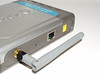
The money would be used to blanket city neighborhoods with fiber-optic cable and radio transmitters that would beam WiFi signals, enabling laptops, handheld computers, cell phones, and other portable devices to connect to the Internet at high speeds anywhere in the city.

As noted at GigaOm, this model is unlike any other in blending resources from government, business and non-profits. Can it work? Who knows, but if it does the next step might be to combine it with an idea like One Laptop Per Child movement, but with a domestic focus. Nigeria just ordered (and payed for) 1 million of the wireless-equipped laptops. It could happen in the U.S. too — wi-fi access and low-cost wireless laptops opening up new opportunities for a lot of kids.

And as long as cities are launching wi-fi networks, the might want to consider making them green too.

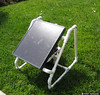
Green Wi-FiThe technical concept behind the Green Wi-Fi network is fairly simple. Each node in the network consists of a battery-powered router and a solar panel to charge the battery. The nodes are mounted on rooftops, and the network’s Wi-Fi signals are transferred over a grid using a wireless network standard known as 802.11b/g.

The first seed money has arrived, enough to produce and test prototype nodes. It came from the One Laptop Per Child initiative (OLPC), which aims to construct a $100 laptop to be distributed to children in developing countries. OLPC showed immediate interest in the Wi-Fi initiative, Pomerleau said.


We Got Your Rocket Scientsts Right Here

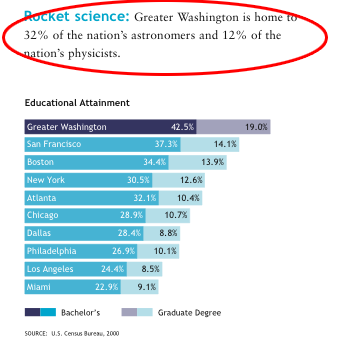
Here’s an interesting tidbit. Here in DC, I’m surrounded by rocket scientists. OK, not surrounded but it turns out the metro-DC area is home to a large percentage of the rocket scientist population. Higher than most cities, I bet.

The latest issue of The Washingtonian pulls some data from the Greater Washington Initiative’s latest regional report, which puts the percentage of rocket scientists in the area at 32% of the population. (12% of the nation’s physicists).

Rocket Scientists in DC

Impressive. But that’s only about a third of the country’s rocket scientists. Where are the rest of them? Where are most of them?


Blast from the Past: Titan IV

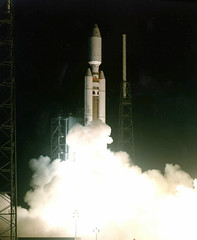
Titan IV

We reached into our video archives and pulled out two rocket launches to show you. Titan IV is the largest unmanned space booster used by the U.S. Air Force to carry payloads as big as the ones the space shuttle carries.

On September 8, 2003, Communications Concepts, Inc. broadcast the launch of the massive Titan IV as it blasted off the launch pad at Cape Canaveral Launch Complex 40. The day’s payload was a satellite for the National Reconnaissance Office. The model rocket was the Titan IV-B, the final model of the now retired Titan program, which was the largest, most powerful, heavy-lift expendable launch vehicle in the United States at the time. This mammoth rocket was as tall as a 20-story building and, with the solid rocket boosters and fuel, weighed about 940,000 kilograms (2 million pounds). In the video, you can see the sheer power of the Titan as the shot, captured from a remote camera less than 500 feet from the launch pad, fills with white just after liftoff.


The Missing Moonwalks

A couple of weeks ago, I posted about the dual anniversaries of the Viking I landing on Mars and the first humans (Neil Armstrong and Buzz Aldrin) to walk on the moon. Well, NPR has video footage of Armstrong’s and Aldrin’s lunar jaunts. The only problem is that they’re pretty shoddy copies. So NPR is looking looking for the original footage.

LandingAlmost everyone on the planet who had access to television watched the first moon landing, back on the night of July 20, 1969. What the TV viewers didn’t know is that they weren’t seeing the best images.

The astronauts actually beamed higher-quality footage back to Earth, but it was only seen by a small number of people at three tracking stations.

Those original images were recorded and put into storage — somewhere. Now, a small crew of retirees, space enthusiasts, and NASA employees are searching for a moon landing that the world has never seen.

The NPR piece goes on to describe how the images most Americans saw on their televisions sets back in 1969 were so degraded — compared to what the folks in Houston’s mission-control saw — and incompatible with television broadcasts that they had to be converted to the right format. Afterwards, the original footage was recorded onto 14-inch reels, which disappeared into the National Records Center in Maryland before NASA brought them to Goddard for "permanent retention." They haven’t been seen since.

The folks from the Apollo team would like very much to see the footage again. Actually, so would I. For the first time, of course.


A Closer Look At GeneBox

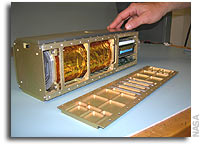
SpaceRef has a bit more about the NASA GeneBox I posted about last week, that’s on board Robert Bigelow’s Genesis I spacecraft. Including a tiny little photograph.

GeneBoxNamed "GeneBox", this small payload was developed by NASA Ames Research Center to test out new ways to perform in-flight genomic analysis of living systems. Indeed, much of what is being flown aboard this satellite is cutting edge biotech – the likes of which have yet to fly aboard the International Space Station. Future versions will be even more capable.

NASA developed the GeneBox payload and Bigelow Aerospace integrated and launched GeneBox – at no cost to NASA. ARC estimates that GeneBox cost approximately $1 million to fabricate, test, and prepare for flight. GeneBox is an adaptation of the "GeneSat" free flyer nanosatellite. NASA ARC expects GeneSat to cost approximately $6 million to develop.

GeneBox was funded entirely by NASA. This effort began with the (now disbanded) NASA Office of Biological and Physical Research (OBPR), then by the NASA Exploration Systems Mission Directorate (ESMD), and currently with NASA ARC internal R&D funds.

Of course, NASA’s collaboration with Bigelow is even more interesting in light of news that the agency is thinking about canning its space station research.


Your Mobile Phone & Your Money

If you’re as absent minded as me, you’ve probably left home once or twice without your wallet, but with your mobile phone attached to your hip. Well, in the future forgetting your wallet may not matter so much as long as you have your mobile phone, at least where needing cash on hand is concerned. Your mobile phone may serve as your wallet.

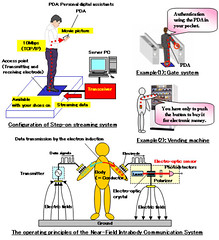
NFC ChipBy next year, you’ll be able to pay simply by swiping your cell phone a few inches from a cash register, with a new wireless standard called Near Field Communication.

An NFC chip in your phone will send your credit-card number — stored on your phone or on the chip — by way of short-distance radio waves.

An electronic reader at the checkout will decode the number and ring up your purchase. Unlike radio-frequency identification (RFID) and other existing contactless payment systems, NFC chips allow two-way information exchange by rolling an RF transmitter and reader into one five-millimeter package.

That means the chip can also take in data, such as a receipt zapped to it by a cash register or a bus schedule from a tag embedded in a bus-stop sign.

What’s Near Field Communications? Glad you asked. (And if you didn’t, I did.) This definition includes a handy chart.

Near Field Communications

But the NFC Forum has the easiest explanation I’ve found.

Near Field Communication (NFC) uses the same principle to link electronic devices. It enables the user to exchange all kinds of information, securely, simply by bringing two devices close together. Its short-range interaction over a few centimeters greatly simplifies the whole issue of identification, as there is less confusion when devices can only "hear" their immediate neighbors.

Evolving from a combination of contactless identification (RFID) and interconnection technologies, NFC technology bridges today’s connectivity gap. It enables the simple transfer of information — from phone numbers to electronic transactions — and allows people to interact with their environment without needing to navigate complicated menus or perform complex set-up procedures.

I wasn’t sure sure what makes that any different than Bluetooth or wi-fi, but apparently it’s a matter of range.

While Bluetooth and Wi-Fi have a range anywhere between 33 feet and 300 feet, NFC deals in inches — eight inches, to be precise. NFC "is designed for shorter distances and lighter content," says Karsten Ottenberg, General Manager of Philips Semiconductors’ Identification unit.

Great. There are only two drawbacks I can think of, and one of them has already been shot down. First, I thought I’d have to buy a new phone, but it turns out simple add-on chips will be available and that they’re pretty inexpensive to produce. That just leaves one problem. Would losing your phone become the same as losing your wallet?


MobaHO!

We love the name MobaHO! That exclamation point captures perfectly the exciting potential of satellite digital multimedia broadcasting.

That potential is being realized in Tokyo, as JCN reports

Mobile Broadcasting Corporation (mbco) and Sapporo-based taxi company Daikoku Kotsu will introduce MobaHO!, the world’s first satellite digital multimedia broadcasting service for personal and mobile device use, for taxi customers this month.

Taxis are equipped with LCD monitors which come with an internal speaker and are placed on the head rest of the passenger seat.

The service will provide taxi customers with a variety of programs such as real-time news, genre-specific music programs and overseas FM radio through 37 audio channels, and seven video channels including news, sports, and entertainment. All programs include ‘taxi ads’ as well.


Russian Rocket Crash Destroys Montana’s First Satellite

Launching rockets into space has become so common and frequent that we tend to forget that space flight is an inherently risky business. As the old adage about general aviation goes, it’s safe– but extremely unforgiving. When things go wrong, they tend to go wrong spectacularly, and the result can be years and years of work lost, as students at Montana State University learned this week when the Russian rocket carrying Montana’s first satellite crashed in Kazakhstan:

At 100 feet tall and 15 feet across, the Dnepr missile was to carry 18 satellites into orbit. Nearly 200 students, faculty, and members of the public gathered at the Engineering and Physical Sciences building on the campus of Montana State University to cheer the launch from Baikonur Cosmodrome as it was relayed by live video.

However, 13 minutes after the launch, a much-anticipated signal from the rocket had not been received. About two hours later, a space news Website posted a story that the rocket had crashed….

The rocket carried MEROPE, Montana EaRth Orbiting Pico-Explorer, which was the culmination of five years of work and waiting by more than 100 MSU students….

MEROPE was a specific satellite design known as a CubeSat. CubeSats are shaped like a cube 10 centimeters (4 inches) on a side and weigh 1 kilogram (2.2 pounds). They were envisioned as student satellites that could be designed, built, tested and launched in the time it takes a student to earn a four-year undergraduate degree.

Undergraduates from physics, electrical engineering, computer science, mechanical engineering, art, business, even geology and microbiology, worked on the project through MSU’s Space Science and Engineering Lab. …

Over its four-month lifetime, MEROPE was to take measurements of the Van Allen Radiation Belt, a donut shaped band of super-charged particles that can kill astronauts and destroy satellites. The belt’s radiation levels and its shape are constantly changing. MEROPE’s monitoring was to contribute to the understanding of "space weather," Larsen said.

As Bill Hiscock, head of MSU’s physics department, points out, 95% of the work done by the students took place simply in getting the satellite to the launch pad. So, although the satellite was lost, the educational value of the project for tomorrow’s engineers and scientists was not.

Russia’s Federal Space Agency says a first stage engine shutdown caused the crash.