Send Your Junk Into Space

This might be a good way of getting rid of excess junk that you have lying around: Send it to space. Earlier this month I posted about the launch of Robert Bigelow’s inflatable spacecraft, Genesis I. Well, via Space Pragmatism comes news of Bigelow’s next big plan. When Genesis II goes up, he’s gonna let you fly your stuff into space, and send you pictures too.

Whereas space was once the domain of only the privileged, Bigelow Aerospace is offering the public an exciting new opportunity to reach the final frontier. For the first time, you can actually send an item of your own into space. Your personal selection will be floating inside a spacecraft hundreds of miles above the Earth. If all systems function properly, your personal treasure (be it a photo, ring, bottle-cap or toy) will be floating in space for years.

And here is the best part: You might even be able to see it. That’s right! The Bigelow Aerospace spacecraft known as Genesis II will be carrying multiple cameras. Some of these cameras will be viewing areas inside the spacecraft where your prized possession is floating. Everyday, Bigelow Aerospace will be downloading images and video from these cameras to its Website. If you log onto the Bigelow Aerospace Web portal, you will have a chance to actually see your item floating by! And who knows? If the Genesis II spacecraft stays in orbit for several years as we expect, you may see your face (or item) many times over!

Inside Genesis I

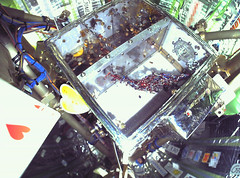
You can also look inside Genesis and see what’s already gone up (besides NASA’s GeneBox, that is). The picture above, by the way, is a box of Mexican jumping beans sent up in Genesis I by Bigelow Aerospace employees.

For $295 a pop, you can send up anything you want as long as it’s:

  • smaller than a golf ball;
  • less than 1 oz. in weight;
  • doesn’t contain any magnets;
  • doesn’t contain power-operated devices, liquid, or powder.

I’m not sure what options that leaves or whether the price beats a similar program from Masten Enterprises, but at least there’s now another way to send more junk into space.


License (Plate) to Track

She may not be real, but I’ve got some advice for that girl Emily. If really want to keep track of a straying spouse, track his license plate.

PlateFinder

Jealous lovers may soon have an alternative to sniffing for perfume to catch a cheating mate: Just follow their license plate.

In recent years, police around the country have started to use powerful infrared cameras to read plates and catch carjackers and ticket scofflaws. But the technology will soon migrate into the private sector, and morph into a tool for tracking individual motorists’ movements, says former policeman Andy Bucholz, who’s on the board of Virginia-based G2 Tactics, a manufacturer of the technology.

Bucholz, who designed some of the first mobile license plate reading, or LPR, equipment, gave a presentation at the 2006 National Institute of Justice conference here last week laying out a vision of the future in which LPR does everything from helping insurance companies find missing cars to letting retail chains chart customer migrations. It could also let a nosy citizen with enough cash find out if the mayor is having an affair, he says.

Or it could let a suspicious spouse find out if the other half is stepping out.

Just one more step in the tracking of everything and everyone. But wouldn’t this be easier with GPS? After all, it works for lost dogs, gang members.

Emily could just get her husband a new phone, say from Sprint or Verizon, but that might make him suspicious. (Then again, a billboard is pretty big tip-off.) But chances are he already has a mobile phone and, as I noted earlier, anyone with a mobile phone can be located and tracked. Next time she wants to hit the joint banking account to send a message to Steven, Emily might consider signing on with AccuTracking, World-Tracker, or U-Locate. The more subtle and probably also cheaper than putting up billboards across the country.


Robots March on Microsoft, Linux

A while ago, I blogged about Microsoft’s foray into Robotics with its Robotics Studio software. Well the Microsoft robotics march continues, but this time the robots are marching on Microsoft due to a bit of synergy with Lego’s own robotics project. Thanks to the toy company, you can build your own robot.

Lego Robot Swiffer

Lego Mindstorms NXT includes LabView software from National Instruments, which lets robot makers program their machines by dragging and dropping icons on the screen instead of writing code. The software works with both Windows XP and recent versions of Mac OS X. Bluetooth wireless signals are supported, so finished robots can be controlled with compatible mobile phones.

The Lego Mindstorms NXT kit, which sells for about $250 and is aimed at children age 10 and older, will arrive in stores early [this] month; it can also be ordered at www.mindstorms.com. The Mindstorms kit includes 519 Lego Technic building blocks; sound, light and touch sensors; a 32-bit microprocessor called the NXT Intelligent Brick, which serves as the robot’s brain; and several motors. Batteries, however, are not included: six AA cells are required.

Lego, it turns out, was a major inspiration in getting Microsoft into the robotics business.

Even a software giant, it seems, has a soft spot for Legos.

"Lego was one of the motivating factors that got this started in the first place," said Tandy Trower, general manager of Microsoft’s robotics initiative, which launched in June. He explained how Lego had told Microsoft about its Mindstorms NXT plans several years ago, even as Trower was beginning to formulate what his group would be like.

Now Microsoft is hoping its robotics suite, which can help people design anything from simple robots to industrial projects, will be seen as an innovative step to getting more people interested in robots. He likens the state of robotics today to that of the early days of PCs.

The synergy with Lego might be great, but here’s a heads-up to Microsoft: Lego’s robots may be marching in your direction, but it looks like some robot enthusiasts are turning to Linux.

Chromet

To spur more development of robots at the hobbyist level, Japan’s National Institute of Advanced Industrial Science and Technology (AIST) is promoting a humanoid creature named HRP-2m Choromet. One problem with current robots, AIST says, is that they tend to be little more than remote-controlled devices. Another is that getting beyond that evolutionary stage tends to take a lot of cash.

Choromet, which bears a striking resemblance to the Transformers character Optimus Prime, comes with programmable software that runs on Linux. It was developed by General Robotix, one of two start-ups working under AIST together with Pirkus Robotix and Dai Nippon Technical Research Institute. The controller, which is driven in real time by AIST’s ArtLinux, was developed by Moving Eye, the other start-up in the group

I dunno. Sure, Choromet looks cool. But I’m thinking that Lego robot with the Swiffer attachment (pictured above) would be a lot handier around the house.


Heatwave, As Seen From Space

Hot enough for ya? You don’t have to read the news to know there’s a heatwave going on, even though it’s heating up Europe to the point that some people think houses may collapse (due to subsidence if heavy rain causes the bone-dry soil to expand and move buildings as it does so). And things have gotten so hot in the U.S. that blackouts and power outages are happening in California, Missouri, and New York.

All you really have to do is step outside. But if you want the big picture, you can check out Envisat’s satellite pictures of Europe which, according to the BBC, show dramatic increases in land and sea temperatures in the UK.

ENVISAT

The images were generated from data gathered by the European Space Agency’s Envisat and Nasa’s Aura satellites.

John Remedios, head of Earth Observation Science at the University of Leicester, said: "The latest satellite data shows a perspective of the environment in which we live that can only be obtained from space.

"The images show temperature increases and increased pollution for every region in the UK."

Envisat, an advanced polar-orbiting Earth observation satellite, was launched in March 2002 by the European Space Agency and provides measurements of the atmosphere, ocean, land, and ice.


Upselling Space Tourism

Well, that didn’t take long. Even before the space tourism industry has taken off (no pun intended), there’s already a first class upgrade that is out of reach for us hoi polloi. From the AP:

You don’t have to be an astronaut anymore to experience walking in space. All you need is $35 million and the willingness to risk your life.

A private Virginia firm that already has sent three super-rich men to the international space station for $20 million each announced Friday it would offer an even rarer adventure: A stroll outside the space station for an extra $15 million.

"It is the holy grail of spaceflight; it’s something very few of the astronauts and cosmonauts have done," said Eric Anderson, chief executive of Space Adventures Ltd.

Added former NASA spacewalker Kathy Thornton, who is on the firm’s advisory board: "It’s just sort of the feeling of freedom, that you are your own satellite."

With the blessing of the Russian space agency, Space Adventures is arranging for the first spacewalking tourist to go into orbit in about a year or so, Anderson said. The trip would involve a launch in a Soyuz capsule, an eight-day stay aboard the international space station and a 90-minute spacewalk in a Russian spacesuit. An extra month would be added to the six-month cosmonaut training.

More information is available directly from the Space Adventures website, where they feature their advertising slug for the offering: "Think outside the spacecraft." 


The Birds and The Bees Meets the Mile High Club

Biology and space flight have been closely intertwined ever since the Soviets first launched Laika into orbit in November of 1957. The unique environment of space presents an incredible laboratory environment for biologists to study biological processes, and literally thousands of experiments have been undertaken in the last 50 years.

Now the Chinese government, following in Mendel’s footsteps, is taking genetic and biological research in space one step further — launching the country’s first seed satellite — specifically designed for seed breeding– this coming September:

Shijian-8 is expected to carry at least 2,000 varieties of plant seeds in nine categories, including grains, cash crops and forage plants, as well as seeds of fungi and molecular biomaterials that have been sequenced.

Sun Laiyan, chief of the China National Space Administration, said the "seed satellite" will enable scientists to try and cultivate high-yield and high-quality plant varieties.

Exposed to special environment such as cosmic radiation and micro-gravity, some seeds will mutate to such an extent that they may produce much higher yield and improved quality, said Sun.

Space experts said 40 per cent of mutated space seeds can be used in space breeding experiments.

Since 1987, nine Chinese satellites and several of China’s six Shenzhou spacecraft have carried seeds for experiments and a number of new species of plant seeds have been bred in space, but never before has the country launched a satellite exclusively for seed breeding.

Space-bred seeds are big business:

Liu Luxiang, director of the Centre for Space Breeding under the Chinese Academy of Agricultural Sciences, said that between 2001 and 2004, space-bred rice and wheat varieties developed by his centre had been planted in about 566,600 hectares, producing an additional 340,000 tons of grain.

Experiments have shown that the vitamin content of vegetables grown from space seeds is 281.5 per cent of that of ordinary vegetables; and microelements of ferrum, zinc and carotene are also higher than normal.

The planting of space tomatoes and green peppers in Southwest China’s Sichuan Province, which started in 1999, has raised average yield by 10 to 20 per cent, with the fruits bigger and of better quality, according to earlier newspaper reports.

Space tomatoes! But are they organic?


DIY Friday: Disguise Your Dish

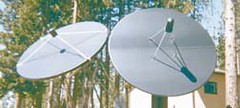
Let’s face it: no matter how cool it may be to have a satellite dish, they make terrible lawn ornaments. Only the most hardy space nut finds the local neighborhood array a thing of beauty– and many homeowners associations have introduced covenants prohibiting the use of large dishes.

But for $900 bucks or so, Clearsat has a DIY solution that will please those who don’t like looking at your dish:

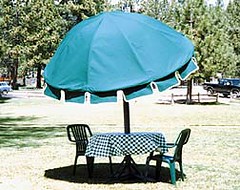
Most Home Owners Associations (HOA’s) have agreed that if the dish is adequately disguised, they will allow it. The ClearSat Umbrella Style Dish Cover will comply with most reasonable HOA’s by covering both the front and back, and when coupled with a set of chairs and table, can actually function as a patio set.

One or two persons can install the umbrella cover in about 15 minutes. It does not require any drilling or modification to the dish whatsoever. Once the fiberglass rods are inserted between the hub and end socket, the cover springs into shape. You simply rest the end sockets on the edge of the dish and zip up the back panels.

The shade provided is not to be overlooked as an added benefit — especially this week, when most of North America is blistering under a scorching heat wave. 


Looking for the Killer WiMAX App

Rumors have been going on for months about the two big U.S. satellite TV providers (DirecTV and EchoStar) merging. The buzz grew louder earlier this week after the Los Angeles Times quoted EchoStar CEO Charlie Ergen at the Allen & Company annual media-mogul-fest in Sun Valley, Idaho saying that combining the two largest satellite TV providers could save $3 billion in expenses.

The comment set off a renewed flurry of press speculation of a potential merger. The Rocky Mountain News (EchoStar is based in Englewood, CO) reported yesterday:

EchoStar Communications Corp. shares were raised to "buy" from "sell" at Citigroup Inc. because of an increased chance that the No. 2 satellite television provider may combine with rival DirecTV Group Inc….

"It reflects our belief that there is a greater chance that EchoStar and DirecTV may attempt to merge," Bazinet said
of his rating change.

A merger is more likely since EchoStar and DirecTV formed a joint venture to bid for wireless spectrum in an auction next month, Bazinet said in the note. Satellite TV companies are also facing rising competition from cable companies such as Comcast Corp. as well as from telephone companies such as Verizon Communications Inc. that are starting TV services.

Propelling the talk is the growing awareness that IPTV will fundamentally change the media landscape and the balance of power between satcom- and telco-delivered content, as well as growing evidence that Rubert Murdoch’s News Corp is set to receive approval for a project that could create a national WiMAX network. As The Hollywood Reporter writes:

Approval is imminent for the project that could take at least two years and $2 billion, providing News Corp. and DirecTV a valuable wireless interactive broadband loop with consumers to directly sell content, advertising, goods and services. WiMax is a wireless a broadband technology often referred to as "WiFi on steroids" with a much wider 30-mile range than the more limited access offered by WiFi services. WiMax, which is short for World Interoperability for Microwave Access, also promises to provide more security and speed than traditional wireless connections.

"If we can pull something off … there is no reason why that shouldn’t link in with everything," News Corp. chairman and CEO Rupert Murdoch said in a recent interview….

High-level sources say the unprecedented undertaking will involve strategic equity partners that bring WiMax spectrum, equipment and other expertise to the mix. In one of the most likely scenarios, News Corp. and DirecTV have been in advanced talks with Clearwire Corp., a WiMax venture of Craig McCaw, in which chipmaker Intel Corp. and equipment manufacturer Motorola Inc. recently invested $900 million.
McCaw has been amassing one of the largest stables of licensed radio spectrum to build his own national wireless WiMax network. Intel, which has a vested interest in the commercial success of WiMax, particularly for PC users, has been one of Clearwire’s partners from the start….

Some sources say that EchoStar could join DirecTV in providing a united domestic satellite-backed WiMax alternative to cable and to telephone competitors such as Verizon, Cingular and Sprint Nextel. Sprint Nextel is working with a consortium of cable operators including Comcast and Time Warner to assist them with a much-needed wireless out-of-home extension.

Still, not everyone is convinced that the coming WiMAX wars will lead to consolidation on the SatCom side. Al Lewis in the Denver Post says that "anybody who believes EchoStar and DirecTV are about to merge should remember the forgotten tome "The Essential Guide to the Echo- Star/DirecTV Deal:"

Australian media mogul Rupert Murdoch had his team of lobbyists canvass Washington with this 123-page diatribe in 2002.

It argued, in exhaustive detail, why Douglas County-based EchoStar should not be allowed to acquire DirecTV from Hughes Electronics….

In October 2002, the Federal Communications Commission [sic– it was the FTC] blocked Ergen’s deal. The Justice Department blocked it too.

Then Murdoch’s News Corp. acquired a controlling stake in DirecTV for $6.6 billion…

And now – four years later – there are continuing rumors that DirecTV, the nation’s No. 1 satellite-TV provider, will acquire EchoStar, No. 2.

EchoStar and DirecTV are working on several joint projects that involve the two-way transmission of voice, video and data. But if Murdoch were to bid on EchoStar, he’d have to argue against his previous arguments. Or he’d have to argue that the satellite-TV business has changed significantly over the past four years.

The results of the August auctions for additional WiFi spectrum will give observers a clue as to who is coming out ahead in the inevitable rush to bring WiMAX to market. And whether the DirecTV and EchoStar rumors are just rumors or not, we’d expect to hear more talk of consolidation on both sides as emerging technology further alters the old divisions between cable, satcom and telcos.
 

Pirates of the World Cup


The recently completed FIFA World Cup had many memorable moments. Some teams advanced further than expected, while some just fell to pieces. Win or lose, most people agree it was an achievement for a national team to make the trip to Germany to begin with – especially if you consider two years elapse before the qualifying rounds are completed.Zidane gets carded  

Some might remember how entire countries became “interupted” during teams’ matches. The people at eBay will never forget how online traffic and transactions slowed down when a match began, then resumed afterwards. Others will remember hearing rumors of less-developed countries’ plumbing systems losing all water pressure once a match’s first half ended.

Apparently, some bars in Hong Kong forgot it was against the law to broadcast matches without paying for them — and the folks at CASBAA are giving notice and are out to teach these pirates a lesson:  


“Although the industry reached out to the Hong Kong food and beverage industry in the run up to the World Cup, stating that pay-TV signal theft is not to be tolerated by government or industry, many bars blatantly screened unlicensed pay-TV broadcasts. We have had no choice but to take the matter to the courts,” said Simon Twiston Davies, Chief Executive Officer of CASBAA.

As an indication of the pay-TV industry’s commitment to the Hong Kong sporting community, Mr Twiston Davies noted that the plaintiffs and CASBAA would donate any proceeds received from the defendants after costs to local sports charities. CASBAA believes it is important to return the funds to where they belong – the support of sports development.

“The issue of intellectual property rights protection requires concerted efforts on all fronts between the government, industry, bar and club owners and the general public, especially as we run up to other global events such as the Beijing Olympics in 2008 and recurring high value events such as the English Premier League,” continued Mr. Twiston Davies. “The sports leagues who stage major events need a fair return on their investment.”


Only licensed pay-TV operators such as Hong Kong Cable, now Television and TVB Pay Vision are authorized to provide such programming. These pirate bars were receiving signals from satellites providing service to other countries.

Spammers and other nasties were at it during the World Cup, too. Hopefully, they’ll soon be forgotten or busted (preferred).

Happy Anniversaries

Pop quiz. Where were you 37 years ago today? Where were you 30 years ago today?

Moon Walk

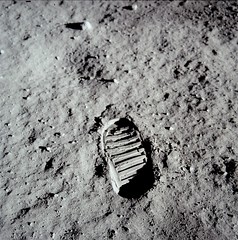
In the first case, I’m not sure where I was, but I was probably learning how to sit up. Meanwhile Neil Armstrong and Buzz Aldrin were becoming the first humans to walk on the moon.

Viking I

Seven years later, I was walking, talking, and probably getting underfoot around the house when Viking I became the first spacecraft to land safely on another planet.

Via Respectful Insolence and MetaFilter.