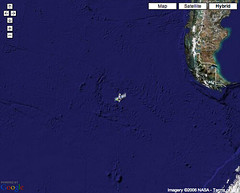
Via Space Pragmatism, here are not one but two interviews with Robert Bigelow, the man responsible for yesterday’s launch of an experimental inflatable spacecraft. There’s also a pretty neat Google Maps site for tracking Genesis in orbit.
Commercial spaceflight took a big leap forward recently. You might even say it sent up a test balloon, in the form of Robert Bigelow’s inflatable spacecraft.
An experimental inflatable spacecraft bankrolled by real estate magnate Robert Bigelow rocketed into orbit Wednesday to test technology that could be used to fulfill his dream of building a commercial space station.
The Genesis I satellite flew aboard a converted Cold War ballistic missile from Russia’s southern ro Mountains at 6:53 p.m. Moscow time. It was boosted about 320 miles above Earth minutes after launch, according to the Russian Strategic Missile Forces.
The launch was a first for the startup Bigelow Aerospace, founded by Bigelow, who owns the Budget Suites of America hotel chain. Bigelow is among several entrepreneurs attempting to break into the fledgling manned commercial spaceflight business.
Bigelow’s balloon was bankrolled to the tune of about $75 million, out of about $500 million dedicated to having an entire fleet of similar modules circling the earth like sausage links. Mars Blog notes that, even allowing for unexpected costs adding up to $3 billion or more, private entrepreneurs might actually be able to get to the point of having manned spacecraft servicing manned space stations faster and cheaper than, say, NASA.
That’s interesting, given that Bigelow’s balloon could lead to hotels and sports arenas in space by 2015, if all goes according to plan. With the price tag for building ’em, though, I can only imagine what the ticket price will be.
I posted earlier about the possibility of brain-machine interfacing in sometime in the future, but it was only the tiniest hint. Now it turns out there’s a lot more afoot, and DARPA — the people who brought you the robot races — is in on it.
A new brain-computer-interface technology could turn our brains into automatic image-identifying machines that operate faster than human consciousness.
Researchers at Columbia University are combining the processing power of the human brain with computer vision to develop a novel device that will allow people to search through images ten times faster than they can on their own.
Darpa, or the Defense Advanced Research Projects Agency, is funding research into the system with hopes of making federal agents’ jobs easier. The technology would allow hours of footage to be very quickly processed, so security officers could identify terrorists or other criminals caught on surveillance video much more efficiently.
The “cortically coupled computer vision system,” known as C3 Vision, is the brainchild of professor Paul Sajda, director of the Laboratory for Intelligent Imaging and Neural Computing at Columbia University. He received a one-year, $758,000 grant from Darpa for the project in late 2005.
Given DARPA’s interest in advanced robot vehicles, I can’t help but wonder what kind of synergy might develop between “cortically coupled computer vision system” and “autonomous vehicles” like those participating in the Grand Challenge.
Just in case you didn’t get enough video in yesterdays post, Phil over at Bad Astronomy points to even more NASA video of the July 4th space shuttle launch, with camera angles from on top and right aft of the starboard solid rocket booster.
The NASA videos area without audio, but here’s a YouTube video of the launch with a play-by-play of the launch.
If you’re reading this, chances are you’re doing so on a computer or laptop that’s plugged into an electrical outlet (or in the case of the latter, running on energy stored in its battery), so you should take a moment to thank the guy some say made it all possible. Nikola Tesla, born (according to A Blog Around the Clock) on this date, 150 years ago.
I have to admit that, although I knew Tesla’s name, I couldn’t claim to know much about his involvement with much of what I (and lots of others, I’m sure) take for granted about modern life. I haven’t often given much thought to who’s being the reality that I wake up in the morning in an air-conditioned house, turn on the lights, retrieve breakfast from the fridge and consume it while either sitting in front of the television or the computer.
Yet all of that’s possible due to alternating current; something Tesla contributed to developing. I had to do a bit of googling to find this PBS site devoted to Tesla, to learn that in fact the AC motor was among his inventions and that he’d patented some 20 different types of AC motors. And that’s not to even mention the radio and remote control. (Channel surfers of the world, we now know whom to thank.)
There’s a bit of irony in remembering Tesla’s birthday, as Archy points out. Tesla is credited with bringing electricity to the United States, of which he became a naturalized citizen. Yet, today many of the villages around his hometown have no electricity. But the occasion of his 150th birthday is bringing people together in Tesla’s homeland, and thus his memory may yet get the lights turned on again.
Here’s a couple of videos to get your Monday started with a bang. Via Mars Blog, here’s a NASA video of the STS-121 solid rocket booster separating from the space shuttle. (Can’t view the video? Check out the Flickr photoset of the view from earth.)
Also, a little late for the 4th of July but fun to watch nonetheless, here’s a YouTube video of 30,000 bottle rockets launched in 2 minutes.
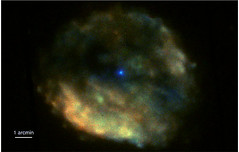
An amazing photo showing the aftermath of a 2,000-year-old star explosion reveals something never seen before: astronomers believe the blue dot at the center may be a neutron star, less than 20 kilometers wide. Space.com reports:
Embedded in the heart of a supernova remnant 10,000 light-years away is a stellar object the likes of which astronomers have never seen before in our galaxy.
At first glance, the object looks like a densely packed stellar corpse known as a neutron star surrounded by a bubble of ejected stellar material, exactly what would be expected in the wake of a supernova explosion.
However, a closer 24.5-hour examination with the European Space Agency’s XMM Newton X-ray satellite reveals that the energetic X-ray emissions of the blue, point-like object cycles every 6.7 hours—tens of thousands of times longer than expected for a freshly created neutron star.
It is behavior that’s more commonly seen in neutron stars that have been around for several million years, researchers say.
The mystery is fully explored in the July 7 issue of the journal Science.
After performing a backflip to allow crewmembers of the International Space Station to inspect its belly (and to provide cool images for space fans everywhere), Discovery docked with the ISS yesterday.
The astronauts moved a huge cargo container, nicknamed Leonardo, onto the space station by robotic arm. Among the goodies awaiting the space station crew were a new stationary bicycle for exercise, an oxygen generator that will eventually allow the space station to support six inhabitants, a machine that cools the station’s cabin air and a lab freezer for scientific samples…
For the first time in three years, the international space station had three crew members. European Space Agency astronaut Thomas Reiter joined Pavel Vingogradov and Jeff Williams, who marked their 100th day at the space station Friday.
The ATV, an unmanned vehicle that will deliver supplies to the International Space Station (ISS), will be put into orbit by the European Ariane-5 launcher. Acoustic testing is vital to ensure the ATV can withstand the vibrations caused by the extreme noise levels generated during launch.
Here’s an interesting story out of the Indian Ocean:
In a global first, four major fishing companies announced today a voluntary halt on trawling in eleven benthic-protected areas in the southern Indian Ocean. This will protect and conserve the benthic and associated fish fauna and related biodiversity in one of the largest marine protected area enclosures ever.
By setting aside an area almost equal to Australia’s Great Barrier Reef National Park, these businesses are sending a clear signal that they want to keep fish on people’s plates for generations to come…
Using the scientific knowledge gathered over a decade of activity in the Indian Ocean and in consultation with staff of the Fisheries Department of the United Nations Food and Agriculture Organization (FAO), SIODFA have delimited 309 000 km2 of ocean floor in eleven separate benthic protected areas — a total zone with an area approximately the size of Norway — where their vessels will no longer fish. To verify compliance with these self-imposed restrictions, the companies will track their vessels’ locations and activities via a special satellite monitoring system.
We’ve written before about how scientists are using satellites to study ecosystems, land and water usage and climate change– but to the best of our knowledge, this is the first time we’ve heard of satellites being used for enforcement of voluntary conservation measures.
Do you know of any other examples? If so, please post them in the comment threads and we’ll highlight them here.


 After performing a
 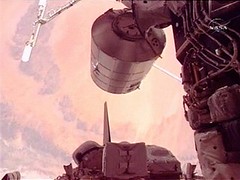 The astronauts moved a huge cargo container, nicknamed Leonardo, onto the space station by robotic arm. Among the goodies awaiting the space station crew were a new stationary bicycle for exercise, an oxygen generator that will eventually allow the space station to support six inhabitants, a machine that cools the station’s cabin air and a lab freezer for scientific samples…