Bezos Goes Orbital

There’s a new player in the tourism-fueled race for space.

As we mentioned back in FebruaryAmazon founder Jeff Bezos has been fueling Blue Origin’s New Shepard Reusable Launch system, according to Space.com.

[The] Blue Origin rocket concept is patterned after the DC-XA that was operated by NASA and the Department of Defense under the Reusable Launch Vehicle program. The flight vehicle was tested at White Sands during the summer of 1996, and demonstrated a 26-hour turnaround between its second and third flights, a first for any rocket. 

Evidence that Blue Origin is moving forward with the project came when the company filed a draft Environmental Assessment with the FAA for the company’s launch site north of Van Horn, Texas:

The more than 200-page draft EA is a necessary step required by the FAA/AST for Blue Origin to get the needed permits and/or licenses to fly their rocket hardware.

Blue Origin proposes to launch its reusable launch vehicles (RLVs) on suborbital, ballistic trajectories to altitudes in excess of 325,000 feet (99,060 meters) from a privately-owned space launch site in Culberson County, Texas.

As outlined in the EA, the Blue Origin launch site would be approximately 25 miles (40.2 kilometers) north of Van Horn, Texas. It lies within a larger, privately-owned property known as the Corn Ranch. Access to the proposed launch site is from Texas Highway 54, which is approximately five miles (8 kilometers) west of the proposed project’s center of operations.

Also on the group’s to do list at the site is putting in place a vehicle processing facility, a launch complex and vehicle landing and recovery area, as well as an astronaut training facility, and other minor support amenities…

"The strategy is to build the New Shepard suborbital vehicle incrementally, starting with low-altitude tests, progressing to higher-altitude testing, and culminating with commercial flights. Early testing would use prototype vehicles that are smaller and/or less capable than the proposed final design," according to the Space.com report. 

Weekend Roundup

We hope everyone enjoyed the long holiday weekend.

The big non-event of the weekend was the expected near-miss between 2004 XP14 and Earth on Monday:

A large asteroid hurtled harmlessly past the Earth early Monday at a distance of about 269,000 miles – slightly farther away than the moon.

Residents with telescopes in the United States and Canada had the best view of 2004 XP14, which appeared as a streaking dot in the northern sky.

Astronomers tracking the space rock’s path since its discovery in 2004 had determined that it would pose no risk to Earth during the encounter nor in the next 100 years. Judging by its brightness, 2004 XP14 was estimated to be a quarter-mile to a half-mile wide.

An asteroid that size, if it smashed into Earth, would probably cause regional destruction. Scientists have said it would take a mile-wide or larger asteroid to cause widespread devastation that could threaten civilization. 

The big event that finally happened– on July 4th, no less–  was the successful launch of space shuttle Discovery yesterday:

The liftoff, right on schedule at 2:38 p.m., was the start of a 13-day flight that is the first in a year for the diminished shuttle fleet as NASA continues its efforts to resume more frequent human spaceflight.

The Discovery is to rendezvous on Thursday with the International Space Station, where it is carrying equipment, supplies and a fresh astronaut for the station’s crew.

But this is also considered the second and final test flight for the shuttle fleet since the loss of the Columbia and its seven astronauts in 2003, and the Discovery’s ascent was scrutinized for the kind of liftoff debris that caused that disaster.

At 2 minutes 53 seconds into the flight, an onboard camera showed numerous pieces of debris appearing to fall away from the external fuel tank. They fluttered away and did not appear to strike the shuttle, carrying a crew of seven.

N. Wayne Hale Jr., NASA’s shuttle program chief, said the pieces had fallen "after the time we are concerned about," after the air becomes so thin that debris usually floats harmlessly away.

A piece of debris that broke off later in the ascent did appear to strike the midbody of the orbiter, NASA officials said. But they added that it probably did not do any damage.

In all, officials said, insulating foam broke away from five spots on the external fuel tank and a solid rocket booster, some with several pieces of foam.

We’ll be bringing you updates of the space shuttle’s 13-day mission over the next two weeks. 


Your Phone, Your Brain & Your Nose

There have been some pretty interesting stories circulating about mobile phones this week, and now seems like a good time to encapsulate them all in one place (especially considering the one that landed in my inbox this morning). 

You’ve probably heard about the alleged connection between mobile phones and brain cancer (And who can forget the Canadian University that banned wifi because of health concerns?) Well, the FDA says there’s no clear connection between (pun intended?) the two, but new research from Italy suggests that your cellphone may be stimulating a part of your brain

Cellphone OKDr. Paolo Rossini of Fatebenefratelli hospital in Milan and colleagues used Transcranial Magnetic Stimulation or TMS to check brain function while people used these phones.

They had 15 young male volunteers use a GSM 900 cell phone for 45 minutes. In 12 of the 15, the cells in the motor cortex adjacent to the cell phone showed excitability during phone use but returned to normal within an hour.

The cortex is the outside layer of the brain and the motor cortex is known as the "excitable area" because magnetic stimulation has been shown to cause a muscle twitch.

The science blogger over at Retrospectacle mentions a Japanese study that yielded similar results, and notes that the motor cortex is affected (and temporarily at that, according to both studies) but not the sensory cortex where the visual, auditory, and olfactory (site, sound, and smell) regions of the brain reside. 

That might be true, but according to another set of researchers chatting on your cellphone while driving (even with hands-free accessories) makes you just as impaired as a drunk driver.  And just as dangerous too.

The researchers used a driving simulation device for their study, published in the summer 2006 issue of Human Factors: The Journal of the Human Factors and Ergonomics Society.

They studied 40 volunteers who used a driving simulator four times — while undistracted, using a handheld cell phone, using a hands-free cell phone and while intoxicated to a 0.08 percent blood-alcohol level — the average legal level of impairment in the United States — after drinking vodka and orange juice.

Three study participants rear-ended the simulated car in front of them. All were talking on cellphones and none was drunk, the researchers said.

Motorists who talked on either handheld or hands-free cell phones drove slightly more slowly, were 9 percent slower to hit the brakes, and varied their speed more than undistracted drivers.

Drivers with an 0.08 percent blood-alcohol level drove a bit more slowly than both undistracted drivers and telephone users, yet more aggressively.

And if your cellphone isn’t distracting enough when you’re driving, imagine how much more distracting it might be if there were smells coming from your cellphone. I kid you not. Trendhunter led me to this article about some researchers working to turn your cellphone into a smellphone

Engineers have already developed a system that can record smells of various fruits, such as apples, oranges, melons and bananas, on to a system of 15 microchips in a handheld device.

Each microchip is an electronic ‘nose’, containing a chemical sensor which can pick up different traces in the odour.

The Japanese inventors of the system say these sensors can come up with thousands of different combinations.

The proportions of each odour are carefully noted by the microchips and when the ‘recording’ is played back they recreate them from 96 manmade chemicals. 

I can’t help wondering if the scientists involved in this project have really thought this through. There may be an actual use for this, but I can also think of some good reasons not to put the capability of recording and transmitting odors via cellphone into the hands of at least some people. Can’t you?

Oh, Say Can You See

The 4th of July in the U.S. is almost always celebrated with a fireworks display, ideally with proper supervision by responsible adults.  Here’s a display up in the sky that’s definitely overseen by responsible rocket scientists, captured via telescope in Betzdorf, Luxembourg.

We recently got word a new satellite has come into service at ASTRA. Launched in April, the ASTRA 1KR satellite underwent a rigorous in-orbit testing before arriving on-station at 19.2° East, which it shares with several other satellites. Ever wonder what that looks like? We’ve got the video.

If you’re an amateur astronomist, you can try this at home. If the skies are dark enough and you have a telescope, you can spot some of the satellites in the Clarke Orbit, a.k.a. the geostationary ring, 36,000 kilometers (23,600 miles) above the Earth.

Most geostationary satellites are really geosynchronous. For radio and television broadcasting, this is essential. With mean motions between 0.9 to 1.1 revolutions per day, these satellites drift across a 45-square-kilometer “box” before corrections are made by spacecraft controllers on the ground via on-board thrusters. Anomalies in the Earth’s gravitational field causes this “drift,” as atmospheric drag is irrelevent at this altitude. The Moon’s gravitational pull provides an out-of-plane force as well, gradually increasing the orbital inclination towards that of the Moon around the Earth (which itself varies between 18 and 29 degrees).

So the satellite’s track tends to resemble a figure-eight track. In the ASTRA 1KR video, we get to see a small portion of this eventual figure-eight. Allowed to go on unchecked, a satellite’s orbit becomes more inclined. Some satellites are purposefully directed towards an inclined orbit, thus providing better coverage of the polar regions. Antarctic research stations rely on these satellites for communications.

Unlike objects in low Earth orbit, geostationary satellites are visible throughout every night of the year, entering the Earth’s shadow for up to 70 minutes per day. During the same period the satellite tends to brighten over several days, twice a year (equinox, +/- one week), when the satellites’ orientation toward the Sun causes “flares,” the most spectacular of which comprise the Iridium system (check this site for predictions). Two line elements can be obtained for nearly all these satellites via Dr. T.S. Kelso’s site.

Verizon Airfone Grounded

Earlier this month, I blogged about JetBlue getting into the in-flight internet/phone business. Now, before the month is quite over, it looks like Verizon is getting out of the in-flight phone business.

Verizon Airfone will exit the in-flight phone business by the end of the year, a company spokesman confirmed Friday.

Airfone’s parent company, Verizon Communications, plans to focus its efforts more on its core business, said Jim Pilcher, a spokesman for Verizon Airfone.

Verizon was initially the favorite to win the FCC auction for the 800MHz spectrum for supplying broadband and phone services in-flight, but dropped out of the running early, which lead to the AirCell — a subsidiary of JetBlue — getting the license to use the spectrum.

Robot Roach Patrol

Forget Raid. Forget Orkin. When you’re facing an infestation of pests, in this case roaches, your best bet might be a robot. This isn’t a new story, from what I can tell, but it’s popped back up in the last couple of days. And it’s an interesting one. Given that you can now have a robot keeping your house clean, why not have one keeping it roach-free?

In a breakthrough for the battle against mankind’s most diehard enemy – the cockroach – European scientists have hoodwinked a group of them into congregating in a place where they can be stamped on easily.

The kick in the mandibles comes from a Belgian-led team who spent three years developing a mini robot that can convince cockroaches to creep out of dark holes and gather in light places. The InsBot looks more like a pencil sharpener than a household pest, but it smells like a cockroach. Most importantly, the InsBot can pass for a Periplaneta Americana (American cockroach).

OK. Maybe you should keep the insecticide handy, since this model apparently just herds the roaches together for easier spraying/stamping. Still, as Technovelgy points out, it has interesting implications for creating more innovative forms of artificial intelligence. Technovelgy also has an interesting post up about a roach-controlled robot. And for good measure, here’s a link to the project itself.

UFO Threatens Space Station

How’s that for a hyperbolic headline? It’s rooted in fact:

MOSCOW – An unknown floating object close to the International Space Station ISS has concerned ground control, according to reports from the US Space Agency NASA on Tuesday.

The object is approximately 2.8 kilometres away from the International Space Station, said the Russian flight control centre in Moscow, citing a NASA source.

The situation… does not yet require a dodge manoeuvre…..

“The object has no number in the list of space debris,” Kireyev said, according to reports from the Russian Itar-Tass agency.

“It is however probably an old piece of space exploration equipment.”

If the object gets any closer to the ISS, astronauts Jeff Williams and Pavel Vinogradov would have to take the precaution of moving to the rescue space shuttle Soyuz TM.

A dodge manoeuvre could cause difficulties for the docking of the US space ship “Discovery”, due to be launched on July 1.

Perhaps the astronauts should practice on this game.

Laptop Go Boom!

We can’t vouch for the veracity of this, but it amused us to no end:

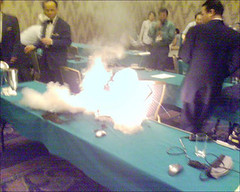
 AN INQUIRER READER attending a conference in Japan was sat just feet away from a laptop computer that suddenly exploded into flames, in what could have been a deadly accident.
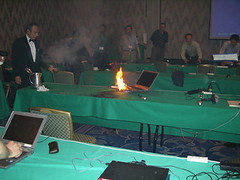
Gaston, our astonished reader reports: "The damn thing was on fire and produced several explosions for more than five minutes"….

"It is only a matter of time until such an incident breaks out on a plane," he suggests.

Our witness managed to catch all the action in these amazing pictures.

"Fire extinguishers leave a mess on your suit and belongings; pack your stuff (if you can) and leave, leave, leave!" he advises.

We don’t have any further details of the model of the computer in question. In light of the evidence, however, we’d suggest you avoid actually using a laptop on your lap. 


The after-photo:


New Satellite Service By 2012?

The FCC has proposed allowing new satellite service in the 17 and 24 gigahertz band spectrum — a proposal which, if passed, could add new competition to satellite radio and other emerging broadcast industries, Billboard Radio Monitor reports:

 In an email exchange with Billboard Radio Monitor, one high-level engineering source wrote that “the ‘Ka-Band’ frequencies (18 GHZ to 40 GHZ) usually suffer from extreme susceptibility to rain-out and fog failure conditions. On the plus side, the satellite antennas (up in orbit) can send more spot-area signals to different parts of the [continental U.S.], potentially creating individual market coverage signals, which can’t effectively be done at 2.3 GHZ.”

Radio Monitor sources and industry observers estimate that the shortest possible timetable for a new satellite service to make its way through the FCC, onto the launch pad and into space would be five or six years.

The FCC’s Notice of Proposed Rule Making (NPRM) for establishing a new satellite service was originally going to be part of the commission’s Open Meeting agenda but it was deleted at the last minute. Instead, the FCC’s commissioners handled the vote later in the day, with all five commissioners approving the NPRM.

An FCC press release about the Notice says the service “holds the potential of bringing a new generation of innovative satellite services to American consumers—providing a mix of video, audio, data and multimedia services to residential and business subscribers.”


Nix and Hyrda

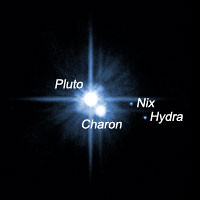
In other Hubble news (see the post below), a pair of small moons orbiting Pluto, first photgraphed by the Hubble Telescope in 2005, now have official names: Nix and Hyrdra.

"Nix and Hydra are roughly 5,000 times fainter than Pluto and are about two to three times farther from Pluto than its large moon, Charon, which was discovered in 1978," according to the official Hubble website.