The Hubble Space Telescope’s Advanced Camera for Surveys (ACS) has been offline since June 19, Space.com reports:
ngineers have yet to figure out what caused the Advanced Camera for Surveys (ACS) to go into "safe mode," essentially a sleep state that prevents normal operations. But the outlook is bright.
"We’re very optimistic" that the camera will be fixed, said Ed Ruitberg, associate program manager for Hubble at NASA’s Goddard Space Flight Center.
Ruitberg told SPACE.com that some potential causes have been ruled out and that the problem is likely with a low-voltage power supply interface, something between the batteries and a camera component. If that’s the case, then redundant electronics can be relied on to bypass the problem area.
"We’re still investigating the problem and working on all sorts of contingencies," said Max Mutchler at the Space Telescope Science Institute (STScI) in Baltimore, where Hubble’s science operations are run. "We’re hoping for the best but preparing for other contingencies."
Space Daily also reports on Hubble’s troubles.
We’ll keep you updated on the efforts to "wake up" the camera….
Posted
June 26th, 2006 in Business Network, Navigation/GPS, Observation, Satellite TV
|
No Comments »
 UPI files the report:
The Delta II rocket launched Wednesday at Cape Canaveral carried a pair of small satellites for the U.S. Defense Advanced Research Projects Agency (DARPA) Micro-Satellite Technology Experiment. The program looks into new spacecraft technologies that could be applied to future military space projects.
Boeing and its crew of subcontractors reported Thursday that the Delta II in its 7925-9.5 configuration performed flawlessly with the payload deploying some 30 minutes after launch in geostationary orbit more than 22,000 miles above the equator….
The rocket was equipped with nine GEM-40 solid-fuel booster rockets that augmented liftoff thrust to 850,000 pounds to which another 450,000 pounds was added three minutes downrange.
Posted
June 23rd, 2006 in Around the Blogs, Observation
|
No Comments »
The New Scientist reports:
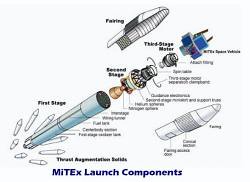 The US military is preparing to launch two technology demonstration satellites on Wednesday, collectively known as the Micro-satellite Technology Experiment (Mitex).
The craft will launch aboard a Delta II rocket from Cape Canaveral Air Force Station, Florida, US. The launch window lasts from 1734 to 2134 EDT (2134 to 0134 GMT on 22 June).
The micro-satellites will test a range of technologies for the Defense Advanced Research Projects Agency (DARPA), the US Air Force and the US Navy. These include avionics, advanced communications, fuels that spontaneously ignite on contact, solar cells and new software. No further details of the technologies are available.
DARPA is interested in investigating the capabilities of small satellites, says DARPA spokesperson Jan Walker. One particular focus of the mission is reducing the mass of equipment by using lightweight materials….
he technologies could have been tested with a single satellite, but because the demonstrator mission has few back-up systems and little pre-flight testing, DARPA decided to split the payload in two to maximise their chances of success.
It’s not just small satellites being tested:
The mission will also be the first flight test of an experimental rocket upper stage for the US Naval Research Laboratory. The upper stage will lift the satellites on the final leg of their journey into geosynchronous orbit.
Some of stage’s new features include: lightweight titanium propellant tanks with internal propellant management devices; novel attitude control thrusters; and solar cells with three semi-conducting layers to more efficiently convert sunlight into electricity.
A larger version of the Mitex launch components diagram can be found here.
Posted
June 22nd, 2006 in Around the Blogs
|
No Comments »
There’s little doubt that satellite technology has transformed aviation. From the widespread use of GPS technology to the in-flight weather updates provided to pilots through services like XM Satellite Weather, satellite-delivered content and information has greatly increased the situational awareness of pilots and, in turn, made aviation safer.
Yet any gadget is only as useful as the underlying information, which is why the National Geospatial-Intelligence Agency (NGA) Stereo Airfield Collection program has awarded Dulles-based GeoEye a $3.7 million contract to image 365 airfields and produce Airport Mapping Databases (AMDB) over a 12-month period:
GeoEye is now the world’s largest developer of airport geospatial information support, terrain and obstacle databases with several hundred airfields mapped to date. Matt O’Connell, GeoEye’s president and chief executive officer said, "We are a leader in providing airport geospatial solutions to key customers like the NGA and the USAF at the best price and with the best performance in the industry."
An Airport Mapping Database is a geospatial database that contains significant features of an airport such as runways, taxiways, buildings, obstacles and terrain surrounding an airfield. This information supports the safe movement of aircraft and helicopters on runways and taxiways. These products can also be used to support training, mission or contingency planning and visual simulations for ordinary operations or crisis situations. GeoEye is uniquely positioned to fulfill this contract for North American and international airfields by virtue of its IKONOS satellite’s ability to generate a three-dimensional image from stereo data collected during a single orbital pass. The result is a three-dimensional map-accurate image of an airport that can be quickly and cost effectively acquired.
Posted
June 22nd, 2006 in Astronomy, Observation, Satellite TV
|
No Comments »
More robot-related news.
CNet has a gallery of screenshots from Microsoft’s just-announced Robotics Studio.
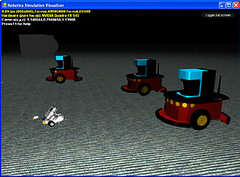
Meanwhile, Wired has write-up on RoboGames, which ends with a quote that sums up the point of getting kids to build robots and bang them into each other.
For [Dan] Albert, as with many of the roboticists who spoke to Wired News, events like RoboGames are about getting kids interested in science and technology. “You start kids out with entertainment, and they gravitate toward engineering as they want more control over their world,” he says.
Finally, though not specifically bot-related, Retrospectacle has an interesting post up about brain-machine interfaces. (Hint: think brain-powered space flight.)
Posted
June 21st, 2006 in Cool Stuff, Front Page
|
No Comments »
While the U.S. is in the midst of a major naval exercise in the Pacific,  near Guam, North Korea has reportedly fueled up a Taepodong missile and is ready to light the fuse.
Among the three U.S. aircraft carrier groups, 30 warships, 280 aircraft and 22,000 soldiers taking part in the naval exercises is the USS John McCain. The exercises, "Valiant Shield 2006," marks the first time a Chinese delegation is observing.
Now is not the best time to test an ICBM over the Pacific. You know Japan is not happy about it and has made it known. They’re still upset about the 1998 missile test.

As reported by the AP:
This is an Orbview-3 satellite image provided by GeoEye showing the Taepodong missile launch complex in North Korea, called Musudan-ri, in May 2006. North Korea referred to its missile program Monday, June 19, 2006 in its official media for the first time since it apparently began preparations for a test launch, as a U.S. official confirmed the North has completed fueling a missile that is poised to fire.
Posted
June 20th, 2006 in Around the Blogs, Observation, Satellite TV
|
No Comments »
Speculations, theories and predictions abound in the wake of Bill Gates’ announcement that he’s quitting his day job in a couple of years. Among the ideas being bandied about the blogosphere, the predicted end of software is the second most interesting.
Here’s the dilemma for Microsoft. It knows that the Webtop is coming. It knows that desktop applications and Web applications are going to become more and more indistinguishable. And it is making a play for that future with Windows Live and Office Live. But as an organization, it’s heart is just not in it. And why should it be?
Why? Well, I don’t know, but it’s a great lead-in to the first most interesting hint on Microsoft’s direction in a post-Gates world: robots.
Microsoft will announce today that it is launching a new effort to dominate the robot world. They will offer a software platform that could provide a foundation operating environment for robots.
Their motivation for the efforts,according to an announcement letter from Tandy Trower, General Manager, Microsoft Robotics Group,is, "We think robotics is poised to take off rapidly, and there are solid indications that this is true! With component hardware costs coming down and computational capabilities increasing, the robotics industry appears to have the right conditions to really grow quickly."
OK. So Microsoft isn’t building robots (yet?), but launching an effort to help people build robots is an interesting direction, and maybe a feasible one since there isn’t a "webtop" application for that. (Is there?)
Check out the Robot Gossip link for more info on what Microsoft’s up to (like funding a Center for Innovative Robotics at Carnegie Mellon) and specs on Robotics Studio.
Posted
June 20th, 2006 in Cool Stuff, Front Page
|
No Comments »
A couple of months ago, I posted about China’s space program (and NASA’s interest in it).
Well, China’s back in the news with plans for moon exploration. Or, rather, the major news media has caught on to China’s lunar ambitions.
A top official in China’s space program has set 2024 for the country’s first moonwalk, a Hong Kong newspaper reported on Monday, cementing its position as a new space power.
The mission would kick off in earnest next year, the Beijing-backed Wen Wei Po paper said, when China launches an unmanned lunar satellite in March or April to orbit and survey the lunar surface.
"China now basically possesses the technology, materials and the economic strength" to put a man on the moon, the paper quoted the official as saying.
Of course, if you’ve been reading this blog, this is kind of old news. A couple of months old, anyway.
Posted
June 20th, 2006 in Navigation/GPS
|
No Comments »
Kazakhstan launched its first communications satellite on 18 June
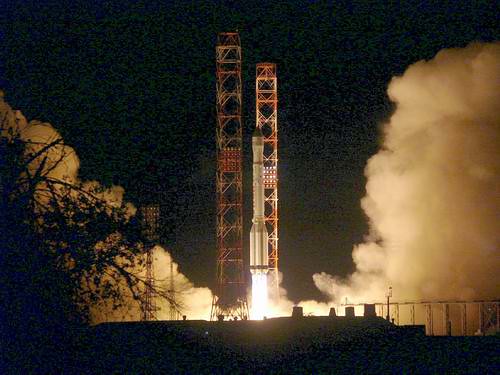
2006 from the Baikonur Cosmodrome. The launch was personally seen by Kazakh president Nursultan Nazarbayev, who invited 18 leaders from media and communications in Russian and Kazakhstan.
The satellite’s advantages will provide for greater communications autonomy and security for the vast Kazakh steppes and new industrial development in the entire region.

Contrary to some rumors among the space cadets, they did not adopt Kazoo from The Flintstones as their mascot.
Posted
June 20th, 2006 in Around the Blogs, Observation, Rockets & Launches
|
1 Comment »
"There’s a new crater on the Moon. It’s about 14 meters wide, 3 meters deep and precisely one month, [sixteen] days old," NASA reports:
NASA astronomers watched it form: "On May 2, 2006, a meteoroid hit the Moon’s Sea of Clouds (Mare Nubium) with 17 billion joules of kinetic energy—that’s about the same as 4 tons of TNT," says Bill Cooke, the head of NASA’s Meteoroid Environment Office in Huntsville, AL. "The impact created a bright fireball which we video-recorded using a 10-inch telescope."
Lunar impacts have been seen before–"stuff hits the Moon all the time," notes Cooke–but this is the best-ever recording of an explosion in progress.

"The video plays in 7x slow motion; otherwise the explosion would be nearly invisible to the human eye. "The duration of the fireball was only four-tenths of a second," says Cooke.
Posted
June 19th, 2006 in Business Network, Cool Stuff, Front Page
|
No Comments »

