Space Tourism Roundup

Expanding on NooBee’s post (below) about the Oklahoma Spaceport, several pieces of news from last week are of interest to those closely following the growth of space tourism and its infrastructure.

"The Civil Aviation Authority of Singapore (CCAS) is laying the groundwork here for the rules to govern flights out of Spaceport Singapore, a planned $115 million (SGD $191 million) project to offer suborbital spaceflights and a host of other experiences to adventure-seeking tourists," Space.com reports: 

Slated to open in 2009, Spaceport Singapore is the brainchild of a consortium of investors and the Virginia-based adventure tourism firm Space Adventures, which announced the project – alongside plans for a United Arab Emirates spaceport and a fleet of suborbital Explorer spacecraft– earlier this year.

Space Adventures and its chief competitor, Virgin Galactic have disputed claims that they are in a "new space race" for tourist dollars. Nonetheless its difficult for observers to refrain from comparing their progress on both spacecraft and spaceports.

Or at least, it’s hard for us to refrain, and we read with interest news reports last week that the state of New Mexico has chosen a Los Angeles firm to design and engineer the new spaceport in the Land of Enchantment. 

Virgin Galactic also revealed design details of its SpaceShipTwo craft last week. Observers wonder
if changes to the craft’s rocket fuel and apogee indicate the possibility of Virgin Galactic pursuing point-to-point suborbital travel.

Finally, the company that bills itself as "the SouthWest Airlines of outer space" reports that one of its customers, Seattle-based ZG Aerospace, is offering to send business cards into space this summer for $50 each.

Who said space tourism wouldn’t be available to the masses? 

Spaceports Abound

Do you know the way to your friendly neighborhood spaceport? Yeah, me neither. If you’re like me you probably had to first ask “what’s a spaceport?”. Well, the commercial space travel industry is heating up and spaceport — where commercial spacecraft launch, I guess — are popping up all over the place. And if you live in Oklahoma, there may be a spaceport coming to your neighborhood.

Oklahoma Spaceport

The Federal Aviation Administration has given its OK for commercial spaceflight operations at Oklahoma’s spaceport, a former military air base that is expected to begin hosting test flights of a new suborbital spacecraft next year.

“We are the planet’s newest gateway to space,” Bill Khourie, executive director of the Oklahoma Space Development Authority, told MSNBC.com after the FAA’s announcement on Tuesday.

The launch site operator license, issued Monday, gives Oklahoma an edge in the nascent space tourism industry — a market also being targeted by California, New Mexico, Florida and even Wisconsin, as well as Singapore and the United Arab Emirates. However, the FAA’s Office of Commercial Space Transportation would have to issue separate licenses to companies wishing to operate from Oklahoma.

With the Oklahoma spaceport scheduled to start an extensive test site schedule in 2007, one already operating in the Mojave, and activity picking up at the New Mexico site, I have jut one question. Is living near a spaceport anything like living near an airport?

DIY WiFi

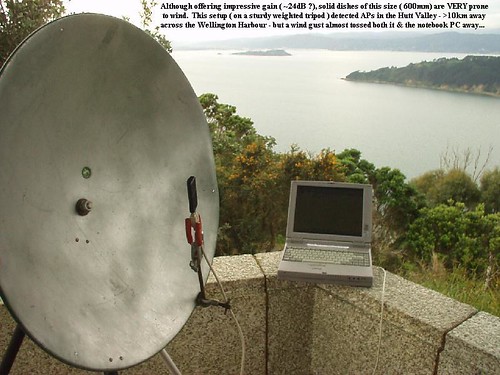
Here’s a few interesting bits about how to build your own antenna, for a DIY Friday. The first one, from Geekcorps Mali, is all about how to build your own antenna with a plastic bottle, using a design based on waveguide theory. Another offers even more detailed instructions. But I was still trying to figure out what one might use these antennae for (and what waveguide theory is) when I stumbled upon some well illustrated instructions on how to build "the poor man’s wifi."


I’m not sure I’ll ever try these instructions, but I had fun looking at the pictures of various wifi access devices made from little more than a USB adaptor and some Chinese cookware. 

Chaperone via Cellphone

Back in April, I blogged about Sprint’s GPS tracking package aimed at parents who want to keep better track of the cellphone-totting kids. Well, it’s a trend that seems to be catching on. Verizon just rolled out its own “chaperone” service.

Verizon on Monday introduced a new service aimed at parents who wish to keep track of where their children are through their cell phones. Additionally, the service will give children a way to easily contact their parents.

The “Chaperone” service would be provided in conjunction with the kid-friendly LG Migo, a cell phone designed for easy operation by even the youngest users. The system uses GPS capabilities built into the phone in order to track a child’s position.

The parent would be able to see where the phone is located from a map on the Verizon Web site. Additionally, parents can download a cell phone-based application that would perform similar functions, Verizon said.

… Another feature, called Child Zone, provides a service for parents where they would be alerted when the Migo phone leaves a predetermined area. The service would send a text message to the parent’s Verizon phone.

Linux News has screenshots of the locator screen for the Sprint plan, which give some idea of what parents on Verizon’s plan might see when logging on to make sure little Johnny or Susie comes straight home from soccer practice. It also quotes an industry analyst as suggesting that companies offer such services will need to set “realistic expectations for their customers.

LG Migo Phone

I still find myself wondering what other uses folks might find for this technology, like keeping tabs on straying spouses, etc. That the service requires use of Verizon’s LG Migo phone, which adults are unlikely to use, might reduce that threat. Of course, it would be easy enough to slip the phone into the purse, briefcase, car, etc., of the suspected spouse (or anyone else, for that matter) and keep track of their comings and goings while undetected. But, then again, there are already services that track anyone who has a cellphone, so perhaps that segment of the GPS market is already being served.

Staring into the Sun

You’ve heard it since high school. Staring into the sun is bad for your eye. Fortunately, you now have a satellite to do it for you, and even take pictures. I happened across this MetaFilter thread about the TRACE, the Transitional Region and Coronal Explorer, and discovered a treasure trove of photographs shot by the satellite. Kinda like this one.

Solar Flair

TRACEBuilt and launched in April of 1998, on a mission to enable scientists to "study the connections between fine-scale magnetic fields and the associated plasma structures on the Sun in a quantitative way by observing the photosphere" (whatever that means) the satellite isn’t exactly new. But it took its millionth picture of the sun back in October of 1999. So it’s a great source of photographs that make great wallpaper for your desktop your IM profile, as well as movies that just make interesting viewing.

Hawking: We Gotta Get Out of This Place

Blaring in an above-the-fold headline on the Drudge Report yesterday and making its way around the blogosphere today is world-renowned astrophysicist Stephen Hawking’s statement during a press conference that humans must colonize space to survive. The AP reports:

 Humans could have a permanent base on the moon in 20 years and a colony on Mars in the next 40 years, the British scientist told a news conference.

"We won’t find anywhere as nice as Earth unless we go to another star system," added Hawking, who arrived in Hong Kong to a rock star’s welcome Monday. Tickets for his lecture planned for today were sold out.

He added that if humans can avoid killing themselves in the next 100 years, they should have space settlements that can continue without support from Earth.

"It is important for the human race to spread out into space for the survival of the species," Hawking said. "Life on Earth is at the ever-increasing risk of being wiped out by a disaster, such as sudden global warming, nuclear war, a genetically engineered virus or other dangers we have not yet thought of.”

The 64-year-old scientist — author of the global bestseller A Brief History of Time — uses a wheelchair and communicates with the help of a computer because he suffers from a neurological disorder called amyotrophic lateral sclerosis, or ALS.

Hawking said he’s teaming up with his daughter to write a children’s book about the universe, aimed at the same age group as the Harry Potter books.


Teleport Falls on Troubled Times

Times are tough for Staten Island’s famous high-tech Teleport, according to the Staten Island Advance.

Billed as one of the region’s most secure communications centers for businesses, the 100-acre corporate campus has faced scepticism– and recurring difficulty attracting tenants– since it first opened in the 1980s. A New York Times article from 1988 reports:

The root of the problem is that office development is the secondary focus of the Teleport, a joint venture of Merrill Lynch, the Port Authority of New York and New Jersey, the City of New York and the Western Union Corporation.

The project’s centerpiece is an 11-acre field dotted by 14 satellite dishes. A concrete parapet 50 feet high surrounds the field to reduce electronic interference, and fiber-optic cables beam the satellite transmissions to companies throughout the New York metropolitan region.

But companies have been slow to sign on. The Teleport, in the northwest corner of Staten Island, about eight miles southwest of the ferry to Manhattan, has suffered from a stigma of being too far off the track. Although modest bus service exists, the Teleport is essentially a suburban project designed around the automobile.

For top executives of Manhattan companies with employees who rely on mass transit, the automobile orientation has killed the Teleport as a potential site for computer or back-office operations.

10 years later, during the dot-com boom, the Teleport was at the height of its success and occupancy rate– in large part because of the secure satellite and landline communication facilities it offered. The future looked bright for the "Teleport" model:

The Teleport Communications Group…  built a satellite "infield" in the park that connected to a master control center. The center operates a fiber-optic network connecting all the new buildings in the teleport park and extends into Manhattan and Brooklyn. Primarily, the infrastructure allows companies to operate their mainframe data centers or have secure sites for servers and vital network equipment.

The Port Authority began to promote the unique characteristics of the world’s very first teleport to businesses that required access to broadband communications. It’s $70 million gamble has paid off and continues to deliver dividends. Today there are five fully leased buildings at the Staten Island site with rent above market rates. More than 2,100 people are employed in new jobs at the teleport, in industries including computer operations, communications, security, building services, back office functions and telecommunications.

The New York City teleport model is being followed in cities worldwide. In fact, experts say there may be as many as 200 of these new ports in existence by the year 2005.

But now, according to the Staten Island Advance, the Teleport looks less like the future than it does a ghost town:

Industry experts and developers say the troubling numbers here are skewed by the Port Authority-managed Teleport in Bloomfield, which recently lost its signature satellite dishes and where two buildings are completely empty. The worker population has dropped from a high of more than 3,000 in the late 1990s to 1,000 today.

New investments are being made to keep the Teleport’s high-tech infrastructure up to date. But will that be enough to lure companies back out to Staten Island?

Only time will tell. 


Electronic Paper… Will it keep my desk neater?

New technology changes the way we do business every day.  Take a technology like e-paper (below), add an internet connection (wi-fi of course) and some writing recognition software and you have a computer that fits in a file folder. Or at a minimum you could read that 100-page contract without going blind using your Blackberry. –mfc

post below from http://blog.scifi.com/tech/

Epson develops new super-thin, flexible e-paper

Related Entries:  Future Tech : Portable Entertainment : Tech Briefs


epson_epaper_w.jpgEpson has developed new 7.1-inch piece of electronic paper that’s bendable and has a very respectable resolution of 1,536 x 2,048 pixels. Electronic paper is a thin material that acts as an electronic display, allowing for text and graphics to be displayed just like a screen, but with the image remaining when it’s powered off. Similar technology will be used in Sony’s oft-delayed portable Reader, and as the technology develops, more and more uses for it will undoubtedly be discovered. Epson’s new paper is less than half a millimeter thick and it’s also flexible, both said to be firsts for e-paper displays.

Rest in Space

Humans have long imagined the stars as the place where loved ones reside after their deaths. Now the spiritual metaphor can become reality, thanks to a Japanese firm’s plans to give people a boost to heaven:

A venture business here is offering people the chance to get closer to space by launching a personal satellite business allowing customers to send ashes or photos of loved ones up into orbit for as long as 30 years.

The service is being provided by Yokohama-based firm Astro Research. The satellites are cube-shaped, measuring 25 cm to a side, inside which the memorabilia can be stored.

The satellites will be launched into space from overseas, and will orbit the earth at an altitude of between 600 and 800 kilometers for about 30 years. For several years customers will able to confirm their positions by radio….

But there is a catch — the price tag of the service is 100 million yen. For most people, that will make the cost of sending their memories into outer space astronomical. 

Sort of brings a whole new meaning to the notion that the deceased are looking down on you, now doesn’t it? 


Cisco Getting Into Satcom

Israel’s Globes Online reports Gilat’s SkyEdge technology, having met Cisco’s development criteria, will be incorporated into enterprise routers, helping customers with voice, video, data and wireless communications transmission over high speed satellite networks.

Gilat CEO and president Amiram Levinberg said, “Teaming with Cisco in developing and marketing interoperable networking solutions truly differentiates Gilat in the VSAT market and shows our commitment to provide our customers with an edge beyond the latest technology, via its cooperation with market leaders. We believe Cisco’s interest to add satellite communication capability into its enterprise routers is good news for the satellite industry in general as it expands the addressable market for satellite communication technology and services.”

Gilat’s U.S. subsidiary Spacenet is selling Cisco-compatible network modules today. Glad to see their technology is getting traction in the U.S.

I like their fruity video.