WBMSAT Satellite Industry News Bits 11/08/2013


Soyuz-FG rocket booster with Soyuz TMA-11M space ship – R&D Magazine

Russian rocket carries Sochi Olympic torch and three astronauts to the International Space Station.
[R&D Magazine – 11/08/2013]

Even in a tough fiscal environment, the satellite industry gathered in record numbers at Global Milsatcom 2013 in London to present their latest solutions for military users.
[NSR – 11/08/2013]

U.S. allies’ access to MUOS debated after a MUOS satellite in geostationary orbit successfully maintained telephone links with an aircraft flying over the North Pole.
[Space News – 11/08/2013]

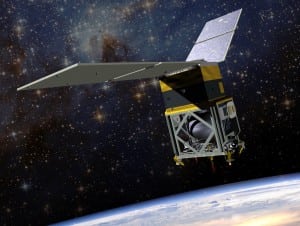
SES 8, Orbital Sciences artist’s concept – Space News

SES-8 satellite, which provides SES both replacement capacity and additional transponders for new business, is now scheduled for launch Nov. 22 aboard a Space Exploration Technologies Corp. (SpaceX) Falcon 9 rocket.
[Space News – 11/08/2013]

Orbcomm feels its strategic partnership with Inmarsat to develop satellite M2M could help standardization efforts in the industry.
[Space News – 11/08/2013]

Problems with the Exelis-built navigation payload on the U.S. Air Force’s next generation of positioning, navigation and timing satellites appear to be solved.
[Space News – 11/08/2013]

Lockheed Martin Space Systems has concluded that disaggregation of space assets to render them less vulnerable to attack is not all it’s cracked up to be.
[Space News – 11/08/2013]

Chinese satellite launch – US News

Pentagon could reduce its reliance on foreign-owned satellites like the Apstar-7 by increasing its supply of bandwidth or decreasing its seemingly limitless demand.
[US News Opinion – 11/07/2013]

Canada revamps satellite regulations to make industry more competitive, reducing fees, easing coverage restrictions for satellite licensees, and going to bat for them seeking orbital slots outside the Canadian arc.
[Space News – 11/07/2013]

Later than planned launch of its new GX satellite to hit profits of Inmarsat.
[Yahoo Finance – 11/07/2013]

Russian military satellite to blast off atop Proton-M carrier rocket November 12, with no details on the purpose or specifications of the satellite.
[SatNews – 11/07/2013]

E6B strategic airborne command post – Military Aerospace

Northrop Grumman gets $18.5 million contract to build SATCOM capability for E-6B strategic airborne command post.
[Military Aerospace – 11/07/2013]

MTN Communications renews critical capacity agreement with SES as cruise ships, yachts and exploration vessels worldwide demand more connectivity.
[Satellite Spotlight – 11/07/2013]

SpeedCast extends global maritime VST network across Indian and South Atlantic oceans.
[Satellite Evolution Group – 11/07/2013]

ORBIT Communication Systems to show OceanTRx stabilized VSAT product line for maritime oil and gas communications at OilComm 2013.
[Offshore Technology International – 11/07/2013]

Why satellite TV has an edge over cable.
[Yahoo Homes – 11/07/2013]

Kinross Gold signs three-year deal with BT to provide communications network connecting sites in the U.S., Canada, Brazil, Chile and Spain.
[Satellite Spotlight – 11/07/2013]

Integrated marketing and communications agency Sage Communications acquires satellite and space marketing and public relations firm Longbottom.
[Yahoo Finance – 11/07/2013]

Research and Markets report projects the mobile satellite service market to grow at a CAGR of 10.1 % over the period 2011 – 2015.
[Yahoo Finance – 11/06/2013]

Boeing artist’s concept of robotic satellite – Space News

DARPA looks for 10 retired satellites to raid for parts in on-orbit salvaging demo.
[Space News – 11/06/2013]

Canada blocks MDA from Russian radar satellite competetion.
[Space News – 11/06/2013]

FEMA wants to extend contract for satellite connectivity with On Call Communications for extra three months at additional $450,000 cost.
[Government Security News – 11/06/2013]

Areas of interest for the PCW mission – CSA graphic – Space News

Com Dev and MDA jockey for position on Canadian Arctic satellite project.
[Space News – 11/06/2013]

Australian company EM Solutions gets follow-on order from Japanese government for additional quantity of its on-the-move satellite broadband terminals.
[Australian Defence Magazine – 11/06/2013]

Azam Medial chooses Eutelst capacity, services, and DTH experience to support its new pan-African pay-TV platform.
[Satellite Evolution Group – 11/06/2013]

Navman Wireless USA announces a new satellite communications option for its OnlineAVL2 fleet tracking platform enabling continuous visibility of both heavy equipment and on-road vehicles even when out of cellular range.
[Yahoo Finance – 11/06/2013]

NASA working hard to develop laser-based space communications systems said to be key to ensuring rapid and accurate transmission of information from spacecraft around the solar system.
[Yahoo News – 11/05/2013]

Reportlinker announces new market research report in its catalogue: “Global Fixed Satellite Service Market 2012 – 2016.”
[Yahoo Finance – 11/05/2013]

Euroconsult – Government and industry to combine for 1,150 satellites over next ten years.
[Satellite Evolution Group – 11/05/2013]

Spacecom’s Amos 4 satellite Ku-band capacity bought entirely by a Southeast Asian data services provider.
[Via Satellite – 11/05/2013]

ITC Global announces it has launched the world’s first production service for oil & gas and mining clients utilizing the new iDirect X7 remote modem, offering remote location performance of 20 Mbps or better.
[Yahoo Finance – 11/05/2013]

Thuraya partners with Vocality to provide Vocality network router solutions through its global network of service partners serving commercial and defense mobile satellite communications markets.
[Satellite Spotlight – 11/05/2013]

India’s attempt to become just the fourth nation to successfully send a mission to Mars makes good start with successful blast off of the Mangalyaan orbiter.
[Independent – 11/05/2013]

New satellite communications building opening at Goonhilly will provide super fast broadband from Avanti to rural areas of Cornwall that would otherwise be out of reach.
[itv – 11/05/2013]

Kazakhstan provided Kyrgyzstan joint use of KazSat to offer satellite communications and broadcasting in the interests of the telecommunications sector in Kyrgyzstan.
[Hispanic Business – 11/05/2013]

Globalstar proposal to use satellite spectrum for terrestrial Wi-Fi has potential for success, unlike the fiasco that was LightSquared.
[CNN Money – 11/04/2013]

Thuraya and TrustComm introduce Starlight, and enhanced mobile satellite service.
[Yahoo Finance – 11/04/2013]

Euronics of Germany teams up with Eutelsat to take satellite broadband to German consumers still beyond range of a quality broadband experience.
[Yahoo Finance – 11/04/2013]

Hughes to provide satellite back-up solution for the US National Weather Service OPsnet (Operational Systems Network).
[HIspanic Business – 11/04/2013]

Artistic rendition courtesy of ESA.- SatNews

ESA’s ground station on Tenerife island receives laser signals over a distance of 400,000 km from NASA’s latest moon orbiter, the Lunar Atmosphere and Dust Environment Explorer (LADEE).
[SatNews – 11/03/2013]

Fourth edition of NSR’s SCADA/M2M via Satellite report offers the industry’s most complete analysis of this vital satellite communications market.
[NSR – November 2013]

 WBMSAT satellite communications consulting services


Big Bang Monday: Hot Jupiters

hd189733

Fascinating, via NASA Visualization Explorer

In the search for Earth-like planets, astronomers uncover a strange blue world.

Scientists estimate more than 100 billion planets exist beyond our solar system. These alien worlds, known as exoplanets, orbit distant stars located light-years from Earth. One such planet is called HD 189733b. A gas giant slightly larger than Jupiter, HD 189733b circles its star from a distance of only 3 million miles. That’s 13 times closer than Mercury is to our sun. As a result, temperatures in its atmosphere approach 2,000°F. Astronomers discovered HD 189733b in 2005 after observing its parent star dimming with every pass, or transit, of the planet. We now know from follow-up observations by NASA’s Hubble Space Telescope that HD 189733b is blue in color.

If only the original Star Trek was still around — they’d come up with a good episode around these “Hot Jupiters.” This one’s only 63 light years away.

We’re hoping our friends at BigBangPrints.com come out with an exoplanet gallery soon. For now, we’ll settle for regular Jupiter.


Virgin Galactic’s First Flight: Global Broadcast

Visit NBCNews.com for breaking news, world news, and news about the economy

NBC Universal will broadcast the first Virgin Galactic flight live.

The Today show will be seen by millions and get incredible ratings. Hopefully, the first flight will be during sweeps.


Michael Francis Ford, 1948-2013

Mike Ford

Mike Ford

Mike Ford was the creative genius behind Americom’s branding campaign, launched in 2006, and encouraged the creation of this blog.


Michael Francis Ford, a noted Democratic political strategist, entrepreneur and founder of the Center for the Study of the American Dream at Xavier University, died on November 5 at the Johns Hopkins Hospital in Baltimore, Md., after battling melanoma for five years. He was 65.

Over four decades, Mr. Ford served in nine presidential campaigns, holding senior strategic positions for Edward Kennedy in 1980, Walter Mondale in 1984, Jerry Brown in 1992 and Howard Dean in 2004. In addition, he managed more than 100 gubernatorial, US Senate, US House and mayoral campaigns across the country.

Former Vice President Walter Mondale said in a letter this week: “A man of many gifts, Mike’s greatest gift may have been his ability to inspire young people around him, teach them to be the best versions of themselves, and to understand the importance of giving back to their community and country.”

After graduating from Xavier University in 1970, Mr. Ford remained in Cincinnati, Ohio where his political career blossomed. In addition to numerous local and statewide campaigns, Mr. Ford served as Executive Assistant to Ohio Governor John J. Gilligan. He later served as campaign manager, Deputy Mayor and Chief of Staff to Cincinnati Mayor Jerry Springer, and was as an international representative and organizer for AFSCME, AFL-CIO.

In 1980, Ford was part of a cadre of seasoned political veterans who helped lead Senator Edward Kennedy’s challenge to President Jimmy Carter for the Democratic presidential nomination. Among other assignments, Ford managed Kennedy’s crucial Pennsylvania primary win, which breathed new life into the campaign at a critical time.

In 1984, while serving as Deputy Campaign Manager and National Field Director for Vice President Walter Mondale’s presidential campaign, Ford’s persuasive post-primary memos urging an ambitious effort to register minority and union voters and advocating for an “out-of-the box” selection for running mate, were published in The Quest for the Presidency, 1984.

Mike taught and inspired legions of young volunteers and first-time staffers and turned them into the next generation of political professionals.

Writing about Ford in The Quest for the Presidency, 1992 author Peter Goldman described Ford as: “a tough, veteran pol, equally at home in the world of ideas.”

In 1988, Mike and his wife, Sally, founded Bay Communications, a strategic communications firm, consulting for executives of Fortune 500 companies, Democratic national and state parties and caucuses, international unions, and political action committees.

While serving in the 90’s as the Senior Advisor to the Executive Vice President of Internet Operations at Citibank, Mr. Ford created the “Financial Services in the Next Ten Years” White Paper, helping Citibank focus on company-wide long term planning, including voice recognition and A/I, universal/simultaneous multi-lingual translation, and miniature robotics as virtual guides for consumers.

In 1996, Ford created the Affordable Access Trust Inc., a unit investment trust filed with the SEC, designed to package low cost units of Warren Buffett’s Berkshire Hathaway Corporation, at the time trading at $50,000 a share. The Trust was terminated after Buffett to reluctantly created lower cost “Berkshire B shares” at a 96% discount from the “A share” price. The B shares have quintupled in value since then.

A Newsweek article noted the Trust’s extraordinary genesis and impact. “The gestation of the Baby Berkshires began not on Wall Street but in Annapolis, Md., with political consultant Michael Ford, who specializes in working for liberal Democrats. Ford decided he could do well by doing good.”

“I just wanted to let the average person buy a piece of the best investor of our time,” Mr. Ford told Newsweek.

Mr. Ford’s unique career afforded him the chance to consult a variety of clients, ranging from the NBA Players’ Association, the New York City Metropolitan Transit Authority, and many technology start-ups. Mr. Ford was even enlisted by the producers of the 1983 film The Dead Zone to help create scenes about a New Hampshire primary election event.

In 2009, Mr. Ford founded the Center for the Study of the American Dreamat his alma mater, Xavier University. The Center serves as the nation’s pre-eminent clearinghouse for information on the state of the American Dream.

As its Founding Director, Mr. Ford led the Center’s efforts in generating significant original research analyzing shifts in the Dream’s continuing evolution. Under Mr. Ford’s leadership, the Center has received significant national attention for its work.

At the time of his death, Mr. Ford was working on a book on the history, meaning, and future of the American Dream, which his family plans to publish posthumously. The book’s genesis comes from his 2012 Washington Post Sunday Outlook 5 Myths opinion piece “Five Myths about the American Dream.”

Mr. Ford’s commentaries appeared in radio and newspapers including The Chicago Tribune, and The Cincinnati Enquirer, The Cleveland Plain Dealer, and Huffington Post, He appeared on “Larry King Live,” the “Today Show” and CNN’s “Crossfire,” serving as a political analyst and campaign spokesperson.

He lectured at Harvard’s Kennedy School of Government, Ohio State University, American University, University of Cincinnati, Wake Forest University, and the Clinton School of Public Service at the University of Arkansas.

Mr. Ford was such an avid reader that his home contains a two-story library filled with thousands of books and busts of his Founding Father heroes. His many passions ranged from writing, classical music, American history, financial investing, art collecting, cooking, and his favorite sports teams, most notably the Washington Redskins and Xavier Musketeers basketball.

Mr. Ford was born in Washington, D.C. on June 27, 1948, and grew up in Takoma Park, Md. He attended St. Michael’s School in Silver Spring, Md. and St. John’s College High School in Washington, D.C. He received an A.B. from Xavier University in Cincinnati, an M.A. in Government from Georgetown University in Washington, D.C., and was a Graduate Fellow at the Institute of Public Administration at Penn State University.

Surviving Mr. Ford are his wife Sally, of Glyndon, Md.; a son, Matthew of New York, N.Y.; Mary Jo Ford (Richard) Schneider of Herndon, Va., Patrick (Peggy) Ford of Columbia, Md., Christopher Ford of Detroit, Mich., and Maureen (Dave) Jester of Damascus, Md.; numerous nieces and nephews, and other family and friends.

The family suggests donations in Michael’s memory to the Center for the Study of the American Dream, Xavier University, 3800 Victory Parkway, Cincinnati, Ohio 45207-5471; or to the continuing research efforts at Johns Hopkins University, c/o Dina Mallis Klicos, Kimmel Cancer Center Development Office 750 E. Pratt Street, Suite 1700, Baltimore, Md. 21202. Please indicate that the donation is in memory of Michael Ford.

With heroic symbolism, Mr. Ford died on Election Day.

Olympic Torch in Space!

The AP report, via ABC News

A Russian rocket soared into the cosmos Thursday carrying the Sochi Olympic torch and three astronauts to the International Space Station ahead of the first-ever spacewalk for the symbol of peace.

Video streamed by the U.S. space agency NASA reported a flawless docking with the space station about six hours after the craft blasted off from Russia’s manned space facility in Baikonur, Kazakhstan.

The unlit torch for the 2014 Winter Olympics in the Russian city of Sochi is to be taken on a spacewalk Saturday, then return to Earth on Monday (late Sunday EST) with three departing space station astronauts.

The arriving crew members Thursday were Russia’s Mikhail Tyurin, American Rick Mastracchio and Koichi Wakata of Japan.

Once the newcomers enter the space station following a long hatch-opening process, the orbiting lab will have nine people aboard for the first time since 2009. Fyodor Yurchikhin of Russia, NASA’s Karen Nyberg and Italian Luca Parmitano are the crew scheduled to return to Earth with the torch via a Monday landing on the steppes of Kazakhstan.

The Olympic torch will not burn onboard the space outpost because lighting it would consume precious oxygen and pose a threat to the crew. The crew will carry the unlit torch around the station’s numerous modules before taking it out on a spacewalk.

The Olympic torch was taken aboard the U.S. space shuttle Atlantis in 1996 for the Atlanta Summer Olympics, but this is the first it time it will be taken outside a spacecraft.

“It’s a great pleasure and responsibility getting to work with this symbol of peace,” Tyurin told journalists on Wednesday before the launch.

Russians Oleg Kotov and Sergei Ryazanskiy will take the torch out of the space station on Saturday while American Michael Hopkins remains inside.

The four-month Sochi torch relay, which started in Moscow on Oct. 7, is the longest in the history of the Olympics. For most of the 65,000-kilometer (39,000-mile) route across Russia, it will travel by plane, train, car and even reindeer sleigh.

Some 14,000 torch bearers are taking part in the relay that stops at more than 130 cities and towns.

Last month, the Olympic flame traveled to the North Pole on a Russian nuclear-powered icebreaker. Later this month it will sink to the bottom of the world’s deepest lake, Lake Baikal. In early February, it will reach the peak of Mount Elbrus, at 5,642 meters (18,510 feet) the highest mountain in Russia and Europe.

The torch will be used to light the Olympic flame at Sochi’s stadium on Feb. 7, marking the start of the 2014 Winter Games that run until Feb. 23.


Satcom: We Don’t Suck

sat_chart

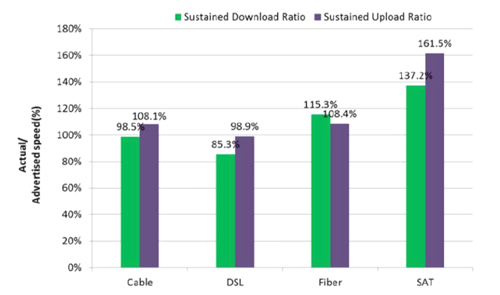
For years, Internet by satellite was deemed “acceptable” by those who couldn’t get broadband by other means. Satellite operators have known for 20+ years that Ka-band was good for data, but nobody had the balls to really make a financial and operational commitment toward achieving commercial and/or technical success. Hughes, Starband, Wildblue and a host of 2nd and 3rd tier resellers tried to make a go of it, but nobody could get the cost of satellite bandwidth down to a workable level.

When satellite operators are getting 80% EBITDA margins from video distribution, why bother?

ViaSat set out to change perceptions by working the technology to make it work. They’re winning.

Mark Fidelman put together a solid piece in Forbes last week that should have been written 15 years ago — if big satcom walked the talk back then. He sat down with ViaSat CEO Dankberg and got into the details:

Most people would assume that the bandwidth issues will forever limit the size of the satellite communications market, but I’d hold off on that assumption. Dankberg explained that current satellite systems are manufactured by different vendors that build to the lowest common technical denominator. The three primary components, the satellite, the ground systems and the satellite communications service providers are all different vendors with different priorities. Which means that the entire communication system is not optimized. These systems are like a large truck with a lawn mower engine meant for a race car driver.

“So what we’ve done is developed all three of those areas. We build the ground system, we design the satellites and we operate them, so we know what we need,” Dankberg explained, “Since we are the architect of all three, we can completely integrate and optimize the system.”

Dankberg told me that ViaSat-1 used existing space components, and sub-systems, but that ViaSat-2 will have a better design and thus optimized architecture. He believes it will be twice as fast as ViaSat-1 which means it will provide even greater competition with high speed cable and DSL providers.

That means anyone anywhere could have their own high speed communications antenna. Essentially filling the gaps that current providers can’t fill due to regulatory or terrestrial issues. Yes satellite communication technology still operates on higher frequencies which don’t propagate walls very well. But Dankberg says in those situations antennas on cars, busses, trains, homes and commercial buildings will convert the signal to lower frequency Wi-Fi which is better able to penetrate the interiors of buildings.

Has anyone noticed that when you need higher bandwidth the most, it never seems to be available? I’m thinking about those situations where streaming video, uploading and downloading media are essential but are slow due to network congestion. Dankberg’s solution was to develop a type of artificial intelligence: “One of the things we did to make our network faster is develop software to figure out what you are doing, and deliver it faster that you otherwise would get -because we can anticipate what you’re going to do,” Dankberg said.

Satellite’s gotten such a bad rap that Exede partner Dish Network barely mentions the word on its website. And not at all in TV spots…

Mark Dankberg and his team are real innovators and us rocket scientists are glad to see this part of his business meet real success.


Hiding From Satellites

spysat

We’ve been fans of DLR’s Heavens Above site for years, a site that predicts when orbiting spacecraft are expected to be seen from Earth. Iridium flares are especially fun to predict to impress your friends.

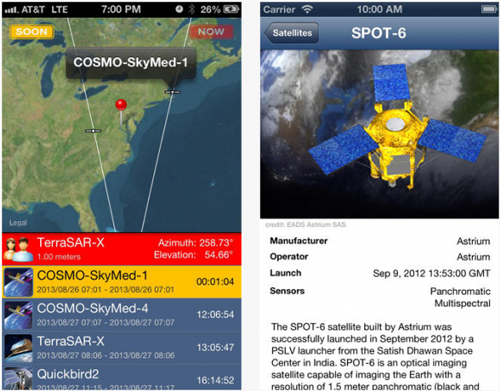
Now we have s spacecraft prediction app of a more topical “spying” nature: SpyMeSat, a $2 app that predicts flyovers by observation satellites. Via SlashGear

SpyMeSat was created by Orbit Logic, Inc., which specializes in supplying software to the aerospace and intelligence communities. The app, which was released last week, gets its data from organizations like NORAD, but it doesn’t use any classified information. In other words, any terrorists or human rights abusers looking to hide from satellites already can access the info through other data sources. The app’s chief purpose is to gather all that data into one cheap app.

“We were careful to only include satellites that are unclassified and whose orbits are published by NORAD,” Orbit Logic president Alex Herz said. “Even the sensor data — resolution, etc. — was taken only from the websites published by the satellite operators. So everything SpyMeSat is using is open and public.”

The app is accurate to 16 meters. You can set SpyMeSat to give you alerts for any location, track satellites even when they’re not overhead, call up resolution specs for each model, and learn about their various on-board sensors. Satellite models in the database are owned and operated by either public or private bodies, including the GeoEye, France’s SPOT-5, India’s CartoSat-2A, DigitalGlobe WorldView, and RADARSAT-2 of Canada.

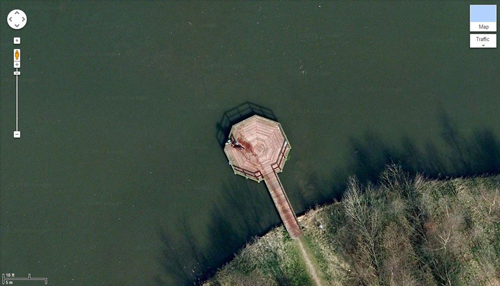
It may save you some embarrassment.

gmap_scary_w


Big Bang Monday: Lunar Halo

lunar_halo_w

Photo by Pauli Hänninen

Simply spectacular, via Yle.

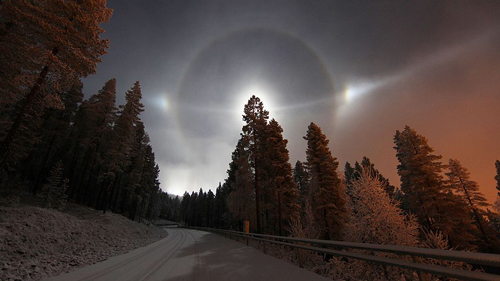
Laplanders got a rare and beautiful sight last Friday, when the Levi ski resort fired up its snow machines to start preparing its pistes. The Finnish resort usually has early and reliable snow, one of the reasons it is due to host the FIS World Cup in mid-November.

In the village of Sirkka, near Levi in the municipality of Kittilä, photographer Pauli Hänninen and his family were curious about the shining halos in the skies above them.

”It was cold and very foggy, the temperature was around -10 degrees Celsius,” said Hänninen. ”It was down to the snow-making, as dozens if not hundreds of canon were making the course for the World Cup and elsewhere.”

”When the clouds began to break, there were rainbow colours in the sky and a halo spanning 360 degrees!” continued Hänninen. ”It was worth taking a picture or two.”

lunar_halo_tree_w


WBMSAT Satellite Industry News Bits 11/01/2013

John Logan of EM Solutions, Brisbane, has entered The Australian Innovation Challenge with his mobile satellite terminal. – The Australian

Comms-on-the-move Ka-band mobile satellite terminal developed by EM Solutions of Australia, enabling high speed data transfer while driving in locations lacking other communications, finds emergency applications.
[The Australian – 11/02/2013]

FAA loosens rules for electronic devices during flights.
[USA Today – 11/01/2013]

Spacecom announces a manufacturer’s workaround for Amos 5 power-supply anomaly that should enable the satellite to operate for its full 15-year service life.
[Space News – 11/01/2013]

Delayed O3b satellites should be repaired and ready for launch in March 2014.
[Space News – 11/01/2013]

The number of commercial aircraft providing either Wi-Fi or cellular connectivity will reach 4,048 by the end of 2013, representing 21% of the global fleet, according the recent research published by IHS Inc.
[SatNews – 11/01/2013]

China’s homegrown Beidou Navigation Satellite System will be put into its first oversea operation in Thailand early next year.
[GPS Daily – 11/01/2013]\

GCI extends capacity agreements with Intelsat to support broadband services to Alaskan schools and medical clinics, as well as telemedicine applications for hospitals in underserved areas.
[SatNews – 11/01/2013]\

Analysts forecast the Global Fixed Satellite Service market to grow at a CAGR of 5.44 percent over the period 2013-2016.
[SBWire – 10/31/2013]

Latest Ericsson Mobility Report presents key statistics and future forecasts which should provide satellite technology, especially High Throughput Satellites (HTS) , with highly promising short term opportuniteis.
[NSR – 10/31/2013]

Telesat considers expansion after one of its new satellites helps increase revenues in third quarter.
[Ottowa Business Journal – 10/31/2013]

NASA will rely on hosted payload to continue some of the long-running Earth-system observations the agency took over from the National Oceanic and Atmospheric Administration (NOAA) in April.
[Space News – 10/31/2013]

Astrium enters into partnership agreement with IHS to deliver satellite imagery and services for intelligence analysis and reporting.
[Via Satellite – 10/31/2013]

MTN Communications experiences a surge in demand, claiming customers increased demand for additional bandwidth on its network by 61% since 2013.
[Via Satellite – 10/31/2013]

Astrium Services is expanding its global VSAT coverage following the signing of new separate Ku-band capacity agreements with SES and Eutelsat.
[Satellite Evolution Group – 10/31/2013]

UltiSat signs multi-year contract with Eutelsat for capacity on EUTELSAT 5 West A to provide C-band service to nongovernmental organizations (NGO) in Africa.
[The Wall Street Journal – 10/31/2013]

Ocean Dream – Via Satellite

Having recently signed a new deal with MTN Communications to enhance its onboard suite of connectivity options for passengers and crew, cruise ship operator Pullmantur executive explains the need for satellite.
[Via Satellite – 10/31/2013]

Signalhorn is selected for ht operation and management of a pan-African network for one of the world’s leading providers of offshore service vessels in the global energy industry.
[Satellite Evolution Group – 10/30/2013]

SimbaNET uses iDirect’s Evolution platform to advance Nigeria-based satellite network.
[Via Satellite – 10/31/2013]

Dreamchaser hoisted by helicopter – R&D Magazine

Sierra Nevada Corp.’s Dream Chaser space plane skids off runway in test flight landing as landing gear collapses.
[R&D Magazine – 10/30/2013]

Arianespace reschedules SES, Hispasat and ESA’s launch dates, with consent of its customers.
[Via Satellite – 10/30/2013]

Raytheon is awarded $11.9 million contract for sustainment services supporting the Military Satellite Communications System (MILSATCOM) Global Broadcast System (GBS). [Signal online – 10/30/20103]

High speed satellite broadband provider ViaSat defies the naysayers who have stigmatized satellite communications as impractical, flawed, and slow.
[Chicago Tribune – 10/30/2013]

Comtech Telecommunications Corp is awarded $1.4 million for communications jamming high-power amplifier systems.
[Satellite Spotlight – 10/30/2013]

Dish and Southwest start in-flight iPad lending program for on-demand entertainment on Wi-Fi enabled Southwest flights..
[Via Satellite – 10/30/2013]

Maxwell Technology, in partnership with Cable Wise, expands satellite internet to Northern KwaZulu-Natal.
[Human IPO – 10/30/2013]

Global Maritime VSAT market expected to grow at CAGR of 7.71 percent between 2012 and 2016 according to new Research and Markets report.
[Satellite Spotlight – 10/29/2013]

Data product differentiation beginning to become important again in the Earth Observation market.
[NSR – 10/29/2013]

Eutelsat and Es’hailSat announce that their jointly owned EUTELSAT 25B/Es’hail 1 satellite launched August 29, went into commercial service October 29.
[The Wall Street Journal – 10/29/2013]

Astrium to build new satellite for DIRECTV.
[Space Daily – 10/29/2013]

Space training in China – asiaone

Hundreds of space professionals from developing economies receive space training in China, including Pakistan, Nigeria, and Bolivia.
[Asia One – 10/29/2013]

Artist’s rendering of the Ball Smallsat – Via Satellite

Ball Aerospace & Technologies’ Green Propellant Infusion Mission is selected to test advance form of thermal insulation that could become standard on future satellites and cryogenic subsystems.
[Via Satellite – 10/29/2013]

Artist’s rendering of the LADEE – R&D Magazine

NASA’s Lunar Laser Communication Demonstration makes history, successfully transmitting data from lunar orbit to Earth at a rate of 622 Mbps.
[R&D Magazine – 10/28/2013]

ESA approves sale of Artemis telecom satellite to Avanti.
[Spaceflight Now – 10/28/2013]

Measat CEO says company is open to partnerships.
[Via Satellite – 10/28/2013]

ILS Proton successfully launches the Sirius FM 6 satellite.
[Via Satellite – 10/28/2013]

Gogo signs deal with Japan Airlines to deliver in-flight connectivity.
[Via Satellite – 10/28/2013]

Oil and Gas companies – will High Throughput Satellites change the equation?
[Via Satellite Webinar November 14, 2013]

 WBMSAT satellite communications consulting services

DIY Friday: ArduSat To Go

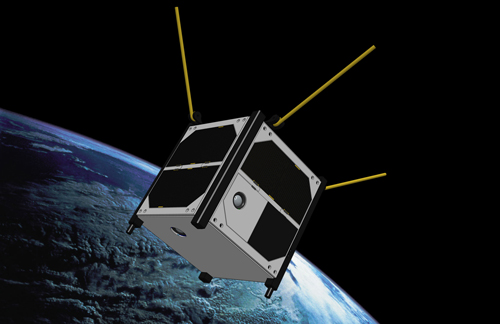
ardusat

From NanoSatisfi, a way to conduct your own in-orbit experiments…

Space has never been closer, which brings with it innumerable possibilities. And these are just a few of the things that we think are pretty neat about it:

1) Affordability. NanoSatisfi is driving down the cost to build, launch and maintain satellites in space—it’s a rocket scientist thing, no big deal. The important part is that it means we can offer access to space, and all of the possibilities therein, at a cost that won’t break anyone’s piggy bank.

2) Simplicity. Space is more than a playground for rocket scientists and astrophysicists—NanoSatisfi is building technology to make exploring and interfacing with space accessible for everyone, starting with ArduSat.

3) Creativity. We’re empowering tomorrow’s explorers with ArduSat, the world’s first open space platform. Whether it’s a dream to map every river of the world, or an aspiration to build the first live-action version of space Invaders the game, we are making the tools available.

And to think it all started with a successful Kickstarter campaign.

ardusat_orbit_w