Commercials on Your Cell?

You had to know it was coming. As soon as your favorite television shows and events became available on your mobile phone, commercials couldn’t be too far behind.  This time, however, watching advertisements might pay off if you’re paying attention. 

Virgin Mobile USA plans to announce a way that people can talk for no money at all. They will, however, have to pay with a chunk of their attention.

The program, called SugarMama, lets people earn one minute of talking time by watching 30-second commercials on a computer or receiving text messages on their phones, then answering questions to prove they were, in fact, paying attention. 

Granted, we’re just talking text messages here, but how soon before full-fledged TV-style ads start coming to you via your mobile phone?

It’ll be interesting to see how well this pans out. Industry analysts suggest that anyone who’s "too cheap to buy a minute" probably can’t afford an Xbox (one of the products to be advertised), but Virgin says that the program will put a youth market that’s already inundated with advertisements "in control" of what they see and how they respond. 

The only problem I see is the unanswered question of just when and how often these advertisements arrive? it’s one thing to be interrupted by a phone call. It’s another to be interrupted by an advertisement?

Homemade Mobile

Here’s one I’ve been saving for a DIY Friday. I didn’t believe it at first, but apparently there are people out there making their own mobile phones. And of course, in the age of the internet, they’ve inevitably found one another. 

Matt Hamrick hates standard-issue mobile phones almost as much as he loves tinkering with them to make them better.

The software security expert reckons he’s spent around $3,000 over the past two years trying to get his calendar and e-mail to sync between his Apple computer and his phone.

"The phones aren’t getting any better," he says. "I’ve been looking for a phone that would meet my requirements for 10 years now."

That quest gained new momentum this month when the Silicon Valley Homebrew Mobile Phone Club, a group Hamrick co-founded, attracted about 40 people to its first meeting.

The fledgling organization owes its name and inspiration to the famous Homebrew Computer Club of the 1970s, which many historians now credit with innovations that paved the way for the personal computing revolution. Members hope something equally climactic will arise from their new association.

Hamrick’s even written a manifesto of sorts for his movement, and there’s at least one more out there like it. I’m impressed with anyone who takes on the task of building their own mobile phone. After all, like most people (according to one of the manifestos), I’m still figuring out how to use the one I bought. 

In a recent phone conversation with a friend, I needed a phone number of a mutual acquaintance. My friend had the number in his mobile phone, but it took several minutes for me to convince him that he could review numbers stored there without hanging up. The sad part of this is that upon discussing the incident with friends who are responsible for the software in some phones, they laughed at what they viewed as "stupid user behavior." Tsk. tsk. If your phone software is so good, why do most of your customers persist in erroneous beliefs about it’s function?

Good question. I’m a bit further along than the guy who didn’t know he could view numbers without hanging up his phone, but I’m a little iffy on whether I can record numbers without hanging up phone. And I’ve never tried to synch it with anything either, though I’m sure I could. And I know it’s got voice dialing capabilities, but I haven’t figured out how to use that either. 

If these guys are modeled on the Homebrew Computer Club, maybe they’ll do for mobile phones what that group did for desktop innovation. And maybe I’ll use a few more functions on my phone.

XM Radio Helix

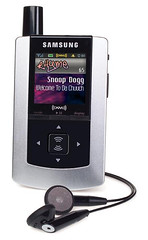
Uh oh. It looks like XM satellite radio is about to have even more legal trouble with RIAA. I blogged a while back about how RIAA filed a lawsuit against XM over the alleged ability of XM’s Inno player to not only play music but also record it.  Well, the news about XM’s new Samsung Helix player may be likely to strengthen the RIAA’s case — it records music too. If you hear a song and right in the middle decide to recort it, the Helix records it, from the beginning. 

Samsung Helix

TO be filed under Best Ideas of the Year: Imagine a tiny music player, smaller than an iPod, that’s also an XM satellite radio receiver. When you hear a song you like — even if it’s halfway over — one press of a button records it from the beginning.

Meet the Samsung Helix (and its twin, the Pioneer Inno): a tiny, well-designed $400 radio that not only lets you enjoy satellite radio in the car, at home or when you’re jogging, but also plays back your own MP3 files and up to 750 songs that you’ve recorded from the satellites.

… Now, not everybody is happy about this feature of the Helix and its Pioneer sibling. XM, which was largely responsible for the design of both players, has been sued by the increasingly busy lawyers of the Recording Industry Association of America. They’re calling the design of these players a tool for copyright infringement.

Or not. It turns out that you can’t do much more with the music you record on the Helix than listen to it on the device. You can’t export it to a computer or another MP3 player. You can’t burn it to a CD, at least not before you download from a pay service like Napster. And since it’s music you already payed to listen to via XM, if you download it you’re actually paying for it twice

So maybe this doesn’t bolster RIAA’s case much. Then again, maybe it’s the price that’s bothering them. They’re asking $150,000 per song in their lawsuit. But to doanload a song you "bookmark" on the Helix is only going to cost you $1.

Watching TV at 35,000 feet

Last week I was reading an article on the 2nd anniversary of the introduction of broadband Internet service on Lufthansa aircraft

The online, in-flight service — which has proven so popular that Lufthansa is now offering it on nearly 80% of its long-haul flights — is provided by Connexion by Boeing (CbB). The CbB system uses geosynchronous satellites to connect to the Internet, with a Wi-Fi hotspot on the aircraft itself. SES AMERICOM plays a critical role in delivering the airborne internet; Connexion by Boeing utilizes our AMC-23 satellite to provide high-speed access to customers flying over the Pacific Ocean. (AMC-23 was designed and specified in conjunction with CbB to provide Ku-band coverage of major air routes across the Pacific Ocean).

That satellite connection — and SES is proud to play a role in delivering it — is changing the way people travel, and becoming a “must have” amenity for many business travelers. One recent study conducted by Boeing found that:

  • 83 percent of those surveyed said that the availability of the Connexion by Boeing service will have an impact on future travel plans and their choice of airline carrier;
  • 94 percent said they plan to use the service again on a future flight;
  • 78 percent said that the service’s speed met or exceeded their expectations.

As for how people are using the service, the study found:

  • 90 percent of respondents said they accessed their work e-mail, most of whom use a virtual private (corporate) network;
  • 76 percent accessed their personal e-mail;
  • 69 percent said they browsed the Internet;
  • 41 percent engaged their friends and family via instant messaging or live chat applications.

Using IM and email to stay in touch with others while crossing the oceans is a great way to increase business productivity. But as I read the article and study about Lufthansa’s experience with Connexion by Boeing over the last two years, I was reminded of a personal experience I had on Lufthansa flight earlier this spring.

Because I travel so frequently,  and I like to stay connected with “hometown” news, I purchased a Slingbox device. Slingbox enables you to tune in to your TV service at home via the Internet. On this occasion, I was flying on an overnight Lufthansa flight to Luxembourg via Frankfurt, and had gotten online using CbB.

Like most business travelers, I initially got online to check my work email, and I spent some productive time catching up on business matters. But then I had a thought — I wondered if I could use CbB to connect to my Slingbox and to try tuning in the news program — from 35,000 feet. It worked!

“Tuning in at home” while over the North Atlantic was made possible by many technologies — twice by satellite. First, the video signal was carried by an AMERICOM satellite and downlinked by a cable operator in New York. Then, an AMERICOM satellite was used to provide Internet service to the aircraft. In between, there are the new technologies: the Slingbox and CbB. Oh, and of course, there’s the Internet.

That, to me, is what is truly amazing about the combination of satellite technology with the Internet. Productivity is nice, but being able to sit back and relax with your favorite local programming while flying across time zones — that’s the type of future we’ve long imagined. And thanks to satellite technology, that future is here. This really is rocket science.

 

Comet Cancelled?

What’s that in the sky? A bird? A plane? Well, no. It’s a comet, but nothing you need to worry about according to Phil over at Bad Astronomy.

Comet

Well, today is the day, once again, that the world won’t end. I’m shocked, shocked, that the comet fragment predicted to hit in the Atlantic causing a seismic event and an ensuing tidal wave hasn’t materialized.

Of course, the day’s not over yet. But I’m pretty sure how this will turn out.

Chris has been blogging the story of whether or not a comet will hit the earth today, and is pretty sure it won’t. He’s updated his post about his Sirus Radio interview on the subject with more than enough links to make an effective case. 

But keep one eye on the sky today just in case, will ya?

NASA on Hurricanes

It’s that time of year. Hurricane season is upon us, and NASA is stepping up its services to better communicate with employees through its intranet. Good thing too, because half of NASA’s offices are smack in the middle of the path Katrina and Rita took to land last year. 

The InsideNASA intranet, built on Vignette’s Next-Generation web Presence platform, help employees at 11 US facilities stay informed about office closures, evacuation procedures and when it’s safe to return to work. Information on the site also will guide employees to make a "safe-arrival call" when they reach their destination.

… There’s also a real-time feed from the Department of Homeland Security (DHS) helps monitor theorist threat advisories. The site has approximately 130 portlets, "a small window of content, such as an animated real-time weather map," Holm said. "We also have an announcement portlet that offers all the latest information at NASA submitted by employees."

… A virtual private network (VPN) provides employees remote access from virtually any device with internet connectivity, such as a Research In Motion (RIM) Blackberry or Palm Treo. NASA employees also can call a hotline to find gas or a hotel when there not able to log into the network, Holm said. "Just for my group, we budgeted about US$300,000 for the project this year," she said. "It includes personnel, management training, operations, content and disaster support, and publishing and information architecture."

Makes sense, since NASA has something of an inside track when it comes to advance info on hurricanes. Metroblogging New Orleans posted that NASA’s satellite study of Rita last summer yielded an interesting discovery about what’s behind the strength of some hurricanes.  

Using a satellite last summer to study hurricane Rita from above, scientists discovered that towering clouds near the storm’s eye were good predictors of future storm strength.

… Specifically, if hot towers are active at least 33 percent of the time during a three-hour period, surface winds have an 82 percent chance of intensifying. Making such measurements on the fly could improve the forecast of a storm’s strength just prior to landfall.

Here’s hoping more accurate forecasts combined with getting information out faster will lead to getting more people out of the path of the next big hurricane.

Google Earth Mashup of Kennedy Space Center

Via Google Maps Mania comes this very cool mashup:

South Florida newspaper Florida Today has built a Google Maps mashup of space launch sites at Kennedy Space Center and Cape Canaveral. It includes a database of every launch since the dawn of the space age, shuttle and rocket launch video and images, and video tours inside facilities people usually don’t get a chance to see guided by its space reporters. It also has an enhanced 3D Google Earth version you can download as well 

The standard 2-D tour is interesting, but if you want an amazing tour experience you’ll want a (warning: highly addictive) copy of Google Earth (available here) to view the mashup.

In either version, you can click on various launch pads and browse photos, videos, and a database of launches, and generally while away a good part of a Tuesday at work.


Really Rocket Science Ringtone Blasts Off

We’ve launched a new gizmo here at the Really Rocket Science blog– free countdown ringtones for your mobile phone.

The idea for the ringtone came from Andrew Tytla,  Marketing Communications Manager at SES AMERICOM and Jim Lewis of CCI Florida, who suggested it to International Launch Services. (CCI Florida produces all launch video broadcast for Cape Canaveral.)

While in the studio for the ASTRA 1KR launch in April, Don Spencer (PDF) sat down and recorded a clean “countdown” for the ringtone, which was later combined with a dramatic Atlas rocket liftoff.

If you have witnessed the broadcast of an Atlas launch, you have heard Don Spencer’s voice. He’s known as the “Voice of Atlas.”

Now you can download the ringtone for free and have the “Voice of Atlas” tell you when you’ve got an incoming call.

Will Disintegrating Comet Ruin Your Weekend Plans?

Some of you may be familiar with a rumor that’s been circulating various apocalyptic astronomy blogs: that fragments of the comet 73P/Schwassmann-Wachmann will impact the Atlantic Ocean this Thursday, thus ruining the Memorial Day weekend plans for millions of people (but perhaps leading to a bounceback for Posiedon’s flagging box office receipts).

Phil Plait over at the Bad Astronomy Blog has been busy debunking the myth, pointing out that, among other things, the closest the disintegrating comet is coming to earth is, oh, about 5.5 million miles.

Hardly the makings of a disaster film, much less a reason to cancel a trip to the Jersey Shore.

In any case — if you want to have a clever astronomical answer to the watercooler question of "what are you doing for Memorial Day weekend?", Phil has a collection of blog posts he’s written on the topic. And the photos he’s collected of the comet are worth checking out.

Tell your friends!