Where’s the bus? Satellite technology (combined with your handheld or PDA) may soon provide the answer to that question, at least in Manhattan. NY1 News reports:
A plan using a satellite tracking system for buses is moving forward.
 New York City Transit says a pilot program proposed last year could be in place by November.
Technology will allow for website displays with real-time bus locations and arrival times.
Updates would also be available on electronic message boards.
Riders will even be able to access times on your cell phone or blackberry.
And if you had a ringtone to this classic Replacements song — well, then riding the bus would almost be cool.
Posted
May 19th, 2006 in Front Page, Observation, Space Business
|
No Comments »
Remember those flying robots we mentioned earlier? Well, Europe has some. Or at least one, a remote-controlled flying reconnaisance robot pictured below.
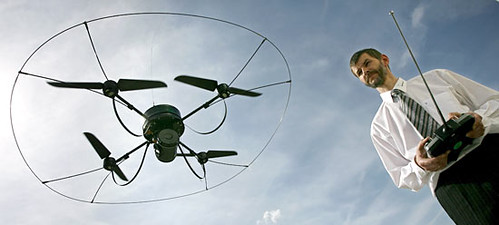
This and others like it are on exhibit as I write this, at ELROB — the European Land-Robotic Fair, in Hammelbert Germany. I guess Europe is not to be outdone by DARPA.
Posted
May 18th, 2006 in Front Page
|
No Comments »
Quick. What’s the best part about a rocket launch, any rocket launch? If you ask me, it’s seeing something like this.

Right? So, would someone please explain to me what’s the point of a smokeless rocket launch?
James Woodward, a history professor at California State University in Fullerton, presented his research into Mach-Lorentz thrusters Wednesday at the Future in Review conference here. Mach-Lorentz thrusters (MLTs), assuming they can be scaled up from lab tests, could provide a new source of propulsion that "puts out thrust without blowing stuff out the tailpipe," Woodward said.
MLTs are based on Mach’s principle, which suggests that all particles in the universe have an effect on each other, and the work of Hendrik Lorentz, who conducted research into the movement of charged particles in a magnetic field. Woodward has constructed an engine that takes advantage of the fact that objects produce energy when their mass changes slightly, he said.
Woodward used capacitors to change the mass of an object and then applied a current to that mass. That produces a small amount of thrust. Increasing the voltage and frequency of the current increases the strength of the thrust, to the point where the engine could be used to adjust the orbit of a satellite, or push a rocket into space.
Is there a downside to "blowing stuff out the tailpipe"? Is there an upside to not doing so?
Posted
May 18th, 2006 in Around the Blogs
|
No Comments »
You might have thought, after the demise of Napter and the ensuing deluge of RIAA lawsuits, that satellite radio was a pretty safe bet. After all, you’re not so much downloading music as you are catching it as it falls from the sky. Kinda like collecting rainwater. As consumer, you’d be right. You’re relatively safe, for now. It’s the providers that could be in trouble, as XM radio learned upon getting sued by RIAA.

The recording industry on Tuesday sued XM Satellite Radio Holdings Inc. (Nasdaq:XMSR – news), alleging its Inno device that can store music infringes on copyrights and transforms a passive radio experience into the equivalent of a digital download service like iTunes.
The suit accuses XM Satellite of “massive wholesale infringement,” and seeks $150,000 in damages for every song copied by XM customers using the devices, which went on sale earlier this month. XM, with more than 6.5 million subscribers, said it plays 160,000 different songs every month.
…
“…Because XM makes available vast catalogues of music in every genre, XM subscribers will have little need ever again to buy legitimate copies of plaintiffs’ sound recordings,” the lawsuit says referring to the hand held “Inno” device.
The suit says that XM has touted its service’s advantages over the iPod and cites XM’s advertising literature that says “It’s not a Pod. It’s the mothership.”
At $150,000 a pop, you’d better be careful what you beam down from “the mothership.” But, as the guys over at Gizmodo suggest, you might want to get yourself an Inno before they disappear forever. (Though the folks at XM say the lawsuit is just a negotiating tactic.)
In slightly related news, if you’re a Sirius Radio subscriber you’ll can listen to Bad Astrology blogger Phil Plait on Discovery Channel Radio at 9:00pm EST. He’ll be talking about the likelihood of Earth having a run in with a comet sometime next week…
Posted
May 17th, 2006 in Astronomy, Observation, Rockets & Launches
|
No Comments »
Ever lose your mobile phone, never to see it again? Well, what if it could find it’s way back to you? Or what if it could at least come when you called it? (Assuming, of course, that you’ve given it a name.) Sounds a little crazy, but having lost a few phones myself, that’s the first thing that came to mind when I heard about WiMo; the Windows Mobile Robot.
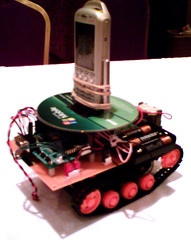 WiMo uses a Windows Mobile 5.0 Smartphone as the central "brain" of the robot. This Smartphone sits directly ontop of a Windows Mobile SDK cd (I did say i was using the SDK in a fun and unique way). The Smartphone communicates to a microcontroller via Bluetooth, using our Managed Bluetooth classes and also communicates with a Pocket PC (and soon to be desktop pc instead) via WiFi. The Pocket PC can be used to remotely control WiMo. The action pad of the Pocket PC is used for standard movement (up, down, left, right, stop).
… WiMo is learning to make conversation and respond to voice commands via some new prototype APIs in Voice Command. These APIs are not available yet, but we are looking to make them available in the future. WiMo can respond to his name, tell jokes if asked, and even dance!
OK. So your phone would have to be a Windows Mobile Smartphone and find its way into that contraption before it it could find its way home. But the idea’s gotta start somewhere, right?
Seeing as how GPS can be used to track just about everything and everyone, and how easy it it to find anyone who has a mobile phone, why not a phone that kind find it’s way home? If my cat can do it, so should my phone someday.
Via Robot Gossip.
Posted
May 17th, 2006 in Front Page, Rockets & Launches
|
No Comments »
This past March, the EU issued a report on the urgent need for broadband connectivity throughout Europe. A new project announced on May 15th is designed to bring high-quality broadband service in less developed areas to address this demand with the HYLAS satellite.
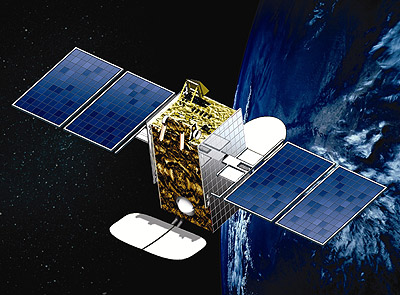
For Giuseppe Viriglio, Director of European Union and Industry Programmes for the European Space Agency, “HYLAS will play an important role in demonstrating the advanced technological capabilities of European space companies which are truly competitive on a global scale. It also makes significant progress in solving the social problem of poor broadband coverage in many parts of Europe and serves as a template for future large scale projects ".
Responding to the i2010 initiative, the satellite will use Ka-band for broadband data communications and Ku-band for HDTV broadcasting. Considering the report does not include new EU Member States added in 2004 (Czech Republic, Estonia, Hungary, Latvia, Lithuania, Malta, Poland, Slovakia and Slovenia), space-based broadband connectivity will play a key role in less-developed and rural communities around the world.
How appropriate as Wednesday is the first World Information Society Day.
Posted
May 16th, 2006 in Astronomy, Observation, Rockets & Launches
|
No Comments »
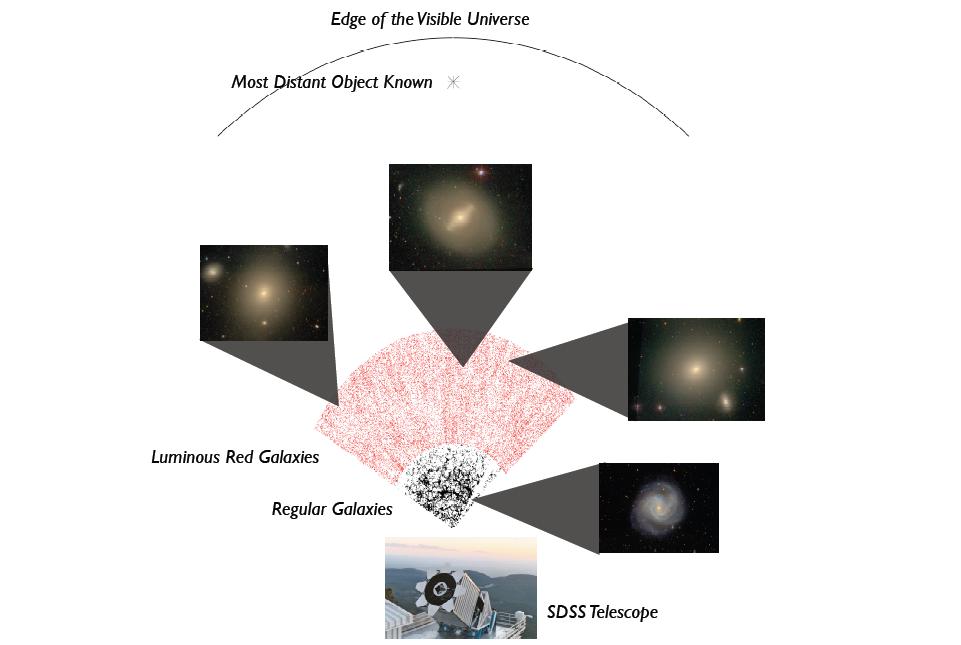
Astronomers have released the largest-ever atlas of the cosmos — and it’s coming soon to the world wide web.
The Royal Astronomical Society reports:
Traditionally, astronomers have needed to take a "spectrum" of each galaxy to determine [the distance between galaxies], splitting its light into many components to reveal sharp features with which to measure the amount of redshifting. This requires a time-consuming, individual observation of each galaxy.
The new cosmic map has been constructed using a novel technique focusing on a special class of galaxy whose intrinsic colour is very well known. For these ‘Luminous Red Galaxies’ researchers can measure the amount of colour distortion, and hence the approximate distance of the galaxy, just by looking at digital images of the sky, without the need to obtain a full spectrum.

What is most striking is that the new study and atlas have revealed that "the ordinary matter our bodies are made of and that we experience in everyday life only accounts for a few percent of the total cosmic budget:"
Our Universe contains billions of galaxies of all shapes and sizes. In recent years astronomers have used increasingly large surveys to map out the positions of these galaxies, stepping their way out into the Cosmos.
The new cosmic map unveiled today is the largest to date —
a three-dimensional atlas of over a million galaxies spread over a distance of more than 5 billion light years. The findings confirm that we live in a Universe filled with mysterious
dark matter and
dark energy.
"We have analyzed the patterns in this map and discovered waves of structure over a billion light years across," said Dr. Chris Blake of the University of British Columbia, principal author of the study. "These waves were generated billions of years ago and have been vastly stretched in size by the expanding Universe."
The full findings of the report can be found
here.
Posted
May 16th, 2006 in Observation, Satellite TV, Space Tourism
|
No Comments »
I wouldn’t change your plans yet (though you might want to get busy practicing the Ameriroids game), but Michael Cabbage at the Orlando Sentinel reports on the progress of NASA’s program to identify asteroids that cross the earth’s orbit — and takes a look at the odds of a an asteroid striking the earth in the coming decades:
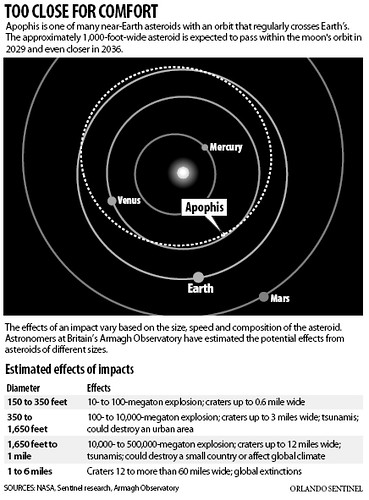
Mark your calendar for Sunday, April 13, 2036. That’s when a 1,000-foot-wide asteroid named Apophis could hit the Earth with enough force to obliterate a small state.
The odds of a collision are 1-in-6,250. But while that’s a long shot at the racetrack, the stakes are too high for astronomers to ignore.
For now, Apophis represents the most imminent threat from the worst type of natural disaster known, one reason NASA is spending millions to detect the threat from this and other asteroids….
Objects this size are thought to hit Earth about once every 1,000 years, and, according to recent estimates, the risk of dying from a renegade space rock is comparable to the hazards posed by tornadoes and snakebites. Those kind of statistics have moved the once-far-fetched topic of killer asteroids from Hollywood movie sets to the halls of Congress.
"Certainly we had a major credibility problem at the beginning — a giggle factor," said David Morrison, an astrobiologist at NASA’s Ames Research Center in Mountain View, Calif. "Now, many people are aware this is something we can actually deal with, mitigate and defend against."
In 1998, lawmakers formally directed NASA to identify by 2008 at least 90 percent of the asteroids more than a kilometer (0.6 mile) wide that orbit the sun and periodically cross Earth’s path. That search is now more than three-quarters complete.
Last year, Congress directed the space agency to come up with options for deflecting potential threats. Ideas seriously discussed include lasers on the moon, futuristic "gravity tractors," spacecraft that ram incoming objects and Hollywood’s old standby, nuclear weapons.
To help explore possible alternatives, former Apollo astronaut Rusty Schweickart has formed the B612 Foundation. The organization’s goal is to be able to significantly alter the orbit of an asteroid in a controlled manner by 2015.
For those so inclined, more things to worry about can be found on the NASA Near Earth Object Program website.
Bloggers Blog also has a roundup of other posts on Apophis fron around the blogosphere.
Posted
May 15th, 2006 in Business Network
|
No Comments »
Is this a case of "turnabout is fair play" or what? I blogged earlier about some California counties using GPS to track gang members after they’re released from prison. Well, this morning I opened my hometown paper (OK, I "opened" it in my web browser) to learn that in my neck of the woods thieves are tracking GPS units, and have started making off with them instead of expensive car stereos.
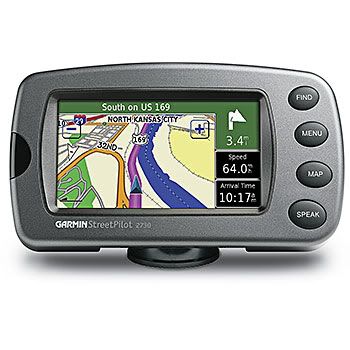 More than 50 dashboard-mounted Global Positioning System receivers have been stolen from parked cars in Alexandria and Arlington County since January, and police are urging motorists to hide the units, which range in price from $200 to nearly $3,000.
"It’s basically like leaving $700 in cash on the dashboard and asking someone to take it," said Mary Garrand, crime analyst for the Alexandria Police Department, who has noted about 25 stolen devices this year, mostly from Old Town.
Apparently increased demand for these gadgets among car owners has created increased demand among an unexpected demographic. Of course, if you leave your car unlocked or — as in one case — leave the top down, with your GPS unit attached to the dashboard with a piece of adhesive, you might expect to be relieved of it eventually.
[Detective Damon] Washington, one of several detectives who recently canvassed the hardest-hit areas in Arlington in search of suspects, said it comes down to this: "Don’t leave anything in your car that you’re not willing to lose."
It wasn’t long ago that car stereos started coming with removable faces, to ward off would-be thieves. Most GPS units — the dashboard variety, at least — are removable. So take it with you, or you might not be able to find it later.
If they ever catch the folks who’re heisting these GPS units, once they’re convicted and have served their sentences, I think they should be tracked via GPS upon their release. And nabbed if they come anywhere near a major parking lot. That’d be poetic justice. Dontcha think?
Posted
May 13th, 2006 in Space Business
|
No Comments »
Are rockets déclassé when it comes to launching stuff into space?
Well, not really. Nothing can quite compare to the countdown to launch and the rumble as the rocket lifts off from the pad.
But in the future, rockets might not be the only way of lifting things into the Clarke Orbit and beyond.
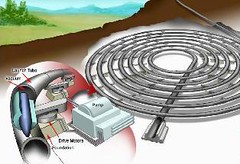
We’ve written before about the space elevator; the picture above depicts another method being explored by scientists and engineers — a giant slingshot:
What if we could throw something so hard, it would wind up in space? At NASA’s behest, Ed Schmidt and Mark Bundy of the Army Research Lab are looking at ways of firing projectiles into orbit.
The notion has a very long pedigree. Back in 1687 when Isaac Newton first came up with the theory of gravity he also introduced the concept of an orbital cannon which could fire a cannonball so fast that it would never come down. The first serious attempt to shoot into space was the High Altitude Research Program (HARP) carried out in the US in the 60’s…. HARP used a modified 16-inch naval gun to loft projectiles to the incredible altitude of 112 miles before being cancelled in 1967.
The ARL study looks at more sophisticated approaches than your basic cannon, including a blast wave accelerator, and electro-magnetic rail gun, and an EM coil gun. But the wildest idea may be the Slingatron: a giant, hypervelocity, rapid-fire slingshot. The machine would spin a projectile faster and faster through a spiral-shaped tube, building up increasing amounts of centripetal force along the way – just like a discus-thrower, spinning himself around before a toss, or like a latter-day King David, winding up his weapon before he whacks Goliath.
Personally, we think slingshots are dangerous– you could poke out your brother’s eye, as Mom used to warn– but cannons look pretty cool:
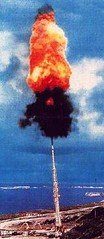
And engineers for a relaunched HARP project could easily be found in the autumn in Montana, at the Annual World Championship Punkin Chunkin.
Then again, slingin’ a punkin would be pretty cool, too.
Posted
May 12th, 2006 in Around the Blogs, Navigation/GPS
|
1 Comment »