Enhanced by MobTV Technology

In writing about the whole mobTV phenomenon, I’ve been wondering about something that I haven’t asked about until now. Just how does one enjoy watching video on such a tiny screen? I mean, I haven’t measured them, but the screens on even the best phones seem rather small for any serious or enjoyable viewing; definitely not for watching full length programs.

As usual, I should have known someone would be way ahead of me on this. Enter video glasses for mobile TV

Kowon Technology, a South Korean venture start-up, Wednesday announced it plans to introduce an eye-glass type display _ dubbed MSP-209 – in the local market next week at 199,000 won.

The product is equipped with a pair of liquid crystal display (LCD) screens, roughly the size of a human pupil _ 4.2 millimeters by 4.8 millimeters _ in both lenses.

“Weighing just 2 grams each, this micro LCD would be the world’s smallest and lightest screen available. The weight of the video glasses would be also fine at 58 grams,” Kowon vice president Park Hong-tae said.

Park continued Kowon did not compromise the all-important visual quality to minimize the display size because the miniature screen features programs at 320X240 pixels resolution, similar to that of digital multimedia broadcasting (DMB).

They’re also being called "anti-glance" glasses, because you can watch your video without worrying about your fellow commuters or other neighbors peeking over your shoulder. And it’s supposed to be like watching a 32 in. television screen about two yards away. So, it’s like watching television in your living room, but from anywhere. And you also get to look as though you’ve been "enhanced by Borg technology." Not bad for the equivalent cost of $216 in U.S. dollar. 

Via MobileMentalism.Com.

YouTube Goes Mobile

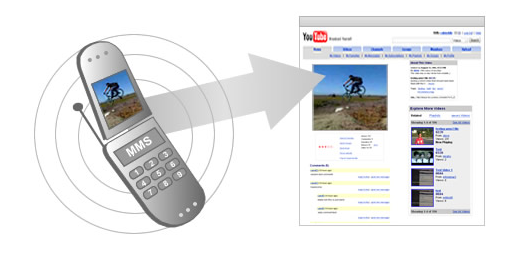
Here’s something interesting in mobile news. YouTube has just started offering a mobile upload option

A growing number of handheld devices are capable of recording video. YouTube wants to disconnect users from their Web cams and computers, said Steve Chen, one of the company’s founders and its chief technology officer.

Most user-created clips are taken with Web and digital video cameras, Chen said. The new service will likely produce greater numbers of spontaneous and candid clips.

"The good thing about it is that you don’t have to go home to YouTube anymore," Chen said. "People may not carry their digital cameras with them when they go out. But everybody carries their cell phone…I’m interested in seeing what kind of content this will produce." 

I’ve had a YouTube account since they launched, but I haven’t figured out what to do with it, because the only video camera I own is the one in my mobile phone. I haven’t found much of a reason to use that feature on my phone either. Actually, I have a PDA that shoots video as well, but haven’t had a reason to use the PDA in ages. Until now, that is. 

So, I’ve created a mobile profile on my YouTube account, and plugged in PDA so it can recharge. Now all I need is a reason to shoot video. 

And while you’re at it, YouTube, how about a way for me to view videos on my mobile phone? I mean, Tivo just inked a deal to deliver web-based video to my living room. Can somebody do the same thing for my phone?

Via Blogspotting

Ever-1 for Everyone?

While we’re on the subject of robots, have you noticed they’re becoming more and more human all the time? This one — developed in Korea — is only the second android ever made, and though she can’t move from the waist down she comes in handy in some situations.

Korea has developed its own android capable of facial expressions on its humanoid face, the second such machine to be developed after one from Japan.

… Ever-1 can move its upper body and “express” happiness, anger, sadness and pleasure. But the robot is still incapable of moving its lower half. Ever-1’s skin is made from a silicon jelly that feels similar to human skin. The face is a composite of two stars, and its torso on a singer.

The 15 monitors in the robotic face allow it to interpret the face of an interlocutor and look back at whoever stands near it. Ever-1 also recognizes 400 words and can hold a basic verbal exchange.

According to the article, Ever-1 (Eve R-1. Get it?) could earn her keep by giving directions in department stores and read stories to children. On that last one, if you asked me, I’d bet that the kids (a) won’t be fooled by Ever-1, and might even be frightened.

But I just might lose that bet. Robot Dreams has a post up about a new robot from NEC that’s also designed to designed to interact with people, and is pictured with some happy looking kids.

Oh well. If I’m right, Ever-1 might be able to get work piloting tentacled flying robots.
 

Attack of the Flying Tentacled Robots

Call me crazy, but if the folks who came up with flying robots got together with the people who’ve invented tentacled robots, they could potentially take over the world. Or at the very least have a pretty interesting sci-fi flick on their hands.

Robotic "tentacles" that can grasp and grapple with a wide variety of objects have been developed by US researchers.

Most robots rely on mechanical gripping jaws that have difficulty grabbing large or irregularly shaped objects. Replacing these with tentacle-like manipulators could make robots more nimble and flexible, say the scientists.

The tentacle-like manipulators, known as "Octarms", resemble an octopus’s limb or an elephant’s trunk. They were developed through a project called OCTOR (sOft robotiC manipulaTORs), which involves several US universities and is funded by the US Defense Advanced Research Projects Agency (DARPA).

"An elephant’s trunk can pick up a peanut or a tree trunk," says Ian Walker, a member of the project team from Clemson University in South Carolina. "This ability, inherent in the OCTOR robots, gives OCTOR arms a huge advantage over conventional industrial robots." 

Would it be a case of science fact catching up wth science fiction? 

Maybe. Just maybe.

But the question remains, once we have tentacled flying robots … what do we do with them?

Cellular Love Detector

It’s an idea I’ve had knocking around in my head for a while, or at least since I started writing for this blog. And it may be an idea whose time has come. But given my somewhat limited technological abilities, someone else is gonna have to make it happen.

While pondering the various ways technology might be employed to improve the life of the everyday man or woman on the street, it occurred to me that while exploring the various uses for mobile technologies affairs of the heart were being overlooked. Since scores of people carry mobile phones these days, that allow them to do everything from playing their favorite music via satellite radio to watching their favorite shows, it seems like a no-brainer to use the same technology to track down potential candidates for significant-other status. If I thought of it, surely someone out there with greater technical acumen than me has thought of it and tried to make it a reality. 

Enter the Cellular Love Detector.  It works like this: dial the access number, the number of your latest crush, and talk as you would normally do while the Love Detector does it’s magic and spits out a report. 

Using the Love-Detector Cell Service is as simple as dialing the access number, and your friend’s phone number right after… Once the conversation starts, all you need to do is have a NORMAL conversation. Speak about work, homework, movies or any other thing. …

During the call, our server will monitor the excitement levels and other related parameters your friend is demonstrating, and will calculate the "Love-Level" as detected in the conversation. Once the conversation has ended, the final report will be sent to your cellular phone using SMS or audio message! The final report is not only about the "Love-Level", and includes other parameters, like "Concentration", "Embarrassment" and even "Anticipation".

Sounds like an interesting idea, and one that may be useful to folks who are impaired when it comes to detecting mutual admiration. But I don’t think it goes far enough. 

Look, we already know how easy it is to track someone down using various technologies. We can use GPS to track down lost pets and roving gang members. We can use GPS and cell phones to track down wandering teenagers. And I just read that it’s pretty easy to track anybody who’s carrying a cell phone, whether they make calls or not. 

Most people know that when they make a mobile call—during a 911 emergency, for example—authorities can access phone company technology to pin down their location, sometimes to within a few feet.

A lesser-known fact: Cell phone companies can locate you any time you are in range of a tower and your phone is on. Cell phones are designed to work either with global positioning satellites or through “pings” that allow towers to triangulate and pinpoint signals. Any time your phone “sees” a tower, it pings it.

Here’s a more straightforward explanation

Real-time tracking of cell phones is possible because mobile phones are constantly sending data to cell towers, which allows incoming calls to be routed correctly. The towers record the strength of the signal along with the side of the tower the signal is coming from. This allows the phone’s position to be easily triangulated to within a few hundred yards.

The technology is already within reach of consumers. You can sign up for services like AccuTracking, World Tracker, or ULocate. For that matter you can build your own. So, the genie is out of the bottle and unlikely to go back in. 

Why not put it all together in the service of matchmaking? The Google Earth Blog had the same premonition I did, upon hearing news of at least one dating service letting customers use Google Earth to locate prospective dates.

It can only be a matter of time before other dating services implement a Google Earth interface for showing approximate locations for prospective dates. It would be a smart move in my opinion and not too difficult to implement technically.

Exactly. At least one dating service already uses GPS to alert customers to potential dates in their vicinity, if the prospective date is on the customer’s "hotlist." Another popular online dating service was considering a similar move earlier this year. Even the practice of "toothing" — meeting potential dates via Bluetooth-enabled mobile phones — started as a hoax and blossomed into reality. 

So, I guess my idea isn’t all that far fetched, but would just take things one step further. Here’s how it would work, at least as I imagine it. You register with the service, and fill out a profile indicating your interests, the type of person you’re seeking, etc. You don’t have to do much more than that to start getting matches, except to indicate that you’d like to be "trackable" via your mobile phone.

Then some computer in some warehouse in the middle of nowhere runs through it’s database to find potential matches that are also "trackable." When you’re out and about with your phone, you’d get a message from the service when there’s a good match in your vicinity, with a link to their profile. At that point, you’d be asked to decide whether you want to make contact or not. At the same time, your potential match would see the same message with your profile and the option to make contact.

You and your match would get, say, three contact options. First, chatting via SMS or a chat client. Second, talking via mobile phone (with numbers masked, of course). And finally, if you’ve opted to have your location tracked and chosen to make contact and your match has done the same, you could get one another’s approximate location via GPS, and meet in person.

I haven’t seen anything quite like that available, but if I did and I were single I’d sing up for it. With all that technology at your disposal, who needs Cupid?

U.S., India Team Up for the Moon

"Indian and U.S. space agencies Tuesday signed an agreement to put two U.S.-made scientific instruments on board of Chandrayaan-I, India’s first unmanned moon explorer, in 2008, Indo-Asian News Service reported:

NASA will put one mini synthetic aperture radar (Mini SAR) and moon mineralogy mapper (M3) on board of Chandrayaan-I, according to the agreement.

"The objective of SAR is to detect water in the permanently shadowed areas of lunar polar regions, while M3 will map the minerals on the lunar surface and study its characterization," [Indian Space Research Organization (ISRO) chairperson G. Madhavan] Nair said.

Chandrayaan-I will be launched from the Satish Dhawan Space Centre (SDSC) at Sriharikota in southeast India’s Andhra Pradesh, by an advanced polar satellite launch vehicle (PSLV), into a 240-24,000 km earth orbit and placed subsequently in a 100-km polar orbit around the moon, with its own propulsion system.


Unstoppable Flying Robots

What’s that in the sky? A bird? A plane? No, it’s a flying robot. An unstoppable flying robot, according to some experts. 

The technology for remote-controlled light aircraft is now highly advanced, widely available — and, experts say, virtually unstoppable.

Models with a wingspan of five metres (16 feet), capable of carrying up to 50 kilograms (110 pounds), remain undetectable by radar.

And thanks to satellite positioning systems, they can now be programmed to hit targets some distance away with just a few metres (yards) short of pinpoint accuracy.

Security services the world over have been considering the problem for several years, but no one has yet come up with a solution.

The article quotes a number of experts who suggest flying robots may be a security threat, includes a photo of the U.S.-built "Predator" unmanned aerial vehicle, and cites development of similar technology in other countries. 

But the discussion in the blogosphere is tinged with doubt. Over on Dvorak Uncensored, at least one commenter rattles off a laundry list of pitfalls between having the technology and making it work, including everything from getting a decent engine to finding an open channel. Meanwhile, Bruce Scheiner pegs the article as tipping the" movie-threat hype meter." 

On the other hand the DefenseTech post mentioned in the article ends with the statement "How great the threat is this time remains to be seen."

Geocaching Hits Yosemite

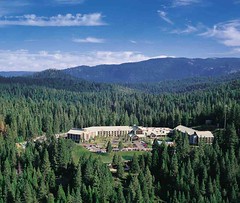
The popularity of geocaching– a high-tech scavenger hunt conducted using handheld GPS units– is not likely to be a surprise to readers of the Really Rocket Science blog. But the AP has an interesting report on how a lodge in Yosemite National Park is capitalizing on the sports’ popularity to bring visitors to its luxurious surroundings:


 [T]he Tenaya Lodge, just outside Yosemite National Park near Wawona, began offering a geocaching program along with its nature hikes and horseback riding outings last year….

Built 15 years ago and renovated recently, the 244-room Tenaya Lodge is the grandest of Yosemite’s perimeter "gateway" hotels catering to the park’s overflow and visitors who prefer to put a little distance between themselves and Yosemite Valley’s bustle….

Essentially, the sport is a cross between orienteering and a treasure hunt using high-tech navigation. Someone hides a "cache" – typically a plastic or metal bucket with a lid – with a logbook and some goodies in it and publishes the precise latitude and longitude on the Web. The goal is to dial those coordinates into your handheld GPS unit and have it lead you to the stash.

Since the sport began in 2000, it has grown exponentially. According to Geocaching.com, there are currently 202,735 caches in 218 countries…..

When I switched on the unit, it locked onto four satellites in geostationary orbit – meaning they appear to hover over one point on the globe – and spat out our elevation (5,288 feet) and our exact location (37 degrees, 26.402 minutes by 119 degrees, 36.237 minutes.) Depending on how well it linked up with the satellites, it was accurate to anywhere from 25 to 100 feet. With various "waypoints" pre-programmed, the GPS unit directed my wife, Jeri, and me down a series of increasingly rough dirt roads – the last was four-wheel-drive territory _ and beeped to alert me at various junctions. Or at least it was supposed to. The hotel is still working the kinks out of the system.

Read the full report on the author’s geocaching adventure in Yosemite here.


GPS for Gangs

It works for finding lost pets and kids out past curfew, so it makes perfect sense to use GPS in fighting crime. I’ll be interested to see how California’s plan to track gang members using GPS works out.

 Under an arrangement between prison officials and San Bernardino, high-risk parolees known to belong to street gangs will be released from custody on the condition that they wear a GPS bracelet on their ankles at all times.

They appear as moving dots on a map and if they try to remove the anklet or enter unauthorized areas the device sends an alert to a base station monitored by law enforcement officials. 

I suppose it’s nothing new. According to the article, it’s already used by some California counties to monitor sex offenders. But when you combine that story with the ability to track wandering teenagers (or spouses) via GPS, it starts to sound like an episode of Wild Kingdom. It’s just that the tag is on a tasteful bracelet instead of being fastened to an ear. 

One question arises in my mind, however. How secure is this tracking system? In the cases of people who might be subject to retaliation or other attacks if identified — like sex offenders and gang memvers — how easy would it be for someone with enough technical knowledge, and an intent to do harm, to hone in on their tracking device and  locate them?

Super Space Computing = Chess Tourney


I’m impressed.  Really impressed.  I think this calls for the first space-based human vs. computer chess tournament. Any takers? Check out what our fine computer scientists and mechanical engineers at Los Alamost National Laboratory are cooking up for us: 

Los Alamos National Laboratory has announced funding of a new space payload which dramatically increases on-orbit computational capabilities. The project is jointly sponsored by the National Nuclear Security Administration’s (NNSA) Office of Nonproliferation Research and Development (NA-22), and the U.S. Department of Defense.

The experimental payload will demonstrate and validate technologies offering more than 1,000 Giga Operations-per-second (GOps) processing capability for Software-Defined Radio (SDR) functions in space. SDR is a technology of interest to the military to support tactical communications and to commercial television and radio broadcasting. The payload computer’s signal-processing capability of 1,000 GOps is approximately the same as supercomputers of the last decade, which occupied 50,000 cubic feet and used 50 kW of power. This new payload, by contrast, is designed to weigh 40 pounds and consume only 80 watts, a performance which is enabled by state-of-the-art, 90-nanometer Virtex-4 silicon-chip technology from Xilinx, Inc.