DIY Friday: Crayons taking flight

It’s not everyday you get to launch a Crayon. Trailer Trash Aerospace (what a name…) gives us the lowdown on how they made this happen:

The crayon came from our "need" for a cheep 4" rocket to test our 54 mm motors, at $6 for the airframe and nose cone the cheep part is covered! It has proven to be very sturdy by landing several times with the laundry still safely tucked in the airframe! The drawback is due to the plastic tail cone, they are somewhat labor intensive to build. Only a couple of pictures were taken of the build, when we make an another one we will shoot more!


So what would you call it if you get all the colors in a Crayola box up in the air at the same time? 


RF Delusions Now Online

Doug Lung presented his paper RF Delusions Saturday afternoon at the NAB2006 Conference (which we covered here) and has now posted the presentation online for those who missed it:

The presentation addresses common "delusions" concerning broadcast coverage, interference and RF safety. The major focus is coverage. One example illustrates that using data from the azimuth patterns in the FCC CDBS and the standard elevation patterns from OET-69 may lead to significantly different results from those obtained by using the actual antenna azimuth and elevation patterns. (These would include the actual electrical and mechanical beam tilt.) This is one of the more extreme cases and limitations on time and computer resources would make it difficult, if not impossible, for the FCC to study all U.S. TV stations using their actual 3D antenna patterns.

Most interference studies conducted using the FCC software (available on its Web site) with its inherent simplifications and methodology for calculating the depression angle will not show such an extreme difference in signal levels. Ironically, errors are likely to be greater when azimuth and elevation patterns from the FCC antenna database and OET-69 are used instead of actual antenna patterns for studies conducted with third party coverage and interference software that accurately calculates the depression angle. Directional antenna azimuth and elevation patterns should be included with recent TV construction permit applications, but they have to be extracted individually from exhibits attached to the application.

Audio copies of the presentation are also available at NABStore.com.

Fermi’s Paradox: Why We Haven’t Met Any Aliens

Seed Magazine takes a look at Fermi’s Paradox:

Sometime in the 1940s, Enrico Fermi was talking about the possibility of extra-terrestrial intelligence with some other physicists. They were impressed that life had evolved quickly and progressively on Earth. They figured our galaxy holds about 100 billion stars, and that an intelligent, exponentially-reproducing species could colonize the galaxy in just a few million years. They reasoned that extra-terrestrial intelligence should be common by now. Fermi listened patiently, then asked, simply, "So, where is everybody?" That is, if extra-terrestrial intelligence is common, why haven’t we met any bright aliens yet? This conundrum became known as Fermi’s Paradox.

"The Paradox has become even more baffling" in the past 60 years, as the technology to conduct the search for intelligence has improved dramatically with no results, according to the article’s author, Professor Geoffrey Miller of the University of New Mexico. Miller posits a radical hypothesis:

I suggest a different, even darker solution to the Paradox. Basically, I think the aliens don’t blow themselves up; they just get addicted to computer games. They forget to send radio signals or colonize space because they’re too busy with runaway consumerism and virtual-reality narcissism. They don’t need Sentinels to enslave them in a Matrix; they do it to themselves, just as we are doing today. Once they turn inwards to chase their shiny pennies of pleasure, they lose the cosmic plot. They become like a self-stimulating rat, pressing a bar to deliver electricity to its brain’s ventral tegmental area, which stimulates its nucleus accumbens to release dopamine, which feels…ever so good.

It’s an interesting theory. Perhaps ET is too busy playing Pac Man (does that reveal I’m a Gen Xer or what?) to care about reaching out to explore our solar system. Zoning out takes precedence over homing in for alien species, says Miller:

This is the Great Temptation for any technological species—to shape their subjective reality to provide the cues of survival and reproductive success without the substance. Most bright alien species probably go extinct gradually, allocating more time and resources to their pleasures, and less to their children. They eventually die out when the game behind all games—the Game of Life—says "Game Over; you are out of lives and you forgot to reproduce."

 The full entertaining article can be found here

National Astronomy Day: “Bringing Astronomy to the People”

This Saturday, May 6th, is the 33rd Annual National Astronomy Day, and events are being held all around the country: 

Astronomy Day is a grass roots movement designed to share the joy of astronomy with the general population – "Bringing Astronomy to the People."  On Astronomy Day, celebrated this year on Saturday, May 6, thousands of people who have never looked through a telescope will have an opportunity to see first hand what has so many amateur and professional astronomers all excited.  Astronomy clubs, science museums, observatories, universities, planetariums, laboratories, libraries, and nature centers host special events and activities to acquaint their population with local astronomical resources and facilities.  Many of these events are located at non-astronomical sites; shopping malls, parks, urban centers-truly Bringing Astronomy to the People.  It is an astronomical event that helps highlight ways the general public can get involved with astronomy – or at least get some of their questions about astronomy answered.

Astronomy Magazine has a partial list of events around the country. If you know of events near you, please post them in the comment threads. 

More Robots

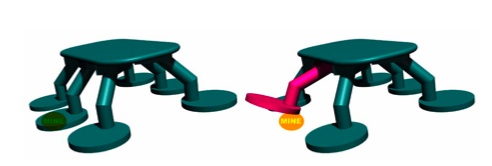
While we’re on the subject of robots, how’d you like to strap these to your feet and stroll through a minefield? 

That’s what developers at Singapore’s BioMedical Research Centre have in mind. But before you decide, you should know these shoes are designed to keep you from stepping on a landmine. There’s a research paper (in PDF format) about them, that has more technical lingo than I can decipher. Fortunately Robot Gossip has translated it all into laymen’s terms. 

The shoes have six short legs under each of your feet. The pods on each of the little legs has a metal detector. If one of the robot-shoe legs senses a trigger of a mine then it releases so that it can move up out of the way without setting off the mine. You would be supported by the other five legs on the shoe. When you step forward the leg locks in place again.

Also, everyone’s talking about Genibo — the robot dog that replaced AIBO — but there’s yet another robo-dog making the scene: the X-Cybie, which is an updated version of the iCybie. The X-Cybie is already available for order on Amazon, for $149, and will ship on May 4th. 

There aren’t any pictures the X-Cybie just yet, but word on the iCybie forum is that it’s basically the same as the iCybie (pictured below) except that this model has a fur coating that will come in a variety of colors. I can only imagine the fur would make the X-Cybie more fun to pet, but I can’t help wondering if it sheds. 


Another Robot Race

Last month I posted about the Great Robot Race. Well, the folks at DARPA at it again. Only this time robots will make their way through city streets, instead of the desert, during Grand Challenge

The Pentagon said Monday that a third Grand Challenge competition would be held to foster research and development into advanced robot vehicles.

In contrast to the previous contest, which took place in the desert on the border between California and Nevada, the new competition will be carried out in a mock urban area. Robots will be required to obey traffic laws while merging into traffic, as well as negotiating traffic circles, busy intersections and obstacles. The event is scheduled for Nov. 3, 2007.

First prize for successfully completing the 60-mile course in less than six hours will be $2 million. Second prize will be $500,000 and third prize is set at $250,000.

But if you want to participate, you’d better hurry. There’s already an Urban Challenge Participants Conference scheduled for May 20th, in Reston, Virginia. You can register at the Grand Challenge website. After that, you’ll have a bit more time (but not much), depending on which track you choose

DARPA also will make funding available for contenders before the finals, through two tracks:

  • Teams could submit detailed proposals for up to $1 million in technology development funds, with the government obtaining limited licensing rights to the resulting technologies. The selected teams would proceed to a semifinal known as the National Qualification Event.
  • Teams could participate in a series of qualifying tests, just as competitors did in the 2004 and 2005 DARPA Grand Challenges. The teams selected for the National Qualification Event would get $50,000, and the teams that are successful at that event will get $100,000 and a spot in the November 2007 finals.

Track A proposals are due on June 23rd, and Track B proposals on October 5th.

Science Mythbusting

Over on Newsvine, I came across an interesting post by someone who claims to be busting the myths about science, and found a couple of interesting items on the list.

Myth 2. The Great Wall of China is the only manmade structure visible from space

There are several variations on this folkloric statement, and they’re all quantifiably false. Astronauts can spot the Great Wall from low-Earth orbit, along with plenty of other things like the Giza pyramids and even airport runways. But they can’t see the Wall from the Moon. 

Myth 12. There is no gravity in space

Blame the term "zero-gravity" for this common misconception. Gravity is everywhere, even in space. Astronauts look weightless because they are in continuous freefall towards the Earth, staying aloft because of their horizontal motion. The effect of gravity diminishes with distance, but it never truly goes away. It is also untrue that space is a vacuum. There are all kinds of atoms out there, albeit sometimes far apart. 

I don’t know about the gravity question (any physicists out there?), but apparently our mythbuster is dead on about the Great Wall.

“You can see the Great Wall,” Lu says. But it’s less visible than a lot of other objects. And you have to know where to look.

In fact stretches of the wall aren’t even visible from China. They’ve been buried by sand for centuries. NASA has used space-based radar to map out hidden parts of the ancient structure. [Astronaut Ed] Lu is trying to get a picture of it, too, with a digital camera. 

I don’t know if Lu every got his picture, but I did track down the pictures NASA took with its "space-based radar." 

The mythbuster also takes on some common myths about asteroids.

New in Sunnyvale: A VW Jet Car Putting Out 1450 h.p.

A VW New Beetle with 1450 horsepower? Ya gotta see this video 

SF Chronicle’s Michael Taylor spent some time with the builder of this machine, Ron Patrick of Sunnyvale, California:

"You drive the car up to about 90 miles an hour and you spool up the jet, then hit it W.O.T. (wide-open throttle)," he said, fondly recalling one of his rides. "It’s one of the finest feelings you can have in your life. In the rear view mirror, all you see is light and hear the thunder of the jet. It’s like you’re going down the largest hill you’ve ever been on."


Jet cars aren’t new. This is how close the VW Bug and jet cars have come together, a Walt Arfons Jet Car driven by Paula Murphy (a.k.a. "the Flying Housewife" and "Miss STP") at Bonneville Salt Flats in 1963 (note the Bug in the background):

Drag racing VW Bugs aren’t just for Herbie any more. The VW Drag Racing Club cites one old Bug that can do a quarter-mile in 10.5 seconds @ 125 m.p.h. — and it’s driven to and from the track!


Weather Satellites Launch After Weather Delays

Seventh time’s the charm, right?


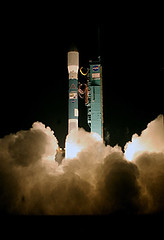
After six tries over eight days, NASA launched a Delta 2 rocket Friday and a pair of satellites that will give planet Earth its newest health checkup by examining the secrets of clouds.

The 12-story-tall rocket built by Boeing rumbled off Space Launch Complex-2 at 3:02 a.m. into foggy skies at Vandenberg Air Force Base.

The approximately $515 million mission placed two satellites into orbit: CloudSat and CALIPSO (Cloud-Aerosol Lidar and Infrared Pathfinder Satellite Observations). About 90 minutes later, officials confirmed that the satellites had arrived in space.

“With the successful launch of CloudSat and CALIPSO we take a giant step forward in our ability to study the global atmosphere," said David Winker, CALIPSO principal investigator from NASA’s Langley Research Center, Va. "In the years to come, we expect these missions to spark many new insights into the workings of Earth’s climate and improve our abilities to forecast weather and predict climate change."

 We wrote about the launch in anticipation on the 20th of April; Rocco kept us updated in the comment threads ("CloudSat can’t launch because of clouds. Go figure."); but now the wait is over, and you can view Friday’s successful launch here.

DIY Friday: DIY Energy

A belated happy Earth Day to all. We went kinda "off the grid" last Friday, in honor of Earth Day, and thus found it somewhat difficult to get a DIY Friday post published. We had it all ready to go, but that whole smoke signals set up didn’t quite work. So, here’s our belated DIY Friday post, as the clock ticks down on Earth Day afterglow.

This first bit isn’t exactly a DIY project,  but having a solar generating briefcase last Friday — like the one we spotted on ProductDose recently —  might have helped get the DIY Friday post published. It’s handier than a gas generator, and so much less fossil fuel dependent. Besides, it generates more than enough electricity to power a laptop, so we could have charged up the iPod while we were at it. 

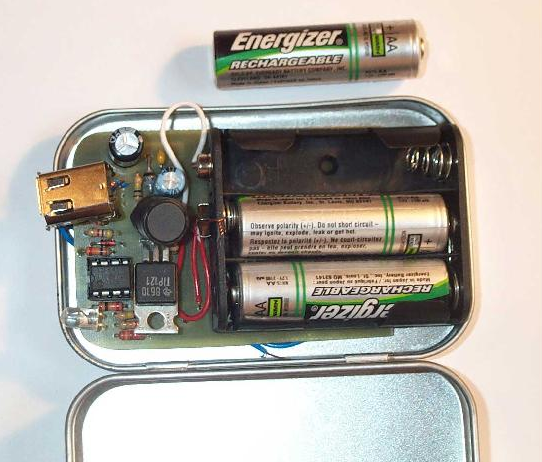
Speaking of iPods, this Altoid tin hacked into an iPod charger sounds like a good idea, if only the inventors could get it working. They cite a couple of reasons why it doesn’t, which I’ll post here in hopes that someone will be able to help them out. 
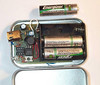
There are (at least) two reasons this charger _does not_ work:

1. The transistor doesn’t let enough current flow to fully charge the inductor.  The other option is a FET, but a FET needs a minimum of 5 volts to switch fully on. This is discussed in the SMPS section.

2. The inductor is simply not big enough. The charger doesn’t produce nearly enough current for the iPod.  We didn’t have an accurate way to measure the iPod charging current (save cutting apart the origional charging cable) until our parts arrived from Mouser.  The inductors recommended are nowhere near large enough for this project.  A suitable substitution might be the coil Nick de Smith uses on his MAX1771 SMPS.  Its a 2 or 3 amp coil from digikey:

[ http://www.desmith.net/NMdS/Electronics/NixiePSU.html#bom ]

This device can provide a small amount of power to a USB or firewire device, but not enough to charge an (3G) iPod.  It WILL power, but not charge, a totally dead 3G iPod.

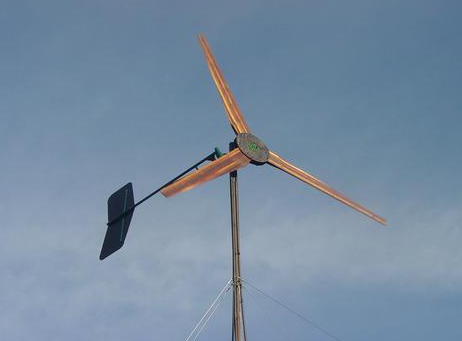
Meanwhile, as long as we’re on the subject of power, this homebrew wind turbine sounds like a pretty good idea. I don’t know how much power it generates, but I bet it will power a laptop and an iPod (probably) as the builder says he’s seen "3800 watts from it in a high wind." I’m not sure how much power that is, but he says he’s a bit more than he can use. 

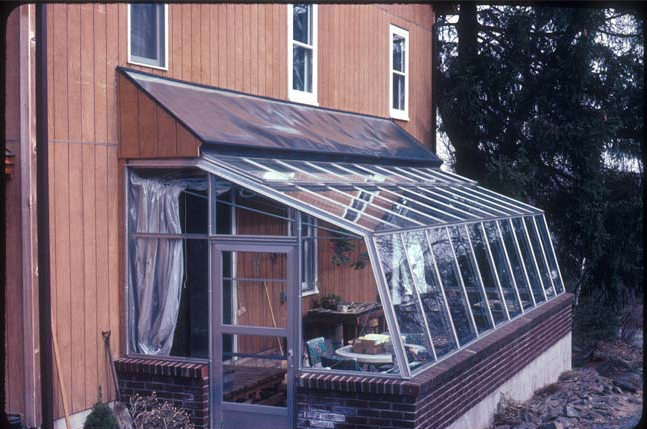
The guy who made the wind turbine would probably do well to team up with the David Mears — a professor of Bioresource Engineering at Rutgers University —  who managed to hack his entire house into such an energy efficient mode, with adjustments including a woodstove and a solar enabled greenhouse (pictured above),  that he and his family went 25 years without getting a heating bill. That’s also 25 winters of not burning fossil fuels to heat the house.  That’s not just good for the pocket book, but good for the earth too. And that makes for a happy (though belated) Earth Day.