Asteroid 2005 YU55

A 400-meter wide Near-Earth asteroid will be cutting it close tomorrow. Will you be able to see it? Yes, but it won’t be easy.

Astro Guyz explains…

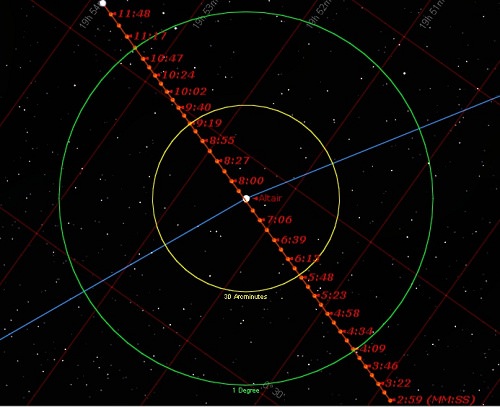
Closest approach to Earth occurs at 11:29 UTC/06:29 EST at about 202,000 miles distant, placing it high to the south west for observers on the US Eastern Seaboard. (Don’t forget to “fall back” to Standard time on Sunday, November 6th; you wouldn’t want to miss seeing the asteroid because of  an anachronistic convention, but I digress..)  At its closest approach, 2005 YU55 will glide along at one degree every 7 minutes, easily noticeable after a few minutes of observation at low power. I plan to target selected areas with my GOTO mount, sketch the field, then watch for changes. I may also take some wide-field piggyback stills with the DSLR, but mostly, this one will just be fun to watch. The asteroid will pass through the constellations Aquila, Delphinus, and Pegasus as it heads westward. Interestingly, 2005 YU55 passes within a degree of Altair centered on 6:07:30PM EST only 27 minutes after local sunset, and also makes a very close pass of the star Epsilon Delphini during closest approach. These both make good visual “anchors” to aim your scope at during the appointed time and watch. Keep in mind, the charts provided are rough and “Tampa Bay-centric…” on an approach as close as this one, two factors muddle the precise prediction coordinates of the asteroid; one is the fact the gravitational field of the Earth will change the orbit of 2005 YU55 slightly, and two is that the position will change due to the position of the observer on the Earth and the effect of parallactic shift. Many prediction programs assume the Earthly vantage as a mere point in space, fine for positioning deep sky objects but not so hot for ones passing near the planet. A good place to get updated coordinates is JPL Horizons website which lets you generate an accurate ephemeris for your exact longitude latitude and elevation.


Big Bang Monday: Super-energetic Millisecond Pulsar

I like pulsars and I love how our friends at NASA GSFC explain it — with animation.

An international team of scientists using NASA’s Fermi Gamma-ray Space Telescope has discovered a surprisingly powerful millisecond pulsar that challenges existing theories about how these objects form.

At the same time, another team has located nine new gamma-ray pulsars in Fermi data, using improved analytical techniques.

A pulsar is a type of neutron star that emits electromagnetic energy at periodic intervals. A neutron star is the closest thing to a black hole that astronomers can observe directly, crushing half a million times more mass than Earth into a sphere no larger than a city. This matter is so compressed that even a teaspoonful weighs as much as Mount Everest.

“With this new batch of pulsars, Fermi now has detected more than 100, which is an exciting milestone when you consider that, before Fermi’s launch in 2008, only seven of them were known to emit gamma rays,” said Pablo Saz Parkinson, an astrophysicist at the Santa Cruz Institute for Particle Physics at the University of California Santa Cruz, and a co-author on two papers detailing the findings.

One group of pulsars combines incredible density with extreme rotation. The fastest of these so-called millisecond pulsars whirls at 43,000 revolutions per minute.

Millisecond pulsars are thought to achieve such speeds because they are gravitationally bound in binary systems with normal stars. During part of their stellar lives, gas flows from the normal star to the pulsar. Over time, the impact of this falling gas gradually spins up the pulsar’s rotation.

The strong magnetic fields and rapid rotation of pulsars cause them to emit powerful beams of energy, from radio waves to gamma rays. Because the star is transferring rotational energy to the pulsar, the pulsar’s spin slows after this transfer is completed.

Typically, millisecond pulsars are around a billion years old. However, in the Nov. 3 issue of Science, the Fermi team reveals a bright, energetic millisecond pulsar only 25 million years old.

The object, named PSR J1823−3021A, lies within NGC 6624, a spherical collection of ancient stars called a globular cluster, one of about 160 similar objects that orbit our galaxy. The cluster is about 10 billion years old and lies about 27,000 light-years away toward the constellation Sagittarius.

Fermi’s Large Area Telescope (LAT) showed that eleven globular clusters emit gamma rays, the cumulative emission of dozens of millisecond pulsars too faint for even Fermi to detect individually. But that’s not the case for NGC 6624.

“It’s amazing that all of the gamma rays we see from this cluster are coming from a single object. It must have formed recently based on how rapidly it’s emitting energy. It’s a bit like finding a screaming baby in a quiet retirement home,” said Paulo Freire, the study’s lead author, at the Max Planck Institute for Radio Astronomy in Bonn, Germany.

J1823−3021A was previously identified as a pulsar by its radio emission, yet of the nine new pulsars, none are millisecond pulsars, and only one was later found to emit radio waves.

Despite its sensitivity, Fermi’s LAT may detect only one gamma ray for every 100,000 rotations of some of these faint pulsars. Yet new analysis techniques applied to the precise position and arrival time of photons collected by the LAT since 2008 were able to identify them.

“We adapted methods originally devised for studying gravitational waves to the problem of finding gamma-ray pulsars, and we were quickly rewarded,” said Bruce Allen, director of the Max Planck Institute for Gravitational Physics in Hannover, Germany. Allen co-authored a paper on the discoveries that was published online today in The Astrophysical Journal.

WBMSAT Satellite Industry News Bits 11/04/2011

Recently launched Eutelsat satellites Atlantic Bird 7 and W3C will  provide capacity to support growth in fast developing markets.
[Broadband TV News – 11/04/2011]

Astrium selected by DIRECTV to design and manufacture high power DIRECTV 15, with 30 Ku-, 24 Ka-, and 18 Reverse-band transponders.
[4-traders -11/04/2011]

Launch of NigComSat-1R on December 19 in China may be jeopardised unless  Nigerian Communications Satellite Limited comes up with N1.8 billion by November  5.
[This Day Live – 11/04/2011]

United Continental selects Panasonic Avionics to provide Wi-Fi connectivity  on more than 300 United Airlines and Continental Airlines mainline aircraft  beginning in 2012.
[Market Watch – 11/04/2011]

New House of Representatives legislation to reform U.S. satellite export  controls, removing satellites and related components from U.S. Munitions List,  gets strong endorsement from Satellite Industry Association.
[Satellite Today – 11/03/2011]

Chinese spacecraft successfully dock in orbit, moving China closer to manning  its own space station in about a decade.
[R&D Magazine – 11/03/2011]

ViaSat-1 reaches destined orbit following successful completion of all  maneuvers, to begin in-orbit testing.
SatNews –  11/03/2011]

Inmarsat subsidiaries Stratos Government Services and Segovia are awarded  Indefinite Delivery/Indefinite Quantity contract by DITCO for U.S. Navy Military  Sealift Command’s Next Generation Wideband commercial satellite communications  infrastructure and service.
[Sacramento Bee – 11/03/2011]

SES fleet extension program through 2014 to increase global capacity by 23%  over year-end 2010, with 85% of capacity dedicated to highly dynamic emerging  markets including Asia, Latin America, Middle East, and Africa; SES-7 and SES-8  represent $400 million program for South Asia and Asia-Pacific region.
[SatNews –  11/03/2011]

Spacecom satellite AMOS-5, to be launched December 11, is transported to  Baikonur Spaceport.
[SatNews – 11/03/2011]

Next Soyuz launch from Kourou, set for mid-December, to carry six satellites,  including Astrium Pleiades1 Very High Resolution Earth observation satellite,  Chilean satellite SSOT, and the four satellites of the Elisa constellation.
[SatNews –  11/03/2011]

GMV is awarded Euro 3 million contract to provide control center of new  Spanish satellite Paz, due for launch at end of next year.
[SatNews –  11/03/2011]

JITC certification of Thales Joint Tactical Radio System Enhance Multiband  Inter/Intra Team Radio allows users access to ultra high frequency SATCOM IW on  their fielded radios via software upgrade.
[SatNews –  11/03/2011]

Thuraya and Al Aan TV provide media feeds for starving Somalia.
[SatNews –  11/03/2011]

International Conference on Student Small Satellites CSSS2012 will bring  together young engineers and scientists in telecommunications, electronic  devices and systems for small satellites around the world.
[SatNews –  11/03/2011]

Congressional Budget Office urges U.S. Department of Defense to abandon  current GPS network upgrade plan and focus on upgrading GPS receivers; endorses  Iridium’s satellite constellation as potential alternative.
[Satellite Today – 11/02/2011]

Small Business Committee Republicans ask FCC to withhold LightSquared  approval.
[Nextgov – 10/31/2011]

Cobham announces two six-year contracts for ground antennas worth up to  $72.7M with U.S. Navy and Thales, following acquisition of antenna manufacturer  Trivec-Avant.
[Space News – 11/03/2011]

Though Inmarsat’s overall business has been flat, the company will have  record-breaking year in revenue and profit on cash coming in from LightSquared.
[Space News – 11/03/2011]

Federal government will conduct first nationwide test of Emergency Alert  System Wednesday, Nov. 9, at 1 P.M., interrupting television, radio, cable, and  satellite shows for up to 3 1/2 minutes.
[The Advertiser – 11/03/2011]

NSR report expects satellite capacity leasing revenues will reach US$17.2  billion by 2020, up from US$10 billion in 2010, as satellite operators continue  to buck global economic malaise.
[Market Watch – 11/02/2011]

China may be tinkering with U.S. satellites, and experts say other countries  are likely doing the same – some say that technological Cold War is well  underway.
[Discovery News – 11/01/2011]

Satellite communications evolved from use of C-band to use of Ku-band to  address demand for more bandwidth – Ka-band high throughput satellites are the  next step in the evolution, promising a revolution in satellite services.
[Voice &  Data – 11/01/2011]

Canadian satellite hardware and services provider MDA reports core business  doing well, but puts innovative satellite-servicing project on hold while  waiting for U.S. government contract.
[Space News – 11/01/2011]

Fleet Management Solutions is selected by U.S. Justice Department Federal  Bureau of Prisons to equip fleet vehicles and mobile assets with Fleet Director  Global Iridium-base asset tracking system.
[Sacramento Bee – 11/01/2011]

Boeing to manufacture and test its Crew Space Transportation spacecraft at  Kennedy Space Center’s Orbiter Processing Facility-3, as NASA and Space Florida  partner for exclusive use of the facility, with Space Florida leasing it to  Boeing.
[SatNews – 11/01/2011]

China plans to launch 20 carrier rockets with 25 satellites into space by end  of the year.
[SatNews –  10/31/2011]

Space X’s and Tesla’s Elon Musk recognized as Innovator of the Year in  Technology by Wall Street Journal Magazine.
[SatNews –  10/31/2011]

Arianespace signs for launch of Optus 10 in 2013.
[SatNews –  10/31/2011]

Intelsat signs capacity agreements with Turner Broadcasting for Latin  American coverage.
[Satellite Today – 10/31/2011]

United Arab Emirates re-opens negotiations with France regarding acquisition  of military surveillance satellite to monitor Iranian activity.
[SatNews –  10/31/2011]

MBC group picks Eutelsat’s Atlantic Bird 7 to support HDTV roll-out across  Middle East and North Africa.
[Market Watch – 10/31/2011]

NGA selects Harhttp://www.reallyrocketscience.com/wp-admin/post.php?post=2125&action=editris to participate in mentor-protégé program with Spatial Data  Integratoins, designated as women- and minority-owned small business in  geospatial industry.
[SatNews –  10/31/2011]

Soyuz-U rocket with Progress M-13M cargo spacecraft successfully launches  from Baikonur with supplies for International Space Station.
[SatNEws –  10/30/2011]

Satellites built by Utah State University students successfully launched  aboard rocket from Vandenberg Air Force Base in California.
[HJ News – 10/29/2011]

Turkmenistan to launch satellite to escape Russian dependency.
[Euraisanet – 10/29/2011]

WBMSAT satellite communications systems consulting services


Extreme UV Flash

From our friends at SpaceWeather.com, report of a huge sunspot…

NOAA forecasters have upgraded the chance of X-class solar flares today to 20%. The source would be AR1339, one of the biggest sunspots in many years. The active region rotated over the sun’s eastern limb two days ago and now it is turning toward Earth. Solar flare alerts: text, voice.

The sunspot has already unleashed one X-flare on Nov. 3rd around 2027 UT. A movie from NASA’s Solar Dynamics Observatory shows the extreme ultraviolet flash.

The flare created waves of ionization in Earth’s upper atmosphere, altering the normal propagation of radio waves over Europe and the Americas. In Ireland, the flare’s effect was felt even after dark.

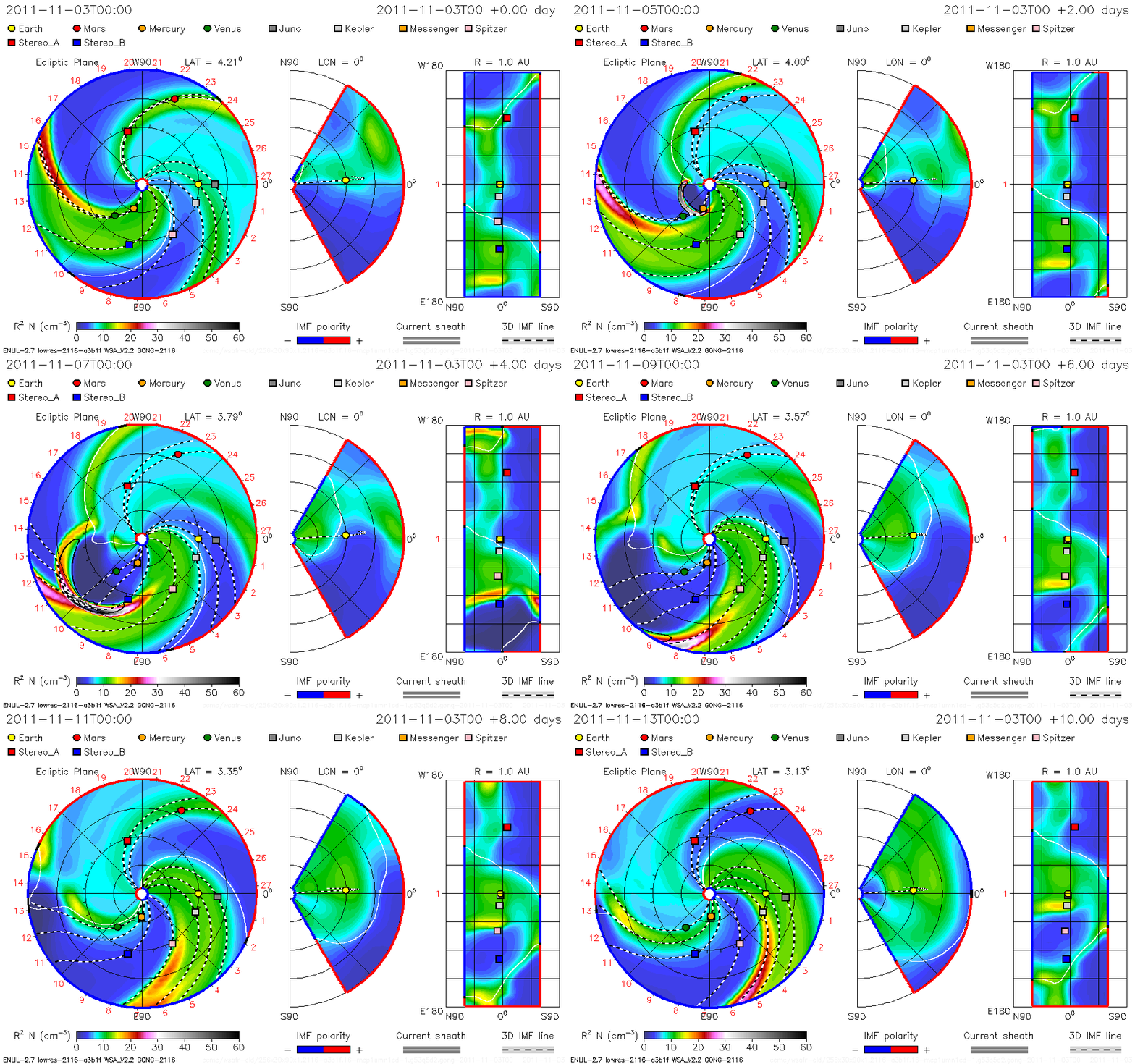
A cloud of plasma or “CME” raced away from the blast site at 1100 km/s. The CME is not heading for Earth. It is, however, heading for Mercury and Venus.

Check out the storm track.


WBMSAT Satellite Industry News Bits 10/28/2011

Making what could be its final flight, Delta II rocket deploys new  weather and environmental research satellite for NASA and NOAA.
[NASA Space Flight – 10/28/2011]

China will launch Long March-2F/H rocket early next month, carrying unmanned  spacecraft Shenzhou-8 which will conduct the country’s first space docking with  Tiiangong-1, or Heavenly Palace-1, a space lab module.
[Space Daily – 10/28/2011]

Secure World Foundation to discuss evolution in China’s role in space, as the  country has developed and deployed space-based intelligence, surveillance, and  reconnaissance capabilities to support military and national security and  enhance their regional power.
[SatNews –  10/28/2011]

Miami-based NewCom International donates year’s worth of Internet  connectivity to aid Germany-based NGO Welthungerhlife’s humanitarian work in  Liberian refugee camps.
[PR Web –  10/28/2011]

Coalition to Save Our GPS challenges LightSquared’s forecasts that FCC will  be able to resolve controversy over company’s planned LTE network, using  conference call to slam LightSquared’s business plan and technical claims.
[PC World – 10/28/2011]

Mitec Telecom employees plan to buy all its VSAT satellite communications  division.
[Montreal Gazette – 10/28/2011]

Marine Data Solutions of Cape Town begins implementing Automatic  Identification System coastal network at lighthouses along South African coast.
[SatNews –  10/28/2011]

LightSquared enters into collaborative partnership with antenna solutions  provider PCTEL to develop technology to resolve concerns regarding interference  with GPS.
[PR Newswire – 10/27/2011]

Astrium hands over Arabsat-5C to ARABSAT after successful completion of  in-orbit testing.
[SatNews –  10/27/2011]

Suspected Chinese hackers interfered with Landsat-7 and Terra AM-1 satellites  in 2007 and 2008 according to Bloomberg Businessweek story citing upcoming  congressional commission report.
[Computer World – 10/27/2011]

Arianespace’s full launcher family in place as flight-ready versions of  Ariane 5, Soyuz, and Vega are together at the Spaceport for the first time.
[SatNews –  10/27/2011]

TV and radio stations, and satellite, cable, and wireline video systems  required to participate in first national test of Emergency Alert System  Wednesday, November 9.
[Examiner – 10/27/2011]

TeleCommunications Systems’ Commercial Mobile Alert System receives FEMA  certification as emergency alert system for delivery to mobile phones.
[SatNews –  10/27/2011]

Canadian government plans to invest as much as $477M in U.S.-led Wideband  Global Satellite system.
Vancouver Sun – 10/27/2011]

Newtec hosted free webinars December 14 and 15 to explore expected growth in  government demand for satellite bandwidth for data, video, and voice  communication.
[SatNews –  10/27/2011]

RRsat launches second DVB-S2 platform on MEASAT-3a.
[PR Newswire – 10/27/2011]

Vizada and Mexican service provider MultiSAT deliver satcom services and  solutions for Mexican mining industry.
[Marketwatch – 10/27/2011]

Astrium Services launches portal to provide satellite imagery of forests in  Congo Basin to organizations working to conserve the regions forests.
[Satellite  Evolution – 10/27/2011]

Fourteen months after launch, the Air Force’s first Advance Extremely High  Frequency military communications satellite is finally on station following  arduous maneuvers precipitated by premature engine shutdown.
[Florida Today – 10/26/2011]

After disappointing results in marketing to U.S. Government’s National  GeoSpatial Intelligence Agency, EADS Astrium shifts attention to Asia where  demand for EO satellites and imagery is growing across the board.
[NSR Report – 10/26/2011]

Intelsat partners with du of United Arab Emirates to jointly offer MCPC  television program distribution solutions on Intelsat 10.
[Market Watch – 10/26/2011]

DigitalGlobe and NTT GEOSPACE launch new online geospatial intelligence  service powered by DigitalGlobe featuring on-demand access to imagery of  Japanese landmass.
[SatNews –  10/26/2011]

Iridium announces complete suite of AxcessPoint products and services that  allow laptop connected to Iridium phone to become wireless hotspot connecting  smart phones, laptops and other devices to the Internet over the Iridium  network.
[TMCnet – 10/26/2011]

Stratos Government Services is awarded five-year Indefinite Delivery  Indefinite Quantity contract by United States Coast Guard to provide large  cutter connectivity.
[SatNews –  10/26/2011]

Spirent positioning & navigation test solution now supports China’s  Compass/Beidou-2 satellite navigation system.
[Market Watch – 10/26/2011]

SES Astra 1N enters commercial service over Europe.
[Satellite Today – 10/25/2011]

United Arab Emirates reopens negotiations with France for a military  surveillance satellite.
[UPI – 10/25/2011]

UK regulator Ofcom writes to International Telecommunications Union asking it  to rescind the satellite spectrum granted to ICO Satellite after its failure for  32 months to establish viable business using the spectrum.
[The Register –  10/25/2011]

U.S. space entrepreneur warns that China could own the moon by 2026.
[SatNews –  10/25/2011]

UltiSat Europe gets sole-source contract from Danish National Procurement  agency allowing Danish federal and local government agencies to buy satellite  services more easily.
[Market Watch – 10/25/2011]

NSSLGlobal opens up new spot beam for maritime use in southeast Asia on SES’  NSS6 satellite.
[SatNews –  10/25/2011]

Spacenet selected to provide upgraded network performance capabilities at  Cumberland Farms’ 600-plus convenience and gasoline retail stores in 11 states.
[TMCnet – 10/25/2011]

Hughes Network Systems provisions GTECH Columbia with advance HN satellite  networking solution, connecting more than 1,100 lottery sites in Colombia.
[SatNews –  10/25/2011]

ARINC successfully launches GLOBALink/Iridium Data Link communications  service for Asiana Airlines of South Korea.
[SatNews –  10/25/2011]

U.S. Strategic Command commander Gen. Kehler warns satellite industry service  providers that rising amount of data collected by U.S. satellites is starting to  exceed Pentagon’s ability to process it.
[Satellite Today –  10/24/2011]

EUTELSAT announces full entry into commercial service of its high capacity  ATLANTIC BIRD 7 satellite, with enhance footprint providing coverage in North  Africa and Gulf states.
[SatNews –  10/24/2011]

AsiaSat 7, built for AsiaSat by Space Systems/Loral, arrives at Baikonur  Space Center.
[SatNews –  10/24/2011]

Polar satellite project under consideration by Canadian government might be  required to fix inability of F-35 Joint Strike fighter plane to communicate in  Canadian North.
[CTV News – 10/24/2011]

Harris receives $20M in orders to provide manpack radios to U.S. Army and  Marine Corps that include ability to upgrade to Mobile User Objective Systems  satellite communications.
[Market Watch – 10/24/2011]

Globecomm Systems sees growth in satellite communications in the areas of  Media, Wireless, Government, Enterprise, and Maritime, with increasing trend  toward use of multiple devices.
[Satellite Spotlight – 10/24/2011]

Recently published standard ETSI TC SES specification TS 102 856 Parts 1 and  2 describes how to support transport of Multi-Protocol Label Switching data and  signalling flows over a Broadband Satellite Multimedia network.
[SatNews –  10/24/2011]

European Space Agency’s Galileo constellation will use Passive Hydrogen Maser  atomic clock stable to 1 second every 3 million years, developed by SELEX  Galileo, an Finmeccanica company.
[SatNews –  10/24/2011]

German satellite ROSAT re-entered atmosphere over Bay of Bengal.
[Space Daily – 10/23/2011]

Since Craig Cooning took over Boeing’s struggling space and intelligence  systems in 2008 it has doubled its backlog from five years ago.
[LA Times – 10/23/2011]

WBMSAT satellite communications systems consulting services

DIY Friday: Jack-O-Lantern Flamethrower

So this may not be exactly rocket science, but you’ve got to admit THIS IS SO COOL!!

Flamethrowing Jack-O’-Lantern from Randy Sarafan on Vimeo.

Via Instructables, naturally…

A flamethrowing jack-o’-lantern keeps the trick-or-treaters a safe distance from your house and is a fine addition to any anti-Halloween arsenal. At the first sign of any sugar-obsessed imp, simply press the trigger button and wirelessly shoot a one-second burst of flames out of the jack-o’-lantern’s mouth. This plume of hellfire will make even the most bold of people think twice about approaching your door. Very few people are willing to risk life and limb for the chance of a tiny box of milk duds.

WARNING!: This pumpkin is extremely dangerous and you definitely should not make one of these. The instructions were posted here are for entertainment purposes only. I do not condone the manufacture or use of flamethrowing jack-o’-lanterns. Seriously, nothing good will come of making one of these. Don’t do it.

For entertainment only.


Chinese Hacking Space

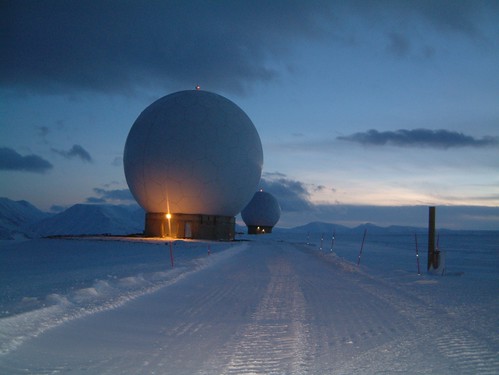
Spitsbergen! Somebody in China decided to hack a couple of observation spacecraft via the Svalbard Earth Station in Norway. The scoop, via Bloomberg BusinessWeek

Computer hackers, possibly from the Chinese military, interfered with two U.S. government satellites four times in 2007 and 2008 through a ground station in Norway, according to a congressional commission.
The intrusions on the satellites, used for earth climate and terrain observation, underscore the potential danger posed by hackers, according to excerpts from the final draft of the annual report by the U.S.-China Economic and Security Review Commission. The report is scheduled to be released next month.
“Such interference poses numerous potential threats, particularly if achieved against satellites with more sensitive functions,” according to the draft. “Access to a satellite‘s controls could allow an attacker to damage or destroy the satellite. An attacker could also deny or degrade as well as forge or otherwise manipulate the satellite’s transmission.”
A Landsat-7 earth observation satellite system experienced 12 or more minutes of interference in October 2007 and July 2008, according to the report.
Hackers interfered with a Terra AM-1 earth observation satellite twice, for two minutes in June 2008 and nine minutes in October that year, the draft says, citing a closed-door U.S. Air Force briefing.
The draft report doesn’t elaborate on the nature of the hackers’ interference with the satellites.


Highway to Hughes

I love a good customer service “moment of truth” situation. Something that’ll either keep or boot a customer. Whether it’s B2B or B2C, this is a moment when you should delight the customer — or else.

HughesNet just blew it in Texas. The report, via the Austin American-Statesman

When a police officer in their driveway screamed for Ken and Linda Schutt to evacuate their home as a wildfire closed in, they grabbed two dogs, three framed photos and clothes in a suitcase. Two days later, they surveyed what was left of their double-wide mobile home and started taking care of business: call the insurance company, the utilities and HughesNet, their satellite Internet provider. That’s when the headaches began.

Linda Schutt said she called the Maryland-based HughesNet to cancel service and couldn’t believe how the customer representative handled the call.

“She wanted me to send back the equipment — the dish, the cable and modem. When I asked her what part of me saying that our house burned to the ground that she didn’t understand, she insisted I return their equipment. If we didn’t, she said we owed $100,” Linda Schutt said.

The Schutts temporarily put aside dealing with HughesNet. They’d lost everything in the Sept. 5 fire, including the American flag that was used on the casket of Linda Schutt’s brother after he was killed in the Vietnam War.

The week after the fire, she wrote HughesNet a letter complaining about the service and saying she’d never use the company again.

“I included the burned satellite dish because that’s all that we found. It wasn’t any good, but since they insisted they wanted their equipment, we sent what we could find,” she said.

On Saturday, Linda Schutt got a call from someone who she thought was a HughesNet representative. “I thought he was calling about my letter, but I later found out it was a bill-collecting agency,” she said.

That call also didn’t end well. “He also told me we owed $100 for the equipment,” she said.

On Tuesday, Schutt said she noticed Hughes withdrew $106.25 from her bank account, presumably the cost to replace the equipment.

Statesman Watch contacted HughesNet on the Schutts’ behalf. Spokeswoman Judy Blake said the complaint was referred to the company’s executive customer service team. Within minutes, HughesNet called Linda Schutt to tell her the $106.25 would be credited back to her bank account.

“I’m sorry that she went through that,” Blake said, referring to the customer service representative who first spoke with Schutt. “I don’t know what went wrong, but perhaps the customer rep didn’t have the authority to give her credit or thought about asking a higher-up.”

Schutt is happy to get the refund. “But that wasn’t the point. We could afford the $100. It’s just that after all we’d been through, they could have been a little understanding. It’s the principle. If Statesman Watch hadn’t called on our behalf, we’d still be fighting this,” she said.

The good people at Hughes should be reminded of the Two Rules of Business:

  1. The customer is always right.
  2. If the customer is ever wrong, re-read rule #1.


Big Bang Monday: “Protoplanet” LkCa 15 b


Great work by astronomers Adam Kraus (University of Hawaii Institute for Astronomy) and Michael Ireland (Macquarie University and the Australian Astronomical Observatory) in finding the youngest planet ever.

“LkCa 15 b is the youngest planet ever found, about 5 times younger than the previous record holder,” said Kraus. “This young gas giant is being built out of the dust and gas. In the past, you couldn’t measure this kind of phenomenon because it’s happening so close to the star. But, for the first time, we’ve been able to directly measure the planet itself as well as the dusty matter around it.”

Kraus will be presenting the discovery at an Oct. 19 meeting at NASA’s Goddard Space Flight Center. The meeting follows the acceptance of a research paper on the discovery by Kraus and Ireland by The Astrophysical Journal.

The optical sleight of hand used by the astronomers is to combine the power of Keck’s Adaptive Optics with a technique called aperture mask interferometry. The former is the use of a deformable mirror to rapidly correct for atmospheric distortions of starlight. The latter involves placing a small mask with several holes in the path of the light collected and concentrated by a giant telescope. With that, the scientists can manipulate the light waves.

“It’s like we have an array of small mirrors,” said Kraus. “We can manipulate the light and cancel out distortions.” The technique allows the astronomers to cancel out the bright light of stars. They can then resolve disks of dust around stars and see gaps in the dusty layers where protoplanets may be hiding.

“Interferometry has actually been around since the 1800s, but through the use of adaptive optics has only been able to reach nearby young suns for about the last 7 years.” said Dr. Ireland. “Since then we’ve been trying to push the technique to its limits using the biggest telescopes in the world, especially Keck.”

The discovery of LkCa 15 b began as a survey of 150 young dusty stars in star-forming regions. That led to the more concentrated study of a dozen stars.

“LkCa 15 was only our second target, and we immediately knew we were seeing something new,” said Kraus. “We could see a faint point source near the star, so thinking it might be a Jupiter-like planet we went back a year later to get more data.”

In further investigations at varying wavelengths, the astronomers were intrigued to discover that the phenomenon was more complex than a single companion object.

“We realized we had uncovered a super Jupiter-sized gas planet, but that we could also measure the dust and gas surrounding it. We’d found a planet at its very beginning” said Kraus.

Drs. Kraus and Ireland plan to continue their observations of LkCa 15 and other nearby young stars in their efforts to construct a clearer picture of how planets and solar systems form.

Mirrors. Go figure.

Want to know how this was done? Get the details.


Hydrazine Vampires?

Well, not exactly vampires. In keeping with the spirit of the season, Jamie Zawinski chose to call DARPA’s Phoenix Program “space vampires,” which was picked up by Boing Boing and spun up as “vampire satellite,” a la zombie satellite.

Communication satellites in geosynchronous orbit (GEO), approximately 22,000 miles above the earth, provide vital communication capabilities to warfighters. Today, when a communication satellite fails, it usually means the expensive prospect of having to launch a brand new replacement communication satellite. Many of the satellites which are obsolete or have failed still have usable antennas, solar arrays and other components which are expected to last much longer than the life of the satellite, but currently there is no way to re-use them.

The goal of the Phoenix program is to develop and demonstrate technologies to cooperatively harvest and re-use valuable components from retired, nonworking satellites in GEO and demonstrate the ability to create new space systems at greatly reduced cost. Phoenix seeks to demonstrate around-the-clock, globally persistent communication capability for warfighters more economically, by robotically removing and re-using GEO-based space apertures and antennas from de-commissioned satellites in the graveyard or disposal orbit.

I suspect we’ll get a response from the good people at ViviSat and MDA in Canada. Although they’re talking about on-orbit refueling, not scavenging for parts.