LCROSS Anomaly

"Anomaly" is a very bad word when referring to in-orbit spacecraft. That’s what the LCROSS team is dealing with now, via SpaceRef.com:

Mon, 24 Aug 2009 11:58:30 PM EDT

Upon starting an early morning communications pass on Aug. 22, 2009, the Lunar Crater Observation and Sensing Satellite (LCROSS) mission operations
team discovered the spacecraft had experienced an anomaly.

According to spacecraft data, the LCROSS Internal Reference Unit (IRU) experienced a fault. The IRU is a sensor used by the spacecraft’s attitude control system (ACS) to determine the orientation and trajectory of the spacecraft. The anomaly caused the spacecraft ACS to switch to the Star Tracker Assembly for spacecraft positional information and caused the spacecraft’s thruster to fire excessively, consuming a substantial amount of fuel. Initial estimates indicate that the spacecraft still contains sufficient fuel to complete the full mission.

LCROSS mission operations declared a ‘spacecraft emergency’ and were allocated additional communications time on the Deep Space Network. The team conducted procedures to mitigate the problem and were able to restart the IRU and reduce fuel consumption to a nominal level. Automatic operations procedures also were implemented to minimize the possibility of another IRU anomaly from occurring while the spacecraft is out of contact with the ground. Since the re-start of the IRU, the spacecraft has not experienced any additional problems.

The team continues to actively assess and mitigate the situation and is in contact with the manufacturers of the IRU and star tracker to investigate the root cause of the problems. Mission managers remain optimistic the LCROSS mission can reach its successful conclusion with projected impact at the lunar south pole currently set for 4:30 a.m. PDT on Oct. 9, 2009.


Greece Fire


 Nice satellite imagery via the University of Maryland’s FIRMS (Fire Information for Resource Management System) and NASA’s MODIS Rapid Response System.  MODIS: Moderate Resolution Imaging Spectroradiometer.

The fires near Athens were brought under control recently. Here’s a video report:


And here’s more on MODIS, the rocket science behind the imagery…


Naro Rocket Launch


Spectacular launch from South Korea’s Oenaro Island earlier today:

South Korea launched its first rocket Tuesday, just months after rival North Korea’s launch drew international anger, but space officials said the satellite it carried failed to enter its intended orbit.

A Science Ministry statement called the launch a "partial success," as the satellite separated from the rocket normally before entering a different orbit.

The launch could boost South Korea’s space ambitions, but the North warned it would keep a close eye on the international response. There was no immediate comment from North Korea.

The two-stage Naro rocket — delayed several times since July due to technical glitches — lifted off Tuesday from South Korea’s space center on Oenaro Island, about 290 miles (465 kilometers) south of Seoul, about 5 p.m. (0800 GMT, 4 a.m. EDT).

It was South Korea’s first launch of a rocket from its own territory. Since 1992, it has launched 11 satellites, all on foreign-made rockets sent from overseas sites.

The rocket, built with Russian help, was carrying a domestically built satellite aimed at observing the atmosphere and oceans.

Lots of witnesses…


 Quality video, too…


Langford Rocket


South of Buffalo (N.Y.), off State Route 75, is an interesting sculpture garden — including this steel rocket. Found a few in the area, including Griffis Sculpture Park in Ashford Hollow, not far from Ellicottville — the "Aspen of the East."

 
View Larger Map

This part of Western New York State is full of vibrant farming communities, so you can expect a different kind of rocket science on display: tractor pulls. Like this one in Langford, held on 2 August 2009…

WBMSAT News Bits for August 21, 2009

Intelsat announces the 45th anniversary of its operation, having launched the Early Bird, or Intelsat 1, satellite over the Atlantic on April 6, 1965 as an intergovernmental organization.
[Satellite Today – 08/21/2009]

Southwest Airlines prepares to begin fleetwide rollout of Wi-Fi in first quarter of 2010 using Row 44’s satellite service.
[Information Week – 08/21/2010]

WildBlue pursues $30m slice of American Recovery and Reinvestment Act money to help subsidize satellite broadband connections for about 10,000 homes in Colorado and Wyoming and another 10,000 i Arizona which are not served by high-speed cable, fiber, or DSL lines.
[Digital Cable News – 08/21/2009]

Satellite testing of KVH mini-VSAT in Australia and New Zealand is complete and it has been activated for service there, providing Internet and voice communications needs for maritime and aeronautical applications.
[PRNewswire – 08/21/2009]

Lunar Orbiter, launched in June, uses wave amplifier to transmit massive amounts of data at 100 Mbs; with Lunar Crater Observation and Sensing Satellite, launched at the same time, NASA hopes to find suitable landing site for future manned mission to moon.
[Computer World – 08/20/2009]

Harris wins multi-year contract to provide high-speed internet and advanced voice and data to Carnival Corp. cruise ship passengers.
[Satellite Today – 08/20/2009]

Government of Canada invests $8.7m in next generation mobile satellite communications research and development undertaken by EMS SATCOM.
[Canada News Center – 08/20/2009]

Ariane 5 rocket scheduled to lift off Friday with dual payload of 4,000 Kilo JCSAT-12 satellite to provide communications for Japan and the Asia-Pacific region, and 2,500 kilo Optus satellite for Australian and New Zealand TV and broadcasting services.
[AFP – 09/20/2009]

Verizon squares off against traditional cable providers and satellite TV companies, demonstrating the ability to tie together a cellphone with its FiOS TV service.
[Wall Street Journal – 08/19/2009]

Iinternational Datacasting acquires Comtech Tiernan in cash transaction of over $2m.
[Satellite Today – 08/19/2009]

Nimiq 5 delivered by Space Systems/Loral to International Launch Services Baikonur Space Center in preparation for September 18 launch.
[Satellite Today – 08/19/2009]

SkyTerra seeks $37m of federal stimulus money from the National Telecommunications and Information Administration to deploy two new wireless devices, to work on both terrestrial and satellite systems, for public safety workers.
[Business Journal – 08/19/2009]

South Korea cancels first launch of satellite from its territory due to a technical problem.
[NY Times – 08/19/2009]

TerreStar selects BroadSoft VoIP application to power its new satellite mobile broadband service to launch later this year.
[TMCnet – 08/19/2009]

Landsat 5 experiences anomaly rendering it out of control with power at critical levels, but spacecraft is stabilized.
[Satellite Today – 08/18/2009]

Lockheed Martin plans to cut workforce by 4.5%, but plans do not include cut back of facilities expansion in Philadelphia.
[Business Journal – 08/18/2009]

iDirect platform excels during speed, mobility, and disaster testing at Fort Monmouth military exercise.
[PRNewswire – 08/18/2009]

Private Equity Firm Greenhill’s plan to take over Iridium is approved by FCC.
[Forbes – 08/17/2009]

A United Launch Alliance Delta II becomes last rocket to lift off from Cape Canaveral’s Space Launch Complex 17A as it carries aloft the twenty-first and last GPS AIIR satellite for the U.S. Air Force.
[NASA Spaceflight – 08/17/2009]

ISS Reshetnev wins contracty from Russian Radio Research and Development Institute to develop AM5 and AM6 satellites; will work with Thales Alenia Space.|
[Satellite Today – 08/17/2009]

While fears of the bottom falling out for all MSS operators due to the economic crisis have been overestimated, cautions is still the best attitude for the short term.
[NSR Report – August 2009]

WBMSAT PS – Satellite Communications Consulting Services

Death of a Star


An optical image from the 0.6-m University of Michigan/CTIO Curtis Schmidt telescope of the brightest Radio Planetary Nebula in the Small Magellanic Cloud, JD 04. The inset box shows a portion of this image overlaid with radio contours from the Australia Telescope Compact Array. The planetary nebula is a glowing record of the final death throes of the star. (Optical images are courtesy of the Magellanic Cloud Emission Line Survey (MCELS) team).


The current Monthly Notices of the Royal Astronomical Society is reporting on super planetary nebulae, with University of Western Sydney Associate Professor Miroslav Filipovic going so far as to call them sexy in an interview with ABC:

Filipovic believes planetary nebula images are the most impressive objects in the galaxy.

"When you look at the Hubble pictures, they are the sexiest pictures you can find," he says.

According to Filipovic, it’s important to understand how super planetary nebulae form, particularly as they represent the fate of our Sun.

"This is something that will happen to us in about five billion years from now," he says.


Get a load of the abstract:

We report the extragalactic radio-continuum detection of 15 planetary nebulae (PNe) in the Magellanic Clouds (MCs) from recent Australia Telescope Compact Array+Parkes mosaic surveys. These detections were supplemented by new and high-resolution radio, optical and infrared observations which helped to resolve the true nature of the objects. Four of the PNe are located in the Small Magellanic Cloud (SMC) and 11 are located in the Large Magellanic Cloud (LMC). Based on Galactic PNe the expected radio flux densities at the distance of the LMC/SMC are up to ∼2.5 and ∼2.0 mJy at 1.4 GHz, respectively. We find that one of our new radio PNe in the SMC has a flux density of 5.1 mJy at 1.4 GHz, several times higher than expected. We suggest that the most luminous radio PN in the SMC (N S68) may represent the upper limit to radio-peak luminosity because it is approximately three times more luminous than NGC 7027, the most luminous known Galactic PN. We note that the optical diameters of these 15 Magellanic Clouds (MCs) PNe vary from very small (∼0.08 pc or 0.32 arcsec; SMP L47) to very large (∼1 pc or 4 arcsec; SMP L83). Their flux densities peak at different frequencies, suggesting that they may be in different stages of evolution. We briefly discuss mechanisms that may explain their unusually high radio-continuum flux densities. We argue that these detections may help solve the ‘missing mass problem’ in PNe whose central stars were originally  1–8 M . We explore the possible link between ionized haloes ejected by the central stars in their late evolution and extended radio emission. Because of their higher than expected flux densities, we tentatively call this PNe (sub)sample –’Super PNe’.

Sexy indeed.


Air-to-Air Broadband


Inflight broadband services is something we’ve liked for years. Why? Satcom love, baby.

Connexion by Boeing was a real winner. In fact, it’s probably still being used by Air Force One and other U.S. agencies — especiallly over the Pacific via GE-23. Ed loved it, as did most users who’ve experienced it.

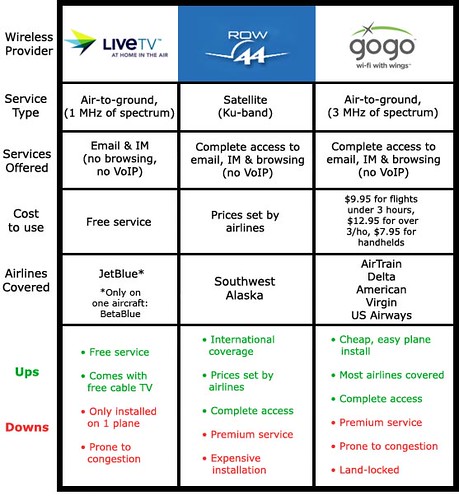
We like Row 44 now, since they’ve got satcom love working for them. In the U.S., there are two other options, but they use ground-based communications systems to make the connection. Alaska Airlines (see above aircraft with satellite antenna housing) and Southwest are using Row 44’s equipment and service. Good decision.

Dvice.com published this comparison chart last week:


 No VoIP, ey? I’m sure there’s a hack for that.

DAEMAR September, 2009 Topic: Spacecraft Consultants – Invaluable White Hair and Experienced Eyes!

The Situation:

Background –

In the satellite industry there have been some rather spectacular satellite failures, as well as significant in orbit anomalies, that have seriously affected missions and caused many insurance claims over the last 10 to 15 years.  This has generally been due to design or test oversights and errors discovered very late in a program, or not at all, ending up in orbit.

As Mr. Keith Vokert (CEO, Satellite Consulting, Inc.) has pointed out in a great paper on this topic titled “THE NEED FOR ONE MORE LOOK or WHEN WHITE HAIR IS A GOOD THING”, the causes of the problem are generally as follows:

·          No single cause but often a combination of factors

·          Relying on process

·          Schedule pressures

·          Fewer senior experts on staff

·          Less time for reviews

·          Limited number of independent reviewers

·          Much smaller customer teams

·          ITAR has reduced content

·          Financial pressures 

Mr. Volkert goes on to analyze the situation in much greater detail and strongly suggests that the pool of retired engineers, readily available as consultants, should be utilized “to provide at least one last look through a more experienced set of eyes.”

You can find this August 28, 2007 paper at the following link:

www.aerowebspace.com/aiaa/archives/volkert.ppt

I totally agree with Mr. Volkert’s assessment and also the use of the words “at least”.  This is because, for companies without sufficient senior staff or who may not have their own customer team, the use of these readily available experienced senior consultants throughout the course of a satellite program provide an invaluable substitute, or supplement, to any direct staff deficiencies. 

Experience versus Process –

Although most aerospace companies would indicate that they understand and appreciate the value of the experience senior technical personnel (i.e., those with 20, 30, or more years of experience) bring to the table to help insure the technical quality of the spacecraft produced, history does not necessarily support this.  Senior professionals are often the first to be laid off in tough economic times, industry consolidation, and/or company reorganizations.  In addition, there has also been a natural loss of experienced people overall due to the retirement of these older individuals who started when the aerospace industry was in its early stages (i.e., primarily in the 60’s and 70’s) and the fact that the number of young people entering the aerospace industry since that time has declined, favoring computers, software and other fields.  The loss of senior professionals leaves the younger less experienced engineers to fill the void and as it used to be said to “re-learn the wheel”.   Essentially, these younger engineers end up having to learn from their own experience what their senior counterparts could have advised them about from their past experience, had they still been available to them.  This loss of resident experience often means repeating past problems and mistakes over again as well as ineffectively handling new ones.  To compound this problem further, some of these same companies have eliminated the use of consultants who could have compensated for the loss of resident experience and also help mentor and advise its younger engineers.  Essentially these consultants, many of whom retired after over 30+ years of experience in the industry, working in conjunction with their younger counterparts, could be a good solution if utilized, to maintain the necessary technical quality for mission success. 

The bottom line is that aerospace companies as a whole often have less experience on their staffs than they once had and some of these companies also have a tendency against using consultants that might supplant this loss of experience.

The main reason these companies usually give for reducing their more senior staff and eliminating the use of consultants is that they have to operate leaner.  Operating leaner generally means reducing your higher paid senior staff and perceived expensive consultants.  Also management often tends to believe that they can maintain the quality of the product and avoid problems just by improving the processes.  Basically management sometimes tends to believe that the senior experience is less critical to quality than a better management plan.  I have seen companies unsuccessfully try to apply six sigma techniques in an attempt to improve satellite quality, replace successful program management methods with poorer ones, stay with failing processes too long before fixing them, badly fix other processes before first proving them out, and even reduce technical team size reasoning that process improvements trump team size.  Oftentimes the managers in charge have not come up through the spacecraft technical ranks and therefore don’t always appreciate what is necessary for quality and mission success.  This lack of appreciation frequently leads these managers to reduce costs without any thought to the impact it might have to the end result.

Misconception Related to Consultant Usage –

Speaking of costs, there is often a misconception that using consultants is more expensive to a company than hiring someone full-time.  In a recent article in Kiplinger’s Personal Finance Magazine (Sept., 2009 Edition, Page 80) on Consulting it states the following advantage of being a consultant:

“As for drumming up business, you may have an edge in the current economy.  Companies are looking to hire consultants because they are cheaper that full-time workers.”

While it’s true that consultants generally demand a higher hourly rate, it is also true that consultants are less costly for a number of other good reasons as highlighted in the following advantages.   Specifically advantages number 3, 4 and 5 save the company considerable expense relative to direct employees.  To be fair there are also disadvantages shown in using consultants.  However, as far as these disadvantages are concerned, as shown in red they are often not really significant or can easily be overcome.

Advantages and Disadvantages of Using Consultants vs Direct Employees

Advantages –

1.       Consultants provide a valuable service to the company by bolstering company teams with experienced and knowledgeable people to help insure the program requirements are met and that the quality of the satellites are as good as they can be.

2.       Can provide expertise that a customer may not have in its current employee staff.

3.       Consultants need no training (i.e., can hit the ground running).

4.       From the companies perspective consultants are flexible and can be hired and let go as needed.

5.       Consultants provide the company with significant financial benefits.  The company does not take on the overhead and benefits obligation of a direct hire such as health & insurance benefits, vacation, family relocation & associated compensation, potential cultural adjustments, and/or other considerations.

Disadvantages –

1.       When consultants leave long term assignments (e.g., as residents at spacecraft manufacturers or subcontractors), they walk away with a good amount of knowledge gained that is not written down or passed on to their company colleagues.  Even though they provide weekly reports, it is inevitable that not all daily information learned gets disseminated.  This means that the company may have less in-house knowledge than it would ordinarily have if its own people were located at the manufacturer facilities.  This can be an important deficit if anomalies occur and have to be resolved over the life of a particular satellite (i.e. the availability of all historical documentation and knowledge is critical to the successful resolution of on-orbit anomalies).  On the other hand the company can write consultant contracts to assure all information collected during the course of the program (paper and soft copy) is handed over by the consultant to the company as their property.

2.       Because consultants can be hired and let go at a moments notice, they may not share the same feeling of ownership in the satellite or program like their direct employee counterparts.  On the other hand, consultants being retired work primarily for the love of the industry making them generally focused totally on the job at hand and independent in their thinking and analysis (i.e., not being direct employees they have no political allegiances and no pre-determined biases that can often negatively affect the independence and attitude of direct employees). 

Conclusions:

So with the above in mind, the following conclusions are made:

1.       Senior technical professionals with their past experience and knowledge are still a critical component to assure spacecraft quality and mission success.

2.       Retired technical professionals are a cost effective way to supplement a company’s staff with critical expertise.

3.       Processes can be improved, but are not a substitute for the application of senior technical expertise and experience.

Let us know what you think!  We welcome your comments, opinions and thoughts on this important topic.

Consultant Service Question for Prospective Clients:

Would there be an interest by prospective clients (i.e., Spacecraft Buyers, Operators, Manufacturers or any others interested in this posting) in a spacecraft related training or mentoring course for your younger technical staff members and/or managers?  One possible series could be from DAEMAR Principal Consultant Robert Youngblood, a recognized expert in spacecraft/mission operations, who previously developed a series of seminars that cover the various aspects of spacecraft fleet maintenance and operation as well as the examination of fundamental principles and real-world decisions.

While DAEMAR does not currently advertise this service, let us know if there would be an interest in this kind of course or seminar series as a consulting service?

Best Regards,

Mark Halverson

CEO, DAEMAR Consulting and Enterprise Group LLC

Spacecraft Consultants – Invaluable White Hair and Experienced Eyes!

The Situation:

Background

In the satellite industry there have been some rather spectacular satellite failures, as well as significant in orbit anomalies, that have seriously affected missions and caused many insurance claims over the last 10 to 15 years.  This has generally been due to design or test oversights and errors discovered very late in a program, or not at all, ending up in orbit.

As Mr. Keith Vokert (CEO, Satellite Consulting, Inc.) has pointed out in a great paper on this topic titled “THE NEED FOR ONE MORE LOOK or WHEN WHITE HAIR IS A GOOD THING”, the causes of the problem are generally as follows:
 

  • No single cause but often a combination of factors
  • Relying on process
  • Schedule pressures
  • Fewer senior experts on staff
  • Less time for reviews
  • Limited number of independent reviewers
  • Much smaller customer teams
  • ITAR has reduced content
  • Financial pressures

Mr. Volkert goes on to analyze the situation in much greater detail and strongly suggests that the pool of retired engineers, readily available as consultants, should be utilized “to provide at least one last look through a more experienced set of eyes.”

You can find this August 28, 2007 paper here

I totally agree with Mr. Volkert’s assessment and also the use of the words “at least”.  This is because, for companies without sufficient senior staff or who may not have their own customer team, the use of these readily available experienced senior consultants throughout the course of a satellite program provide an invaluable substitute, or supplement, to any direct staff deficiencies.


Experience versus Process

Although most aerospace companies would indicate that they understand and appreciate the value of the experience senior technical personnel (i.e., those with 20, 30, or more years of experience) bring to the table to help insure the technical quality of the spacecraft produced, history does not necessarily support this.  Senior professionals are often the first to be laid off in tough economic times, industry consolidation, and/or company reorganizations.  In addition, there has also been a natural loss of experienced people overall due to the retirement of these older individuals who started when the aerospace industry was in its early stages (i.e., primarily in the 60’s and 70’s) and the fact that the number of young people entering the aerospace industry since that time has declined, favoring computers, software and other fields.  The loss of senior professionals leaves the younger less experienced engineers to fill the void and as it used to be said to “re-learn the wheel”.   Essentially, these younger engineers end up having to learn from their own experience what their senior counterparts could have advised them about from their past experience, had they still been available to them.  This loss of resident experience often means repeating past problems and mistakes over again as well as ineffectively handling new ones.  To compound this problem further, some of these same companies have eliminated the use of consultants who could have compensated for the loss of resident experience and also help mentor and advise its younger engineers.  Essentially these consultants, many of whom retired after over 30+ years of experience in the industry, working in conjunction with their younger counterparts, could be a good solution if utilized, to maintain the necessary technical quality for mission success.  
 
The bottom line is that aerospace companies as a whole often have less experience on their staffs than they once had and some of these companies also have a tendency against using consultants that might supplant this loss of experience.

The main reason these companies usually give for reducing their more senior staff and eliminating the use of consultants is that they have to operate leaner.  Operating leaner generally means reducing your higher paid senior staff and perceived expensive consultants.  Also management often tends to believe that they can maintain the quality of the product and avoid problems just by improving the processes.  Basically management sometimes tends to believe that the senior experience is less critical to quality than a better management plan.  I have seen companies unsuccessfully try to apply six sigma techniques in an attempt to improve satellite quality, replace successful program management methods with poorer ones, stay with failing processes too long before fixing them, badly fix other processes before first proving them out, and even reduce technical team size reasoning that process improvements trump team size. Oftentimes the managers in charge have not come up through the spacecraft technical ranks and therefore don’t always appreciate what is necessary for quality and mission success.  This lack of appreciation frequently leads these managers to reduce costs without any thought to the impact it might have to the end result.

Misconception Related to Consultant Usage
 
Speaking of costs, there is often a misconception that using consultants is more expensive to a company than hiring someone full-time.  In a recent article in Kiplinger’s Personal Finance Magazine (Sept., 2009 Edition, Page 80) on Consulting it states the following advantage of being a consultant:

“As for drumming up business, you may have an edge in the current economy.  Companies are looking to hire consultants because they are cheaper that full-time workers.”

While it’s true that consultants generally demand a higher hourly rate, it is also true that consultants are less costly for a number of other good reasons as highlighted in the following advantages.   Specifically advantages number 3, 4 and 5 save the company considerable expense relative to direct employees.  To be fair there are also disadvantages shown in using consultants.  However, as far as these disadvantages are concerned, as shown in italics they are often not really significant or can easily be overcome.


Advantages and Disadvantages of Using Consultants vs Direct Employees

Advantages

  • Consultants provide a valuable service to the company by bolstering company teams with experienced and knowledgeable people to help insure the program requirements are met and that the quality of the satellites are as good as they can be.
  • Can provide expertise that a customer may not have in its current employee staff.
  • Consultants need no training (i.e., can hit the ground running).
  • From the companies perspective consultants are flexible and can be hired and let go as needed.
  • Consultants provide the company with significant financial benefits.  The company does not take on the overhead and benefits obligation of a direct hire such as health & insurance benefits, vacation, family relocation & associated compensation, potential cultural adjustments, and/or other considerations.


Disadvantages

  • When consultants leave long term assignments (e.g., as residents at spacecraft manufacturers or subcontractors), they walk away with a good amount of knowledge gained that is not written down or passed on to their company colleagues.  Even though they provide weekly reports, it is inevitable that not all daily information learned gets disseminated.  This means that the company may have less in-house knowledge than it would ordinarily have if its own people were located at the manufacturer facilities.  This can be an important deficit if anomalies occur and have to be resolved over the life of a particular satellite (i.e. the availability of all historical documentation and knowledge is critical to the successful resolution of on-orbit anomalies).  On the other hand the company can write consultant contracts to assure all information collected during the course of the program (paper and soft copy) is handed over by the consultant to the company as their property.
  • Because consultants can be hired and let go at a moments notice, they may not share the same feeling of ownership in the satellite or program like their direct employee counterparts.  On the other hand, consultants being retired work primarily for the love of the industry making them generally focused totally on the job at hand and independent in their thinking and analysis (i.e., not being direct employees they have no political allegiances and no pre-determined biases that can often negatively affect the independence and attitude of direct employees).

Conclusions

So with the above in mind, the following conclusions are made:

  • Senior technical professionals with their past experience and knowledge are still a critical component to assure spacecraft quality and mission success.
  • Retired technical professionals are a cost effective way to supplement a company’s staff with critical expertise.
  • Processes can be improved, but are not a substitute for the application of senior technical expertise and experience.

Let us know what you think!  We welcome your comments, opinions and thoughts on this important topic.

Consultant Service Question for Prospective Clients

Would there be an interest by prospective clients (i.e., Spacecraft Buyers, Operators, Manufacturers or any others interested in this posting) in a spacecraft related training or mentoring course for your younger technical staff members and/or managers?  One possible series could be from DAEMAR Principal Consultant Robert Youngblood, a recognized expert in spacecraft/mission operations, who previously developed a series of seminars that cover the various aspects of spacecraft fleet maintenance and operation as well as the examination of fundamental principles and real-world decisions.
 
While DAEMAR does not currently advertise this service, let us know if there would be an interest in this kind of course or seminar series as a consulting service?

Best Regards,

Mark Halverson

CEO, DAEMAR Consulting and Enterprise Group LLC

WBMSAT News Bits for August 14, 2009


Satellite Industry News Bits August 14, 2009

atrexx introduces SCPC satellite services to South America and the Caribbean using its 2way2sat platform and the Intelsat 903 satellite.
[SatNews – 08/14/2009]

Thaicom expects to launch its IPStar broadband service in India later this year, as it reports a net profit of $5.8m for the second quarter.
[Satellite Today – 08/14/2009]

Integration of Optus D3 on Arian 5’s core stage clears way for JCSAT-12 to be integrated in upper position, in preparation for August 21 launch.
[SatNews – 08/13/2009]

GSA to manage purchase of $5b worth of commercial satellite services during next 10 years for all federal agencies including defense department.
[SatNews – 08/13/2009]

U.S. gives OK for the Indian Space Research Organization to launch Algerian satellites having American components using an Indian launch vehicle.
[SatNews – 08/13/2009]

Ukraine plans to launch an Earth remote sensing satellite in April 2010.
[SatNews – 08/13/2009]

Satellite news gathering is taking on a new look, with smaller vehicles enabled by small automatic antennas and broadband connectivity offered by systems such as C-COM Satellite Systems’ iNetVu.
[TMCnet – 08/13/2009]

Harris raises 2010 forecast on 2009 fiscal year results which included 13% increase in net income, and a fourth quarter of new order bookings of $129b.
[FloridaToday – 08/13/2009]

Lockheed Martin begins construction of new facilities in Newtown, PA to support satellite construction programs for government and commercial customers.
[Satellite Today – 08/13/2009]

Intelsat sales increase 10% in second quarter, driven by demand for communications infrastructure.
[Washingon Business Journal – 08/12/2009]

Surrey Satellite Technology Ltd. announces that the UK-DMC2 satellite has commenced operations and is delivering images.
[Satellite Today – 08/12/2009]

Satellite gravity maps show disastrous draining in India’s breadbasket, resulting in shrinking aquifers.
[IEEE Spectrum – 08/12/2009]

Gilat second quarter revenues down from 2008 by $9.6m, with net loss of $1.2m.
[GlobeNewswire – 08/11/2009]

Globecomm Systems to design, build, and test RF electronic upgrade kits for legacy X-band terminals deployed around the globe which are no longer supportable, under $2m government contract from a major global organization.
[SatNews – 08/11/2009]

Asiasat 5 is launched into space aboard Proton rocket from Baikonur Cosmodrome in Kazakhstan on August 10.
[Space – 08/11/2009]

WildBlue Communications announces successful start of rural broadband service on a third satellite, EchoStar’s AMC-15, a satellite provided to Echostar by SES Americom.
[Agriculture OnLine – 08/10/2009]

Dish Network shows signs of getting churn under control as it shows positive subscriber growth in second quarter for the first time in five quarters, adding 26,000 net new customers.
[Bloomberg – 08/10/2009]

SPOT LLC to provide real-time race tracking and GPS mapping for Primal Quest Badlands co-ed teams race through South Dakota’s Black Hills and Badlands.
[Globe NewsWire – 08/10/2009]

Keystone selected by Channel One to provide nationwide satellite distribution to schools of the school news broadcast.
[Business Wire – 08/10/2009]

Delays in U.S. Navy satellite program and decision by military not to launch more backup transmitters and receivers may lead to dead zones in communications coverage for U.S. troops and operatives in very remote regions of world in 2010.
[Defense News – 08/10/2009]

Iridium second quarter profit is up by 53% over 2008, at $28.6m.
[Washington Business Journal – 08/10/2009]

Western Canada’s Telus reaches 115,000 IPTV customers overall, with a gain of 17,000 subscribers in second quarter, a gain of 125% over last year; its Bell TV satellite TV service reaches more than 90% of the households in its region.
[FierceIPTV – 09/10/2009]

Dish Network profit slides 81% due to costs of litigation with TiVo, although it was able to add subscribers and maintain revenue.
[CED Magazine- 08/10/2009]

New undersea cables to Africa planned to provide broadband alternative to satellite, with 10 planned to be in service by middle of 2010.
[NY Times – 08/09/2009]

Commercial satellite transponder demand growth appears to be set for steady growth over next 10 years, though specific S-band and Ku-band trends vary substantially by region.
[NSR Report – August 2009]

WBMSAT PS – Satellite Communications Consulting Services