DIY Friday: Laser Lighter

Live dangerously: smoke. Oh, and light up with via a laser, via Instructables


 WARNING: This kind of laser can cause permanent damage to eyesight in less than a second. NEVER look into the beam or reflection of ANY laser including this one

Drone Control? There’s An App For That

Great piece in Wired’s Danger Room on a new iPhone app developed at MIT:

Her crew of 30 grad students and undergrads is chasing a number of new ideas and technologies, all aimed at easing the sometimes unwieldy interactions between machines and their human masters. As an example, she refers to the complex, suitcase-sized controller that soldiers must haul around to control hand-thrown Raven unmanned aerial vehicles, or UAVs. Cummings wants something simpler. And what could be simpler than an iPhone?

Actually, using an iPhone was her undergrads’ idea — because experimenting with it as a basis for a new robot controller meant she’d have to buy them all iPhones of their own. “We had the idea in June,” Cummings told Danger Room. “In six weeks, we went from the idea to a real flight test,” using MIT’s indoor robot range. (See video.) The total cost? $5,000 for a new, commercially available, quad-rotor robot — plus the cost of iPhones for her crew.

The iPhone bot controller is basically just an app, like any other. It relies on only the iPhone’s existing gear, and the phone can still be used for regular calls, web-browsing, texting, etc. HAL’s bot-wrangling app sends GPS coordinates to the robot, which navigates around using its own, built-in “sense-and-avoid” capabilities. Along the way, the bot can stream video or snapshots back to the iPhone.

 Yeah, there’s a video…


Wanted: Satellite Joint Venture in India


It’s no secret satcom has wildly optimistic projections for providing service in India — television and Internet. Direct-to-home satellite television probably has the greatest potential. All you need to do is get beyond government bureaucracy. Simple.

Satellite companies have been trying to get more business from India for years. The AAP-1/NSS-11 satellite’s South Asian beam was specifically designed for DTH. Did they get the business? No. The government insists on majority ownership by Indian entities. Antrix books plenty of space on it, but no DTH business.

So how will they satisfy demand? Buy a satellite from another operator.

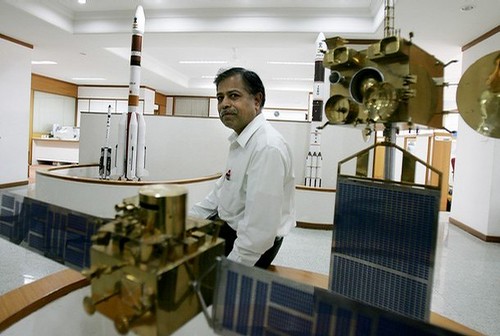
Antrix Corp, India’s only space services company, is out to break new ground in the $2.5 billion industry.

The Rs 1,000 crore firm is scouting for joint ventures with similar overseas firms to own and operate satellites.

It is talking to one European and a regional company, to buy a large sized communications satellite, managing director K R Sridhara Murthi told DNA.

"We are looking to build strengths in new areas and have kicked off talks with these parties to own and operate satellites," Murthy added. But he refused to divulge the names of the involved parties pending finalisation of a deal.

The move follows an earlier attempt at a similar JV in 2004 with Malaysia’s MEASAT Global to develop a satellite neighbourhood for broadcasting and telecom customers across the wider Asia-Pacific region. 

 Given last month’s space agreement with the U.S., it seems India will be next real power in space.

Jet Pack

For your next summer vacation adventure, check out Canadian company Jetlev:

Our first production model JETLEV-FLYER is undergoing final testing by MS Watersports GmbH, our German licensee, and results will be available soon. There will be two versions, one with a 155 HP engine and the other with 215 HP. Top speed of the 215 HP model is expected to easily exceed 40 mph (64 km/h), and flight ceiling will still be restricted to 28 feet (8.5 m) for safety reasons. Specifications are subject to change and will be announced after final testing has been completed.

For performance and duration records and other special applications, future versions of JETLEV-FLYER could reach speeds in excess of 50 mph (80 km/h), altitudes of 50 feet (15 m), cruise duration of 5 hours, range exceeding 180 miles (300 km), and carry payloads in excess of 1000 lbs (454 kg). Ultimately, it is largely safety considerations, not technical limitations that will dictate the limits of design.

Besides the obvious recreational and entertainment applications, there are many potential practical applications of Jetlev technology including beach patrol, search-and-rescue, offshore services, marine/bridge inspection and maintenance, maritime safety, harbor security, anti-piracy missions, and the military. Interested parties are encouraged to explore joint ventures with or license the technology from Jetlev Development Corporation in Canada.


Here’s the Fox News report:


Speeding Stars in Space


Can’t drive 55? Try 1 million MPH:

Stars in a distant galaxy move at stunning speeds — greater than 1 million mph, astronomers have revealed.

These hyperactive stars move at about twice the speed of our sun through the Milky Way, because their host galaxy is very massive, yet strangely compact. The scene, which has theorists baffled, is 11 billion light-years away. It is the first time motions of individual stars have been measured in a galaxy so distant.

While the stars’ swiftness is notable, stars in other galaxies have been observed to travel at similarly high speeds. In those situations, it was usually because they were interlopers from outside, or circling close to a black hole.

But in this case, the stars’ high velocities help astronomers confirm that the galaxy they belong to really is as massive as earlier data suggested.

Bizarre, indeed

The compact nature of this and similar galaxies in the faraway early universe is puzzling to scientists, who don’t yet understand why some young, massive galaxies are about five times smaller than their counterparts today.

"A lot of people were thinking we had overestimated these masses in the past," said Yale University astronomer Pieter van Dokkum, leader of the new study. "But this confirms they are extremely massive for their size. These galaxies are indeed as bizarre as we thought they were."

Scientists used the new velocity measurements, conducted with the Gemini South telescope in Chile and the Hubble Space Telescope, to test the mass of a galaxy identified as 1255-0. The same way that the sun’s gravity determines the orbiting speed of the Earth, the galaxy’s gravity, and thus its mass, determines the velocities of the stars inside it.

That’s awesome. Check the NASA site for details.

Astronomers confess that it is a difficult riddle to explain how such compact, massive galaxies form, and why they are not seen in the current, local universe. “One possibility is that we are looking at what will eventually be the dense central region of a very large galaxy,” explains team member Marijn Franx of Leiden University in the Netherlands. “The centers of big galaxies may have formed first, presumably together with the giant black holes that we know exist in today’s large galaxies that we see nearby.”

To witness the formation of these extreme galaxies astronomers plan to observe galaxies even further back in time in great detail. By using the Wide Field Camera 3, which was recently installed on the Hubble Space Telescope, such objects should be detectable. “The ancestors of these extreme galaxies should have quite spectacular properties as they probably formed a huge amount of stars, in addition to a massive black hole, in a relatively short amount of time,” says van Dokkum.

This research follows recent studies revealing that the oldest, most luminous galaxies in the early universe are very compact yet surprisingly have stellar masses similar to those of present-day elliptical galaxies. The most massive galaxies we see in the local universe (where we don’t look back in time significantly) which have a mass similar to 1255-0 are typically five times larger than a young compact galaxy. How galaxies grew so much in the past 10 billion years is an active area of research, and understanding the dynamics in these young compact galaxies is a key piece of evidence in eventually solving this puzzle.


 Looking back in time, 10 billions ago. A million mile per hours. This astronomy stuff can be so mind-boggling.

Good vs. Evil

Just about everybody I’ve ever met in the satellite business was a good person. Honest, smart and nice to work with. Yeah, some of you may disagree with that assessment. Those that aren’t any good, don’t last long.

Take the news from Montana about the satellite TV installer who moonlighted as a burglar. During installation, he was actually "casing the joint," as they used to say. Not anymore. He’s going to jail because that’s just not cool, dog. Watch the video from KHBB-TV.

A local TV technician was sentenced today (8/5) for stealing thousands of dollars of items from the houses he worked in. Court papers say while Kyle Peck was working as a satellite installation technician at Buzzard Wireless in Great Falls he studied the homes of his clients and then came back later to rob them. During that time, he apparently stole video game systems, TVs and cash.

Today, he pleaded guilty to three felony counts including theft and burglary.

Under the plea agreement, he will serve a five year deferred sentence. Peck had two accomplices during his crimes, which he had previously met at juvenile drug court.

Axle Cremer was Peck’s lookout. He also pled guilty to theft today and will serve a three year deferred sentence.

Though most of the stolen items were returned, together the teens must also pay $700 in restitution.


There may be "nothing there" in Montana, but there certainly is justice.

Have You Seen My Tool Bag?


 My wife, like astronaut Heide Stefanyshyn-Piper, is a busy woman — and a Ukrainian-American. Last November, during a spacewalk, a tool bag got loose and got away. My wife loses her car keys about once a week, but we seem to find them just fine.

That tool box? Amateur astronomers were tracking it, and Universe Today predicted it would drop into the Pacific Ocean over the weekend, in a fireball no less. Space.com confirmed it:


The $100,000 tool bag plunged toward Earth and burned up as it re-entered the atmosphere, according to the U.S. Air Force’s Joint Space Operations Center tracking it and more than 19,000 other pieces of space junk in orbit today from Vandenberg Air Force Base in California.


Here’s how it happened…


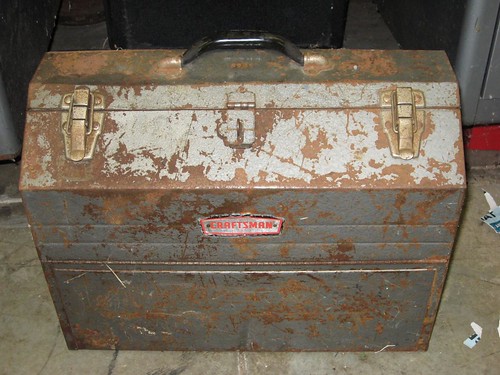
If it was a Craftsman Tool Box, it might have survived. In the 70’s, a friend of mine was working on a 1968 Ford Bronco is his driveway (it was a mess; we called it "Skylab"). While the thing was up on cinder blocks, it crashed while he was under it. It fell on the tool box, which saved him from major injury — or worse.

He later sold the Bronco, but he kept the tool box. Still uses it, too.


DIY Friday: Vortex Cannon

This is pretty awesome: a vortex cannon demonstration, seen on BBC One:


Can I make one myself? You bet: Instructables has it for you.

This one is so easy to make and gives great results. You will need a fog machine to generate the rings for both of these projects.

What You Need…

1. 32 Gallon Plastic Trash Can
2. Heavy Duty Trash Bag
3. Golf Ball
4. 2 Bunjee Cords
5. Tape
6. Box cutter


Who’s afraid of the big bad wolf?


Bankrupt in Bermuda, Desperate in Delaware


Remember ProtoStar? We do. They’re the company that launched a satellite into orbit about a year ago, and stationed it over East Asia. Bold move by the Bermuda-headquartered, San Francisco-based company (but incorporated in Delaware). They filed for the orbital slot through Singapore, hoping to get the satellite coordinated quickly. Launched another satellite only a couple of months ago. Looks like a good business to back with some venture capital.

Well, it was a good business (and might be again sometime in the future). They filed for bankruptcy yesterday:

Protostar filed for Chapter 11 bankruptcy protection Wednesday after lenders agreed to finance the company’s operations until it sells its satellites.

ProtoStar is suffering from a liquidity crunch after two customers decided to stop using one of its satellites – moves that forced the company to shut the operations of that satellite down and stop collecting revenue from it.

Investors including New Enterprise Associates, Redshift Ventures and VantagePoint Venture Partners have provided the company with more than $182 million in equity since 2004.

Chief Financial Officer Cynthia M. Pelini said in court documents that lenders demanded ProtoStar pay off its debt. However, the company was able to negotiate an arrangement under which the lenders would provide enough financing to keep the company’s operations going until it sells one or both of the satellites.

ProtoStar is now seeking permission from the U.S. Bankruptcy Court in Wilmington, Del., to borrow up to $16 million under a bankruptcy loan from a group of lenders led by Wells Fargo and use cash collateral securing claims from secured noteholders.

Protostar also is seeking permission to enter into a multiple draw term loan agreement with lenders led by Credit Suisse, Cayman Islands Branch.

Without the financing, ProtoStar said it wouldn’t have enough cash to fund its operations while it tries to sell its assets or cover expenses related to its bankruptcy case.

Separately, ProtoStar urged the bankruptcy court to issue an order spelling out the protections it’s entitled to now that it’s in Chapter 11.

ProtoStar, which has companies that operate in foreign jurisdictions such as Bermuda, Indonesia, Korea and Singapore, said creditors and counterparties to leases and other contracts “may not be well-versed” with the U.S. Bankruptcy Code. As a result, they may not be aware that they can’t seize ProtoStar assets located outside the U.S. or terminate agreements while the company is in bankruptcy.

ProtoStar has $528 million (book value) in assets and $463 million in debt, according to court papers.

Interesting. After trying to bulldog it’s way through frequency coordinations (generally a very civil discussion among engineers and regulators), using local offices for convenience and favorable tax jurisdictions to minimize what they owe to the U.S. government, the company is arguing for protection from the courts in Delaware. How you do business permeates your organization — and affects customer relationships.

Probably scared away some customers, too. Without paying customers, what good is your rocket science business?

If the satellites are for sale, we’ve got an opportunity for another operator to buy them.


Solar Filter


Great shot by Thierry Legault, using special solar filters, of the ISS and shuttle, silhouetted against the Sun. Via OnOrbit