Archive for the ‘Cool Stuff’ Category

Ooh, A Pwasma Spectwometer!

Wednesday, May 18th, 2011

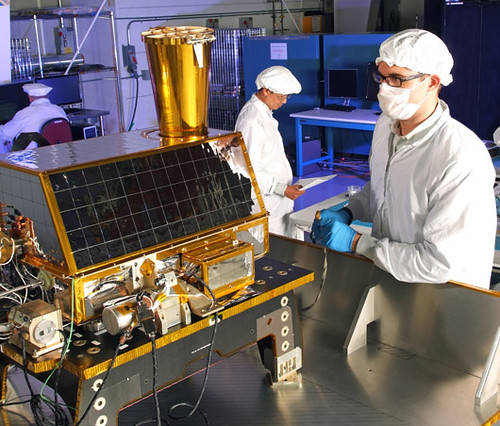
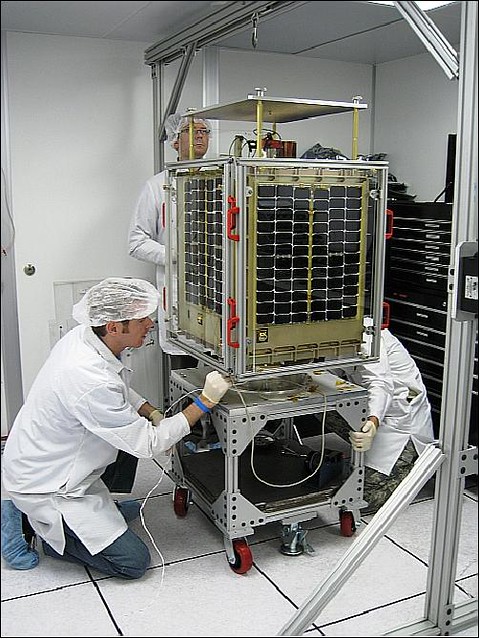
In addition to Cornell’s cracker-sized satellite, another part of STS-134‘s payload is WISPERS or Canary — a plasma spectrometer designed and built by the Applied Physics Lab at Johns Hopkins University in Laurel, Maryland.

Canary, a plasma spectrometer, will investigate the interaction of approaching spacecraft with the background plasma environment around the ISS and disturbances in the ionosphere caused by space vehicles. The device will also provide a better understanding of the origin and impact of plasma irregularities in the Earth’s ionosphere, and demonstrate low-cost techniques for monitoring those conditions. Canary is the second Wafer Integrated Plasma Spectrometers (WISPERS) device created by APL; engineers used innovative MicroElectroMechanical (MEMS) technology when designing WISPERS to reduce size and energy consumption while increasing sensitivity. The first WISPERS device was launched last year aboard FalconSat-5. “Canary and WISPERS will provide on-orbit data for understanding how spacecraft operations affect the natural environment,” says Robert Osiander, principal investigator for WISPERS at APL.
Canary gathers particles of plasma (an electrically-charged gas) through a hole smaller than the diameter of a human hair; the particles are then sorted according to energy and type by a titanium electrostatic analyzer less than a tenth of an inch thick. By measuring the type and energy levels of plasma around it, Canary can provide warnings of potentially hazardous operating conditions.

“Canary will add an important new tool to those we use to understand the near-Earth space environment,” says Larry Paxton, a space scientist at APL and member of the Canary team. “Canary will also demonstrate a new, cost-effective approach to supporting our nation’s operations in space.”
Canary was built by APL in coordination with the Space Physics and Atmospheric Research Center (SPARC) at the U.S. Air Force Academy, and was funded in part by the Naval Research Laboratory‘s Operationally Responsive Space (ORS) program. Canary is part of the STP-H3 payload, which is integrated and flown under the direction of the Department of Defense’s Space Test Program. Canary is scheduled to be installed on the ISS on flight day 3.
STS-134 Launch: “Good Stuff”

Monday, May 16th, 2011

Endeavour lifted-off beautifully on its final mission. Commander Mark Kelly exchanged wedding bands with Rep. Gabby Giffords, just so she could wear one from “out of this world” upon his return.

Here’s the MECO (main engine cut-off) and separation…

In the report by Al Jazeera, Gabby was reported to have said “good stuff.”

DIY Friday: X-Wing Fighter

Friday, May 13th, 2011

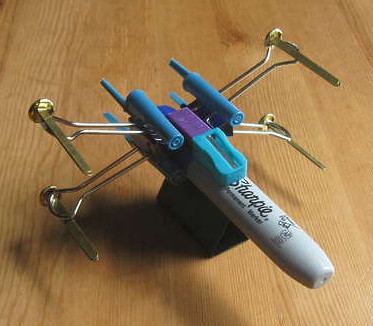
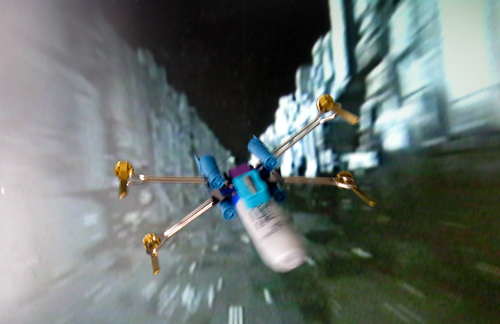
What is that made of? Looks like a Star Wars X-Wing Fighter made of…OFFICE SUPPLIES!

Yes, rocket scientists, it’s that time between Cinquo de Mayo and Memorial Day weekend. You’re in a party mood on Fridays and it’s too early to wear white. Make the day more productive with these common office supplies:

  • 1 chisel sharpie
  • 4 pen lids
  • 1 small pencil sharpener
  • 4 2″ brass fasteners
  • 2 medium binder clips
  • 2 large binder clips
  • 1 defunct memory chip or similar
  • 1 strip of staplesepoxy or hot glue (hot glue works a LOT better)
  • poster putty

Thank Instructables for this diversion and may The Forces be with you.

CHIRP Baked, Ready to Shake

Thursday, May 12th, 2011


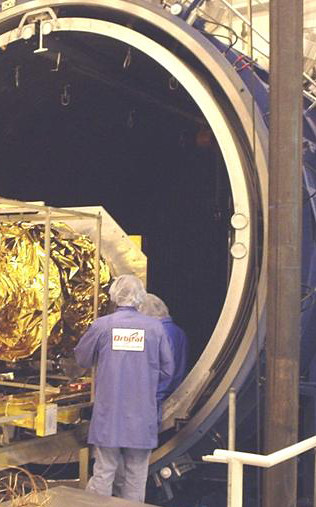
The Commercially Hosted Infrared Payload (CHIRP), set to piggy-back on the SES-2 spacecraft later this year, passed thermal vacuum chamber testing. According to DefPro, all is nominal and you can’t get any better than that in the space business…

SES-USG today announced that the Commercially Hosted Infrared Payload (CHIRP) and its host spacecraft, SES-2, have completed thermal vacuum (TVAC) testing.
The experimental wide field-of-view sensor was designed by Science Applications International Corporation (SAIC) for the U.S. Air Force Space and Missile Systems Center. After integration onto the SES-2 spacecraft, built by Orbital Sciences Corp., the TVAC tests were conducted to demonstrate the sensor’s ability to withstand the space environment it will experience following the launch this August. A preliminary review of the test data indicates the CHIRP payload thermal performance was as expected.
Victoria Kennedy, CHIRP Program Manager at SES noted, “The TVAC was a key milestone for CHIRP, and puts the program well on track for the remaining environmental tests.”
The TVAC is one of a series of recent successful tests completed by the CHIRP program. In January, the payload was integrated onto the SES-2 spacecraft and passed what is known as the initial post-mate electrical checkout. Following this milestone, an integrated ground-to-payload test was completed where the sensor was commanded from SAIC’s Mission Analysis Center in Seal Beach, CA through Orbital’s Mission Operations Center in Dulles, VA. Through this process, payload data, including images and state-of-health data were successfully transmitted. This demonstration was a key risk reduction activity in the development and testing of the CHIRP Ground Segment.
Brent Armand, CHIRP Program Manager at Orbital Sciences Corporation remarked, “The team is very pleased with the payload performance during TVAC. We are all systems go as we look forward to the upcoming vibration test campaign and the near-term completion and delivery of the SES-2 spacecraft.”

To simulate the hot and cold extremes possible in space, the thermal vacuum chamber can reach temperatures in a 600-degree F range from 302° F all the way down to minus 310° F. Wow, the best we can do as humans on earth is the 300-degree Club in Antarctica.

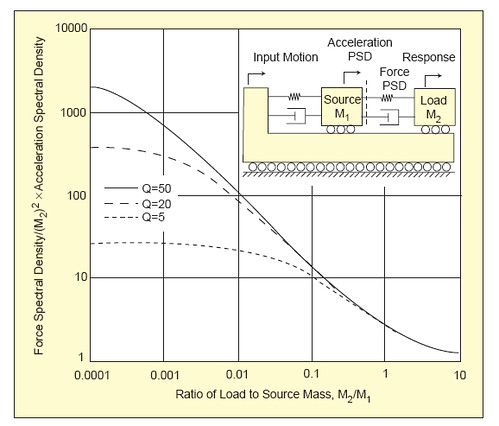
What’s next? Vibration testing, which includes random vibration, base-drive modal and quasi-static load tests – all conducted while the spacecraft is mounted on a shaker.

This NASA video does an excellent job of explaining these critical tests…

Project Blue Box

Thursday, May 5th, 2011

We love this stuff. NASA’s just given us more love, thanks to Gravity Probe-B.

Einstein was right again. There is a space-time vortex around Earth, and its shape precisely matches the predictions of Einstein’s theory of gravity.

Researchers confirmed these points at a press conference today at NASA headquarters where they announced the long-awaited results of Gravity Probe B (GP-B).

“The space-time around Earth appears to be distorted just as general relativity predicts,” says Stanford University physicist Francis Everitt, principal investigator of the Gravity Probe B mission.

“This is an epic result,” adds Clifford Will of Washington University in St. Louis. An expert in Einstein’s theories, Will chairs an independent panel of the National Research Council set up by NASA in 1998 to monitor and review the results of Gravity Probe B. “One day,” he predicts, “this will be written up in textbooks as one of the classic experiments in the history of physics.”

Time and space, according to Einstein’s theories of relativity, are woven together, forming a four-dimensional fabric called “space-time.” The mass of Earth dimples this fabric, much like a heavy person sitting in the middle of a trampoline. Gravity, says Einstein, is simply the motion of objects following the curvaceous lines of the dimple.

If Earth were stationary, that would be the end of the story. But Earth is not stationary. Our planet spins, and the spin should twist the dimple, slightly, pulling it around into a 4-dimensional swirl. This is what GP-B went to space in 2004 to check.

Read on, rocket scientists.

Eta Aquarids

Wednesday, May 4th, 2011

Up all night with NASA

Would you like to see a piece of Halley’s Comet? Now’s your chance! Each spring as Earth passes through the debris trail from Halley’s Comet (1P/Halley), the cosmic bits burn up in our atmosphere and result in the annual Eta Aquarid meteor shower. In 2011 the peak will occur on the night of May 5 and into the morning of May 6. A dark new moon on May 3 will help darken the night skies for a good viewing experience, with meteor rates of about 40-60 meteors per hour under ideal conditions. Ideal viewing conditions are a dark, clear sky away from city lights, especially just before dawn.

On May 5, you can join NASA experts for a live Web chat to observe this year’s Eta Aquarid meteor shower. Make plans to stay “up all night” with NASA experts from 11 p.m. EDT (May 5) until 5 a.m. EDT (May 6). For this overnight Web chat, NASA’s Marshall Space Flight Center will attempt to establish a Ustream view of the skies over Huntsville, Ala. So get ready to help NASA watch the skies!

Joining the chat is easy. Simply return to this page a few minutes before the chat begins. The chat module will appear at the bottom of this page. After you log in, wait for the chat module to be activated, then ask your questions!

No TV? No Internet? Try Satcom.

Tuesday, May 3rd, 2011


First thought upon hearing the news of Usama bin Laden’s demise was “that’s an interesting name for a Pakistani city.” No, Abbottabad wasn’t named after Bud Abbott, originally from Asbury Park, NJ. “Hey, Abbott! I’m a bad boy,” is the signature one-liner from another Jersey guy, Lou Costello of Paterson. The city was actually named after Major John Abbott, an Indian Army Officer.

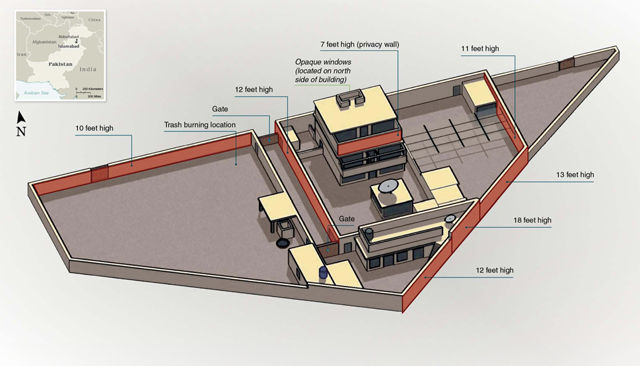
So U.S. intelligence found no telephone or Internet connection for this “fortress” in Pakistan, which they thought was remarkable in a neighborhood such as this. Judging from the widely published architectural rendering, I’d conclude they had a satellite antenna capable of two-way communications. Not impossible to intercept, but that depends on encryption and which spacecraft is being used.

Wouldn’t it be funny if they were using the SES satellites at 57° East? Both NSS-12 and NSS-703 provide plenty of two-way satcom services, and the look angle is favorable. However, the rendering shows the antenna pointed toward the southwestern horizon, suggesting perhaps one of the Arabsat birds. We’ll follow up on that.

Amazing how close it was to Pakistan’s “West Point.”

<

Tripping at NAB

Friday, April 15th, 2011

“By coupling our core Broadband Bonding technology with Network Calculus modeling we are able to effectively use statistics to smash the barrier of unpredictable behavior associated with cellular service to guarantee a certain level of quality necessary for transmitting HD video with extremely low latency,” said Mushroom Networks’ founder and Chief Science Officer, Dr. Rene Cruz, in a statement.

Dude, I’ll have some of what he had.

That’s what B&C reported on Mushroom Networks and their Teleporter product, introduced at NAB 2011 in Las Vegas. Their other products, with name like PortaBella and Porcini, do have a unique branding scheme. Apparently, somebody in their creative department sold them on it and I find it refreshing. This is what you need to get noticed (Engadget liked it enough to write about it, so that’s a plus).

Figures: they’re based in Southern California.

SlingBlockDishBuster!

Friday, April 8th, 2011


How quickly analysts respond to big stories in industries they “follow” or otherwise expert in their inner workings. Many examples exist, but this one really got me…

David Berliner, an adviser at BDO Consulting, told Kary that the deal may be all about gaining customers for Dish Network’s satellite service. He cited a similar situation — the $95 million acquisition of electronics chain The Wiz by Cablevision in 1998. Cablevision “got access to Wiz customers to sell Cablevision services,” said Berliner.

Customers at Nobody Beats The Wiz? There’s no real loyalty in retail consumer electronics.

The issue in this acquisition comes down to streaming rights. Blockbuster had a chance to buy Netflix 10 years ago for $50 million. You’ll recall Sling Media is now part of the DISH Network family and this deal gives them streaming rights to video content practically overnight.

Comcast: prepare for battle. Your on-demand service is now getting hit from all sides. Fiber, satellite, Internet, P2P, etc.

Back to Blockbuster. Was it really Netflix that killed it? Yeah, I think so. Check out this infographic from last month in SocialTimes

Colliding White Dwarfs

Thursday, April 7th, 2011


From the Monthly Notices of the Royal Astronomical Society, we read about two white dwarf stars that will combine to form a helium-burning star — in roughly 37,000,000 years. Get a load of this abstract

We identify SDSS J010657.39-100003.3 (hereafter J0106-1000) as the shortest period detached binary white dwarf (WD) system currently known. We targeted J0106-1000 as part of our radial velocity program to search for companions around known extremely low-mass (ELM, ~ 0.2 Msol) WDs using the 6.5m MMT. We detect peak-to-peak radial velocity variations of 740 km/s with an orbital period of 39.1 min. The mass function and optical photometry rule out a main-sequence star companion. Follow-up high-speed photometric observations obtained at the McDonald 2.1m telescope reveal ellipsoidal variations from the distorted primary but no eclipses. This is the first example of a tidally distorted WD. Modeling the lightcurve, we constrain the inclination angle of the system to be 67 +- 13 deg. J0106-1000 contains a pair of WDs (0.17 Msol primary + 0.43 Msol invisible secondary) at a separation of 0.32 Rsol. The two WDs will merge in 37 Myr and most likely form a core He-burning single subdwarf star. J0106-1000 is the shortest timescale merger system currently known. The gravitational wave strain from J0106-1000 is at the detection limit of the Laser Interferometer Space Antenna (LISA). However, accurate ephemeris and orbital period measurements may enable LISA to detect J0106-1000 above the Galactic background noise.

For a translation, let’s turn to the Smithsonian’s Christine Pulliam

Out of the 100 billion stars in the Milky Way, only a handful of merging white dwarf systems are known to exist. Most were found by Kilic and his colleagues. The latest discovery will be the first of the group to merge and be reborn.

The newly identified binary star (designated SDSS J010657.39 – 100003.3) is located about 7,800 light-years away in the constellation Cetus. It consists of two white dwarfs, a visible star and an unseen companion whose presence is betrayed by the visible star’s motion around it. The visible white dwarf weighs about 17 percent as much as the Sun, while the second white dwarf weighs 43 per cent as much. Astronomers believe that both are made of helium.

The two white dwarfs orbit each other at a distance of 140,000 miles – less than the distance from the Earth to the Moon. They whirl around at speeds of 270 miles per second (1 million miles per hour), completing one orbit in only 39 minutes.

The fate of these stars is already sealed. Because they wheel around so close to each other, the white dwarfs stir the space-time continuum, creating expanding ripples known as gravitational waves. Those waves carry away orbital energy, causing the stars to spiral closer and closer together. In about 37 million years, they will collide and merge.

When some white dwarfs collide, they explode as a supernova. However, to explode the two combined have to weigh 40 percent more than our Sun. This white dwarf pair isn’t heavy enough to go supernova. Instead, they will experience a second life. The merged remnant will begin fusing helium and shine like a normal star once more.

This binary white dwarf was discovered as part of a survey program being conducted with the MMT Observatory on Mount Hopkins, Ariz. The survey has uncovered a dozen previously unknown white dwarf pairs. Half of those are merging and might explode as supernovae in the astronomically near future.

Yeah, there’s a video…