Space Neighborhood


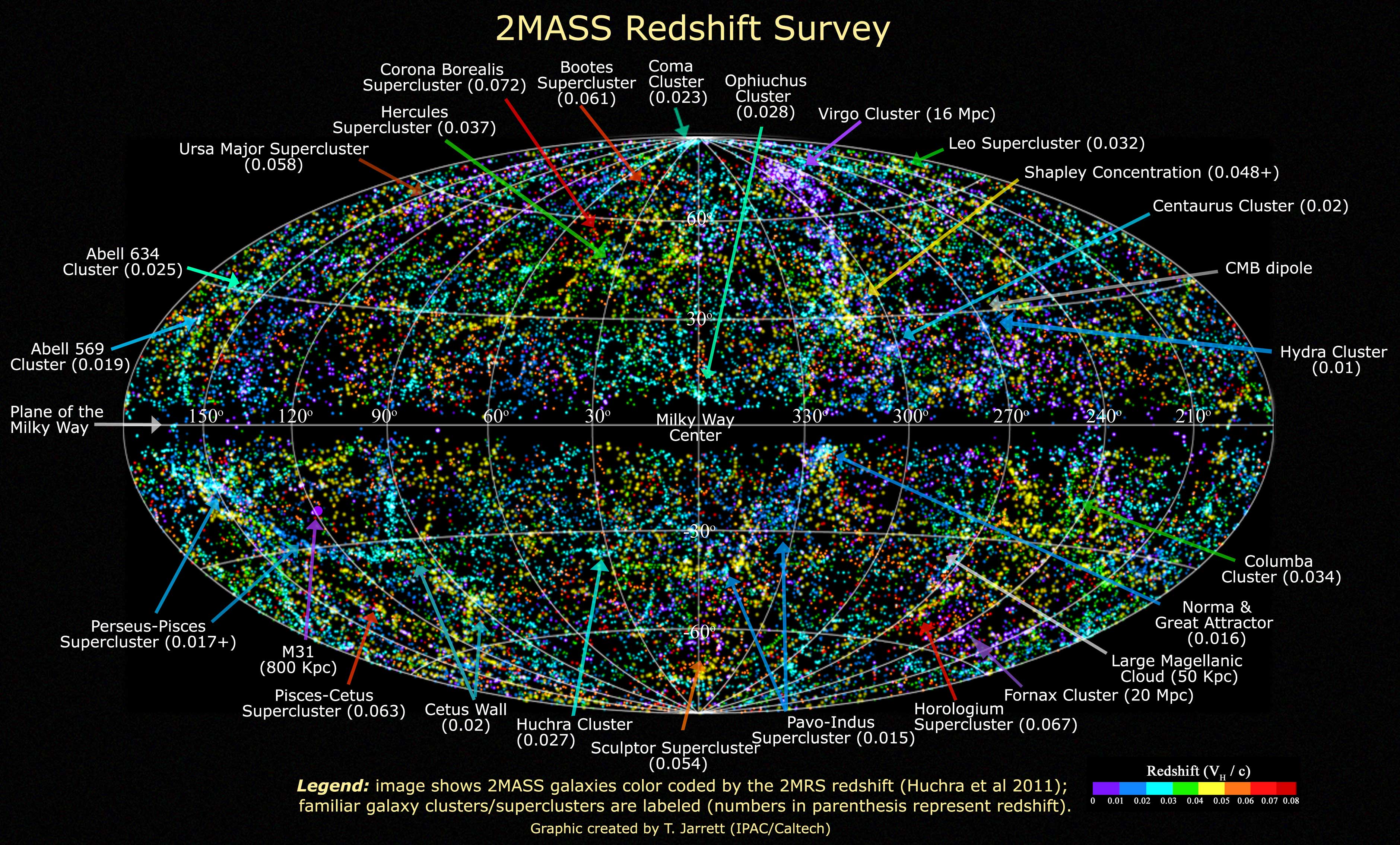
This is a map of the 50,000 galaxies nearest to our own Milky Way. Yeah, there’s billions more. That’s right: billions. The map was featured in NASA’s APOD yesterday.

The Milky Way galaxy has between 200 and 400 billion stars. And estimates on the number of galaxies in the universe go as high as 500 billion.

So this is like a map of downtown Sheboygan.

Go big with the image here.

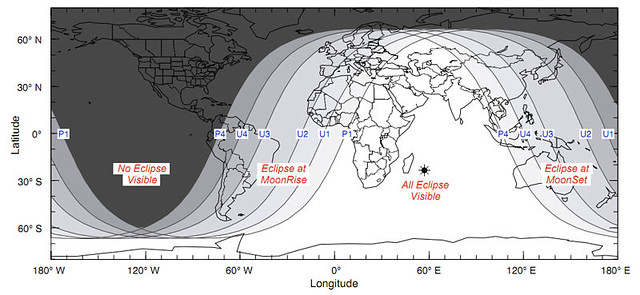
Moon Over Madagascar

A total lunar eclipse is expected on 15 June 2011, with Madagascar being an ideal place to view it.

Lunar Eclipses occur when the Earth passes between the Sun and the Moon. A Total Lunar Eclipse occurs at night and can be seen from the entire night side of the Earth and looks the same to everyone. A Total Lunar Eclipse occurs when the Sun, Earth and Moon are in perfect or near perfect aligment. The Moon passes behind the Earth and goes into Earth’s umbra shadow – the Earth is now between the Sun and Moon and blocks sunlight directly reaching the Moons suface. A Total Lunar Eclipse can only occur when there is a Full Moon.

WBMSAT Satellite Industry News Bits 06/10/2011


International satellite Aquarius/SAC-D built in Argentina and carrying NASA instruments is carried into orbit by Delta 2 rocket in launch from Vandenberg AFB.
[SatNews – 06/10/2011]

SES-3 satellite arrives safely at Baikonour Launch Base aboard Anatov cargo plane, scheduled for July 10, 2011 liftoff.
[4-traders – 06/10/2011]

Northrop Grumman completes systems requirement review for new spacecraft bus to reduce costs to space operations, under NASA contract in support of DoD.
[SatNews – 06/10/2011]

exactEarth books multiple orders for its global vessel tracking and monitoring system.
[SatNews – 06/10/2011]

MDA receives $8.1M contract for multi-satellite ground station for an unnamed customer.
[Satellite Today – 06/10/2011]

Boeing receives Thales Alenia Space contract to provide system integration and testing support for Iridium NEXT.
[SatNews – 06/09/2011]

Taiwanese operator Chunghwa Telecom informs New Tang Dynasty TF that it will not renew contract because new ST-2 satellite does not have enough broadband to carry NTDTV signals.
[Satellite Today – 06/09/2011]

Romantis, international group of companies specializing in space trading and VSAT network solutions, forms Romantis Inc. in Montreal offering satellite capacity, ground infrastructure, VSAT hardware, and IP and video solutions.
[SatNews – 06/09/2011]

Advantech Wireless to deliver VSAT equipment, including new DVB-RCS VSAT hubs and hardware to one of China’s largest satellite communications providers, as it renews supplier contract.
[SatNews – 06/09/2011]

Northrop Grumman provides power system for first spacecraft to orbit Mercury that works to its maximum even in searing heat surrounding closest planet to sun.
[SatNews – 06/09/2011]

NewCom International of Miami adds worldwide satellite phone coverage and mobile global broadband services to its bundled communications portfolio.
[SatNews – 06/09/2011]

Gilat selected by one of Russia’s largest telecom operators to expand network reach of data and telephony services with SkyEdge II broadband satellite network.
[SatNews – 06/09/2011]

Gateway Communications and Altobridges’ combined remote community satellite solution, African Cell Direct/Altobridge lite-site, is named best ‘Wholesale Service Innovation’ at Global Telecoms Business Innovation Awards.
[SatNews – 06/09/2011]

Echostar closes $2B deal for Hughes Communications.
[Denver Business Journal – 06/08/2011]

Astrium will build Measat-3b satellite.
[Satellite Today – 06/08/2011]

Clear Channel Radio announces that five of its stations started simulcasting on XM satellite radio.
[Wall Street Journal – 06/08/2011]

Raytheon completes upgrade of Antarctic satellite communications system at McMurdo Sound, increasing the off-continent communications bandwidth from 20 Mbps to 60 Mbps and integrating alternate downlink station in Australia.
[UPI – 06/08/2011]

Second set of six satellites for Globalstar G2 constellation being prepped for July launch.
[SatNews – 06/08/2011]

Latest solar flare, generating greatest amount of radiation since 2006, could threaten satellite communications.
[mystateline – 06/08/2011]

VT iDirect survey indicates that up to 30% of maritime non-users of VSAT may conduct trials of VSAT within the next 24 months.
[Satellite Spotlight – 06/08/2011]

AT&T Government Solutions gets task order to support U.S. Marine Corps’ MoraleSat Program.
[TechZone360 – 06/08/2011]

Soyuz and NASA astronauts travel as a team aboard Russian spacecraft to the International Space Station.
[SatNews – 06/07/2011]

Nigeria’s National Space Research and Development Agency announces that it will launch two new satellites by the end of June.
[Satellite Today – 06/07/2011]

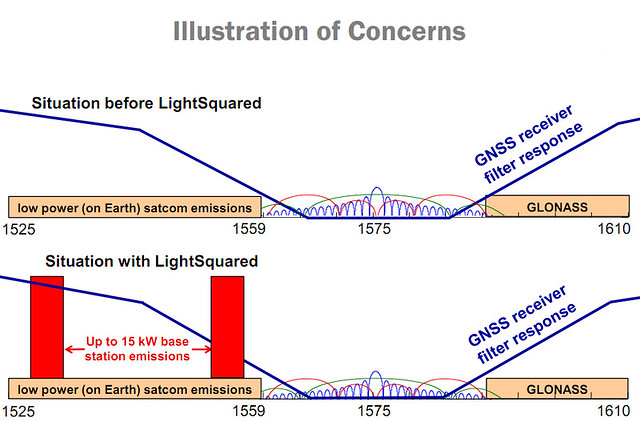
Data from GPS testing in Las Vegas area indicates LightSquared transmitters interfere with high-precision GPS receivers within 1,800 meters and medium precision receivers within 1,200 meters of tower.
[GPS World – 06/07/2011]

KVH mini-VSAT, integrated with KVH’s CommBox Ship/Shore Network Manager, being selected by many competitive fleet operators to meet new ECDIS regulations from the International Maritime Organization.
[SatNews – 06/07/2011]

NSR predicts over $250B in satellite hardware to be orbited by 2025, with over 1,600 satellites to be launched for replacement satellites, growth of Ka-band satellites, and government, science and navigations applications.
[NSR – 06/07/2011]

Trailblazers in digital voice and data communication Irwin Mark Jacobs and Jack Keil Wolf wing prestigious 2011 Marconi Prize.
[benzinga – 06/07/2011]

Telepresence and HD videoconferencing over satellite made possible from anywhere on the planet by Emerging Markets Communications.
[Telepresence Options – 06/07/2011]

Missouri Hospital Association relies on rapid satellite deployments by Spacenet to meet emergency communications needs.
[infoTECH – 06/07/2011]

Departing Nigerian Science and Technology Minister urges the National Space Research and Development Agency and Nigerian Communications Satellite Limited to close ranks and maintain peace over launch of NigeriaSat2.
[SatNews – 06/07/2011]

Members of Software Practitioners of Nigeria confident that satellite projects of Nigerian Communications Satellite Limited capable of improving Nigeria’s economy and taking it to the next level of advanced technology.
[Afrique en ligne – 06/07/2011]

International mission aims to measure saltiness of the sea, with instruments from the United States and other nations aboard an Argentine-built spacecraft to be launched this week from Vandenburg.
[R&D Magazine – 06/06/2011]

Boeing set to lay off 510 employees in its Space Exploration division as the Space Shuttle program comes to an end.
[SatNews – 06/06/2011]

Metacom develops low-cost satellite communications solution ideal for low usage industrial and commercial applications in remote areas of Southern Africa.
[SatNews – 06/06/2011]

Mitsubishi Electric plans to double satellite production capability.
[Satellite Spotlight – 06/06/2011]

UK Government Cabinet Office’s Civil Contingencies Secretariat to discuss its High Integrity Telecommunications System project with Paradigm at CNI 2011 in London.
[info4 Security – 06/06/2011]

Indian former communications and IT minister Dayanidhi Maran takes control of granting spectrum to satellite channels and telecom firms, in direct conflict of interest with his family’s satellite TV business.
[Hindustan Times – 06/06/2011]

Philippine lawmaker expresses grave concern over China’s access to only Philippine satellite Agila 2, in light of China’s continued military aggression in disputed Spratly group of islands.
[Journal Online – 06/06/2011]

Thomas Choi of Asia Broadcast Satellite states that Africa and the Middle-East lose at least $1.4B in annual local market share of satellite communications because of spectrum assignments to Europe and American markets.
[SatNews – 06/06/2011]

STMicroelectronics introduces first member of family of power transistors fully qualified for use in electronic subsystems on board satellites and launchers.
[EETimes – 06/06/2011]

Broadband to be hot topic and CommuncAsia tradeshow according to organizer Singapore Exhibition Services.
[ZDNet Asia – 06/06/2011]

Indra to supply rapid deployment satellite communications systems to Brazil’s armed forces.
[defpro – 06/06/2011]

WBMSAT PS satellite communications systems services


The PNT Took My L-band Baby Away


Seems LightSquared has a problem on its hands, after a report (PDF) from the National PNT Systems Engineering Forum

Key Findings:

  • All GPS receiver applications impacted by proposed LightSquared Network
  • Simulation of fully deployed LightSquared network of ~40,000 base stations would:
    1. Degrade or result in loss of GPS function (ranging, position) at standoff distances ranging from few kilometers and extending to space operations
    2. Out of band emissions due to close proximity to GPS Band
    3. Appear to be satisfactory
  • No universal mitigation approach identified

Seriously, it’s not a good situation, according to Fierce Wireless

Jim Kirkland, vice president and general counsel at Trimble Navigation which has opposed LightSquared’s operations as currently designed, said the tests showed that LightSquared’s network clearly cause interference with GPS.

“There is not a solution here,” he said. “In our view, it’s time to stop squandering resources on this and look for alternative spectrum for this operation. What LightSquared is trying to do is a great thing. It’s very important that we have more competition in broadband and more spectrum in broadband wireless. However, there is one place in the satellite band where this does not work,” and that is the spectrum next to GPS, he said.

It gets worse. According to the WSJ blog post by Amy Schatz, the DoD, aviation and a swarm from Congress are signaling a rough go ahead…

A bipartisan group of 66 House members asked the FCC Tuesday to protect global positioning systems from interference from wireless broadband start-up LightSquared, which is trying to launch a new network.

LightSquared’s airwaves have been knocking out some GPS systems during recent tests in New Mexico, according to unofficial reports from GPS users.

The company has acknowledged the problem but says technological fixes are available. LightSquared and GPS makers are scheduled to file a joint report to the FCC on June 15 about any interference issues.

The aviation industry, Defense Department and other government agencies are worried that the new mobile broadband network’s planned 40,000 cell towers could interfere with highly precise GPS systems used in military, aviation and homeland security equipment. Federal officials and GPS industry advocates have been lobbying Congress heavily to pressure the FCC to resolve any interference issues before letting LightSquared turn on its service.

“We request that the Commission only approve LightSquared’s waiver (to offer service) if it can be indisputably proven that there will be no GPS interference,” the lawmakers wrote Tuesday. A bipartisan group of 34 Senators wrote a similar letter to the FCC last month.

By our count, the House letter was signed by 17 Democrats and 49 Republicans, including four committee chairman: House Armed Services Chairman Howard “Buck” McKeon of California, Science Space and Technology Chairman Ralph Hall of Texas, Small Business Chairman Sam Graves of Missouri and House Foreign Affairs Chairman Ileana Ros-Lehtinen of Florida.

Like a challenge, rocket scientists? They’re hiring!


Africa’s Digital Future: DTH Satellite


Nice pitch from SES Astra’s Christoph Limmer in Balancing Act on the digital transition in Africa. Timed to coincide with a recent deal in Kenya, and the SatCom Africa 2011 show in J-burg, the points made are typical and correct, including…

According to Christoph Limmer, requests for information on satellite TV are flooding in. “Quite often we get asked if satellite can really reach more homes than other infrastructures like cable or terrestrial. The answer simply, is yes. Unlike DTT (Digital Terrestrial Television) or cable which are ground based infrastructures and normally roll-out in certain areas only; satellite has no limitations in achieving 100% population reach.” Digging cable is costly and time consuming and rolling out DTT network infrastructure is facing similar challenges.

However, one must first assume there is electrical power availability and somebody to pay for the service. Advertiser-supported content needs an audience that’s able to pay for their products/services. What I think needs to happen is the satellite operators take the hit and get the service going and wait for the market to catch up.

The developing world needs our help. Get on with it!

Bioluminescence and Chlorophyll Fluorescence

One of many interesting, fantastic details of the film “Avatar” was the bioluminescent plants — and the inter-networked biosystems on Pandora.

Why am I thinking about this? NASA just released details of maps illustrating land plant fluorescence, based on the work of several scientists who published “First observations of global and seasonal terrestrial chlorophyll fluorescence from space.” The abstract:

Remote sensing of terrestrial vegetation fluorescence from space is of interest because it can potentially provide global coverage of the functional status of vegetation. For example, fluorescence observations may provide a means to detect vegetation stress before chlorophyll reductions take place. Although there have been many measurements of fluorescence from ground- and airborne-based instruments, there has been scant information available from satellites. In this work, we use high-spectral resolution data from the Thermal And Near-infrared Sensor for carbon Observation – Fourier Transform Spectrometer (TANSO-FTS) on the Japanese Greenhouse gases Observing SATellite (GOSAT) that is in a sun-synchronous orbit with an equator crossing time near 13:00 LT. We use filling-in of the potassium (K) I solar Fraunhofer line near 770 nm to derive chlorophyll fluorescence and related parameters such as the fluorescence yield at that wavelength. We map these parameters globally for two months (July and December 2009) and show a full seasonal cycle for several different locations, including two in the Amazonia region. We also compare the derived fluorescence information with that provided by the MODIS Enhanced Vegetation Index (EVI). These comparisons show that for several areas these two indices exhibit different seasonality and/or relative intensity variations, and that changes in fluorescence frequently lead those seen in the EVI for those regions. The derived fluorescence therefore provides information that is related to, but independent of the reflectance.

Real science is never too far from science fiction, is it?

That reminds me: I should water the garden.


Shock Collar

An F/A-18C Hornet fighter jet assigned to Strike Fighter Squadron (VFA) 113 breaks the sound barrier during an air power demonstration over the USS Carl Vinson aircraft carrier and Carrier Air Wing 17 in the Pacific Ocean in this U.S. Navy handout photo dated June 3, 2011 (hat tip, MSNBC photoblog).

What causes this? Let’s turn to the Prandtl–Glauert singularity

The Prandtl–Glauert singularity is the prediction by the Prandtl–Glauert transformation that a shock wave approaching infinite pressure is produced as an aircraft approaches the speed of sound. Because it is invalid to apply the transformation at these speeds, the predicted singularity does not emerge. Nevertheless, extreme atmospheric conditions are produced which may give rise to a vapor cone, shock collar, or shock egg of visible condensation.

The air pressure in the immediate vicinity of a transonic aircraft can be described as an “N-wave,” so named because a plot of pressure against time resembles the letter ‘N’. Observed from a stationary point as a shock wave passes, the pressure profile of the wave is composed of a leading compression component (the initial upward stroke of the “N”), followed by a pressure descent forming a rarefaction of the air (the downward diagonal of the “N”), followed by a return to the normal ambient pressure (the final upward stroke of the “N”). The rarefaction may be thought of as the “rebounding” of the compression due to inertial effects.

Since heat does not leave the affected air mass, this change of pressure is adiabatic, with an associated change of temperature. In humid air, the drop in temperature in the most rarefied portion of the shock wave (close to the aircraft) can bring the air temperature below its dew point, at which moisture condenses to form a visible cloud of microscopic water droplets. Since the pressure effect of the wave is reduced by its expansion (the same pressure effect is spread over a larger radius), the vapor effect also has a limited radius. Such vapor can also be seen in low pressure regions during high–g subsonic maneuvers in humid conditions.

Thanks, I needed that. Pretty exciting in real life…

WBMSAT Satellite Industry News Bits 06/03/2011

AT&T Government Solutions announces series of task orders worth up to $48M to provide satellite-based voice, video, and Internet services to deployed military personnel overseas.
[Tech Zone 360 – 06/03/2011]


TS2 of Poland introduces to the global market satellite connections dedicated to foreign correspondents, photo reporters, and journalists for international broadcast of video, voice, or data files.
[Business Wire – 06/03/2011]

atrexx introduces new service platform specifically targeted at demand for broadband services in highly fragmented South American region.
[SatNews – 06/02/2011]

Eutelsat’s KA-SAT high throughput satellite goes live, bringing broadband speeds of up to 10Mbps to homes across Europe.
[telecoms – 06/02/2011]

India to launch GSAT-12, with 12 C-band transponders, on a PSLV C-17 rocket from Sriharikota in July.
[Hindu – 06/02/2011]

Sea Launch AG to launch the Intelsat 18 communications satellite in the second half of 2011.
[SatNews – 06/02/2011]

Azerbaijan, Turkmenistan, and Venezuela all have oil wealth and ambitions in space, with two of the three having ordered satellites and the third starting its own space agency with hints of a satellite order in the works.
[Satellite Spotlight – 06/02/2011]

India gets multi-million dollar contracts to launch 12 foreign satellites into low earth orbits over next two years.
[Kerala next – 06/02/2011]

Spain’s satellite communications service provider ERZIA Tech strikes deal with MTN Satellite Communications of the U.S. to install Rapid Deployment Systems mobile VSAT solution on Spanich research vessel BIO Hesperides.
[TMCnet – 06/02/2011]

Skyware Global announces 69cm Ka-band Outdoor Unit, offering high-performance, cost-effective integrated solution for broadband internet and enterprise broadband solutions.
[SatNews – 06/02/2011]

Cree demonstrates industry’s first C-band GaN HEMT MMIC high power amplifier for satellite communications.
[Business Wire – 06/02/2011]

SES ASTRA announces availability of Nickelodeon HD and Comedy Central HD via HD+ in Germany, comprising ten free TV HD channels.
[SatNews – 06/02/2011]

Cape Town-based telecommunications provider Metacom develops low-cost low-rate satellite communications solution for industrial and commercial applications in remote areas of South Africa.
[Cape Business News – 06/02/2011]

Hughes Network Systems makes available the Hughes Emergency Solutions, to provide robust,, expedited broadband Internet connectivity for business and government when disasters strike, in anticipation of the hurricane season.
[SatNews – 06/02/2011]

Russian Federal Space Agency Roscosmos officials claim Russian GLONASS beats American GPS in accuracy.
[ibn live – 06/02/2011

Navigation Maritime Bulagare reports significant communication cost savings and management efficiencies since retrofitting its fleet of 45 bulk carriers with Iridium OpenPort.
[SatNews – 06/02/2011]

U.S. government trade officials criticize Russian Ministry of Transport for proposing laws requiring Glonass equipment to be installed in all new cars sold in Russia, calling them “unfair.”
[Satellite Today – 06/02/2011]

MDA sells Radarsat-2 emergency support services to Russian Government.
[Satellite Today – 06/02/2011]

Sofradir is awarded contract to provide shortwave infrared arrays for the TROPOMI/S5 mission as part of the GMES joint undertaking by the European Commission and the European Space Agency.
[SatNews – 06/02/2011]

ITT is recognized by NASA with Outstanding Team of the Year award for superior efforts and commitment to excellence in building one of world’s most advance weather instruments – the Advance Baseline Imager for the GOES-R program.
[SatNews – 06/02/2011]

GlobeCast America CEO David Justin steps down.
[Satellite Today – 06/02/2011]

Boeing establishes Exploration Launch Systems Engineering and Integration office in Titusville Florida near Kennedy Space Center to support operational readiness of NASA’s next launch system currently under study.
[SatNews – 06/02/2011]

European Satellite Operators Association discusses important role of satellite services in delivering 100% broadband coverage in Europe at recent meeting.
[SatNews – 06/01/2011]

India to launch 12 foreign satellites in next two years.
[India Times – 06/01/2011]

SES WORLD SKIES U.S. Government Solutions announces completion of Dynamics Testing on the Commercially Hosted Infrared Payload for the SES-2 satellite under construction.
[SatNews – 06/01/2011]

Russia to accelerate GLONASS navigation satellite launches to give its GLONASS navigation system full global coverage capacity by the end of the year according to a senior government official.
[The Hindu – 06/01/2011]

Gilat Satcom launches Shiron hub in Zimbabwe, expanding it reach throughout this African region.
[SatNews – 06/01/2011]

KORE Wireless Group completes acquisition of Melbourne-based Mach Communications, enabling KORE to better respond to global M2M market demand with its integrated cellular and satellite capabilities.
[Benzinga – 06/01/2011]

Spacecom announces that Poland’s TTComm S.A. has signed a number of long-term agreements to lease capacity from the AMOS satellite fleet at 4 degrees West.
[SatNews – 06/01/2011]

Azerbaijan buys first communication satellite, setting a 2012 launch date.
[Bloomberg – 05/31/2011]


Nigerian government, considering building a second satellite, may require the builder to transfer technology, training Nigerian engineers to become satellite builders.
[Vanguard – 05/31/2011]

O3b signs multi million-dollar deal with South Africa-based Mavoni Technologies to roll out broadband to underserviced municipalities in the Northern Cape, Limpopo, and Mpumalanga.
[Engineering News – 05/31/2011]

Multinational Naval coalitions using KVH TracPhone V7 for counter-piracy operations.
[GlobeNewswire – 05/31/2011]

World Surveillance Group acquires Global Telesat, a provider of satellite based tracking and communication solutions to the U.S. government and commercial customers.
[SYS-CON MEDIA – 05/31/2011]

ST Engineering establishes ST Electronics Satellite Systems in a joint venture with Nanyang Technological University and DSO National Laboratories to design, develop, and produce advanced Earth Observation satellites.
[SatNews – 05/31/2011]

NASA selects Fibertek to design, develop, fabricate, test, and deliver laser systems for ICESat-2 mission.
[Satellite Today – 05/31/2011]

SES S.A. signs agreement with YellowSat, a French start-up company that provides Internet connectivity to enterprises, governments, and institutions in Africa, for inclined orbit capacity on NSS-703.
[SatNews – 05/31/2011]

Orbcomm sings partnership deal with Field Intelligence and Controls to provide global data communications.
[Satellite Today – 05/31/2011]

Thailand to launch its sixth satellite, Thaicom 6, in 2013.
[Reuters – 05/30/2011]

SkyVision launches iDirect Evolution network to expand VSAT coverage in Africa.
[PR Newswire – 05/30/2011]

SES joins forces with Kenyan television and broadband operator Wananchi to launch new Direct-to-Home line-up called Zuku TV in East Africa.
[WebWire – 05/30/2011]

Satellite firms see opportunity in Pentagon as increasingly tight budgets will translate into more business for commercial satellite programs.
[Washington Post – 05/29/2011]

NASA missions occupy entire Atlas 5 rocket launch manifest for rest of 2011.
[Spaceflight Now – 05/27/2011]

WBMSAT PS satellite communications systems services


Looks Like The Milky Way


This galaxy is similar to our own Milky Way. Located 30 million light years away, NGC 6744 was recently observed from the La Silla observatory in Chile.

More about the image via PhysOrg.com

This picture of the nearby galaxy NGC 6744 was taken with the Wide Field Imager on the MPG/ESO 2.2-metre telescope at La Silla. The large spiral galaxy is similar to the Milky Way, making this image look like a picture postcard of our own galaxy sent from extragalactic space. The picture was created from exposures taken through four different filters that passed blue, yellow-green, red light, and the glow coming from hydrogen gas. These are shown in this picture as blue, green, orange and red, respectively.

ESO astronomers have used the Wide Field Imager on the MPG/ESO 2.2-metre telescope to capture an image of NGC 6744. This impressive spiral galaxy lies about 30 million light-years away in the southern constellation of Pavo (The Peacock). But this view could almost be a picture postcard of our own Milky Way, taken and sent by an extragalactic friend, as this galaxy closely resembles our own.

We see NGC 6744 almost face on, meaning we get a dramatic bird’s eye view of the galaxy’s structure. If we had the technology to escape the Milky Way and could look down on it from intergalactic space, this view is close to the one we would see — striking spiral arms wrapping around a dense, elongated nucleus and a dusty disc. There is even a distorted companion galaxy — NGC 6744A, seen here as a smudge to the lower right of NGC 6744, which is reminiscent of one of the Milky Way’s neighbouring Magellanic Clouds.

One difference between NGC 6744 and the Milky Way is their size. While our galaxy is roughly 100 000 light-years across, the galaxy pictured here extends to almost twice this diameter. Nevertheless, NGC 6744 gives us a tantalising sense of how a distant observer might see our own galactic home.

Skylon: The Euro Spaceplane


Thirty years in development. How are they paying for it? With lots of future business.

Well, not really. A committee/panel said go ahead and keep developing it, via UniverseToday.com

The consensus for the way forward is to proceed with the innovative development of the engine which in turn will enable the overall vehicle development.

Still pretty cool.